Convert miles to furlongs
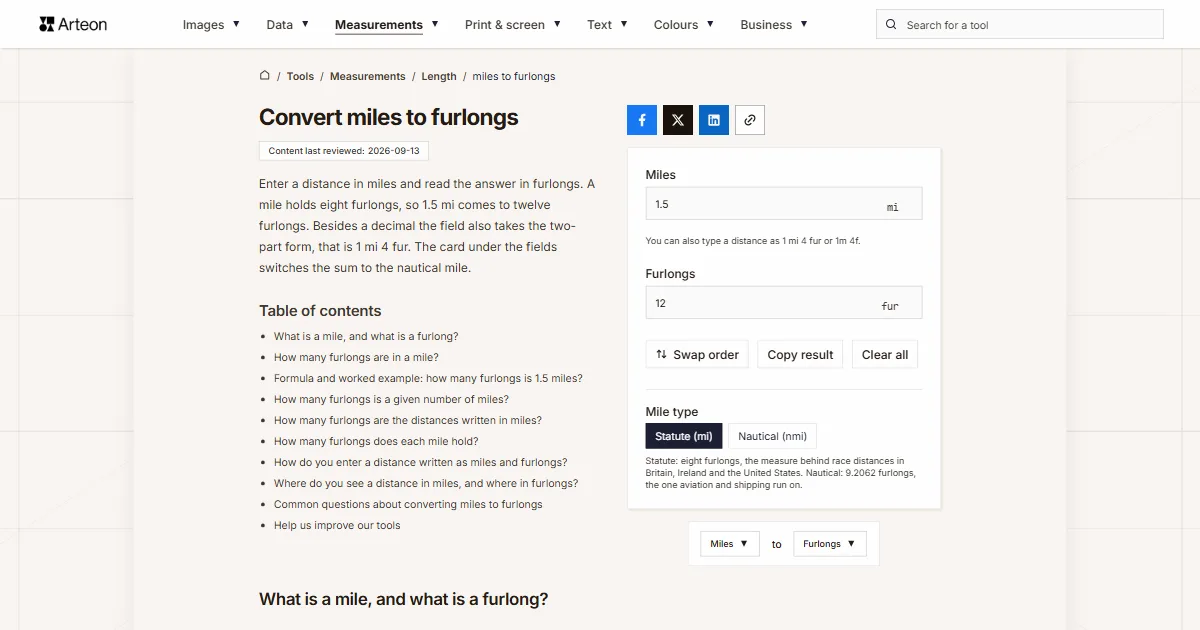
Enter a distance in miles and read the answer in furlongs. A mile holds eight furlongs, so 1.5 mi comes to twelve furlongs. Besides a decimal the field also takes the two-part form, that is 1 mi 4 fur. The card under the fields switches the sum to the nautical mile.
You can also type a distance as 1 mi 4 fur or 1m 4f.
What is a mile, and what is a furlong?
The statute mile is exactly 1,609.344 metres and divides into eight equal parts. Each of them is one furlong, that is 220 yards or 201.168 metres[1]. The NIST table writes the whole division in one line: “1 mile (mi) = 5 280 feet = 8 furlongs = 80 chains = 320 rods”[2].
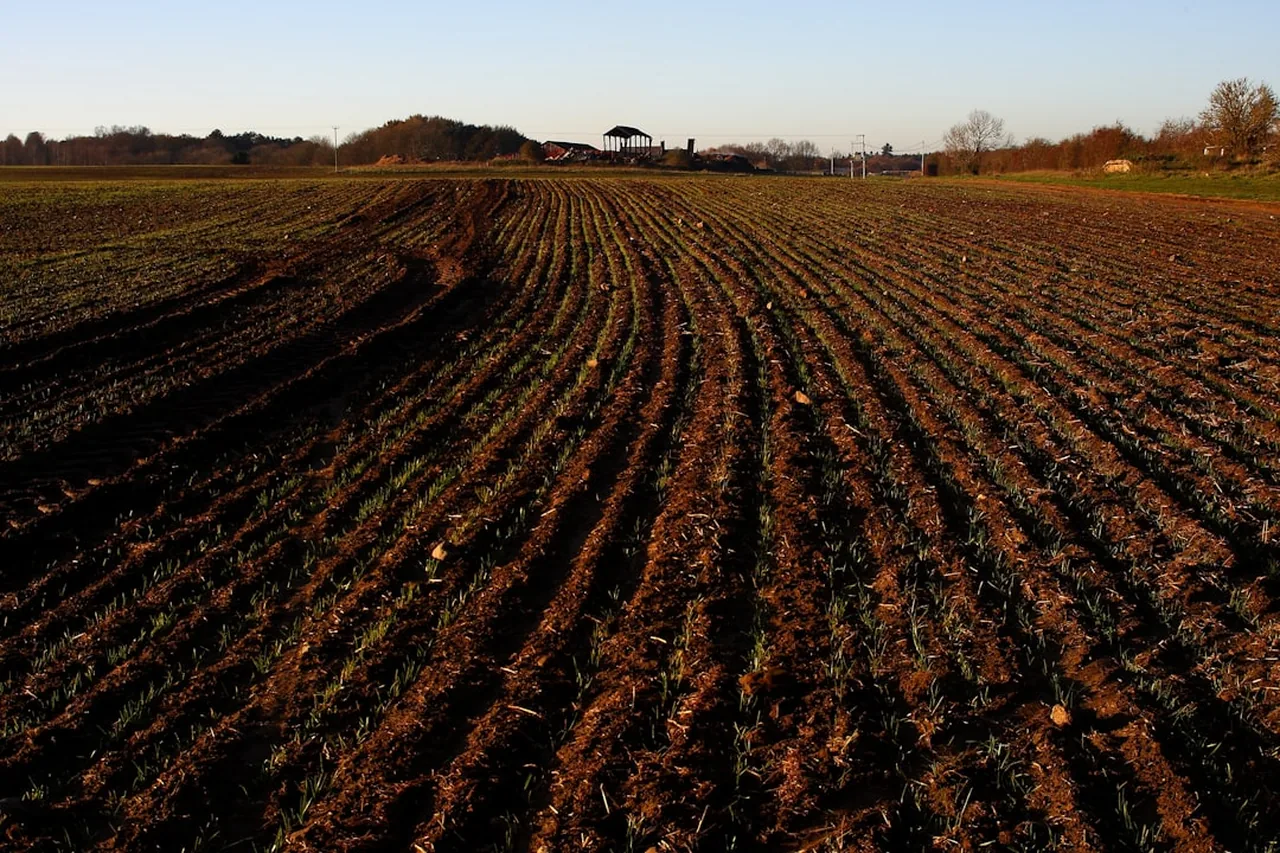
That line starts from the mile, but it was the mile that was fitted to the furlong. The furlong measured ploughed fields long before the mile took its present length. The Roman mile ran to 5,000 feet, and Queen Elizabeth I set the English mile at 5,280 feet, exactly eight furlongs[2]. From that point on both units have shared one division.
The second mile you meet in texts has an entirely different origin. The nautical mile is 1,852 metres and answers to one minute of arc on a meridian, so it holds more than nine furlongs and the figure runs on past the decimal point. The Mile type switch in the converter above moves the sum between the two.
How many furlongs are in a mile?
A statute mile holds eight furlongs. The Weights and Measures Act 1985 gives the mile in Schedule 1 as 1,760 yards and the furlong as 220 yards[3], so the quotient of those two figures is an even eight.
Three values come out of that division and they are the ones you reach for when reading a race card. A quarter of a mile is two furlongs, the American quarter-horse distance. Half a mile gives four furlongs. One and a half miles come to twelve furlongs.
Multiplying by eight has a convenient property: fractions of a mile with 8 and 16 underneath give whole furlongs or halves. An American card distance of 1 1/16 miles therefore comes out in the converter as 8.5 furlongs.
The same sum carries on above a mile. Two miles give sixteen furlongs, and three miles twenty-four. Past one mile, though, British and Irish cards write the answer with two figures at once: whole miles first, then the remainder in furlongs.
Formula and worked example: how many furlongs is 1.5 miles?
The formula has one step: furlongs = miles × 8.
Take one and a half miles. Multiplied by eight it gives twelve furlongs. A British race card prints the same distance as 1m 4f and the converter as 1 mi 4 fur, because four furlongs are left above the whole mile.
In a spreadsheet one formula covers it. If the number of miles sits in cell A2, type =A2*8 in the next cell and drag it down the column.
The other direction is handled by the furlongs to miles converter. A distance given in metres or kilometres goes through the meters to miles and kilometers to miles converters.
How many furlongs is a given number of miles?
| Miles | Furlongs (fur) | Metres (m) |
|---|---|---|
| 0.0625 mi | 0.5 fur | 100.584 m |
| 0.125 mi | 1 fur | 201.168 m |
| 0.1875 mi | 1.5 fur | 301.752 m |
| 0.25 mi | 2 fur | 402.336 m |
| 0.3125 mi | 2.5 fur | 502.92 m |
| 0.375 mi | 3 fur | 603.504 m |
| 0.5 mi | 4 fur | 804.672 m |
| 0.625 mi | 5 fur | 1,005.84 m |
| 0.75 mi | 6 fur | 1,207.008 m |
| 0.875 mi | 7 fur | 1,408.176 m |
| 1 mi | 8 fur | 1,609.344 m |
| 1.0625 mi | 8.5 fur | 1,709.928 m |
| 1.125 mi | 9 fur | 1,810.512 m |
| 1.1875 mi | 9.5 fur | 1,911.096 m |
| 1.25 mi | 10 fur | 2,011.68 m |
| 1.5 mi | 12 fur | 2,414.016 m |
| 1.75 mi | 14 fur | 2,816.352 m |
| 2 mi | 16 fur | 3,218.688 m |
| 2.25 mi | 18 fur | 3,621.024 m |
| 2.5 mi | 20 fur | 4,023.36 m |
| 3 mi | 24 fur | 4,828.032 m |
| 4 mi | 32 fur | 6,437.376 m |
| 5 mi | 40 fur | 8,046.72 m |
| 10 mi | 80 fur | 16,093.44 m |
| 20 mi | 160 fur | 32,186.88 m |
| 50 mi | 400 fur | 80,467.2 m |
| 100 mi | 800 fur | 160,934.4 m |
| 200 mi | 1,600 fur | 321,868.8 m |
| 1,500 mi | 12,000 fur | 2,414,016 m |
How many furlongs are the distances written in miles?
| Form on the race card | Furlongs (fur) | Metres (m) | What it means |
|---|---|---|---|
| 1/16 mile | 0.5 fur | 100.6 m | The fraction that writes half a furlong |
| 1/4 mile | 2 fur | 402.3 m | Two furlongs, the American quarter-horse distance |
| 1/2 mile | 4 fur | 804.7 m | Four furlongs, half of the mile’s division |
| 1 mile | 8 fur | 1,609.3 m | Eight furlongs and the classic mile distance |
| 1 1/16 miles | 8.5 fur | 1,709.9 m | A mile and half a furlong on top |
| 1 1/8 miles | 9 fur | 1,810.5 m | A mile and one furlong |
| 1 1/4 miles | 10 fur | 2,011.7 m | The Kentucky Derby distance, set in 1896[5] |
| 1 1/2 miles | 12 fur | 2,414 m | The distance the Kentucky Derby ran until 1896[5] |
| 4 miles 514 yards | 34.3364 fur | 6,907.4 m | The Grand National distance[6] |
How many furlongs does each mile hold?
| Type of mile | Length in metres | Furlongs (fur) | Where it applies |
|---|---|---|---|
| Statute mile | 1,609.344 m | 8 fur | Race distances[1], road signs in the United States[7] and the mile run in athletics[8] |
| Nautical mile | 1,852 m | 9.2062 fur | Aviation and shipping; you pick it in the Mile type card |
| U.S. survey mile | 1,609.347218694 m | 8 fur | United States surveying up to 31 December 2022[2] |
How do you enter a distance written as miles and furlongs?
British and Irish race cards give longer distances with two figures at once. The input field takes that form directly, without breaking it apart.
Copy the form across with the symbols
Type 1 mi 4 fur, or paste 1m 4f straight from a British race card. The hint under the field says a distance can be entered this way, and the symbols mi and fur are the same in every language.Leave the statute mile in place
The two-part form describes the statute mile, so the Mile type card stays on Statute (mi). After picking Nautical (nmi) the field takes a plain decimal, because the furlong belongs to the division of the statute mile.Read the answer in furlongs
An entry of 1 mi 4 fur gives 12 fur. The Copy result button puts that figure on the clipboard, ready for a spreadsheet or a note.Enter the next distance as a plain number
Besides the two-part form the field takes an ordinary decimal, so 1.25 miles goes straight in. Clear all empties the fields for a new value.
Where do you see a distance in miles, and where in furlongs?
Which unit you are looking at is settled by the country the figure comes from. Races across the English-speaking world are measured in miles and furlongs[1], and the commonest distances fall between five and twelve furlongs[10].
Courses on the European mainland give the distance in metres. The Prix de l’Arc de Triomphe is run over 2,400 metres, and the Italian Derby over 2,200. Those figures answer to 11.9 and 10.9 furlongs, so they sit close to the twelve and eleven furlongs of a British card without matching them.
Mexico is a case of its own, because it uses both measures at once. The Hipódromo de las Américas race card prints a distance as “502.92 METROS (2 1/2 F)” and “1,307.60 METROS (6 1/2 F)”[11], giving metres and furlongs on one line.
One country puts furlongs outside the racecourse as well: Myanmar signs distances in them beside miles[1]. A distance given in metres goes through the meters to miles converter, and a race written in miles and yards through the miles to yards converter.
Convert Miles to other units
Sources
- Furlong — Wikipedia
- Handbook 44, Appendix C. General Tables of Units of Measurement — NIST
- Weights and Measures Act 1985, Schedule 1 — legislation.gov.uk
- Revelation 21:16, Revelation 14:20, Luke 24:13, King James Version — BibleGateway
- Kentucky Derby — Wikipedia
- Grand National — Wikipedia
- Manual on Uniform Traffic Control Devices, 11th Edition, Chapter 2D — Federal Highway Administration
- Mile run — Wikipedia
- U.S. Survey Foot: Revised Unit Conversion Factors — NIST
- Horse racing — Wikipedia
- Programas de carreras — Hipódromo de las Américas
- Mile — Wikipedia
Every figure in the tables was computed from the unit definitions and checked arithmetically before publication. Historical values and the names of local units come from the sources listed above.
Content last reviewed: · written and checked by the Arteon team
Common questions about converting miles to furlongs
How many furlongs are in half a mile?
Half a mile is four furlongs, that is 804.672 metres. The sum is comfortable here because the mile divides into eight parts, so every simple fraction of a mile gives a round number of furlongs: a quarter of a mile is two furlongs and three quarters of a mile six.
What does 1 1/16 miles mean on a race card?
It is a mile and half a furlong on top, 8.5 furlongs in all. The denominator says how many parts the mile was cut into, and a sixteenth of a mile answers to exactly half a furlong. In metres the answer comes to 1,709.9 metres. You can type that fraction straight into the field, as 1 1/16.
How many furlongs is a marathon?
A marathon comes to 209.75 furlongs. The distance is 42,195 metres, that is 26 miles and 385 yards, and dividing it by 201.168 metres[2] gives just under two hundred and ten furlongs. The figure carries a fraction because the remaining 385 yards come to 1.75 furlongs. The 26 mi 385 yd form itself is handled by the miles to yards converter.
Does the field take an entry of 1 mi 4 fur?
It does. The input field recognises the two-part form by the unit symbols, so an entry of 1 mi 4 fur counts as twelve furlongs. The hint under the field says so outright. The British race-card form 1m 4f works the same way. Besides that form the field takes an ordinary decimal, for instance 1.5.
How many furlongs are in a nautical mile?
A nautical mile holds 9.2062 furlongs, because it is 1,852 metres and a furlong is 201.168 metres[2]. You pick it in the Mile type card by choosing Nautical (nmi). With that option the field takes a plain decimal, because the nautical mile answers to one minute of arc on a meridian while the furlong belongs to the division of the statute mile.
Why does a mile hold eight furlongs rather than ten?
Because the mile was already divided into eight parts before it took its present length. The English kept the Roman reckoning of the mile as 5,000 feet or eight longer divisions, and equated those divisions with the furlong[12]. In 1593 Parliament kept the mile of eight furlongs and, rather than shorten the rod the furlong was derived from, raised the number of feet in a mile to 5,280[12]. The rod and the furlong used to measure land kept their length as a result.
May a furlong be used in a trade document in Britain?
Only as a supplementary indication alongside a metric unit. The Weights and Measures Act 1985 lists the furlong in Part VI of Schedule 1, among the measures allowed in that role[3]. The mile as 1,760 yards and the chain as 22 yards stand in the same place.
Help us improve our tools
Have an idea for a new feature, spotted a bug or want to suggest another tool? Write to us — we reply within 24 hours.