Convert furlongs to miles
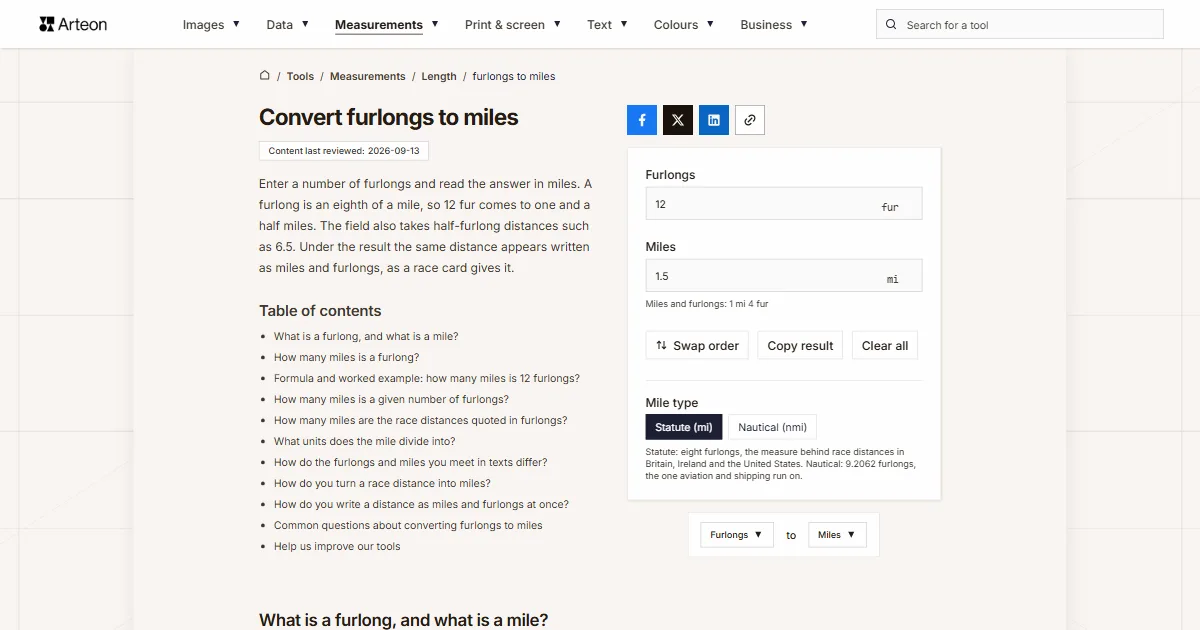
Enter a number of furlongs and read the answer in miles. A furlong is an eighth of a mile, so 12 fur comes to one and a half miles. The field also takes half-furlong distances such as 6.5. Under the result the same distance appears written as miles and furlongs, as a race card gives it.
What is a furlong, and what is a mile?
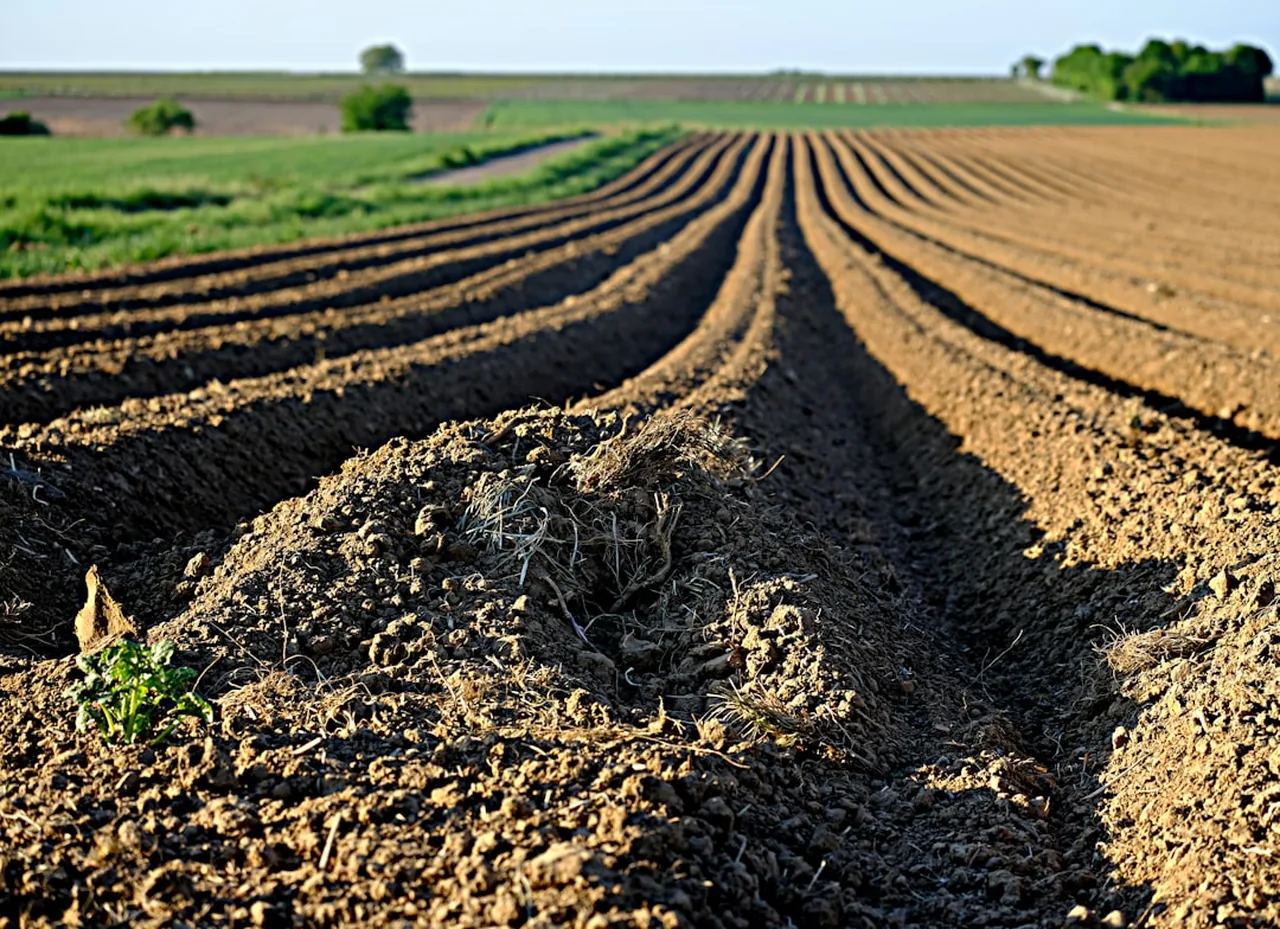
A furlong is a unit of length of 220 yards, that is 660 feet or 201.168 metres[1]. The name comes from the Old English furh, a furrow, and lang, long. The unit measured the length of the furrow a team of oxen could plough without resting[1], so it came straight off the farm.
The mile got its present length only under Queen Elizabeth I, and it was the furlong that fixed it. The Roman mile ran to 5,000 feet, and the queen set the English mile at 5,280 feet, which is exactly eight furlongs[2]. A number that looks arbitrary follows from that one adjustment. Today the statute mile is exactly 1,609.344 metres.
The two units now meet on the racecourse. Race distances across the English-speaking world, Canada and the United States included, are given in miles and furlongs[1], and the Mexican race card prints both forms side by side, for instance “1207.01 METROS (6 F)”[3].
How many miles is a furlong?
A furlong is 0.125 miles, exactly an eighth of a mile. The mile holds eight of them, and the NIST table gives that figure outright, in a single line: “8 furlongs = 1 mile (mi) = 5 280 feet”[2].
Three numbers come out of that arithmetic, all of them inside the range the commonest races fall into: the English article on horse racing puts that range between five and twelve furlongs[4]. Five furlongs come to 0.625 miles. Eight furlongs make exactly one mile. Twelve furlongs come to one and a half miles.
Every answer ends on an exact figure, because dividing by eight always terminates. That makes the sum easy in your head: take half, then half again, then half once more.
The exactness holds for half-furlong distances too, the kind that appear on American cards. Six and a half furlongs give 0.8125 miles. Eight and a half furlongs give 1.0625 miles. Both land evenly: half a furlong is one sixteenth of a mile.
Formula and worked example: how many miles is 12 furlongs?
The formula has one step: miles = furlongs ÷ 8.
Take the distance the Kentucky Derby ran until 1896[5]. Twelve furlongs divided by eight give 1.5 miles. A British race card prints the same distance as 1m 4f and the converter as 1 mi 4 fur, because four furlongs are left once the full mile is taken out.
In metres that comes to 2,414.016 metres. In France the Prix de l’Arc de Triomphe is run over 2,400 metres, so twelve furlongs come out fourteen metres longer.
The other direction is handled by the miles to furlongs converter. If your distance comes in yards or feet, the miles to yards and feet to miles converters take it from there.
How many miles is a given number of furlongs?
| Furlongs | Miles (mi) | Miles and furlongs |
|---|---|---|
| 0.5 fur | 0.0625 mi | 0 mi 0.5 fur |
| 1 fur | 0.125 mi | 0 mi 1 fur |
| 2 fur | 0.25 mi | 0 mi 2 fur |
| 3 fur | 0.375 mi | 0 mi 3 fur |
| 4 fur | 0.5 mi | 0 mi 4 fur |
| 5 fur | 0.625 mi | 0 mi 5 fur |
| 5.5 fur | 0.6875 mi | 0 mi 5.5 fur |
| 6 fur | 0.75 mi | 0 mi 6 fur |
| 6.5 fur | 0.8125 mi | 0 mi 6.5 fur |
| 7 fur | 0.875 mi | 0 mi 7 fur |
| 7.5 fur | 0.9375 mi | 0 mi 7.5 fur |
| 8 fur | 1 mi | 1 mi 0 fur |
| 8.5 fur | 1.0625 mi | 1 mi 0.5 fur |
| 9 fur | 1.125 mi | 1 mi 1 fur |
| 10 fur | 1.25 mi | 1 mi 2 fur |
| 10.5 fur | 1.3125 mi | 1 mi 2.5 fur |
| 11 fur | 1.375 mi | 1 mi 3 fur |
| 12 fur | 1.5 mi | 1 mi 4 fur |
| 14 fur | 1.75 mi | 1 mi 6 fur |
| 15 fur | 1.875 mi | 1 mi 7 fur |
| 16 fur | 2 mi | 2 mi 0 fur |
| 18 fur | 2.25 mi | 2 mi 2 fur |
| 20 fur | 2.5 mi | 2 mi 4 fur |
| 24 fur | 3 mi | 3 mi 0 fur |
| 25 fur | 3.125 mi | 3 mi 1 fur |
| 30 fur | 3.75 mi | 3 mi 6 fur |
| 35 fur | 4.375 mi | 4 mi 3 fur |
| 40 fur | 5 mi | 5 mi 0 fur |
| 60 fur | 7.5 mi | 7 mi 4 fur |
| 80 fur | 10 mi | 10 mi 0 fur |
| 100 fur | 12.5 mi | 12 mi 4 fur |
| 1,600 fur | 200 mi | 200 mi 0 fur |
| 12,000 fur | 1,500 mi | 1,500 mi 0 fur |
How many miles are the race distances quoted in furlongs?
| Distance | Miles (mi) | Metres (m) | Where you meet it |
|---|---|---|---|
| 5 fur | 0.625 mi | 1,005.8 m | Lower end of the range that holds the most common races[4] |
| 6 fur | 0.75 mi | 1,207 m | Sprint, printed by the Mexican race card as 1207.01 METROS (6 F)[3] |
| 6.5 fur | 0.8125 mi | 1,307.6 m | Half-furlong distance, on the Mexican card 1,307.60 METROS (6 1/2 F)[3] |
| 7 fur | 0.875 mi | 1,408.2 m | The last distance that still sits below a full mile |
| 8 fur | 1 mi | 1,609.3 m | Exactly a mile, the classic mile distance |
| 8.5 fur | 1.0625 mi | 1,709.9 m | Written on an American card as 1 1/16 miles |
| 9 fur | 1.125 mi | 1,810.5 m | Written on an American card as 1 1/8 miles |
| 10 fur | 1.25 mi | 2,011.7 m | The Kentucky Derby distance, set in 1896[5] |
| 12 fur | 1.5 mi | 2,414 m | Upper end of the same range; the Kentucky Derby ran here until 1896[5] |
What units does the mile divide into?
| Unit | Furlongs (fur) | Yards (yd) | How many fit in a mile |
|---|---|---|---|
| Mile | 8 fur | 1,760 yd | 1 |
| Furlong | 1 fur | 220 yd | 8 |
| Chain | 0.1 fur | 22 yd | 80 |
| Rod | 0.025 fur | 5.5 yd | 320 |
| Yard | 0.0045 fur | 1 yd | 1,760 |
| Foot | 0.0015 fur | 0.3333 yd | 5,280 |
How do the furlongs and miles you meet in texts differ?
| Unit | Length in metres | Value in furlongs | Where it applies |
|---|---|---|---|
| International furlong | 201.168 m | 1 fur | The only furlong in use today, in the United States as well since 1 January 2023[7] |
| U.S. survey furlong | 201.168402337 m | 1 fur | United States surveying up to 31 December 2022[2] |
| Statute mile | 1,609.344 m | 8 fur | Race distances[1], road signs in the United States[8] and the mile run in athletics[9] |
| Nautical mile | 1,852 m | 9.2062 fur | Aviation and shipping; you pick it in the Mile type card |
How do you turn a race distance into miles?
A race card gives the distance in furlongs, sometimes with a half. Four steps turn it into miles.
Type the number of furlongs
The field takes decimals, so a distance of 6½ furlongs goes in as 6.5.Leave the statute mile in place
Races are counted in statute miles, so the Mile type card under the fields stays on Statute (mi). You pick the nautical mile for flying and sailing.Read the answer and the two-part form
Six and a half furlongs give 0.8125 miles. The same value stands under the result field in the Miles and furlongs line, as 0 mi 6.5 fur. The Copy result button puts the figure on the clipboard.Run the next distance the other way
The Swap order button trades the fields, so the same converter works out miles into furlongs. Clear all empties the fields for the next value.
How do you write a distance as miles and furlongs at once?
British and Irish race cards write a distance longer than a mile with two figures: whole miles first, then the remainder in furlongs. Twelve furlongs are 1 mi 4 fur, and twenty furlongs are 2 mi 4 fur. The converter prints that form under the result field, in the Miles and furlongs line, so you see both at the same time.
The form reads from the left. The first figure says how many whole miles the distance holds, the second how many furlongs are left over. The remainder stops below eight, because eight furlongs make the next whole mile.
The same cards add yards on the end as well. The Grand National runs to four miles and 514 yards in that form[10]. That third part is handled by the miles to yards converter, which takes the 26 mi 385 yd form.
Going the other way, from the two-part form to a number of furlongs, is the job of the miles to furlongs converter. Its input field takes 1 mi 4 fur directly.
Convert other units to Miles
Sources
- Furlong — Wikipedia
- Handbook 44, Appendix C. General Tables of Units of Measurement — NIST
- Programas de carreras — Hipódromo de las Américas
- Horse racing — Wikipedia
- Kentucky Derby — Wikipedia
- Revelation 21:16, Revelation 14:20, Luke 24:13, King James Version — BibleGateway
- U.S. Survey Foot: Revised Unit Conversion Factors — NIST
- Manual on Uniform Traffic Control Devices, 11th Edition, Chapter 2D — Federal Highway Administration
- Mile run — Wikipedia
- Grand National — Wikipedia
- Weights and Measures Act 1985, Schedule 1 — legislation.gov.uk
Every figure in the tables was computed from the unit definitions and checked arithmetically before publication. Historical values and the names of local units come from the sources listed above.
Content last reviewed: · written and checked by the Arteon team
Common questions about converting furlongs to miles
What does the abbreviation fur stand for?
Fur is the symbol for the furlong. The NIST table uses it, listing the unit as “1 furlong (fur) = 660 feet = 10 chains = 40 rods”[2]. In the converter the symbol sits beside the input field, and in the two-part form under the result it follows the remainder, as in 1 mi 4 fur.
Why is the furlong still in use?
The racecourse keeps it in use. The furlong remains the measure of race distance across the English-speaking world, Canada and the United States included[1]. It also has legal standing: the Weights and Measures Act 1985 lists the furlong in Schedule 1 among the measures that may be given as a supplementary indication alongside metric units[11]. One country puts furlongs on public roads as well: Myanmar signs distances in them beside miles[1].
How many miles is threescore furlongs in the King James Bible?
Seven and a half miles. Threescore means sixty, and sixty furlongs divided by eight give 7.5 miles. That is how Luke describes the road from Jerusalem to Emmaus in the King James Version: “about threescore furlongs”[6]. The same sum handles the other two passages in that translation: one thousand six hundred furlongs come to two hundred miles, and twelve thousand furlongs to one thousand five hundred miles.
Does the field take half a furlong?
It does. Distances of 5½, 6½ and 8½ furlongs go in as 5.5, 6.5 and 8.5. The answers come to 0.6875, 0.8125 and 1.0625 miles. The field accepts both a full stop and a comma, so a figure copied from a foreign race card works too. A plain fraction works as well: typing 5 1/2 gives the same answer as 5.5.
How many nautical miles is a furlong?
A furlong is 0.108622 nautical miles. The figure comes from dividing 201.168 metres by 1,852 metres[2] and runs on for several places, because the furlong belongs to the land measures while the nautical mile comes from a measurement of the Earth. You see this answer after picking Nautical (nmi) in the Mile type card.
Is the American furlong a different length from the British one?
Since 1 January 2023 both come to exactly 201.168 metres. Before that the American furlong was derived from the survey foot and ran to 201.168402337 metres[2]. The survey foot was retired at the end of 2022[7], so conversions on both markets now give the same figure. The gap came to four tenths of a millimetre per furlong.
How do you convert furlongs to miles in a spreadsheet?
One operation does it. If the number of furlongs sits in cell A2, type =A2/8 in the next cell and drag the formula down the column. Metres take a second formula, =A2*201.168, because that is how many metres one furlong holds[2].
How is the furlong related to the acre?
An acre is a rectangle one furlong long and one chain wide. A furlong is 660 feet and a chain is 66 feet, and the product of the two comes to 43,560 square feet, exactly the acre in the NIST table[2]. That shows what the unit was made for: the furlong measured the length of a field and the chain its width.
Help us improve our tools
Have an idea for a new feature, spotted a bug or want to suggest another tool? Write to us — we reply within 24 hours.