Pressure Unit Converter – Check All 53 Units
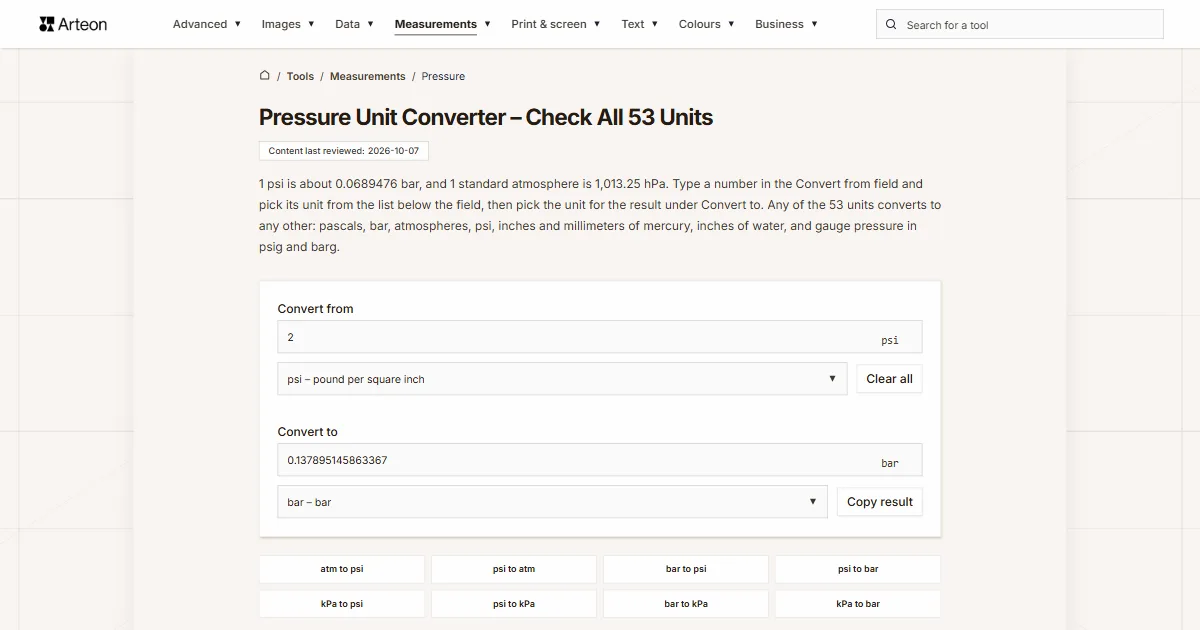
1 psi is about 0.0689476 bar, and 1 standard atmosphere is 1,013.25 hPa. Type a number in the Convert from field and pick its unit from the list below the field, then pick the unit for the result under Convert to. Any of the 53 units converts to any other: pascals, bar, atmospheres, psi, inches and millimeters of mercury, inches of water, and gauge pressure in psig and barg.
How do I convert units of pressure?
Type a number in the Convert from field and pick its unit from the list below the field, then pick the unit you want under Convert to. The result appears as you type. It works the other way round too: type a number in the Convert to field and the converter fills in the first one.
Both lists hold the same 53 units in 8 groups: Most used, Metric (SI), Bar, atmosphere and other non-SI, Kilogram-force (technical atmosphere), Mercury column and torr, Water column, Imperial and US customary, Gauge pressure. You don't have to look for a unit in the list. Type it with the number, for example “32 psi”, “29.92 inHg”, “1013 mb” or “7 inWC”, and the converter sets the unit next to the field and tells you below it which one it chose. If you type just “atmosphere”, it picks the standard atmosphere, “of mercury” on its own means inches of mercury and “water column” means inches of water, and a line below the field says that other versions are in the list.
Only the units in the Gauge pressure group take a minus sign, because a vacuum is negative gauge pressure. Psi, bar or pascals from the other groups are absolute pressures, which can't drop below zero, so a minus sign there brings up a message. The Copy result button copies the number from the Convert to field, and Clear all empties both fields.
How many bar is 1 psi?
One pound per square inch (psi) is about 0.0689476 bar, or 6.89476 kPa. The other way round, 1 bar is about 14.5038 psi. To go from psi to bar in your head, divide by 14.5, and to go from bar to psi, multiply by 14.5.
You'll meet this conversion most often at the tire pump. Psi is still widely used for tire pressure in the US and Canada[1], and in the US the recommended pressure is printed in both kilopascals and psi on the Tire and Loading Information label on the edge of the driver's door[2]. Tire pressure is also often given in bar[3]. A common car tire pressure is 32 psi[4], which is about 2.21 bar or 221 kPa. Single pairs with their own tables are in the psi to bar converter, the bar to psi converter and the psi to kPa converter.
What are common tire pressures in bar and kPa?
| Tire | Psi | Bar | Kilopascals |
|---|---|---|---|
| Car tire, common pressure | 32 psi | about 2.21 bar | about 221 kPa |
| Bicycle tire, common pressure | 65 psi | about 4.48 bar | about 448 kPa |
| Road racing bicycle tire | 120 psi | about 8.27 bar | about 827 kPa |
How many psi, bar and kPa are the most used pressure units?
| Unit | In psi | In bar | In kilopascals |
|---|---|---|---|
| pascal (Pa) | about 0.000145038 psi | 0.00001 bar | 0.001 kPa |
| hectopascal (hPa) | about 0.0145038 psi | 0.001 bar | 0.1 kPa |
| millibar (mbar) | about 0.0145038 psi | 0.001 bar | 0.1 kPa |
| millimeter of mercury (mmHg) | about 0.0193368 psi | about 0.00133322 bar | about 0.133322 kPa |
| kilopascal (kPa) | about 0.145038 psi | 0.01 bar | 1 kPa |
| inch of mercury (inHg) | about 0.491154 psi | about 0.0338639 bar | about 3.38639 kPa |
| pound per square inch (psi) | 1 psi | about 0.0689476 bar | about 6.89476 kPa |
| bar | about 14.5038 psi | 1 bar | 100 kPa |
| standard atmosphere (atm) | about 14.6959 psi | 1.01325 bar | 101.325 kPa |
| megapascal (MPa) | about 145.038 psi | 10 bar | 1,000 kPa |
What is a pascal, and where do hPa, kPa and MPa come from?
The pascal (Pa) is the unit of pressure in the International System of Units (SI): one newton of force spread over one square meter. It is named after Blaise Pascal, and engineers use it for stress, Young's modulus and tensile strength as well[5]. A pascal is a very small pressure, so in practice you'll see its multiples.
Weather services report air pressure in hectopascals, as the World Meteorological Organization recommends, so typical sea-level pressure is about 1,013 hPa. US reports usually give inches of mercury or millibars, and a millibar is the same size as a hectopascal[5]. In Canada, Environment and Climate Change Canada gives pressure in kilopascals, for example 102.4 kPa in Ottawa[6], which is about 30.24 inHg. The newton per square millimeter is exactly 1 MPa, so steel and concrete strengths written in N/mm² and in MPa are the same numbers. Gigapascals measure the stiffness of materials, and the newton per square centimeter is 10 kPa.
How many pascals and psi are the SI units?
| Unit | In pascals | In psi |
|---|---|---|
| newton per square centimeter (N/cm²) | 10,000 Pa | about 1.45038 psi |
| newton per square millimeter (N/mm²) | 1,000,000 Pa | about 145.038 psi |
| gigapascal (GPa) | 1,000,000,000 Pa | about 145,038 psi |
How big are the bar, the millibar and the standard atmosphere?
The bar is a round 100,000 Pa, close to average air pressure on Earth. The Norwegian meteorologist Vilhelm Bjerknes introduced both the bar and the millibar[3]. The bar is not an SI unit, but the International Bureau of Weights and Measures lists it among the non-SI units in use[7]. In the US, NIST counts it among units that may stay in fields where they are already used but must not be brought into new ones[8]. A millibar is a thousandth of a bar, exactly 1 hPa.
The standard atmosphere (atm) is 101,325 Pa, a value the General Conference on Weights and Measures fixed in 1954[9]. That is 1.01325 bar, about 14.6959 psi, and about 29.9213 inHg. One bar is about 1.3% smaller than one atmosphere.
The dyne per square centimeter (barye) comes from the old CGS system and is 0.1 Pa, a millionth of a bar. Some writers once called this unit “bar” as well, which caused confusion with today's bar[10].
Other prefixes give more units of the bar family. The microbar (µbar) equals the barye, 0.1 Pa, and is used in acoustics. The decibar (dbar) is 10 kPa. Oceanographers give water pressure in it, because in fresh water the pressure rises by 1 dbar for every 1.019716 m of depth, so decibars and meters of depth come out as almost the same number. The kilobar (kbar) is 100 MPa and is common in geology, particularly in experimental petrology. The list also has the centibar (cbar) and the megabar (Mbar)[3]. The megabar and the millibar differ only in the case of the letter M, so type “Mbar” with a capital M for the megabar and “mbar” with a lowercase m for the millibar.
The pièze (pz) is the pressure unit of the meter–tonne–second (MTS) system, which measured force in sthènes. It equals 1 kPa and was used, for example, in the Soviet Union from 1933 to 1955[11]. The hectopièze (hpz) is a hundred pièzes, exactly 1 bar, and some pressure gauges were marked in it[12].
How many pascals and psi are the bar, the atmosphere and other non-SI units?
| Unit | In pascals | In psi |
|---|---|---|
| microbar (µbar) | 0.1 Pa | about 0.0000145038 psi |
| dyne per square centimeter (barye) | 0.1 Pa | about 0.0000145038 psi |
| centibar (cbar) | 1,000 Pa | about 0.145038 psi |
| pièze (pz) | 1,000 Pa | about 0.145038 psi |
| decibar (dbar) | 10,000 Pa | about 1.45038 psi |
| hectopièze (hpz) | 100,000 Pa | about 14.5038 psi |
| kilobar (kbar) | 100,000,000 Pa | about 14,503.8 psi |
| megabar (Mbar) | 100,000,000,000 Pa | about 14,503,800 psi |
What is kg/cm², and how does it differ from bar?
A kilogram-force per square centimeter (kgf/cm², often written kg/cm²) is the pressure of the weight of one kilogram on one square centimeter. The same unit is called the technical atmosphere (at). It equals 98.0665 kPa, about 2% less than a bar[13], so 1 kg/cm² is 0.980665 bar and about 14.2233 psi.
The unit is deprecated and stays in use mainly because older pressure gauges marked in it are still around. Older publications also abbreviate it as ksc[13], and the field reads “at”, “kgf/cm²”, “kg/cm²”, “kp/cm²” and “ksc” as the same unit.
The other units of this group are built from the kilogram-force, and three of them equal a water column: the gram-force per square centimeter is a centimeter of water, the kilogram-force per square meter is a millimeter of water, and the tonne-force per square meter is a meter of water. The kilogram-force per square millimeter is 9.80665 MPa.
How many pascals and psi are the kilogram-force units?
| Unit | In pascals | In psi |
|---|---|---|
| kilogram-force per square meter (kgf/m²) | 9.80665 Pa | about 0.00142233 psi |
| gram-force per square centimeter (gf/cm²) | 98.0665 Pa | about 0.0142233 psi |
| tonne-force per square meter (tf/m²) | 9,806.65 Pa | about 1.42233 psi |
| technical atmosphere (at) | 98,066.5 Pa | about 14.2233 psi |
| kilogram-force per square millimeter (kgf/mm²) | 9,806,650 Pa | about 1,422.33 psi |
How do I convert inches of mercury, mmHg and torr?
The inch of mercury (inHg) is the unit of air pressure in US weather reports[14], and it is also used in aviation and refrigeration[15]. Pilots in North America and Japan get altimeter settings in inches of mercury, while most other countries use hectopascals. At or above the transition altitude, aircraft set their altimeters to the standard 29.92 inHg or 1,013.25 hPa[15]. The two numbers differ by four hundredths of a hectopascal, because 29.92 is rounded: 29.92 inHg is about 1,013.21 hPa, and 1,013.25 hPa is about 29.9213 inHg.
Boost and vacuum gauges in modified cars and manifold pressure gauges in piston aircraft also read in inches of mercury[15]. In older literature, the inch of mercury was based on a mercury column at 60 °F[15], and because the density of mercury changes with temperature, such a column gives a slightly different pressure. That is why the list also has the inch of mercury at 32 °F, the inch of mercury at 60 °F and the centimeter of mercury at 0 °C, with as many digits as NIST gives[8]. The foot of mercury is 12 inches of mercury.
The millimeter of mercury (mmHg) is defined as exactly 133.322387415 Pa, and medicine still measures blood pressure, eye pressure and central venous pressure in it[16]. A blood pressure of 120/80 mmHg is about 16/10.7 kPa, or 2.32/1.55 psi.
The torr is exactly 1/760 of a standard atmosphere, about 133.322368 Pa. It is about one part in seven million smaller than the millimeter of mercury[16], a gap you'll only see in the eighth digit, yet the converter keeps the two units apart. The torr is used in high-vacuum physics and engineering[17], the millitorr is a thousandth of it, and the micron of mercury is a thousandth of a millimeter of mercury.
How many pascals and hectopascals are the mercury units?
| Unit | In pascals | In hectopascals |
|---|---|---|
| millitorr (mTorr) | about 0.133322 Pa | about 0.00133322 hPa |
| micron of mercury (µmHg) | about 0.133322 Pa | about 0.00133322 hPa |
| torr (Torr) | about 133.322 Pa | about 1.33322 hPa |
| centimeter of mercury at 0 °C | approx. 1,333.22 Pa | approx. 13.3322 hPa |
| centimeter of mercury (cmHg) | about 1,333.22 Pa | about 13.3322 hPa |
| inch of mercury at 60 °F | approx. 3,376.85 Pa | approx. 33.7685 hPa |
| inch of mercury at 32 °F | approx. 3,386.38 Pa | approx. 33.8638 hPa |
| foot of mercury (ftHg) | about 40,636.7 Pa | about 406.367 hPa |
How many psi is an inch of water column?
The inch of water (inH₂O, also written in. WC or iwg) is the pressure of a water column one inch high[18]. One inch of water is about 249.089 Pa, or about 0.03613 psi. In North America it measures small pressures of air and gases, such as the wind supply of a pipe organ. Natural gas reaches homes at a utilization pressure that is typically between 6 and 7 inches of water column, about a quarter of a psi[18]. Seven inches of water is about 0.253 psi or 17.4 mbar.
The centimeter of water (cmH₂O) is a unit of medicine: CPAP machines are set in it, and so are pressures during mechanical ventilation and the central venous pressure[19]. Ten centimeters of water is about 9.807 mbar.
Outdoor gear states waterproofing as hydrostatic head in millimeters: the height of a water column the fabric holds back before water seeps through. A rating of 5,000 mm means a column five meters high[20], which is 0.4903325 bar or about 7.11 psi. The meter of water is fixed by a nominal water density of 1,000 kg/m³ and standard gravity[19], so it is 9,806.65 Pa, and the foot of water is 12 inches of water. The field also reads “ft of head” as feet of water.
Divers count in seawater. The U.S. Navy Diving Manual sets the meter of seawater (msw) at 0.1 bar, so 10 msw is exactly 1 bar, and gives 1 psi as 2.25 feet of seawater (fsw)[21]. One fsw is therefore about 0.444444 psi. For water at a stated temperature, the list also has the centimeter of water at 4 °C, the inch of water at 39.2 °F, the inch of water at 60 °F and the foot of water at 39.2 °F[8].
How many pascals and psi are the water column units?
| Unit | In pascals | In psi |
|---|---|---|
| millimeter of water (mmH₂O) | 9.80665 Pa | about 0.00142233 psi |
| centimeter of water at 4 °C | approx. 98.0638 Pa | approx. 0.014223 psi |
| centimeter of water (cmH₂O) | 98.0665 Pa | about 0.0142233 psi |
| inch of water at 60 °F | approx. 248.84 Pa | approx. 0.036091 psi |
| inch of water at 39.2 °F | approx. 249.082 Pa | approx. 0.0361263 psi |
| inch of water (inH₂O) | about 249.089 Pa | about 0.0361273 psi |
| foot of water at 39.2 °F | approx. 2,988.98 Pa | approx. 0.433515 psi |
| foot of water (ftH₂O) | about 2,989.07 Pa | about 0.433528 psi |
| foot of seawater (fsw) | about 3,064.34 Pa | about 0.444444 psi |
| meter of water (mH₂O) | 9,806.65 Pa | about 1.42233 psi |
| meter of seawater (msw) | 10,000 Pa | about 1.45038 psi |
What are psi, psf and ksi?
Psi is short for pound-force per square inch. Because the pound is exactly 0.45359237 kg and the inch exactly 2.54 cm, one psi has a fixed value of about 6,894.757 Pa[8]. Sea-level air pressure is around 14.7 psi[4]. The pound per square foot (psf) is 1/144 psi, because a square foot has 144 square inches.
A kip is 1,000 pounds-force, a unit structural engineers use for large forces[22]. From it comes the kip per square inch (ksi), used mostly in materials science, where the tensile strength of a material would be a large number of psi[4]. One ksi is about 6.895 MPa. The list also has the short ton-force per square inch (2,000 pounds-force), the long ton-force per square inch (2,240 pounds-force) and the poundal per square foot, based on the poundal, the unit of force of the foot–pound–second system[8].
How many kilopascals and bar are the imperial and US units?
| Unit | In kilopascals | In bar |
|---|---|---|
| poundal per square foot (pdl/ft²) | about 0.00148816 kPa | about 0.0000148816 bar |
| pound per square foot (psf) | about 0.0478803 kPa | about 0.000478803 bar |
| kip per square inch (ksi) | about 6,894.76 kPa | about 68.9476 bar |
| short ton-force per square inch (tsi) | about 13,789.5 kPa | about 137.895 bar |
| long ton-force per square inch | about 15,444.3 kPa | about 154.443 bar |
What is the difference between psig and psia?
Gauge pressure is measured against the air around you, so it equals absolute pressure minus atmospheric pressure. A tire gauge shows gauge pressure: it reads zero when the tire holds the same pressure as the air outside. Tire pressure and blood pressure are gauge pressures by convention, while air pressure and altimeter settings are absolute[1]. A blood pressure of 120 mmHg therefore means 880 mmHg above a perfect vacuum when the air around you is at 760 mmHg[16].
When the difference matters, a letter is often added: psig for gauge and psia for absolute pressure, although NIST discourages this practice[1]. In bar, gauge pressure is written barg. Because the air around the gauge changes with weather and altitude, the gauge reading of a sealed container changes too: when a car drives up a mountain, the gauge pressure in its tires goes up as the air outside gets thinner[1].
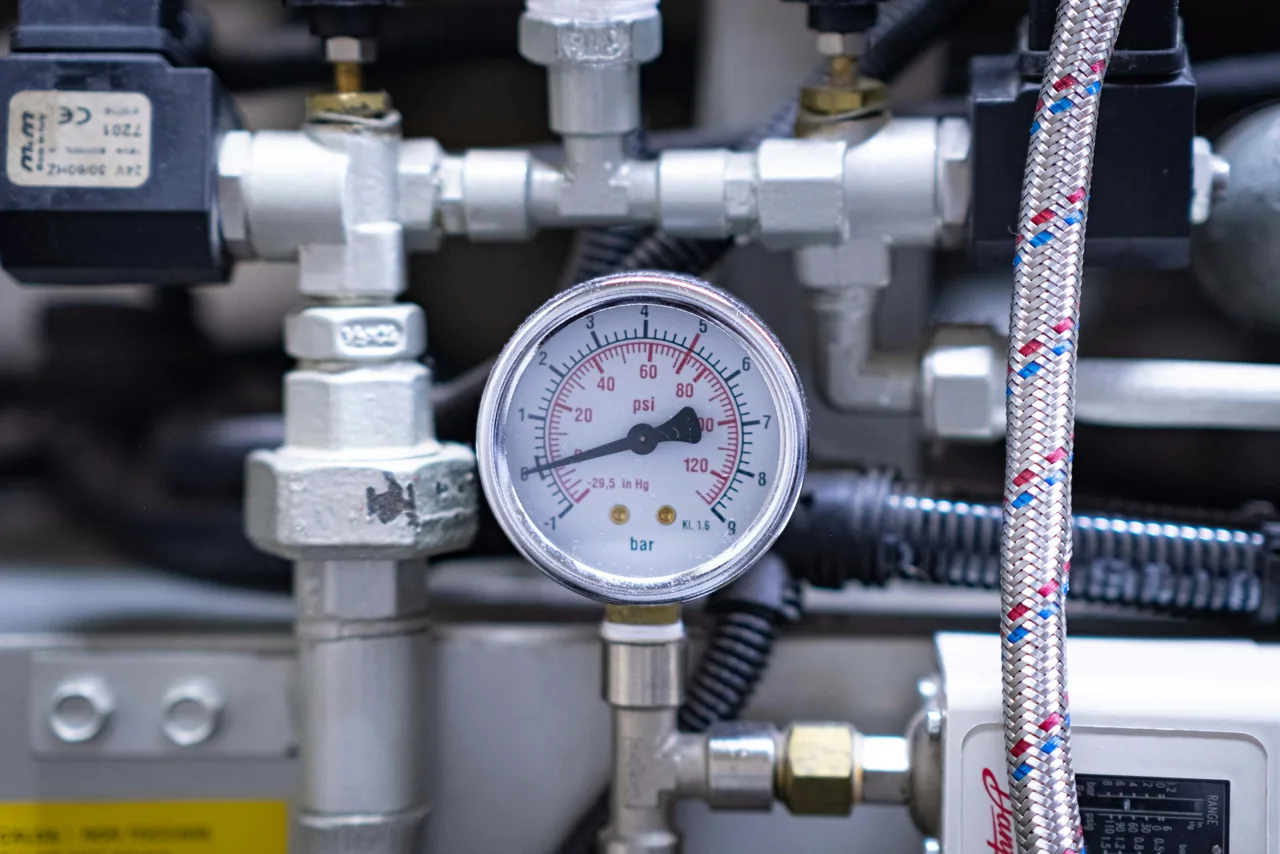
The converter counts all three gauge units from the standard atmosphere of exactly 101,325 Pa. Real air pressure varies with weather and altitude[1], so the true absolute pressure where you are may differ a little. On that basis, 0 psig is about 14.6959 psia, 32 psig is about 46.7 psia, and 2.2 barg is 3.21325 bar absolute. The third gauge unit in the list is the technical atmosphere gauge, written atü in German.
Type a vacuum with a minus sign: −10 psig is about 4.696 psia. The lowest possible value is about −14.6959 psig, where absolute pressure falls to zero, a perfect vacuum, and anything lower brings up a message below the field. Refrigeration technicians read vacuum in inches of mercury, and the low-side gauge of a refrigeration manifold goes down to a 30 inHg vacuum[15]. The gauge in the photo works the same way: its bar scale starts at −1, and 1 bar is about 29.5 inHg, hence the −29.5 in Hg mark.
How much absolute pressure is that?
| Unit | Zero in psia | One unit in psia | Lowest value |
|---|---|---|---|
| bar gauge (barg) | about 14.6959 psia | about 29.1997 psia | −1.01325 barg |
| pound per square inch gauge (psig) | about 14.6959 psia | about 15.6959 psia | −14.6959487755134 psig |
| technical atmosphere gauge (atü) | about 14.6959 psia | about 28.9193 psia | −1.03322745279989 atü |
Pressure conversion chart
| Unit | Pa | bar | atm | inHg | Torr | psi |
|---|---|---|---|---|---|---|
| 1 Pa | 1 | 0.00001 | 0.00000986923 | 0.0002953 | 0.00750062 | 0.000145038 |
| 1 bar | 100,000 | 1 | 0.986923 | 29.53 | 750.062 | 14.5038 |
| 1 atm | 101,325 | 1.01325 | 1 | 29.9213 | 760 | 14.6959 |
| 1 inHg | 3,386.39 | 0.0338639 | 0.0334211 | 1 | 25.4 | 0.491154 |
| 1 Torr | 133.322 | 0.00133322 | 0.00131579 | 0.0393701 | 1 | 0.0193368 |
| 1 psi | 6,894.76 | 0.0689476 | 0.068046 | 2.03602 | 51.7149 | 1 |
What can I type in the Convert from field?
| What you type | Unit set in Convert from | Result in Convert to | How we read it |
|---|---|---|---|
| 32 | pound per square inch (psi) | 2.20632233381388 bar | A number without a unit counts in the unit set next to the field, here psi. |
| 32.5 | pound per square inch (psi) | 2.24079612027972 bar | The period is the decimal point, so this is thirty-two and a half psi. |
| 1,500 | pound per square inch (psi) | 103.421359397525 bar | A comma followed by three digits separates thousands, so we read one thousand five hundred psi. |
| 2,2 | pound per square inch (psi) | 0.151684660449704 bar | A comma followed by one or two digits is a decimal comma, as written in most of Europe, so this is two point two psi. |
| ½ | pound per square inch (psi) | 0.0344737864658418 bar | The fraction character counts as half a psi. |
| 2.2 bar | bar | 2.2 bar | A unit after the number sets that unit next to the field, so we calculate 2.2 bar. |
| 29.92 inHg | inch of mercury (inHg) | 1.01320748119003 bar | An altimeter setting or a US weather report in inches of mercury sets the inch of mercury. |
| 1013 mb | millibar (mbar) | 1.013 bar | The abbreviation mb from weather forecasts sets the millibar. |
| 120 mmHg | millimeter of mercury (mmHg) | 0.159986864898 bar | A reading from a blood pressure monitor sets the millimeter of mercury. |
| 7" WC | inch of water (inH₂O) | 0.0174362237 bar | The inch mark before WC, as on gas pressure gauges, sets the inch of water. |
| 35 psig | pound per square inch gauge (psig) | 3.42641505260893 bar | The letter g sets pound per square inch gauge, and the result in bar is absolute pressure. |
| -10 psig | pound per square inch gauge (psig) | 0.323774270683164 bar | A minus sign is allowed in gauge units, and the field reads it as a vacuum. |
| 3 kg/cm² | technical atmosphere (at) | 2.941995 bar | Kilograms per square centimeter from an older gauge set the technical atmosphere. |
| 1.5e5 Pa | pascal (Pa) | 1.5 bar | Scientific notation from a spreadsheet reads as one hundred fifty thousand pascals. |
Sources
- Pressure measurement — Wikipedia
- Tires (copy of January 1, 2026) — National Highway Traffic Safety Administration
- Bar (unit) — Wikipedia
- Pound per square inch — Wikipedia
- Pascal (unit) — Wikipedia
- Ottawa (Macdonald-Cartier Int’l Airport), current conditions, October 4, 2026 — Environment and Climate Change Canada
- The International System of Units (SI), 9th edition, June 2026 version, Table 8 — Bureau International des Poids et Mesures
- NIST Special Publication 811 (2008), Guide for the Use of the SI, section 5.2, Appendix B.9 and footnotes 8 and 12 — National Institute of Standards and Technology
- Resolution 4 of the 10th CGPM (1954): Definition of the standard atmosphere — Bureau International des Poids et Mesures
- Barye — Wikipedia
- Pièze — Wikipedia
- Pièze (French version) — Wikipedia
- Kilogram-force per square centimetre — Wikipedia
- Glossary: Inches of Mercury — National Weather Service
- Inch of mercury — Wikipedia
- Millimetre of mercury — Wikipedia
- Torr — Wikipedia
- Inch of water — Wikipedia
- Centimetre or millimetre of water — Wikipedia
- Hydrostatic head — Wikipedia
- U.S. Navy Diving Manual, Revision 7 (2016), Table 2-10 (copy in the Internet Archive) — Naval Sea Systems Command
- Kip (unit) — Wikipedia
Every figure in the tables was computed from the unit definitions and checked arithmetically before publication. Historical values and the names of local units come from the sources listed above.
Content last reviewed: · written and checked by the Arteon team
Frequently asked questions about pressure units
How do I work out force from pressure?
Multiply the pressure by the area it acts on, in matching units. A pressure of 100 psi on a piston with an area of 2 square inches pushes with 200 pounds-force. In SI units, 1 bar is 100,000 Pa, so it gives 10 N on a square centimeter. This converter only converts pressure units, so you work out the force separately.
Can the converter turn inHg or hPa into altitude?
No. Air pressure falls with altitude, but it also depends on temperature and weather, so altitude can’t be calculated with a fixed factor. This converter only converts pressure units, and an entry with a length unit, such as “100 ft”, brings up a message below the field.
Have a question or a suggestion?
If a pressure unit is missing or you spot a wrong value, write to us. A source for the value helps us most.