Convert grains to grams
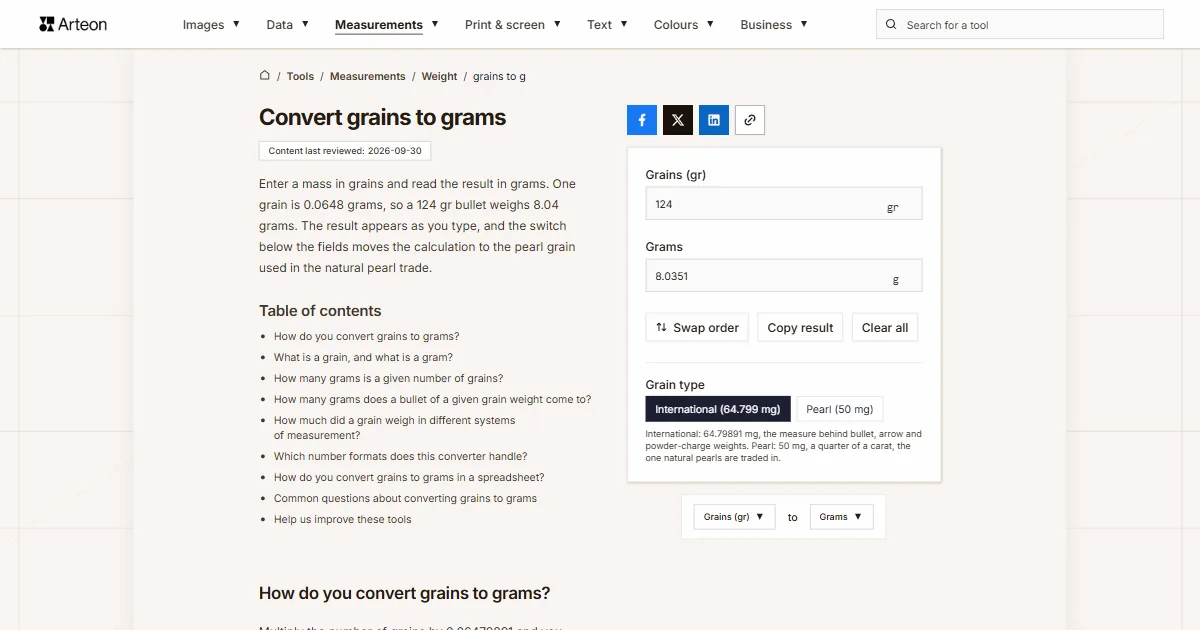
Enter a mass in grains and read the result in grams. One grain is 0.0648 grams, so a 124 gr bullet weighs 8.04 grams. The result appears as you type, and the switch below the fields moves the calculation to the pearl grain used in the natural pearl trade.
How do you convert grains to grams?
Multiply the number of grains by 0.06479891 and you have the mass in grams. A 124 grain bullet comes out at 8.04 grams.
Formula: grams = grains × 0.06479891
An approximation is enough for mental arithmetic. A grain is a little under seven hundredths of a gram, and the multiplier 0.065 comes out three tenths of a percent above the exact figure.
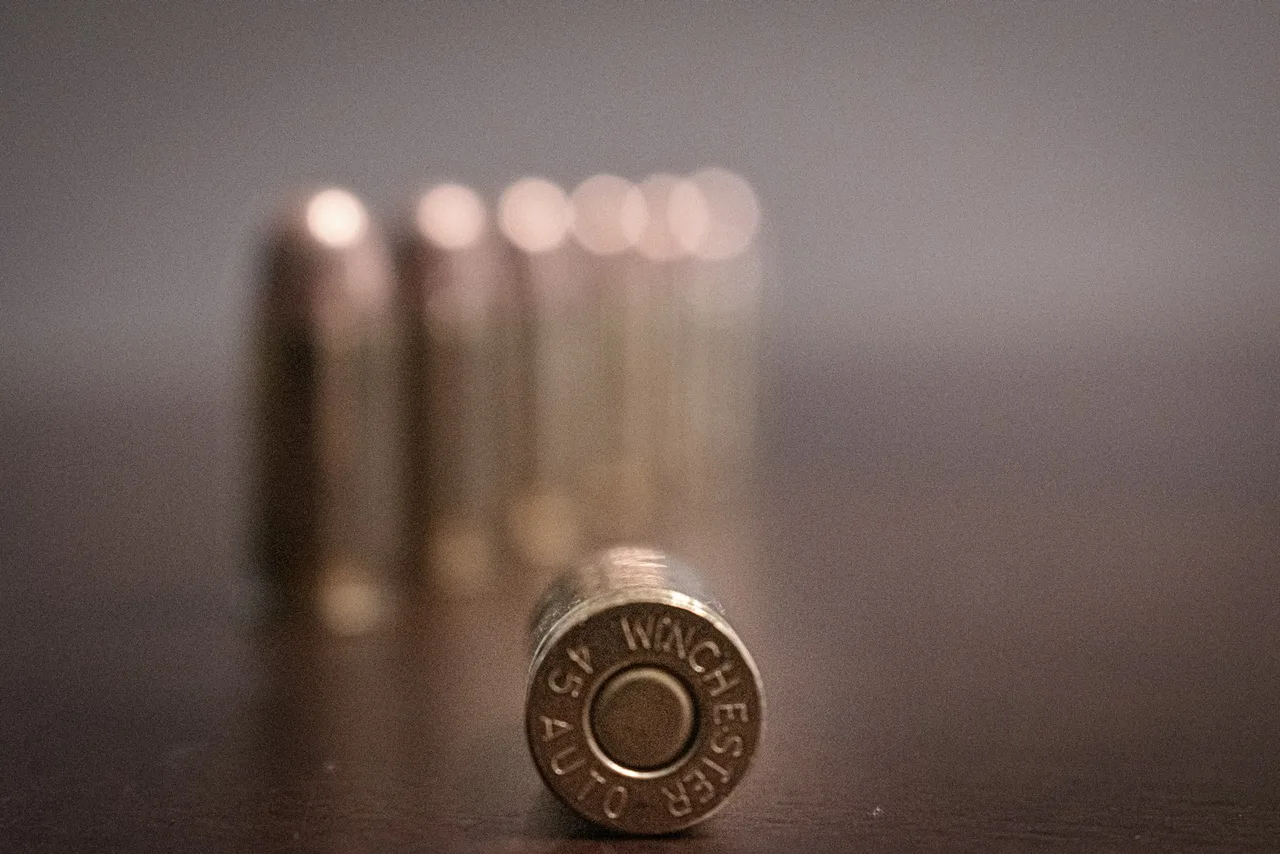
Take three bullet masses from the pistol ammunition standard. A hundred grains is 6.48 grams. A hundred and fifty grains gives 9.72 grams. Two hundred and thirty grains, the .45 Automatic bullet, weighs 14.90 grams. The standard lists the first two for the 9 mm Luger. All three describe the bullet alone: the case, the powder and the primer carry masses of their own.
The multiplier is exact to the last digit, because the grain has a value fixed directly in metric terms: 64.79891 milligrams[1].
Going the other way you divide by the same multiplier. The grams to grains converter does the whole job for you.
What is a grain, and what is a gram?
A grain is a unit of mass equal to 64.79891 milligrams, or 0.06479891 grams[1]. Its symbol is gr.
The name comes straight from a cereal seed. The reference was the mass of a single barley grain, and average wheat and barley grain masses stood in legal definitions of mass from the Bronze Age through the Renaissance[2].
The grain is also the one unit that holds the same value across all three English systems of mass at once — avoirdupois, troy and apothecaries’[2]. The NIST measurement handbook repeats that sentence above each of its three mass tables[1]. What separates the systems is the number of grains in their pound: 7000 in the avoirdupois pound, 5760 in the troy and apothecaries’ pound. That is the whole of the difference between the avoirdupois pound and the troy pound.
A gram is a thousandth of a kilogram, the base unit of mass in the SI system. One gram holds 15.43 grains, and the grams to milligrams converter takes you a thousand times further down the scale.
The grain still turns up in drug dosages. A standard 325 mg aspirin tablet is sometimes given as 5 grains[2], and five grains work out at 323.99 milligrams, about one milligram under the tablet’s metric figure.
In North America the grain also appears in water hardness figures. Hardness is often stated in grains per US gallon of calcium carbonate equivalent, where one grain per gallon comes to roughly 17.1 parts per million[2].
How many grams is a given number of grains?
| Grains | Grams | Milligrams |
|---|---|---|
| 1 gr | 0.0648 g | 64.8 mg |
| 2 gr | 0.1296 g | 129.6 mg |
| 3 gr | 0.1944 g | 194.4 mg |
| 4 gr | 0.2592 g | 259.2 mg |
| 5 gr | 0.324 g | 323.99 mg |
| 6 gr | 0.3888 g | 388.79 mg |
| 7 gr | 0.4536 g | 453.59 mg |
| 7.5 gr | 0.486 g | 485.99 mg |
| 8 gr | 0.5184 g | 518.39 mg |
| 10 gr | 0.648 g | 647.99 mg |
| 12 gr | 0.7776 g | 777.59 mg |
| 15 gr | 0.972 g | 971.98 mg |
| 17 gr | 1.1016 g | 1,101.58 mg |
| 20 gr | 1.296 g | 1,295.98 mg |
| 21 gr | 1.3608 g | 1,360.78 mg |
| 22 gr | 1.4256 g | 1,425.58 mg |
| 23 gr | 1.4904 g | 1,490.37 mg |
| 24 gr | 1.5552 g | 1,555.17 mg |
| 25 gr | 1.62 g | 1,619.97 mg |
| 26 gr | 1.6848 g | 1,684.77 mg |
| 28 gr | 1.8144 g | 1,814.37 mg |
| 30 gr | 1.944 g | 1,943.97 mg |
| 32 gr | 2.0736 g | 2,073.57 mg |
| 33 gr | 2.1384 g | 2,138.36 mg |
| 34 gr | 2.2032 g | 2,203.16 mg |
| 35 gr | 2.268 g | 2,267.96 mg |
| 40 gr | 2.592 g | 2,591.96 mg |
| 42 gr | 2.7216 g | 2,721.55 mg |
| 45 gr | 2.916 g | 2,915.95 mg |
| 46 gr | 2.9807 g | 2,980.75 mg |
| 50 gr | 3.2399 g | 3,239.95 mg |
| 55 gr | 3.5639 g | 3,563.94 mg |
| 60 gr | 3.8879 g | 3,887.93 mg |
| 62 gr | 4.0175 g | 4,017.53 mg |
| 70 gr | 4.5359 g | 4,535.92 mg |
| 75 gr | 4.8599 g | 4,859.92 mg |
| 80 gr | 5.1839 g | 5,183.91 mg |
| 90 gr | 5.8319 g | 5,831.9 mg |
| 100 gr | 6.4799 g | 6,479.89 mg |
| 110 gr | 7.1279 g | 7,127.88 mg |
| 115 gr | 7.4519 g | 7,451.87 mg |
| 124 gr | 8.0351 g | 8,035.06 mg |
| 125 gr | 8.0999 g | 8,099.86 mg |
| 130 gr | 8.4239 g | 8,423.86 mg |
| 140 gr | 9.0718 g | 9,071.85 mg |
| 147 gr | 9.5254 g | 9,525.44 mg |
| 150 gr | 9.7198 g | 9,719.84 mg |
| 158 gr | 10.2382 g | 10,238.23 mg |
| 165 gr | 10.6918 g | 10,691.82 mg |
| 168 gr | 10.8862 g | 10,886.22 mg |
| 180 gr | 11.6638 g | 11,663.8 mg |
| 200 gr | 12.9598 g | 12,959.78 mg |
| 230 gr | 14.9037 g | 14,903.75 mg |
| 250 gr | 16.1997 g | 16,199.73 mg |
| 300 gr | 19.4397 g | 19,439.67 mg |
| 350 gr | 22.6796 g | 22,679.62 mg |
| 400 gr | 25.9196 g | 25,919.56 mg |
| 420 gr | 27.2155 g | 27,215.54 mg |
| 437.5 gr | 28.3495 g | 28,349.52 mg |
| 480 gr | 31.1035 g | 31,103.48 mg |
| 500 gr | 32.3995 g | 32,399.46 mg |
| 650 gr | 42.1193 g | 42,119.29 mg |
| 750 gr | 48.5992 g | 48,599.18 mg |
| 1,000 gr | 64.7989 g | 64,798.91 mg |
| 1,400 gr | 90.7185 g | 90,718.47 mg |
| 1,500 gr | 97.1984 g | 97,198.37 mg |
| 2,000 gr | 129.5978 g | 129,597.82 mg |
| 2,500 gr | 161.9973 g | 161,997.28 mg |
| 5,760 gr | 373.2417 g | 373,241.72 mg |
| 7,000 gr | 453.5924 g | 453,592.37 mg |
How many grams does a bullet of a given grain weight come to?
| Bullet weight | Grams | Cartridge |
|---|---|---|
| 35 gr | 2.27 g | 25 Automatic |
| 60 gr | 3.89 g | 32 Automatic |
| 65 gr | 4.21 g | 380 Automatic |
| 80 gr | 5.18 g | 380 Automatic |
| 88 gr | 5.7 g | 9 mm Luger |
| 90 gr | 5.83 g | 38 Special |
| 93 gr | 6.03 g | 30 Luger (7,65 mm) |
| 95 gr | 6.16 g | 9 mm Luger |
| 100 gr | 6.48 g | 9 mm Luger |
| 101 gr | 6.54 g | 357 Magnum |
| 110 gr | 7.13 g | 357 Magnum |
| 115 gr | 7.45 g | 9 mm Luger |
| 120 gr | 7.78 g | 45 Automatic |
| 124 gr | 8.04 g | 9 mm Luger |
| 125 gr | 8.1 g | 40 Smith & Wesson |
| 130 gr | 8.42 g | 38 Special |
| 135 gr | 8.75 g | 10 mm Automatic |
| 140 gr | 9.07 g | 357 Magnum |
| 147 gr | 9.53 g | 9 mm Luger |
| 148 gr | 9.59 g | 38 Special |
| 155 gr | 10.04 g | 10 mm Automatic |
| 158 gr | 10.24 g | 38 Special |
| 165 gr | 10.69 g | 40 Smith & Wesson |
| 170 gr | 11.02 g | 10 mm Automatic |
| 175 gr | 11.34 g | 45 Automatic |
| 180 gr | 11.66 g | 44 Remington Magnum |
| 185 gr | 11.99 g | 45 Automatic |
| 200 gr | 12.96 g | 45 Automatic |
| 210 gr | 13.61 g | 44 Remington Magnum |
| 220 gr | 14.26 g | 45 Automatic |
| 230 gr | 14.9 g | 45 Automatic |
| 240 gr | 15.55 g | 44 Remington Magnum |
| 250 gr | 16.2 g | 44 Remington Magnum |
| 275 gr | 17.82 g | 44 Remington Magnum |
| 300 gr | 19.44 g | 44 Remington Magnum |
How much did a grain weigh in different systems of measurement?
| Kind of grain | Mass | Where it applied |
|---|---|---|
| International grain | 64.79891 mg | today: bullets, powder, arrows |
| Pearl grain | 50 mg | today: the natural pearl trade |
| Nuremberg apothecaries’ grain | about 62 mg | German pharmacies before metrication |
| Grain of the poids de marc | about 53.114 mg | France before metrication |
| Venetian grano | about 52 mg | the Republic of Venice |
| Grano castellano | 49.914 mg | old Castile |
| Assay grain of the Cologne mark | 12.7 mg | metal assaying |
| Polish gran | 835 mg | Poland, 16th to 18th century |
Which number formats does this converter handle?
| What you type | What the converter shows | How we read it |
|---|---|---|
| 124.5 | 8.0675 g | The decimal point from the numeric keypad, written the way English writes it |
| 124,5 | 8.0675 g | A comma pasted from a market that writes decimals that way is read as a decimal point, so the result is the same |
| 1,500 | 97.1984 g | Three digits follow the comma, so we read it as a thousands separator: the field holds one thousand five hundred. A note under the field shows the other possible reading, 1.5. |
| 1 000 | 64.7989 g | A space between thousands, the way a spreadsheet pastes it, does not split the number in two |
| 3/4 | 0.0486 g | We work the fraction out ourselves, so there is no need to turn it into a decimal first |
| 115½ | 7.4843 g | The ½ character copied from a recipe or a label is added to the number in front of it |
| 124.5 gr | 8.0675 g | A unit symbol pasted along with the number is no trouble: we take the number and leave the symbol out |
How do you convert grains to grams in a spreadsheet?
One multiplication is all it takes. With the number of grains in cell A1, type =A1*0.06479891 in the next cell and you have grams.
Excel also has a ready function that knows unit names. It is called CONVERT and its syntax is CONVERT(number,from_unit,to_unit)[9].
The unit symbol is always written in English and is case-sensitive[9]. The grain is "grain" and the gram is "g", so the whole conversion reads =CONVERT(A1,"grain","g").
The same function takes the other units of mass. =CONVERT(A1,"grain","ozm") gives the same mass in avoirdupois ounces, and =CONVERT(A1,"g","grain") counts the other way.
The result runs long, because the multiplier carries eight decimal places. ROUND sets the number of digits: =ROUND(A1*0.06479891,4) leaves four decimals, matching the result field above.
Convert other units to Grams
Sources
- NIST Handbook 44 (2023), Appendix C. General Tables of Units of Measurement — National Institute of Standards and Technology
- Grain (unit) — Wikipedia
- ANSI/SAAMI Z299.3-2022. Voluntary Industry Performance Standards for Pressure and Velocity of Centerfire Pistol and Revolver Ammunition — Sporting Arms and Ammunition Manufacturers’ Institute
- The Pearl Book, Pearl Commission 2024-1 — CIBJO — The World Jewellery Confederation
- Gran (Einheit) — Wikipedia
- Grain (unité) — Wikipedia
- Grano (unità di misura) — Wikipedia
- Grano (unidad de masa) — Wikipedia
- CONVERT function — Microsoft
Every figure in the tables was computed from the unit definitions and checked arithmetically before publication. Historical values and the names of local units come from the sources listed above.
Content last reviewed: · written and checked by the Arteon team
Common questions about converting grains to grams
How many grams is one grain?
One grain is 0.06479891 grams, or 64.79891 milligrams. The value is fixed directly in metric terms, so the conversion is exact to the last digit. The other way round, one gram holds 15.43 grains.
What does gr mean on an ammunition box?
The grain. The SAAMI standard heads its bullet mass column with that very abbreviation: “Nominal Bullet Weight (gr.)”. The symbol for the gram is a single g, so one letter and a factor of fifteen separate the two.
Why is bullet weight given in grains?
Because the grain is conveniently small. A pistol bullet weighs somewhere between a few and almost twenty grams, so in grains it becomes a three-digit number in which a one percent difference shows without a decimal point. The SAAMI standard lists bullet mass in grains.
Does a troy grain weigh the same as an avoirdupois grain?
Yes. NIST repeats that sentence above each of its three mass tables: the grain is an equivalent quantity in avoirdupois, troy and apothecaries units of mass. What separates the systems is the number of grains in the pound — 7000 for avoirdupois, 5760 for troy and apothecaries.
What is the pearl grain and when should you pick it?
The pearl grain is a unit of the natural pearl trade, equal to a quarter of a carat, which is 50 milligrams. Move the switch below the fields to it when the mass comes from a pearl valuation or a strand description. Bullets, powder and arrows stay with the international grain.
How many grains are in an aspirin tablet?
A standard 325 mg tablet is sometimes given as 5 grains. Five grains work out at 323.99 milligrams, so the two figures describe the same tablet to within about one milligram.
What is the difference between a grain and a gram?
Scale and origin. The gram is a thousandth of a kilogram, the base unit of the SI system, while the grain comes from the English system of measurement. One gram holds 15.43 grains, and one grain is 0.0648 grams.
Help us improve these tools
Have an idea for a feature, found a bug or want to suggest another tool? Write to us.