Weight Unit Converter – Check All 150 Units
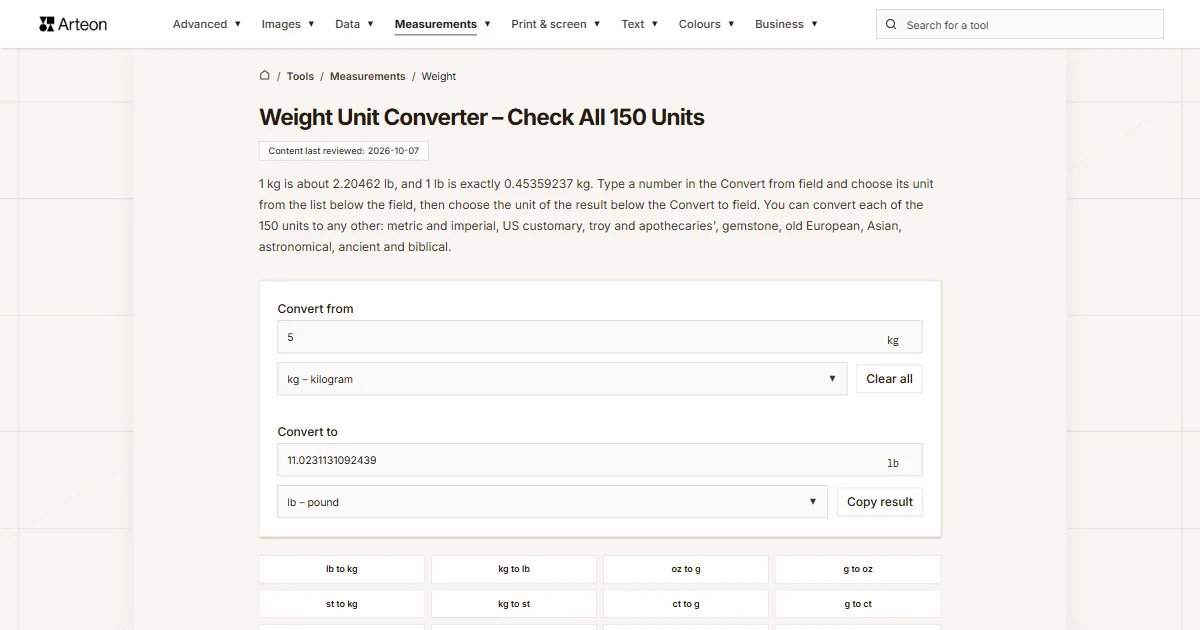
1 kg is about 2.20462 lb, and 1 lb is exactly 0.45359237 kg. Type a number in the Convert from field and choose its unit from the list below the field, then choose the unit of the result below the Convert to field. You can convert each of the 150 units to any other: metric and imperial, US customary, troy and apothecaries', gemstone, old European, Asian, astronomical, ancient and biblical.
How do you convert units of weight?
Type a number in the Convert from field and choose its unit from the list below the field, then choose the unit you want below the Convert to field. The result appears as you type. It also works the other way round: type a number in the Convert to field and the converter fills in the first one.
Both lists hold the same 150 units in 28 groups. The most used units come first, followed by imperial and US customary units, troy and apothecaries' weights, gemstone units and biblical weights. After them come metric, engineering, astronomical and physics units, old units from Poland, Russia and the rest of Europe, Japanese, Chinese and Indian units, and ancient ones.
You don't have to look for the unit in the list. Type it after the number, for example “150 lbs”, “12 oz” or “3 tonnes”, and the converter sets the unit in the list below the field and tells you which one it picked. Plurals and abbreviations work, so “2 kilos”, “2 kg” and “2 kilograms” all set the kilogram.
Some names cover several units. If you type just “2 tons”, the converter takes the short ton of 2,000 pounds used in the US and notes below the field that there are other tons on the list. Hundredweights, drams, shekels and talents work the same way.
Many old units have no single agreed value, because the original standards are lost or the sources disagree. When you pick one of them, a line below the fields shows the value we calculate with and, where the sources differ, the range they give. The result then has only as many digits as the sources can support.
The Copy result button copies the number from the Convert to field, and Clear all empties both fields.
How many kilograms are in a pound?
A pound is exactly 0.45359237 kg, so a kilogram is about 2.20462 pounds. NIST gives this value with a reference to the Federal Register notice of July 1, 1959[1], and the British Weights and Measures Act 1985 uses the same number. Under the act an ounce is a sixteenth of a pound and a stone is 14 pounds[2], so an ounce is exactly 28.349523125 g and a stone 6.35029318 kg.
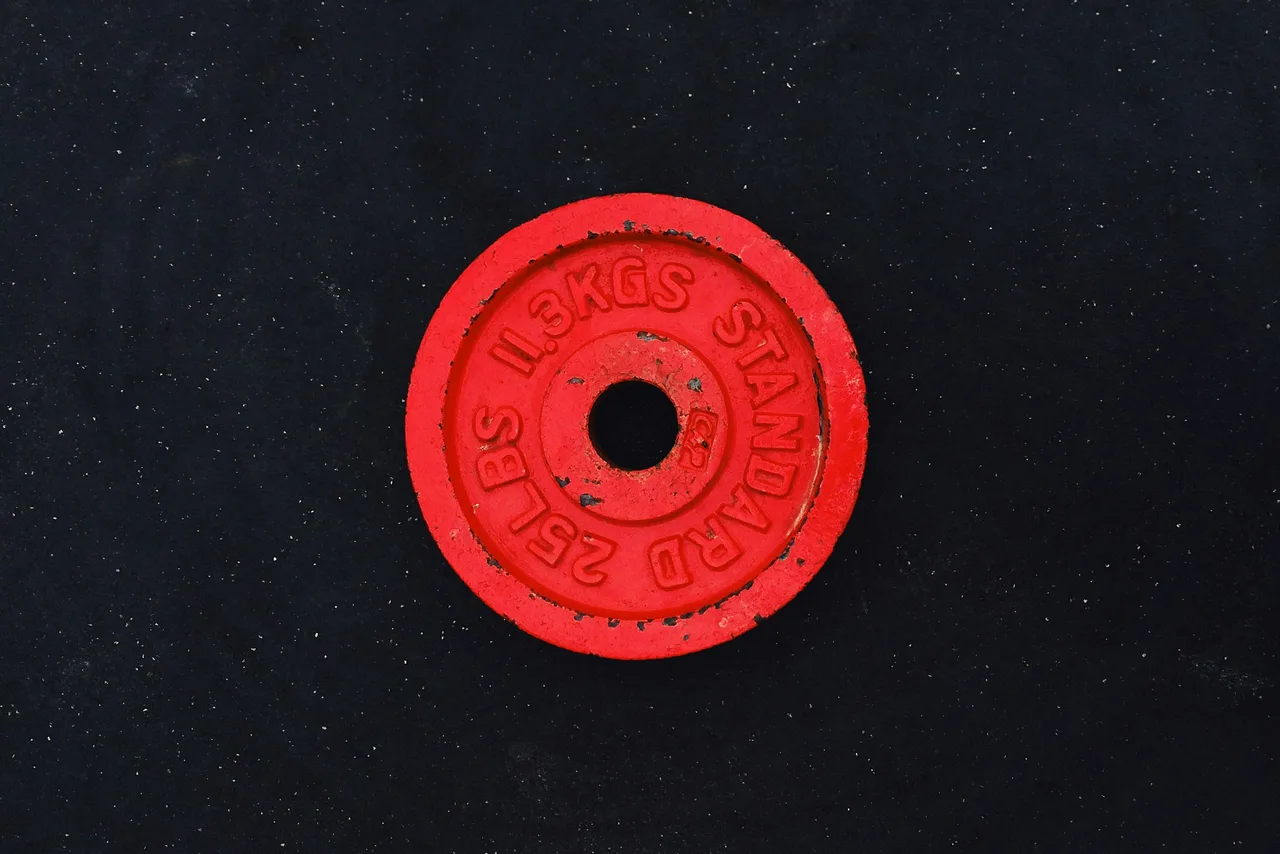
To convert pounds to kilograms, multiply by 0.45359237, and to convert kilograms to pounds, divide by the same number. A body weight of 70 kg is about 154.32 lb, and a 50 lb checked bag is 22.6796185 kg. Single pairs with ready tables are in the pounds to kg converter, the kg to pounds converter and the ounces to grams converter.
Stones and pounds
In the UK and Ireland people still give their body weight in stones and pounds[3]. Of the larger old British units, only the stone survives in everyday use[1]. Type “11 st 6” and the converter reads it as 11 stone and 6 pounds, that is 160 pounds or 72.5747792 kg. The stone to kg converter has a table of whole stones.
How many kilograms and pounds are the most used units?
| Unit | In kilograms | In pounds |
|---|---|---|
| milligram (mg) | 0.000001 kg | about 0.00000220462 lb |
| gram (g) | 0.001 kg | about 0.00220462 lb |
| ounce (oz) | about 0.0283495 kg | 0.0625 lb |
| pound (lb) | about 0.453592 kg | 1 lb |
| kilogram (kg) | 1 kg | about 2.20462 lb |
| stone (st) | about 6.35029 kg | 14 lb |
| tonne (metric ton) | 1,000 kg | about 2,204.62 lb |
What are the metric units of mass?
The base unit of mass in the International System of Units (SI) is the kilogram. Since 2019 it has been defined by fixing the Planck constant at exactly 6.626 070 15 × 10⁻³⁴ J s. Before that, the kilogram was the mass of the international prototype, and the number in the new definition was chosen so that the kilogram stayed the same[4].
The kilogram is the only coherent SI unit whose name already contains a prefix, so multiples and submultiples of mass are formed from the gram: a millionth of a kilogram is a milligram, not a microkilogram[4]. The list has every unit from the quectogram to the quettagram, so a 500 mcg vitamin dose is 0.5 mg, and the field also reads “mcg” and “ug”.
The tonne is not an SI unit, but it's accepted for use with the SI and equals 1,000 kg. The CIPM adopted it in 1879, and some English-speaking countries call it the metric ton[4]. The field reads “t”, “tonne”, “metric ton” and the trade abbreviation “MT”, while “Mt” stays the megatonne. The British act also defines the quintal as 100 kilograms[2].
What are the units of mass from smallest to largest?
| Unit | In kilograms |
|---|---|
| quectogram (qg) | 1 × 10⁻³³ kg |
| rontogram (rg) | 1 × 10⁻³⁰ kg |
| yoctogram (yg) | 1 × 10⁻²⁷ kg |
| zeptogram (zg) | 1 × 10⁻²⁴ kg |
| attogram (ag) | 1 × 10⁻²¹ kg |
| femtogram (fg) | 1 × 10⁻¹⁸ kg |
| picogram (pg) | 1 × 10⁻¹⁵ kg |
| nanogram (ng) | 1 × 10⁻¹² kg |
| microgram (µg) | 1 × 10⁻⁹ kg |
| centigram (cg) | 0.00001 kg |
| decigram (dg) | 0.0001 kg |
| decagram (dag) | 0.01 kg |
| hectogram (hg) | 0.1 kg |
| megagram (Mg) | 1,000 kg |
| gigagram (Gg) | 1,000,000 kg |
| teragram (Tg) | 1,000,000,000 kg |
| petagram (Pg) | 1,000,000,000,000 kg |
| exagram (Eg) | 1 × 10¹⁵ kg |
| zettagram (Zg) | 1 × 10¹⁸ kg |
| yottagram (Yg) | 1 × 10²¹ kg |
| ronnagram (Rg) | 1 × 10²⁴ kg |
| quettagram (Qg) | 1 × 10²⁷ kg |
| metric pound (500 g) | 0.5 kg |
| Zentner (50 kg) | 50 kg |
| quintal (100 kg) | 100 kg |
| kilotonne (kt) | 1,000,000 kg |
| megatonne (Mt) | 1,000,000,000 kg |
| gigatonne (Gt) | 1,000,000,000,000 kg |
Is weight the same as mass?
Not quite. Mass measures how much matter a body contains, while weight is the force that gravity puts on it. In everyday speech weight often means mass, and NIST recommends saying mass whenever mass is meant[1]. This converter works with mass, so it won't take forces in newtons or pounds-force.
A kilogram-force (kgf, also called the kilopond) is the weight of 1 kg under standard gravity of 9.806 65 m/s², exactly 9.806 65 N, and a kip is 1,000 pounds-force[5]. If you type “10 kgf” or “5 kip”, the field says it isn't a unit of mass or weight.
What is the difference between a long ton, a short ton and a metric ton?
The British act builds the larger units from the pound: a quarter is 28 pounds, a hundredweight 112 pounds, a cental 100 pounds and a ton 2,240 pounds[2]. In the United States that ton is called the long ton, and the ordinary US ton, the short ton, is 2,000 pounds[1]. So the long ton (UK) is 1,016.0469088 kg, the short ton (US) is 907.18474 kg, and the metric ton is 1,000 kg.
In the United States and Canada the short ton is the one most commonly used, in Great Britain the long ton, and in metric countries the metric ton[1]. Ship displacement is traditionally given in long tons[6]. Hundredweights follow the same split: 112 pounds in the UK, 100 pounds in the US, where the short hundredweight is still used in selling livestock and some grains[7]. The abbreviation “cwt” sets the short hundredweight and notes below the field that the UK one is on the list too.
The slug is a unit of mass in the British imperial and US customary systems: it's the mass that one pound-force accelerates at one foot per second squared[8], about 14.5939 kg[5].
How many pounds and kilograms are the imperial and US units?
| Unit | In pounds | In kilograms |
|---|---|---|
| grain (gr) | about 0.000142857 lb | about 0.0000647989 kg |
| dram (avoirdupois) | 0.00390625 lb | about 0.00177185 kg |
| quarter (28 lb) | 28 lb | about 12.7006 kg |
| long hundredweight (UK) | 112 lb | about 50.8023 kg |
| long ton (UK) | 2,240 lb | about 1,016.05 kg |
| short hundredweight (US) | 100 lb | about 45.3592 kg |
| short ton (US) | 2,000 lb | about 907.185 kg |
| slug | about 32.174 lb | about 14.5939 kg |
How many grams are in a troy ounce, a carat and a grain?
Jewelers, mints and pharmacists have their own units, and their ounce is heavier than the kitchen one. The troy ounce is 31.1034768 g[2], about 10% more than an ordinary ounce, and gold, silver and platinum prices are quoted per troy ounce. The troy pound has 12 troy ounces[1], and a pennyweight is 24 grains[2]. Britain abolished the troy pound on January 6, 1879 and kept only the troy ounce and its subdivisions, while in the US the troy pound is still legal but seldom used[1].
The apothecaries' system shares the troy ounce and divides it into 8 drachms of 3 scruples each[2]. That's why “1 drachm” in the field sets the dram (apothecaries'), while “1 dram” sets the avoirdupois dram, a sixteenth of an ordinary ounce, and notes that there are two.
Carats and points
The carat is 0.2 g. Its name goes back to the carob seed, and the carat was later standardized at 1/444 ounce and then 0.2 gram[1]. The United States adopted the metric carat on July 1, 1913 and the United Kingdom on April 1, 1914, and a carat divides into 100 points[9], so a 50-point diamond weighs half a carat. Pearls were also weighed in pearl grains of a quarter carat[10]. Karats of gold are a different thing: they give purity, not weight, so the field answers “18 karat” with a note that it isn't a unit of mass.
Grains
The grain is the oldest unit of mass and the smallest in the avoirdupois, troy and apothecaries' systems. It started as a grain of wheat or barley used to weigh silver and gold[1]. Today it's 64.79891 mg, because a pound is exactly 7,000 grains, and the troy ounce has 480 grains[1]. Grains are commonly used for the weight of bullets and propellant, and archers weigh arrows in them[10]. The field reads “gr” as the grain, and the grains to grams converter has a ready table.
How many grams are the troy, apothecaries' and gemstone units?
| Unit | In grams | In grains |
|---|---|---|
| scruple (apothecaries') | about 1.29598 g | 20 gr |
| pennyweight (dwt) | about 1.55517 g | 24 gr |
| dram (apothecaries') | about 3.88793 g | 60 gr |
| troy ounce (oz t) | about 31.1035 g | 480 gr |
| troy pound (lb t) | about 373.242 g | 5,760 gr |
| point (1/100 carat) | 0.002 g | about 0.0308647 gr |
| pearl grain (1/4 carat) | 0.05 g | about 0.771618 gr |
| carat (ct) | 0.2 g | about 3.08647 gr |
How heavy is a pood, a Pfund and a Zentner?
Before the metric system each European country weighed in its own pounds. The Russian funt was 409.512 g, divided into 32 lots, 96 zolotniks and 9,216 doli[11], and a pood was 40 funts[12]. Russian kettlebells were traditionally measured in poods of about 16.38 kg[13], and a 16 kg kettlebell is one pood rounded to a whole kilogram[12]. The converter counts the pood as about 16.3805 kg.
In Germany the word Pfund still means half a kilogram in a shop: in 1854 the German Customs Union fixed the pound at exactly 500 grams[14]. A Zentner is 50 kg in Germany but 100 kg in Austria and Switzerland[15]. The old Vienna pound was about 560 g[14], and the Bohemian centner held 120 pounds of 0.513 kg, 61.6 kg in all[16]. Poland's old centner was 160 pounds, about 64.8 kg[17].
France weighed in the Paris livre of about 489.5 g, divided into 16 ounces[18]. In Spain an arroba was 25 Castilian pounds, about 11.5 kg, while in Colombia half a kilogram is called a libra, which makes the arroba 12.5 kg there[19]. Portugal and Brazil rounded the arroba to 15 kg[20], and Brazil still weighs cattle in it[19]. Venice used two pounds, a light libbra sottile and a heavy libbra grossa, each divided into 12 ounces[21].
How many kilograms were the old European units?
| Unit | In kilograms | Where and when |
|---|---|---|
| Old Polish lut | about 0.01266 kg | Crown of Poland, 1/32 pound |
| New Polish lut | about 0.012672 kg | Congress Poland, 1819–1849 |
| New Polish ounce | about 0.025344 kg | Congress Poland, 1819–1849 |
| Old Polish mark (grzywna) | about 0.2026 kg | Crown of Poland, half a pound |
| Old Polish pound (funt) | about 0.4052 kg | Crown of Poland, 1565–1819 |
| New Polish pound | about 0.405504 kg | Congress Poland, 1819–1849 |
| New Polish stone | about 10.138 kg | Congress Poland, 25 pounds |
| Old Polish stone (kamień) | about 12.967 kg | Crown of Poland, 32 pounds |
| New Polish hundredweight | about 40.55 kg | Congress Poland, 100 pounds |
| Old Polish hundredweight (cetnar) | about 64.84 kg | Crown of Poland, 160 pounds |
| dolya | about 0.0000444349 kg | Russia, 1/96 zolotnik |
| zolotnik | about 0.00426575 kg | Russia, 1/96 funt |
| Russian lot | about 0.0127973 kg | Russia, 3 zolotniks |
| Russian pound (funt) | about 0.409512 kg | Russian Empire |
| pood | about 16.3805 kg | Russia, 40 funts |
| berkovets | about 163.805 kg | Russia, 10 poods |
| Cologne mark | about 0.233811 kg | Holy Roman Empire, weight for coinage |
| Nuremberg apothecaries' pound | about 0.358 kg | pharmacies in German lands |
| Prussian pound | about 0.467711 kg | Prussia, 1816–1858 |
| Prussian hundredweight (Zentner) | about 51.4482 kg | Prussia, 110 pounds |
| Viennese quentchen (1/4 lot) | about 0.0043751 kg | Austria, until 1876 |
| Viennese lot | about 0.0175 kg | Austria, until 1876 |
| Viennese mark | about 0.280668 kg | Austria, until 1876 |
| Viennese apothecaries' pound | about 0.420045 kg | pharmacies in Austria |
| Viennese pound (Pfund) | about 0.56001 kg | Austria, until 1876 |
| Viennese hundredweight (Zentner) | about 56.001 kg | Austria, 100 pounds |
| Bohemian pound (libra) | about 0.513 kg | Bohemia, 1/120 hundredweight |
| Bohemian hundredweight (centnýř) | about 61.56 kg | Bohemia, 120 pounds |
| Swedish pound (skålpund) | about 0.425 kg | Sweden, until 1889 |
| French grain (Paris) | about 0.0000531148 kg | France, until 1799 |
| gros (Paris) | about 0.00382427 kg | France, until 1799 |
| French ounce (once) | about 0.0305941 kg | France, until 1799 |
| French mark (marc) | about 0.244753 kg | France, until 1799 |
| Paris pound (livre) | about 0.489506 kg | France, until 1799 |
| French quintal (100 livres) | about 48.9506 kg | France, until 1799 |
| Castilian ounce (onza) | about 0.0287558 kg | Spain, until 1849 |
| Castilian apothecaries' pound | about 0.34506975 kg | pharmacies in Spain, 12 ounces |
| Castilian pound (libra) | about 0.460093 kg | Spain and Spanish America |
| Castilian arroba | about 11.5023 kg | Spain, 25 pounds |
| Colombian arroba (12.5 kg) | 12.5 kg | Colombia and Ecuador |
| Castilian quintal | about 46.0093 kg | Spain, 100 pounds |
| Portuguese ounce (onça) | about 0.0287 kg | Portugal |
| arrátel (Portuguese pound) | about 0.459 kg | Portugal and Brazil |
| Portuguese arroba (32 arráteis) | about 14.7 kg | Portugal and Brazil, before the metric system |
| arroba (15 kg) | 15 kg | Brazil and Portugal, cattle and cork |
| Portuguese quintal | about 58.8 kg | Portugal, 4 arrobas |
| Venetian light pound (libbra sottile) | about 0.30123 kg | Venice |
| Neapolitan pound (libbra) | about 0.320759 kg | Naples |
| Milanese small pound (libbra piccola) | about 0.326793 kg | Milan |
| Papal Roman pound (libbra romana) | about 0.339072 kg | Rome, Papal States |
| Tuscan pound (libbra) | about 0.3395 kg | Tuscany |
| Venetian heavy pound (libbra grossa) | about 0.476999 kg | Venice |
| Milanese heavy pound (libbra grossa) | about 0.762517 kg | Milan |
| rotolo (Naples) | about 0.890997 kg | Naples, from 1840 |
| cantaro (Naples) | about 89.0997 kg | Naples, 100 rotoli |
How many grams are in a tola, a tael and a catty?
The tola is 180 grains, 11.6638038 g. It was the base of the British Indian weights and the standard measure for gold and silver bullion, and although India replaced it with metric units in 1956, gold bars are still sold in tolas in Bangladesh, India, Nepal, Pakistan and Singapore, most often as ten-tola bars[22]. The seer and the maund were larger Indian trade units built on the tola.
In Hong Kong the catty is 604.78982 g and the tael is a sixteenth of it[23], about 37.8 g. In China the jin has been half a kilogram since 1929, when it held 16 liang[24], and in 1959 the government of the People's Republic ordered it to be divided into 10 liang[25], so a liang is now 50 g.
Japan's Weights and Measures Act of 1891 set the kan at 3.75 kg, exactly 1,000 momme[26]. A momme is therefore 3.75 g, and it's still a recognized unit in the international pearl trade[27].
How many grams are the Indian, Chinese and Japanese units?
| Unit | In grams | Where and when |
|---|---|---|
| tola | about 11.6638 g | India and South Asia, gold |
| seer | about 933.104 g | India, 80 tolas |
| maund | about 37,324.2 g | India, 40 seers |
| mace (錢) | about 3.77994 g | Hong Kong |
| qian (钱) | 5 g | China, since 1959 |
| liang (两, 1/16 jin) | 31.25 g | China, 1929–1959 |
| tael (兩) | about 37.7994 g | Hong Kong, gold |
| liang (两) | 50 g | China, since 1959 |
| jin (斤) | 500 g | China, since 1929 |
| catty (斤) | about 604.79 g | Hong Kong |
| dan (担) | 50,000 g | China, 100 jin |
| picul (擔) | about 60,479 g | Hong Kong, 100 catties |
| fun (分) | 0.375 g | Japan, 1/10 momme |
| momme (匁) | 3.75 g | Japan, pearl trade |
| kin (斤) | 600 g | Japan, 160 momme |
| kan (貫) | 3,750 g | Japan, 1891 law |
How much does the Earth, the Sun and an atom weigh?
Astronomers often give the mass of planets and stars in Earth masses, Jupiter masses or solar masses. According to NASA the Earth is 5.9722 × 10²⁴ kg, the Moon 7.346 × 10²² kg and the Sun 1.9884 × 10³⁰ kg[28]. That makes the Sun about 332,943 Earth masses and Jupiter about 317.8.
At the other end of the scale is the dalton (atomic mass unit), a twelfth of the mass of a carbon-12 atom. The dalton (Da) and the unified atomic mass unit (u) are two names for the same unit, 1.66053906892 × 10⁻²⁷ kg[4], and the field also reads “amu”. The list also has the electron, proton and neutron masses from CODATA 2022[29].
How many kilograms are the astronomical and physics units?
| Unit | In kilograms |
|---|---|
| Moon mass | about 7.346 × 10²² kg |
| Earth mass (M⊕) | about 5.9722 × 10²⁴ kg |
| Jupiter mass (Mᴊ) | about 1.89813 × 10²⁷ kg |
| solar mass (M☉) | about 1.9884 × 10³⁰ kg |
| electron mass (mₑ) | about 9.1093837139 × 10⁻³¹ kg |
| dalton (atomic mass unit) | about 1.66053906892 × 10⁻²⁷ kg |
| proton mass (mₚ) | about 1.67262192595 × 10⁻²⁷ kg |
| neutron mass (mₙ) | about 1.67492750056 × 10⁻²⁷ kg |
| Planck mass | about 2.176434 × 10⁻⁸ kg |
How heavy were the Roman pound, the drachma and the deben?
The Babylonians and Sumerians had 60 shekels in a mina and 60 minas in a talent, and the pound derives from the mina of ancient civilizations[1]. The Roman pound (libra) was divided into 12 ounces[1], and the converter counts it as about 329 g[30]. The Attic drachma, a hundredth of the Attic mina, is about 4.31 g[31]. Egypt weighed in debens, about 13.6 g in the Old and Middle Kingdoms and about 91 g in the New Kingdom[32].
How many grams were the ancient units?
| Unit | In grams | Where and when |
|---|---|---|
| siliqua | about 0.19 g | ancient Rome, 1/1728 libra |
| Roman scruple (scripulum) | about 1.14 g | ancient Rome, 1/288 libra |
| Roman ounce (uncia) | about 27.4 g | ancient Rome, 1/12 libra |
| Roman pound (libra) | about 329 g | ancient Rome |
| Attic obol | about 0.718 g | ancient Athens, 1/6 drachma |
| Attic drachma | about 4.31 g | ancient Athens |
| Attic mina | about 431 g | ancient Athens, 100 drachmae |
| Attic talent | about 25,900 g | ancient Athens, 60 minas |
| kite (qedet) | about 9.1 g | ancient Egypt, 1/10 deben |
| deben | about 91 g | ancient Egypt, New Kingdom |
| Mesopotamian grain (še) | about 0.047 g | Mesopotamia, 1/180 shekel |
| Mesopotamian shekel | about 8.4 g | Mesopotamia |
| Mesopotamian mina | about 500 g | Mesopotamia, 60 shekels |
| Mesopotamian talent | about 30,000 g | Mesopotamia, 60 minas |
How much did a shekel and a talent weigh in the Bible?
The shekel is the basic unit of weight in the Bible. Stone weights found by archaeologists average about 11.3 g, with a spread of 11–13 g[33]. Exodus calls the shekel twenty gerahs and the half shekel a bekah (Exodus 30:13; 38:26)[34]. The converter counts the biblical shekel as about 11.3 g and shows the range from the sources below the fields.
A talent was 3,000 shekels, about 34 kg[33]. Exodus shows the ratio: the silver from 603,550 men at half a shekel each came to a hundred talents and 1,775 shekels (Exodus 38:25–26)[34], and the NIV footnote puts the hundred talents at about 3.4 metric tons[35]. The 666 talents of gold Solomon received each year (1 Kings 10:14) are about 22.6 t in the converter, and Absalom's hair, cut once a year, weighed 200 shekels (2 Samuel 14:26), about 2.26 kg[35].
The mina was 50 shekels in Palestine, about 565 g, and 60 shekels in Babylonia[33]. Ezekiel 45:12 adds up “twenty shekels, five and twenty shekels, fifteen shekels” to a maneh, which is 60[34], and the NIV footnote notes that the common mina was 50 shekels[35]. The converter counts the biblical mina (maneh) as 50 shekels, about 565 g.
How many grams are the biblical weights?
| Unit | In grams | Where and when |
|---|---|---|
| gerah | about 0.565 g | Exodus 30:13, 1/20 shekel |
| bekah (half shekel) | about 5.65 g | Exodus 38:26 |
| biblical shekel | about 11.3 g | Old Testament |
| biblical mina (maneh) | about 565 g | Old Testament, 50 shekels |
| biblical talent | about 33,900 g | Exodus 38:25, 3,000 shekels |
What can you type in the Convert from field?
| What you type | Unit below the Convert from field | Result in the Convert to field | How we read it |
|---|---|---|---|
| 12 | kilogram (kg) | 26.4554714621853 lb | A number without a unit counts in the unit set below the field, here kilograms. |
| 2.5 | kilogram (kg) | 5.51155655462194 lb | The point is the decimal separator, so this is two and a half kilograms. |
| 1,500 | kilogram (kg) | 3,306.93393277316 lb | A comma followed by three digits separates thousands, so the field holds one thousand five hundred kilograms. A line below the field says “Read as 1500. If you meant 1.5, type 1.5.” |
| 2,5 | kilogram (kg) | 5.51155655462194 lb | A comma followed by one or two digits is a decimal comma, as in most of Europe, so this is two and a half kilograms. |
| 3/4 | kilogram (kg) | 1.65346696638658 lb | The field calculates a fraction as it is written, so this is three quarters of a kilogram. |
| 1 1/2 | kilogram (kg) | 3.30693393277316 lb | The field reads a whole number with a fraction as one and a half. |
| 1e3 | kilogram (kg) | 2,204.62262184878 lb | The field reads scientific notation from a spreadsheet as one thousand. |
| 150 lbs | pound (lb) | 150 lb | The plural abbreviation from US labels sets the pound. |
| 5 lb 3 oz | pound (lb) | 5.1875 lb | The field turns pounds and ounces into 5.1875 pounds, because an ounce is a sixteenth of a pound. |
| 11 st 6 | pound (lb) | 160 lb | The field reads a UK body weight as 11 stone and 6 pounds and sets the pound, so it holds 160 pounds. |
| 5 MT | tonne (metric ton) | 11,023.1131092439 lb | The trade abbreviation for metric tons sets the tonne. |
| 150 gr | grain (gr) | 0.0214285714285714 lb | The field reads “gr” as grains, as on boxes of ammunition. |
Sources
- Handbook 44 (2025), Appendices B and C — National Institute of Standards and Technology
- Weights and Measures Act 1985, Schedule 1 — legislation.gov.uk
- Stone (unit) — Wikipedia
- The International System of Units (SI), 9th edition — Bureau International des Poids et Mesures
- Special Publication 811 (2008), Guide for the Use of the International System of Units, Appendix B — National Institute of Standards and Technology
- Ton — Wikipedia
- Hundredweight — Wikipedia
- Slug (unit) — Wikipedia
- Carat (mass) — Wikipedia
- Grain (unit) — Wikipedia
- Фунт, Brockhaus and Efron Encyclopedic Dictionary (Russian version) — Wikisource
- Pood — Wikipedia
- Kettlebell — Wikipedia
- Pfund (German version) — Wikipedia
- Zentner (German version) — Wikipedia
- A. Tejnor, “Není cent jako cent”, Naše řeč 49 (1966), no. 3, pp. 187–188 (Czech version, archived copy) — Czech Language Institute, Czech Academy of Sciences
- cetnar, Encyklopedia PWN (Polish version, archived copy) — Wydawnictwo Naukowe PWN
- Livre (unité) (French version) — Wikipedia
- Arroba (unidad de masa) (Spanish version) — Wikipedia
- Arroba (Portuguese version) — Wikipedia
- Antiche unità di misura della provincia di Venezia (Italian version) — Wikipedia
- Tola (unit) — Wikipedia
- Weights and Measures Ordinance, Cap. 68 — Historical Laws of Hong Kong Online
- 度量衡法, Weights and Measures Act of 1929 (Chinese version) — Wikisource
- State Council order of June 25, 1959 on unifying the measurement system (Chinese version) — Wikisource
- 度量衡法, Weights and Measures Act of 1891 (Japanese version) — Wikisource
- Japanese units of measurement — Wikipedia
- Planetary Fact Sheets — NASA, National Space Science Data Center
- CODATA 2022: electron mass, proton mass, neutron mass — National Institute of Standards and Technology
- Ancient Roman units of measurement — Wikipedia
- Ancient Greek units of measurement — Wikipedia
- Ancient Egyptian units of measurement — Wikipedia
- M. Winkler, “Maße / Gewichte (AT)”, WiBiLex, 2016 (German version) — Deutsche Bibelgesellschaft
- King James Version: Exodus 30:13; 38:25–26; Ezekiel 45:12 — Bible Gateway
- New International Version with footnotes: Exodus 38:25; Ezekiel 45:12; 1 Kings 10:14; 2 Samuel 14:26; Matthew 25:15 — Bible Gateway
- Pound (mass) — Wikipedia
Every figure in the tables was computed from the unit definitions and checked arithmetically before publication. Historical values and the names of local units come from the sources listed above.
Content last reviewed: · written and checked by the Arteon team
Frequently asked questions about units of weight
How much does a cup of flour weigh?
It depends on what is in the cup, because a cup measures volume and different ingredients have different densities: a cup of flour weighs less than a cup of sugar or water. This converter only works with mass, so if you type “1 cup”, the field says it is not a unit of mass or weight.
How much is a talent worth today?
That depends on the metal and its price on the day. The converter gives the weight: a talent of about 34 kg is about 1,090 oz t, so multiply that number by the price per troy ounce. In the parable of the talents (Matthew 25:15) the NIV translates the word as “bags of gold” and adds in a footnote that a talent was worth about 20 years of a day laborer's wage[35].
Why is the pound abbreviated lb?
The abbreviation comes from the Latin word libra, the Roman pound[36]. In the plural it's also written “lbs”, and the converter accepts both, as well as the # sign.
Have a question or a suggestion?
If a unit is missing or a value looks wrong to you, write to us. The source of the information helps us most.