Speed Unit Converter – Check All 33 Units
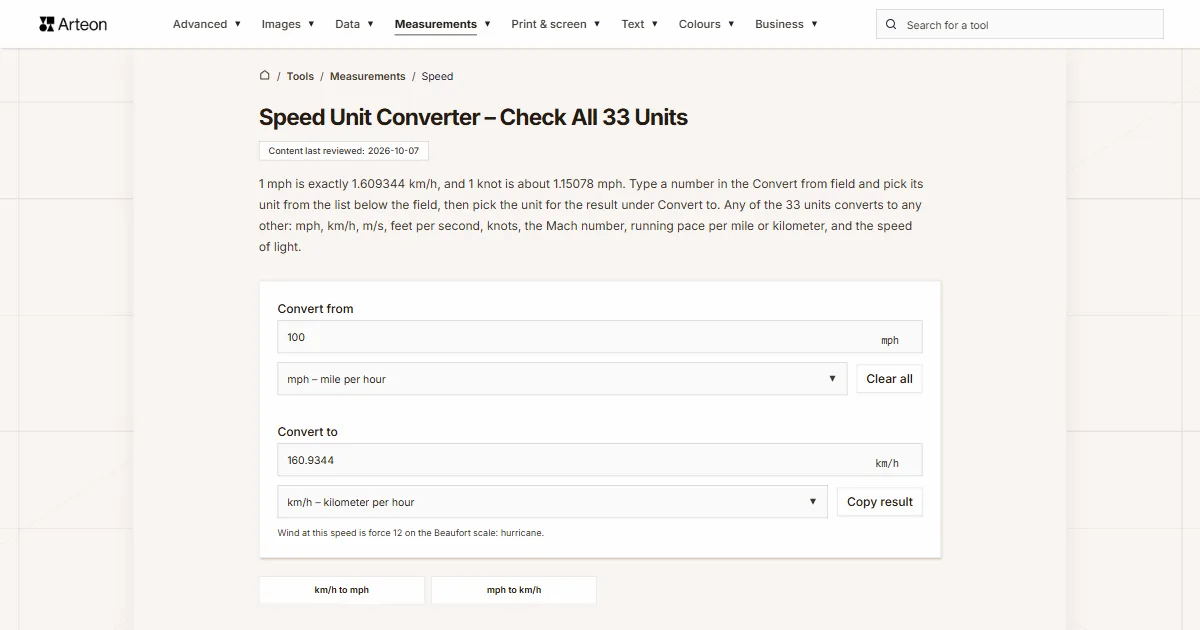
1 mph is exactly 1.609344 km/h, and 1 knot is about 1.15078 mph. Type a number in the Convert from field and pick its unit from the list below the field, then pick the unit for the result under Convert to. Any of the 33 units converts to any other: mph, km/h, m/s, feet per second, knots, the Mach number, running pace per mile or kilometer, and the speed of light.
How do I convert units of speed?
Type a number in the Convert from field and pick its unit from the list below the field, then pick the unit you want under Convert to. The result appears as you type. It works the other way round too: type a number in the Convert to field and the converter fills in the first one.
Both lists hold the same 33 units in 8 groups: Most used, Metric (SI), Metric per minute, hour and day, Imperial and US customary, Nautical and aviation, Running, swimming and rowing pace, Physics and astronomy, Unusual. You don't have to look for a unit in the list. Type it with the number, for example “70 mph”, “100 kph”, “25 kt” or “Mach 0.85”, and the converter sets the unit next to the field and tells you below it which one it chose.
Type a running pace the way your watch shows it: “8:30”, “8'30"” or “8 min 30 s”. In a field set to another unit, such as mph, the converter reads this as minutes per mile, and it shows results in a pace unit as minutes and seconds.
When the Mach number is set at either field, the Air temperature for the Mach number field appears below the fields, because the speed of sound depends on temperature. It starts at 15 °C (59 °F) and takes degrees Celsius from −90 to 60.
Below the result, the converter also gives the force on the Beaufort scale, that is, how strong a wind at this speed would be. Pace units don't get this line. The Copy result button copies the number from the Convert to field, and Clear all empties both fields.
How many km/h is 1 mph?
Miles per hour (mph) is the speed unit of the United Kingdom, the United States and a number of smaller countries[1]. A mile is exactly 1,609.344 m, so 1 mph is exactly 1.609344 km/h[2], and 1 km/h is about 0.621371 mph. To go from mph to km/h in your head, multiply by 1.6, and to go back, multiply by 0.62. Single pairs with their own tables are in the mph to km/h converter and the km/h to mph converter.
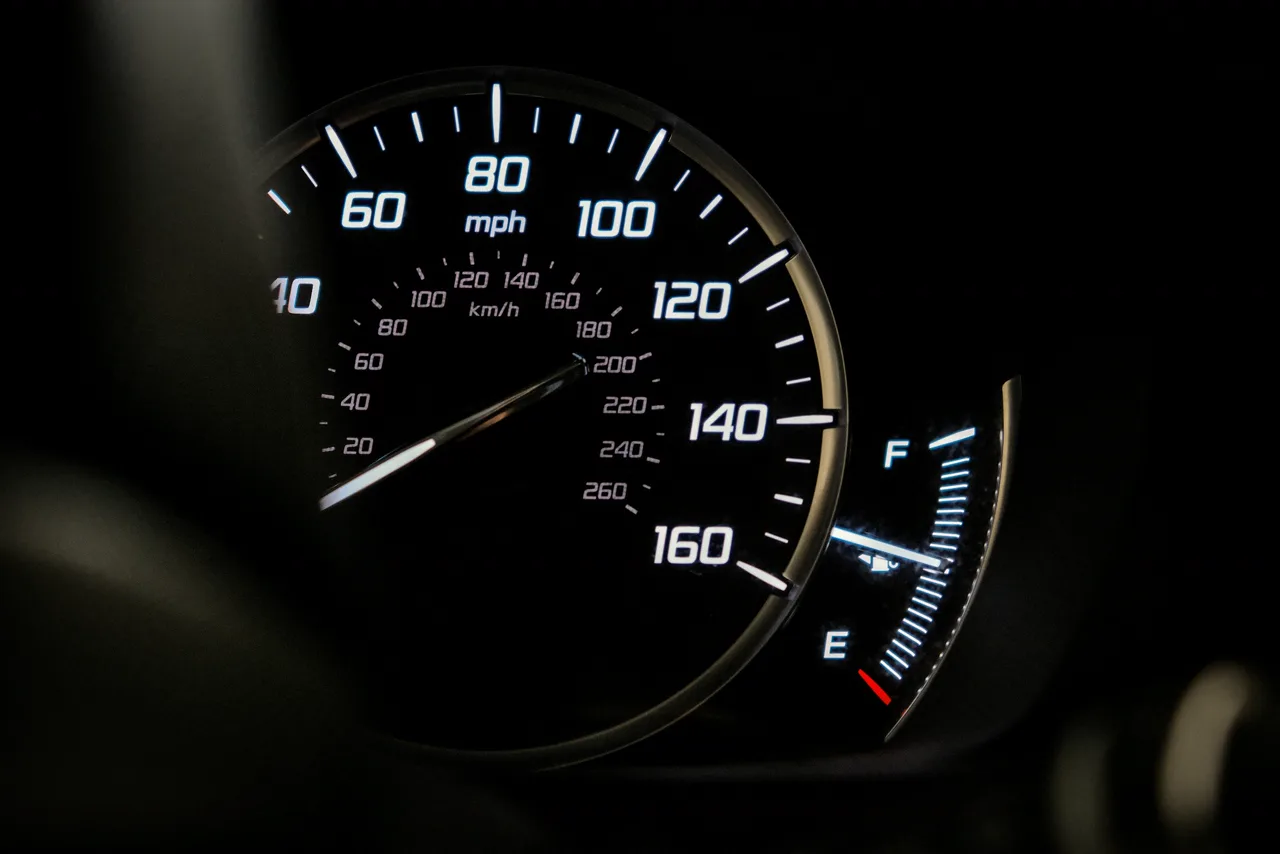
Meters per second show how far you travel in each second. A car at 70 mph covers about 31.3 m every second, and at 30 mph about 13.4 m. In feet, 60 mph is exactly 88 ft/s, because a mile has 5,280 feet and an hour 3,600 seconds.
How many mph, km/h and m/s are the most used speed units?
| Unit | In mph | In km/h | In m/s |
|---|---|---|---|
| meter per second (m/s) | about 2.23694 mph | 3.6 km/h | 1 m/s |
| kilometer per hour (km/h) | about 0.621371 mph | 1 km/h | about 0.277778 m/s |
| mile per hour (mph) | 1 mph | about 1.60934 km/h | 0.44704 m/s |
| knot (kn) | about 1.15078 mph | 1.852 km/h | about 0.514444 m/s |
| minute per kilometer (running pace) | about 37.2823 mph | 60 km/h | about 16.6667 m/s |
| minute per mile (running pace) | 60 mph | about 96.5606 km/h | 26.8224 m/s |
Which imperial and US speed units does the converter know?
All units of this group come from the foot (0.3048 m), the inch (2.54 cm), the yard (0.9144 m) and the mile[2]. The foot per second (ft/s, also written fps) is exactly 1.09728 km/h or about 0.681818 mph. In machining, US shops give cutting speed in surface feet per minute (SFM) and feed rate in inches per minute (ipm)[3], which is why the list has the foot per minute and the inch per minute. It also has the foot per hour, the foot per day, the inch per second, the inch per hour, the yard per second, the mile per minute and the mile per second.
How many mph and km/h are the imperial and US units?
| Unit | In mph | In km/h |
|---|---|---|
| foot per day (ft/d) | about 0.00000789141 mph | 0.0000127 km/h |
| inch per hour (in/h) | about 0.0000157828 mph | 0.0000254 km/h |
| foot per hour (ft/h) | about 0.000189394 mph | 0.0003048 km/h |
| inch per minute (in/min) | about 0.00094697 mph | 0.001524 km/h |
| foot per minute (ft/min) | about 0.0113636 mph | 0.018288 km/h |
| inch per second (in/s) | about 0.0568182 mph | 0.09144 km/h |
| foot per second (ft/s) | about 0.681818 mph | 1.09728 km/h |
| yard per second (yd/s) | about 2.04545 mph | 3.29184 km/h |
| mile per minute (mi/min) | 60 mph | about 96.5606 km/h |
| mile per second (mi/s) | 3,600 mph | about 5,793.64 km/h |
How do I convert m/s to km/h?
A kilometer has 1,000 meters and an hour 3,600 seconds, so 1 m/s is exactly 3.6 km/h, and 1 km/h is about 0.277778 m/s. Multiply m/s by 3.6 to get km/h, and divide km/h by 3.6 to get m/s. A wind of 10 m/s blows at exactly 36 km/h, or about 22.4 mph.
The meter per second is the SI unit of speed, and the list also has the millimeter per second, the centimeter per second and the kilometer per second. The minute, the hour and the day are not SI units, but the International Bureau of Weights and Measures lists them among the units accepted for use with the SI[4]. That is why the meter per minute, the millimeter per minute, the kilometer per minute, the millimeter per hour and the meter per day sit next to km/h. Metric machining gives cutting speed in meters per minute and milling feed in millimeters per minute[3]: a feed of 600 mm/min is 10 mm/s.
Rain rate is measured in millimeters per hour, or in inches per hour in countries where imperial units are more common[5], and 1 in/h is exactly 25.4 mm/h. Hydrogeologists give hydraulic conductivity, which shows how easily water seeps through soil or rock, in units such as meters per day or feet per day[6].
How many m/s and mph are the metric units?
| Unit | In m/s | In mph |
|---|---|---|
| millimeter per second (mm/s) | 0.001 m/s | about 0.00223694 mph |
| centimeter per second (cm/s) | 0.01 m/s | about 0.0223694 mph |
| kilometer per second (km/s) | 1,000 m/s | about 2,236.94 mph |
| millimeter per hour (mm/h) | 2.77777777777778 × 10⁻⁷ m/s | 6.21371192237334 × 10⁻⁷ mph |
| meter per day (m/d) | about 0.0000115741 m/s | about 0.0000258905 mph |
| millimeter per minute (mm/min) | about 0.0000166667 m/s | about 0.0000372823 mph |
| meter per minute (m/min) | about 0.0166667 m/s | about 0.0372823 mph |
| kilometer per minute (km/min) | about 16.6667 m/s | about 37.2823 mph |
How many mph is a knot?
A knot is one nautical mile per hour, exactly 1.852 km/h or about 1.15078 mph. It is used in meteorology and in maritime and air navigation. The ISO symbol is kn, while kt is common too, especially in aviation, where the International Civil Aviation Organization recommends it[7]. The converter reads kn, kt and kts. The length of the nautical mile, 1,852 m, was set by an international hydrographic conference in 1929[4], and the US adopted it in 1954, after using its own nautical mile of 1,853.248 m[7].
The name comes from the chip log, which measured a ship's speed until the mid-19th century. Sailors let a line with knots tied 47 feet 3 inches apart run out over the stern and counted the knots that passed through their fingers while a 28-second sandglass ran[7]. That spacing over 28 seconds is about 0.514 m/s, almost exactly one knot as defined today.
The admiralty knot is based on the British Admiralty mile of 6,080 feet, which Britain used until 1970[8]. It is about 1.85318 km/h, less than a thousandth faster than today's knot. The US knot follows that older US nautical mile and is exactly 1.853248 km/h.
How fast is Mach 1 in mph?
The Mach number is the ratio of a speed to the local speed of sound, so it has no unit. It is named after the Austrian physicist Ernst Mach, after a proposal by the aeronautical engineer Jakob Ackeret in 1929[9]. At Mach 1 an aircraft flies at the speed of sound, and at Mach 1.35 it is 35% faster than sound[9], so the converter keeps the Mach number in the list with the units.
The speed of sound in air depends on temperature[9]. The converter calculates it with the formula and constants of the 1976 US Standard Atmosphere[10]. At 15 °C (59 °F), the standard temperature at sea level, it is about 340.294 m/s, so Mach 1 is about 761.216 mph or 1,225.06 km/h. Between 11 and 20 km of altitude the standard atmosphere stays at −56.5 °C (−69.7 °F)[10], and there Mach 1 is only about 660.052 mph. The often quoted 343 m/s, or about 767 mph, is the speed of sound at 20 °C (68 °F)[11], and for that temperature the converter gives 767.792 mph.
If you know the temperature at flight altitude, type it in the Air temperature for the Mach number field in degrees Celsius. The line below the fields then gives the speed of sound the converter uses.
How fast is Mach 1 at different temperatures?
| Air temperature | In mph | In km/h | In knots |
|---|---|---|---|
| −56.5 °C (−69.7 °F) | approx. 660.052 mph | approx. 1,062.25 km/h | approx. 573.569 kn |
| −40 °C (−40 °F) | approx. 684.725 mph | approx. 1,101.96 km/h | approx. 595.01 kn |
| −20 °C (−4 °F) | approx. 713.49 mph | approx. 1,148.25 km/h | approx. 620.006 kn |
| 0 °C (32 °F) | approx. 741.138 mph | approx. 1,192.75 km/h | approx. 644.032 kn |
| 15 °C (59 °F) | approx. 761.216 mph | approx. 1,225.06 km/h | approx. 661.479 kn |
| 20 °C (68 °F) | approx. 767.792 mph | approx. 1,235.64 km/h | approx. 667.193 kn |
| 30 °C (86 °F) | approx. 780.778 mph | approx. 1,256.54 km/h | approx. 678.477 kn |
| 40 °C (104 °F) | approx. 793.551 mph | approx. 1,277.1 km/h | approx. 689.577 kn |
How do I convert running pace to mph?
Pace tells you how many minutes you need for a mile or a kilometer, so it is speed turned upside down: the faster you run, the smaller the number. Divide 60 by your pace in minutes to get mph. A pace of 8:00 per mile is 7.5 mph, and 6 mph on a treadmill is a pace of 10:00 min/mi.
A marathon is 42.195 km, about 26.22 miles[12], so at 8:00 per mile it takes 3:29:45. If a race or a training plan gives pace per kilometer, convert it with the minute per kilometer (running pace): 8:00 per mile is about 4:58 per kilometer.
Swimmers time themselves per 100 meters or per 100 yards. On a rowing machine, the standard measure of speed is the split, the time in minutes and seconds needed to cover 500 m[13]. A split of 2:00 is 15 km/h or about 9.321 mph.
What is an 8-minute mile in mph, and how long is the marathon?
| Pace per mile | In mph | Pace per kilometer | Marathon time |
|---|---|---|---|
| 6:00 min/mi | 10 mph | 3:44 min/km | 2:37:19 |
| 7:00 min/mi | about 8.571 mph | 4:21 min/km | 3:03:32 |
| 8:00 min/mi | 7.5 mph | 4:58 min/km | 3:29:45 |
| 9:00 min/mi | about 6.667 mph | 5:36 min/km | 3:55:58 |
| 10:00 min/mi | 6 mph | 6:13 min/km | 4:22:11 |
| 11:00 min/mi | about 5.455 mph | 6:50 min/km | 4:48:24 |
| 12:00 min/mi | 5 mph | 7:27 min/km | 5:14:38 |
How many mph and km/h are the pace units?
| Unit | In mph | In km/h |
|---|---|---|
| minute per 100 m (swim pace) | about 3.72823 mph | 6 km/h |
| minute per 100 yd (swim pace) | about 3.40909 mph | 5.4864 km/h |
| minute per 500 m (rowing split) | about 18.6411 mph | 30 km/h |
How many mph is each Beaufort force?
The Beaufort scale describes wind strength in forces from 0 to 12. The converter works out the force from the speed in meters per second, using the limits of the World Meteorological Organization (WMO): force 1 starts at 0.3 m/s, force 5 at 8.0 m/s and force 12 at 32.7 m/s[14]. The limits have one decimal place, so the converter rounds the speed to 0.1 m/s and gives the force and its name below the result. The names come from the WMO table, though the Met Office calls force 9 a severe gale instead of a strong gale[15]. A wind of 30 mph is about 13.411 m/s, or 13.4 when rounded, so the converter shows the line “Wind at this speed is force 6 on the Beaufort scale: strong breeze” below the result.
Tables in knots, such as the Met Office one, set their own limits in whole knots, for example force 5 from 17 knots[15], so at the edge of a force they can give the neighboring one: 16 knots is about 8.23 m/s, which the converter counts as force 5, while the Met Office table still has it as force 4. The km/h column of the WMO table gives whole kilometers per hour and can differ in the same way: 12 km/h is about 3.33 m/s, which the converter counts as force 2, while the WMO table already lists 12 km/h under force 3[14].
Beaufort scale in m/s, km/h, mph and knots
| Force | Name | M/s | Km/h | Mph | Knots |
|---|---|---|---|---|---|
| 0 | calm | 0.0–0.2 | 0 | 0 | 0 |
| 1 | light air | 0.3–1.5 | 1–5 | 1–3 | 1–3 |
| 2 | light breeze | 1.6–3.3 | 6–12 | 4–7 | 4–6 |
| 3 | gentle breeze | 3.4–5.4 | 13–19 | 8–12 | 7–10 |
| 4 | moderate breeze | 5.5–7.9 | 20–28 | 13–17 | 11–15 |
| 5 | fresh breeze | 8.0–10.7 | 29–38 | 18–24 | 16–20 |
| 6 | strong breeze | 10.8–13.8 | 39–49 | 25–30 | 21–26 |
| 7 | near gale | 13.9–17.1 | 50–61 | 31–38 | 27–33 |
| 8 | gale | 17.2–20.7 | 62–74 | 39–46 | 34–40 |
| 9 | strong gale | 20.8–24.4 | 75–88 | 47–54 | 41–47 |
| 10 | storm | 24.5–28.4 | 89–102 | 55–63 | 48–55 |
| 11 | violent storm | 28.5–32.6 | 103–117 | 64–73 | 56–63 |
| 12 | hurricane | 32.7 and more | 118 and more | 74 and more | 64 and more |
How fast is the speed of light in mph?
The speed of light in vacuum (c) is exactly 299,792,458 m/s, or 299,792.458 km/s. The number is exact because in 1983 the meter was defined as the distance light travels in a vacuum in 1/299,792,458 of a second[16]. In miles per hour that is about 670.6 million mph.
The astronomical unit per day is one astronomical unit, exactly 149,597,870,700 m[4], covered in a day. It is about 1,731.46 km/s.
What is a furlong per fortnight?
The furlong per fortnight is a joke unit from the furlong–firkin–fortnight system. It is about 0.1663 mm/s, almost exactly one centimeter per minute: the two differ by less than one part in four hundred[17].
What can I type in the Convert from field?
| What you type | Unit set in Convert from | Result in Convert to | How we read it |
|---|---|---|---|
| 70 | mile per hour (mph) | 112.65408 km/h | A number without a unit counts in the unit set next to the field, here mph. |
| 70.5 | mile per hour (mph) | 113.458752 km/h | The period is the decimal point, so this is seventy and a half mph. |
| 1,000 | mile per hour (mph) | 1,609.344 km/h | A comma followed by three digits separates thousands, so we read one thousand mph. |
| 62,5 | mile per hour (mph) | 100.584 km/h | A comma followed by one or two digits is a decimal comma, as written in most of Europe, so this is sixty-two and a half mph. |
| 100 kph | kilometer per hour (km/h) | 100 km/h | The abbreviation kph sets kilometers per hour, the same as km/h. |
| 25 kt | knot (kn) | 46.3 km/h | The aviation symbol kt sets the knot. |
| 88 fps | foot per second (ft/s) | 96.56064 km/h | The abbreviation fps sets feet per second. |
| Mach 0.85 | Mach number (Ma) | 1,041.3 km/h | The word Mach can come before the number, and the converter uses the temperature below the fields, 15 °C at the start. |
| 8:30 | minute per mile (running pace) | 11.3600752941176 km/h | Minutes and seconds read as a pace per mile, so this is eight and a half minutes per mile. |
| 8'30" | minute per mile (running pace) | 11.3600752941176 km/h | The same pace written with minute and second marks reads the same way. |
| 5:00/km | minute per kilometer (running pace) | 12 km/h | A pace per kilometer with its unit sets minutes per kilometer. |
| 1:45/500m | minute per 500 m (rowing split) | 17.1428571428571 km/h | A rowing split reads as one minute 45 seconds per 500 m. |
| 3.6e1 | mile per hour (mph) | 57.936384 km/h | Scientific notation from a spreadsheet reads as 36. |
Sources
- Miles per hour — Wikipedia
- NIST Special Publication 811 (2008), Guide for the Use of the SI, Appendix B.9 — National Institute of Standards and Technology
- Speeds and feeds — Wikipedia
- The International System of Units (SI), 9th edition, June 2026 version, Table 8 — Bureau International des Poids et Mesures
- Rain — Wikipedia
- Hydraulic conductivity — Wikipedia
- Knot (unit) — Wikipedia
- Nautical mile, Encyclopaedia Britannica (copy of November 18, 2025) — Encyclopaedia Britannica
- Mach number — Wikipedia
- U.S. Standard Atmosphere, 1976, NASA-TM-X-74335 — NOAA, NASA, U.S. Air Force
- Speed of sound — Wikipedia
- Marathon — Wikipedia
- Indoor rower — Wikipedia
- Manual on Codes (WMO-No. 306), Volume I.1, Section E: Beaufort scale of wind, 2010 edition (copy hosted by the Icelandic Met Office) — World Meteorological Organization
- Beaufort wind force scale — Met Office
- Speed of light — Wikipedia
- FFF system — Wikipedia
Every figure in the tables was computed from the unit definitions and checked arithmetically before publication. Historical values and the names of local units come from the sources listed above.
Content last reviewed: · written and checked by the Arteon team
Frequently asked questions about speed units
How do I work out travel time from speed?
Divide the distance by the speed in matching units. 150 miles at an average of 60 mph takes 2.5 hours, which is 2 hours 30 minutes. This converter only converts speed units, so you work out the time separately.
Can the converter turn rpm into mph?
No. Revolutions per minute measure how fast something turns, not how fast it moves along a path, and you need the circumference of the wheel or the diameter of the tool to get mph. An entry with a unit the converter does not know, such as “3000 rpm”, brings up a message below the field.
Have a question or a suggestion?
If a speed unit is missing or you spot a wrong value, write to us. A source for the value helps us most.