Check how easy your text is to read
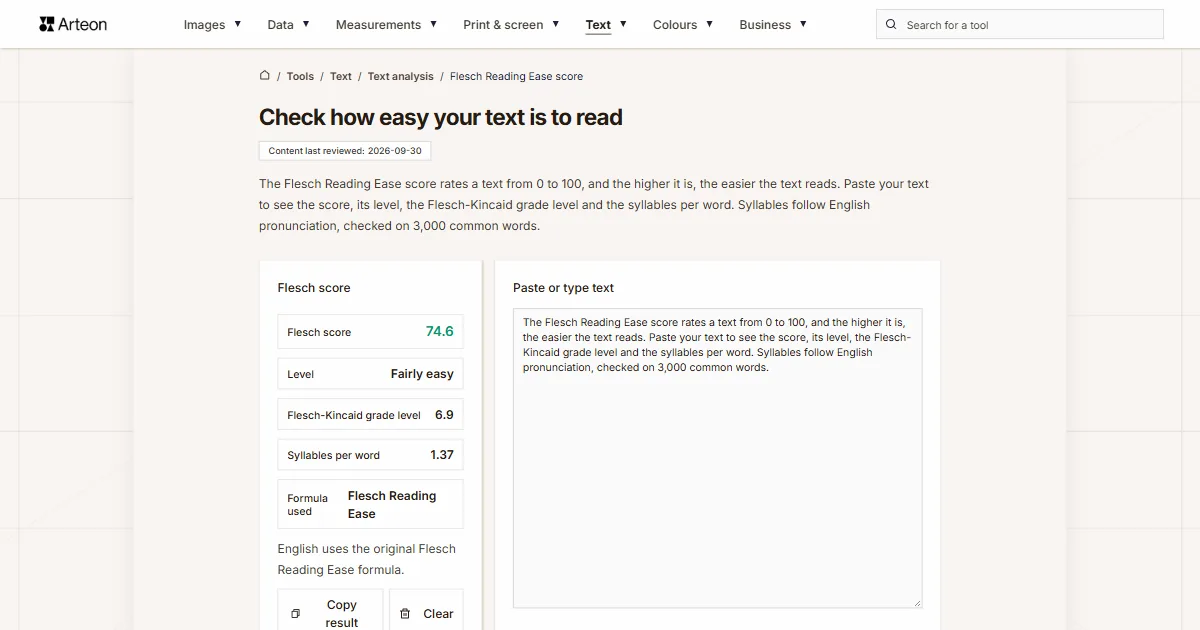
The Flesch Reading Ease score rates a text from 0 to 100, and the higher it is, the easier the text reads. Paste your text to see the score, its level, the Flesch-Kincaid grade level and the syllables per word. Syllables follow English pronunciation, checked on 3,000 common words.
Flesch score
The score appears here once the text has at least three words.
English uses the original Flesch Reading Ease formula.
What is the Flesch Reading Ease score?
The Flesch Reading Ease score measures how easy a text is to read. Rudolf Flesch published it in 1948 in the article A new readability yardstick[1]. The score usually falls between 0 and 100, and the higher it is, the less effort the text takes.
The formula uses two numbers that a program can count without understanding the text: the average sentence length in words and the average number of syllables per word. Long sentences and long words lower the score. Short sentences of one-syllable words reach 100, and a single sentence that runs for dozens of long words drops below zero.
In 1975, J. Peter Kincaid and his team turned the same two averages into a US school grade. They derived the new formula from reading tests taken by 531 Navy enlisted personnel in four technical training schools[2]. That version is known as the Flesch-Kincaid grade level. Another grade-level formula, the Gunning fog index, counts the words of three or more syllables instead of averaging syllables per word.
The calculator above shows both results, together with the level of difficulty, the syllables per word and the name of the formula it used. The versions of this page in other languages use formulas adapted to those languages, because the English numbers don't fit their longer words.

How do you calculate the Flesch Reading Ease score?
Multiply the average sentence length by 1.015 and the average number of syllables per word by 84.6, add the two results and subtract the sum from 206.835[3]. Take the sentence “The Australian platypus is seemingly a hybrid of a mammal and reptilian creature.” It has 13 words and 24 syllables. The sentence part takes away 1.015 × 13, which is 13.195. The word part takes away 84.6 × 24 ÷ 13, which is 156.18. That leaves 37.5, a Difficult text.
The Flesch-Kincaid grade level uses the same two averages with other weights[2]: 0.39 × 13 plus 11.8 × 24 ÷ 13, minus 15.59, gives 11.3, roughly the level of a US eleventh grader.
The calculator does all of this while you type. The Flesch score panel shows the Flesch score, the Level, the Flesch-Kincaid grade level, Syllables per word and the Formula used. A result appears once the text has at least three words.
How does the calculator count syllables and sentences?
Flesch gave precise counting rules[3]. Syllables are counted as the words are pronounced, and when a word has two accepted pronunciations, the one with fewer syllables counts. Figures, symbols and abbreviations count as one-syllable words, while contractions and hyphenated words count as one word each.
The calculator treats numbers and addresses the same way: a number such as 17 or 3.5 counts as one syllable, and so does a web or email address. English spelling doesn't show every syllable, so for words the calculator applies rules for silent letters and vowel pairs, listed in the table below.
We tested those rules on the 3,000 most frequent words in English film subtitles[4], comparing each word with its pronunciation in Wiktionary[5]. Before our corrections of 19 September 2026, the calculator counted 94.7% of the words correctly, and after them 99.2%.
A sentence ends at a period, a question mark, an exclamation point or a line break, so every line of a list counts as a sentence. A period after an abbreviation such as Dr. or e.g. doesn't end a sentence. Flesch also ended a sentence at a colon, semicolon or dash that closes a full unit of speech[3], which takes a human reader to judge. In the calculator, a long sentence with semicolons counts as one sentence.
How does the calculator count syllables in English words?
| Word | Syllables | Before the corrections | Rule |
|---|---|---|---|
| walked | 1 | 1 | -ed after a consonant other than t or d adds no syllable |
| wanted | 2 | 2 | -ed after t or d is a syllable of its own |
| table | 2 | 2 | -le after a consonant is a syllable |
| whole | 1 | 2 | a final e is silent |
| lovely | 2 | 3 | a silent e stays silent before -ly, -ful, -ness and -ment |
| trying | 2 | 1 | -ing after a vowel is a syllable of its own |
| radio | 3 | 2 | i and o next to each other belong to two syllables |
| idea | 3 | 2 | a final ea after a consonant is two syllables |
| unique | 2 | 3 | -que at the end of a word adds no syllable |
| something | 2 | 3 | compounds of some, any, every and no are counted part by part |
| business | 2 | 3 | a list of exceptions covers words spoken with fewer syllables than their spelling suggests |
What does a Flesch Reading Ease score mean?
| Score | Level in the calculator | US school level |
|---|---|---|
| 90–100 | Very easy | 5th grade |
| 80–89.9 | Easy | 6th grade |
| 70–79.9 | Fairly easy | 7th grade |
| 60–69.9 | Standard | 8th and 9th grade |
| 50–59.9 | Fairly difficult | 10th to 12th grade |
| 30–49.9 | Difficult | College |
| 0–29.9 | Very difficult | College graduate |
How does the score change with the type of text?
| Fragment | Syllables per word | Words per sentence | Flesch score | Grade level |
|---|---|---|---|---|
| Three very short sentences | 1 | 3 | 100 | 0 |
| A story for young children | 1.06 | 8 | 100 | 0.1 |
| A blog paragraph | 1.41 | 11 | 76.5 | 5.3 |
| A news item | 1.5 | 20 | 59.6 | 9.9 |
| A sentence from a report | 3.26 | 34 | 0 | 36.2 |
Can you compare Flesch scores across languages?
Only with a formula adapted to each language. French, German, Spanish and the other languages we measured use longer words than English, so the English formula gives the same content a lower score even when it reads just as easily.
The table below shows the size of that effect on the introductions of 312 tools on this site, written separately in eight languages. An average English word has 1.41 syllables and an Italian one 1.96, so the English formula gives the English texts 73 points and the Italian ones 26.2. The adapted formulas close most of that gap, and each language version of this calculator uses its own.
How many syllables does a word have in eight languages?
| Language | Syllables per word | Score with the English formula | Score with the language's own formula |
|---|---|---|---|
| English | 1.405 | 73 | 73 |
| French | 1.501 | 64.3 | 81 |
| German | 1.697 | 48.8 | 66.4 |
| Polish | 1.820 | 39.5 | 73.3 |
| Spanish | 1.868 | 33.4 | 79.3 |
| Czech | 1.891 | 33.7 | 67.7 |
| Portuguese | 1.930 | 28.4 | 70.4 |
| Italian | 1.959 | 26.2 | 64 |
What text does this calculator accept, and how does it score it?
| What you paste | What the calculator counts | Flesch score | How we count it |
|---|---|---|---|
| “Report due on Friday” | 4 words, 1 sentence | 75.9 | Text without a final period counts as one sentence, so a score appears right away |
| “Dr. Smith agreed with the plan. Then he left.” | 9 words, 2 sentences | 100 | The period after “Dr.” is not read as the end of a sentence |
| “The ticket costs 3.5 dollars. We paid at the door.” | 10 words, 2 sentences | 100 | The number 3.5 counts as one word of one syllable, as Flesch’s rules have it |
| “Write to hello@example.com or visit arteontools.com today.” | 7 words, 1 sentence | 91 | An email or web address counts as one word of one syllable, so it does not drag the score down |
| “We came early; the doors were shut; we went home.” | 10 words, 1 sentence | 100 | A semicolon does not end a sentence, so all three clauses stay together |
| “Milk”, “Bread”, “Eggs” and “Butter”, one per line | 4 words, 4 sentences | 100 | Each line of a list counts as a sentence, the way a reader sees it |
| “THE MEETING STARTS AT NOON. PLEASE BE ON TIME.” | 9 words, 2 sentences | 100 | Capital letters change nothing in the count, so text shouted in caps scores the same |
| “<p>Short text.</p><p>Another one.</p>” | 4 words, 2 sentences | 77.9 | We skip HTML tags, and we treat the end of a paragraph as the end of a line |
| “1 2 3 4 5.” | numbers only | no score | We give a score from three words with letters upward, because a shorter text would produce a meaningless number |
| “Это простой текст. Он написан по-русски.” | text in the Cyrillic alphabet | no score | The Flesch score rests on counting syllables in the Latin and Greek alphabets, so for Cyrillic we show the message “The score works for texts written in the Latin or Greek alphabet.” instead of a number |
How do you check readability in three steps?
The calculation runs in your browser, so the text stays on your device.
1. Paste the running text
Paste your text into the Paste or type text field. Flesch advised testing only the running text, without titles, headings or captions.2. Read the result
The Flesch score panel shows the score from 0 to 100, the Level, the Flesch-Kincaid grade level, Syllables per word and the Formula used.3. Edit and check again
Split long sentences and swap long words for shorter ones. The result updates as you type, and Copy result copies the score with the formula name.
How do you see the Flesch score in Microsoft Word?
Word shows both scores in its Readability Statistics window, which opens after a spelling and grammar check[12]. In Word for Microsoft 365 on the Current Channel, go to Home, then Editor, then Document stats. In older versions, such as Word 2016, go to File, then Options, then Proofing, select Check grammar with spelling and Show readability statistics, and run Spelling & Grammar. On a Mac, the same options are under Word, then Preferences, then Spelling & Grammar.
Microsoft's help page gives both formulas and recommends a score between 60 and 70 for most standard files[12]. It doesn't say how Word counts syllables, and that is where Word and this calculator part ways.
We ran four sentences through Word 2016 and through this calculator on 19 September 2026. Word gave the platypus sentence 24.4, which means it counted 26 syllables, two more than the 24 in the worked example on Wikipedia[13]. Word also showed no grade above 12, even for a sentence of long technical words for which the formula gives 39.6. Word's window also lists the number of words and sentences, and the word and character counter gives the same counts for comparison.
How do the calculator's results compare with Word?
| Sentence | Word 2016 | This calculator |
|---|---|---|
| “The Australian platypus is seemingly a hybrid of a mammal and reptilian creature.” | 24.4, grade 12 | 37.5, grade 11.3 |
| “This sentence, taken as a reading passage unto itself, is being used to prove a point.” | 74.2, grade 6.8 | 69, grade 7.6 |
| “The weather was cold this morning. We stayed at home and read a long book.” | 100, grade 0.7 | 100, grade 0.7 |
| A 17-word sentence of long technical words, such as interoperability | 0, grade 12 | 0, grade 39.6 |
What raises the score faster: shorter sentences or shorter words?
In English, both parts of the formula count. One syllable less per word adds 84.6 points, and one word less per sentence adds about one point. Real edits move the syllable average by only a fraction, so the two effects end up close.
The blog paragraph and the news item in the table above show the balance. The blog paragraph scores 76.5 and the news item 59.6, which is 16.8 points lower. Longer sentences account for 9.1 of those points and longer words for 7.7.
Flesch's own advice starts with sentences: break a long one into two, three or four shorter ones, even if they start with And, But or Or[3]. Then go after long words with prefixes and suffixes. He suggests replacing establishment, available and required with setting up, in stock and called for. The word and character counter shows the average sentence length while you edit.
What Flesch score should you aim for?
Flesch set the minimum for Plain English at 60, which is about 20 words per sentence and 1.5 syllables per word. For conversational English aimed at consumers, he asked for at least 80[3]. Microsoft recommends 60 to 70 for most documents[12].
Flesch's tests of magazines and newspapers show what the numbers mean in print[3]: comics scored 92, Reader's Digest 65, Time 52 and The New York Times 39. This page's own prose scores 64.3 in the same calculator, at 1.48 syllables per word.
For a text that many people must read, such as a product page or instructions, aim for 70 and above. A specialist article can sit lower, because its readers came for the detail and accept a longer sentence when it carries it. To tell readers how long the text will take, use the reading time calculator. A very short text, such as a page title, gets a score that swings with every word. For titles and descriptions, length matters more, and the meta title and description checker measures it.
Does the Flesch score show whether readers understand a text?
Only in part. Kincaid's report cites an earlier finding that readability formulas predicted schoolchildren's results in reading comprehension tests with a validity coefficient of about 0.70. That accounts for about half of the differences between texts[2].
The formula sees only the length of sentences and words. It can't tell whether your readers know the words, whether the ideas follow in a sensible order or whether the layout helps. A text of short, common words in a confusing order can score well and still be hard to follow. For text on a screen, the color contrast checker shows whether the text and background colors meet the WCAG levels.
Use the score to find the passages worth rewriting, then read them again with your readers in mind.
Sources
- A new readability yardstick — R. Flesch, Journal of Applied Psychology 32(3), 1948
- Derivation of New Readability Formulas (Automated Readability Index, Fog Count and Flesch Reading Ease Formula) for Navy Enlisted Personnel — J. P. Kincaid, R. P. Fishburne, R. L. Rogers, B. S. Chissom, Research Branch Report 8-75, 1975
- How to Write Plain English (excerpt) — R. Flesch, University of Canterbury, archived copy
- FrequencyWords: word frequency lists from OpenSubtitles 2018 — H. Dave, GitHub
- WikiPron: pronunciation dictionaries mined from Wiktionary — J. L. Lee and others, LREC 2020
- Adaptation of Classic Readability Metrics to Czech — K. Bendová, S. Cinková, Text, Speech and Dialogue 2021, Charles University
- Lesbarkeitsindex — Wikipedia (German)
- Fernández Huerta readability formula — G. Law, LINGUIST List 22.2332, 2011
- Quantifying French Document Complexity — V. Primpied, D. Beauchemin, R. Khoury, Université Laval, Canadian AI 2022
- Readability Formulas Applied to Textbooks in Brazilian Portuguese — T. B. F. Martins, C. M. Ghiraldelo, M. G. V. Nunes, O. N. Oliveira Jr., ICMSC-USP, 1996
- Indici di leggibilità: Gulpease e Flesch — Università Roma Tre, archived copy
- Get your document's readability and level statistics in Microsoft Word — Microsoft Support
- Flesch–Kincaid readability tests — Wikipedia
The results in the tables were computed by this tool's own function and checked by an automated test before publication. The rules, standards and figures the text relies on come from the sources listed above.
Content last reviewed: · written and checked by the Arteon team
Frequently asked questions about the Flesch Reading Ease score
What is a good Flesch Reading Ease score?
Flesch set 60 as the minimum for Plain English and asked for at least 80 in conversational English for consumers. Microsoft recommends 60 to 70 for most documents.
What is the difference between Flesch Reading Ease and the Flesch-Kincaid grade level?
Both use the average sentence length and the average syllables per word. Reading Ease gives a score from 0 to 100, where higher means easier, and the grade level gives a US school grade, where higher means harder.
Why does Microsoft Word give a different score?
Word counts syllables in its own way and shows no grade above 12. For the platypus sentence it showed 24.4 and grade 12, while the formula with 24 syllables gives 37.5 and 11.3.
Why did my score stop at 0 or 100?
The calculator keeps the score between 0 and 100. One sentence of 34 long words gives a raw result of minus 103.9, and three short sentences of one-syllable words give 119.2.
Does the Flesch score work for other languages?
Only with an adapted formula, because other languages use longer words. Each language version of this calculator uses such a formula and shows its name in the Formula used row.
How much text do I need for a score?
At least three words with letters. A text without a final period counts as one sentence, and numbers alone don't get a score.
Is my text sent to a server?
The calculation runs in your browser, and the text stays on your device.
Help us improve our tools
Have an idea for a new feature, found a bug, or want to suggest another tool that would make your work easier? Write to us.
Explore other useful tools

Meta title & description checker
Check title and description length in pixels. Live Google preview and optimization tips.
PNG to JPG
Convert PNG files to JPG in your browser. No file limits, no signup, no server uploads.

Favicon generator
Create a complete favicon.ico set for your website from one image. All required sizes, no login.
Color palette generator
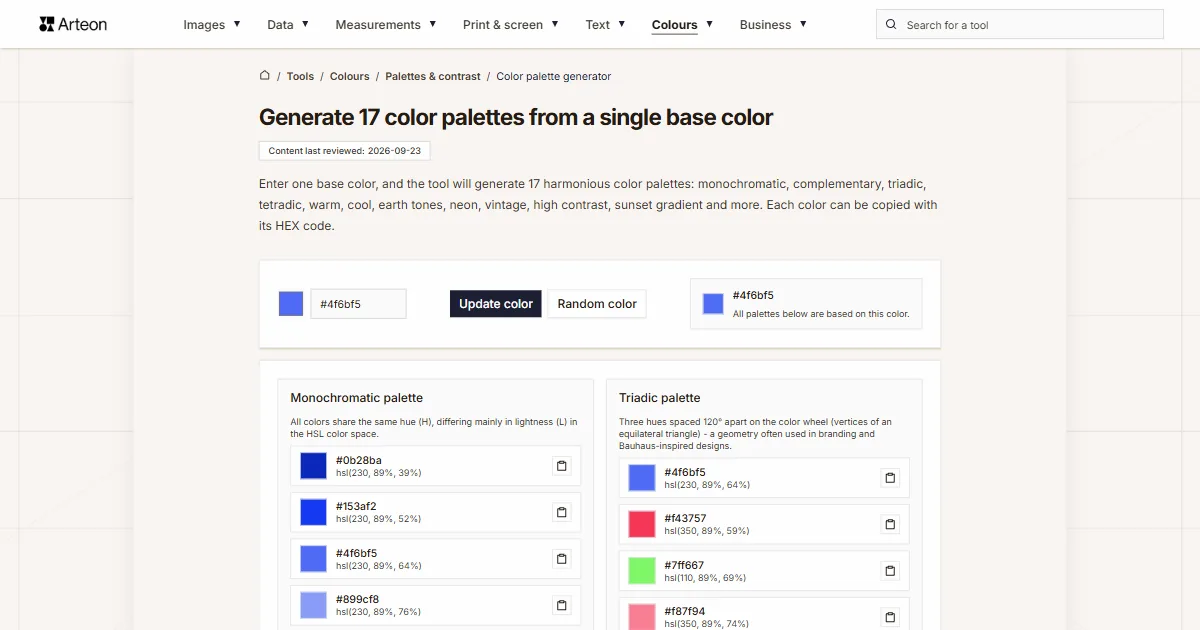
Generate 17 palettes from one color: monochromatic, complementary, triadic and more. HEX codes.
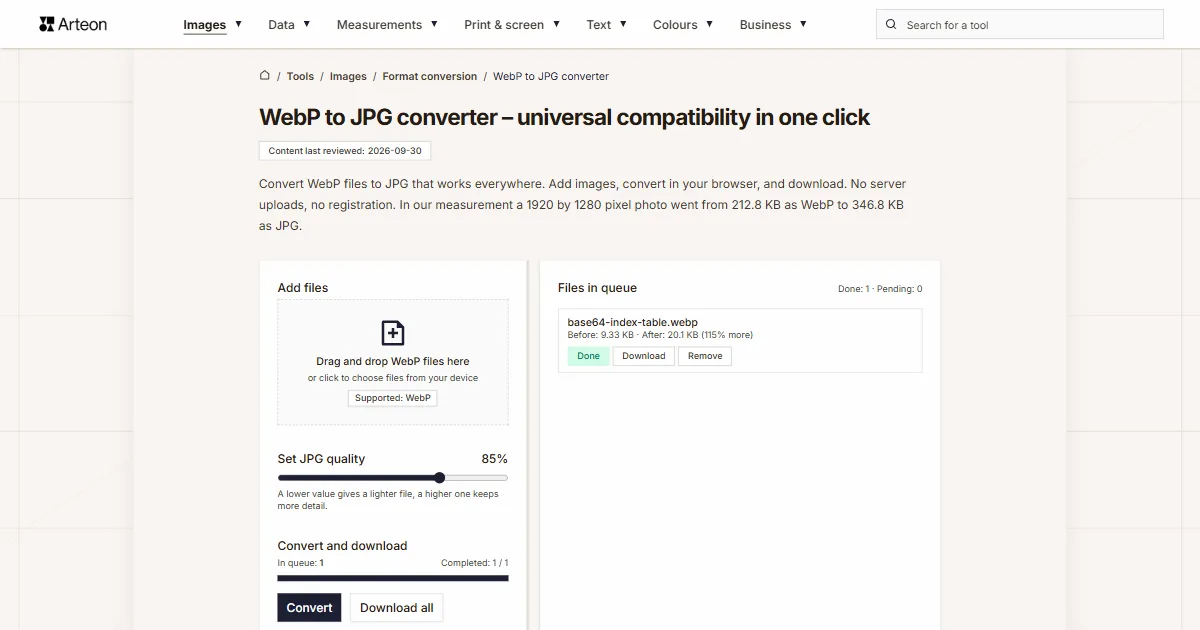
WebP to JPG
Convert WebP files to universally compatible JPG. Works in every app and platform.
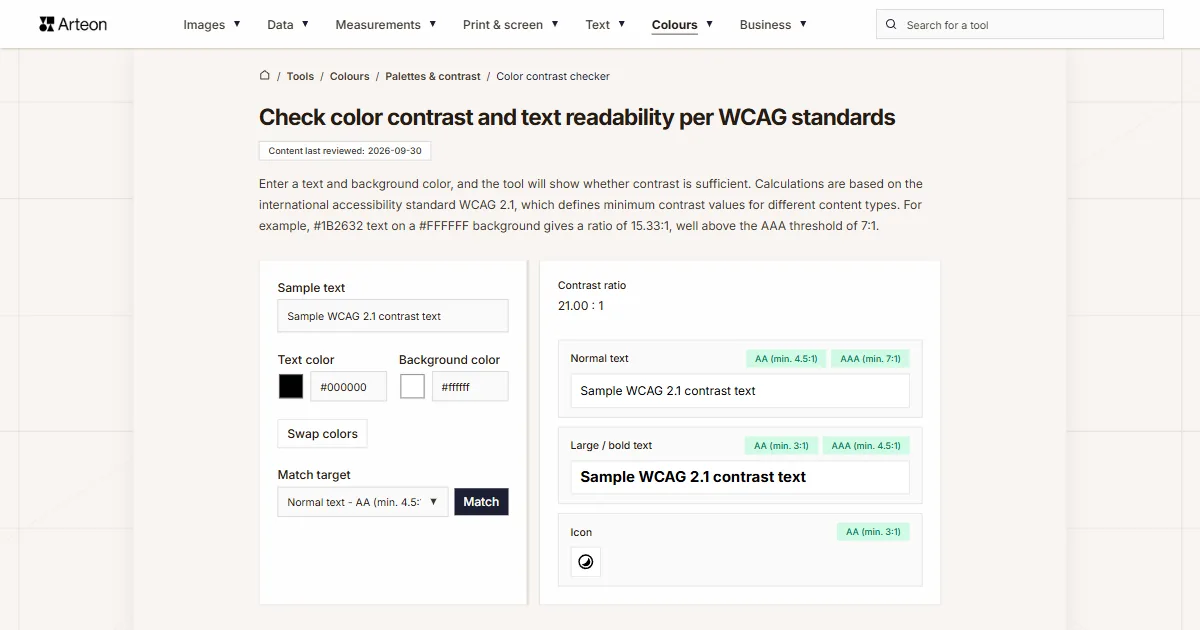
Color contrast checker
Check text and background contrast per WCAG 2.1 AA and AAA. Automatic color correction.
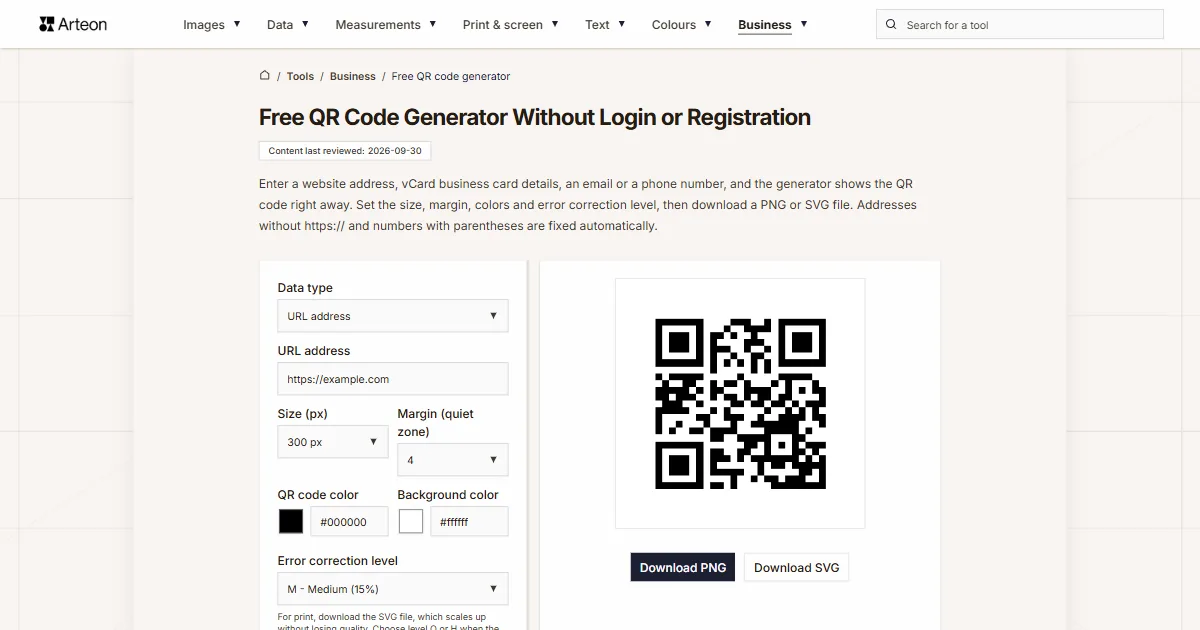
Free QR code generator
Create a QR code for a website, vCard business card or print. Export PNG and SVG, no registration.
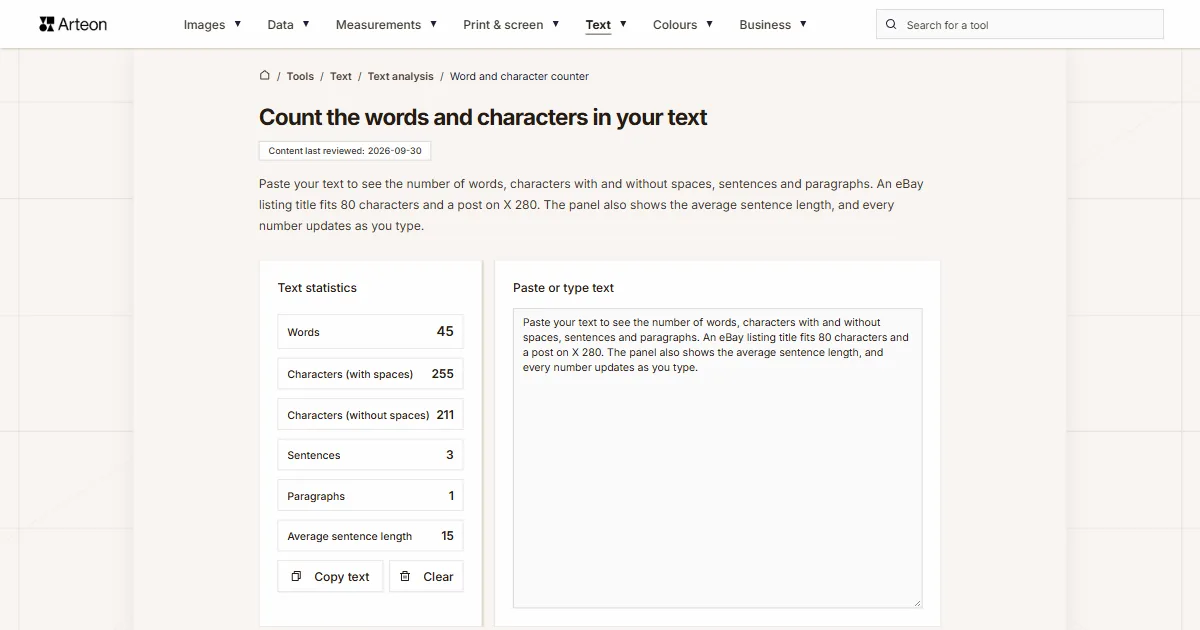
Word & character counter
Count words, characters with and without spaces, sentences, paragraphs and the average sentence length.
Lorem Ipsum Generator
Free Lorem Ipsum generator — 8 text styles, paragraphs, sentences or words. Copy in one click.