Convert nanometers to millimeters
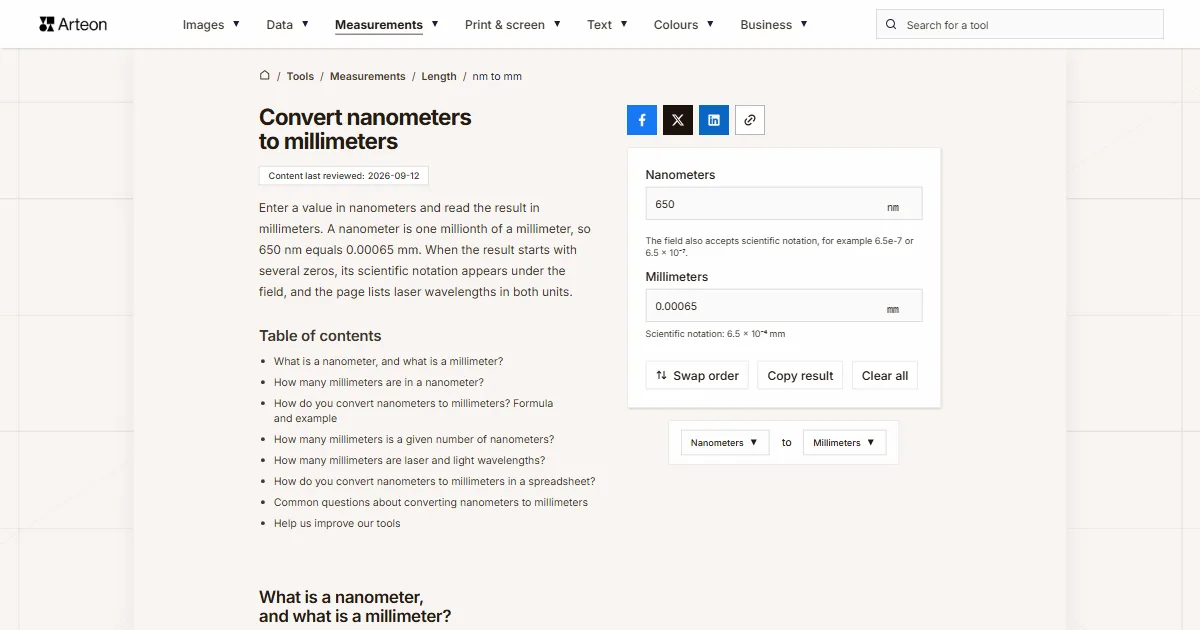
Enter a value in nanometers and read the result in millimeters. A nanometer is one millionth of a millimeter, so 650 nm equals 0.00065 mm. When the result starts with several zeros, its scientific notation appears under the field, and the page lists laser wavelengths in both units.
The field also accepts scientific notation, for example 6.5e-7 or 6.5 × 10⁻⁷.
What is a nanometer, and what is a millimeter?
Nanometers and millimeters are fractions of a meter named with SI prefixes. The prefix milli- means one thousandth, so a millimeter is 0.001 meter and uses the symbol mm. The prefix nano- means one billionth, so a nanometer is 0.000000001 meter and uses the symbol nm. Nano- is on the list of prefixes that the General Conference on Weights and Measures adopted in 1960 together with the name of the SI[1].
Seven years later the same conference abrogated the name micron and the symbol μ for the micrometer, because μ had become the prefix micro-[2]. The nanometer was formerly called the millimicron and written mμ[3].
The unit between them is the micrometer, which is one thousandth of a millimeter[4]. A millimeter therefore consists of 1,000 micrometers, and each micrometer of 1,000 nanometers. The nanometer is also commonly used to specify the wavelength of electromagnetic radiation near the visible part of the spectrum[3].
How many millimeters are in a nanometer?
A nanometer is 0.000001 millimeter, or one millionth of a millimeter. To convert nanometers to millimeters, divide the number of nanometers by 1,000,000, so 650 nm equals 0.00065 mm. The same divisor applies to every value, from 0.34 nm to a million nanometers.
The million comes straight from the prefixes. A millimeter is 10⁻³ meter and a nanometer is 10⁻⁹ meter[1]. The exponents differ by six, so a millimeter is exactly one million times longer than a nanometer.
In decimal form, the decimal point moves six places to the left. That turns 532 nm into 0.000532 mm. With one- and two-digit numbers you fill the empty places with zeros, so 25 nm gives 0.000025 mm. One nanometer is 0.000001 mm, a 1 in the sixth decimal place.
The converter at the top of the page does this as you type. Under the result field it shows the same number in scientific notation, for example 6.5 × 10⁻⁴ mm for 650 nm.
How do you convert nanometers to millimeters? Formula and example
The formula has one form: millimeters = nanometers ÷ 1,000,000. You can also split it into two divisions by 1,000. The first gives micrometers, and the second gives millimeters.
Take the wavelength of a helium–neon laser, 632.8 nm[5]. The first division gives 0.6328 µm. The second gives 0.0006328 mm.
In scientific notation you subtract six from the exponent, so 6.328 × 10² nm becomes 6.328 × 10⁻⁴ mm. In the United Kingdom this way of writing numbers is also called standard form[6].
For the opposite direction, use the millimeters to nanometers converter. A kilometer has as many millimeters as a millimeter has nanometers, as the kilometers to millimeters converter shows. For millimeters in meters, use the millimeters to meters converter, and for a result in inches, the millimeters to inches converter.
How many millimeters is a given number of nanometers?
| Nanometers | Millimeters | Scientific notation |
|---|---|---|
| 0.1 nm | 0.0000001 mm | 1 × 10⁻⁷ mm |
| 0.34 nm | 0.00000034 mm | 3.4 × 10⁻⁷ mm |
| 0.5 nm | 0.0000005 mm | 5 × 10⁻⁷ mm |
| 1 nm | 0.000001 mm | 1 × 10⁻⁶ mm |
| 4 nm | 0.000004 mm | 4 × 10⁻⁶ mm |
| 5 nm | 0.000005 mm | 5 × 10⁻⁶ mm |
| 10 nm | 0.00001 mm | 1 × 10⁻⁵ mm |
| 15 nm | 0.000015 mm | 1.5 × 10⁻⁵ mm |
| 20 nm | 0.00002 mm | 2 × 10⁻⁵ mm |
| 25 nm | 0.000025 mm | 2.5 × 10⁻⁵ mm |
| 30 nm | 0.00003 mm | 3 × 10⁻⁵ mm |
| 40 nm | 0.00004 mm | 4 × 10⁻⁵ mm |
| 50 nm | 0.00005 mm | 5 × 10⁻⁵ mm |
| 60 nm | 0.00006 mm | 6 × 10⁻⁵ mm |
| 100 nm | 0.0001 mm | 1 × 10⁻⁴ mm |
| 125 nm | 0.000125 mm | 1.25 × 10⁻⁴ mm |
| 200 nm | 0.0002 mm | 2 × 10⁻⁴ mm |
| 300 nm | 0.0003 mm | 3 × 10⁻⁴ mm |
| 400 nm | 0.0004 mm | 4 × 10⁻⁴ mm |
| 500 nm | 0.0005 mm | 5 × 10⁻⁴ mm |
| 550 nm | 0.00055 mm | 5.5 × 10⁻⁴ mm |
| 600 nm | 0.0006 mm | 6 × 10⁻⁴ mm |
| 700 nm | 0.0007 mm | 7 × 10⁻⁴ mm |
| 800 nm | 0.0008 mm | 8 × 10⁻⁴ mm |
| 1,000 nm | 0.001 mm | 1 × 10⁻³ mm |
| 2,000 nm | 0.002 mm | 2 × 10⁻³ mm |
| 5,000 nm | 0.005 mm | 5 × 10⁻³ mm |
| 10,000 nm | 0.01 mm | 1 × 10⁻² mm |
| 50,000 nm | 0.05 mm | 5 × 10⁻² mm |
| 100,000 nm | 0.1 mm | 1 × 10⁻¹ mm |
| 500,000 nm | 0.5 mm | 5 × 10⁻¹ mm |
| 1,000,000 nm | 1 mm | 1 × 10⁰ mm |
How many millimeters are laser and light wavelengths?
| Light source | Wavelength | In millimeters |
|---|---|---|
| Blu-ray drive laser | 405 nm | 0.000405 mm |
| Blue laser pointer | 445 nm | 0.000445 mm |
| Green laser pointer | 532 nm | 0.000532 mm |
| Sodium D line (center of the doublet) | 589.29 nm | 0.00058929 mm |
| Helium–neon laser | 632.8 nm | 0.0006328 mm |
| DVD drive laser | 650 nm | 0.00065 mm |
| CD drive laser | 780 nm | 0.00078 mm |
| Infrared inside a 532 nm green laser pointer | 1,064 nm | 0.001064 mm |

How do you convert nanometers to millimeters in a spreadsheet?
The converter at the top of the page handles a single value. A whole column of measurements needs one formula, entered once in the spreadsheet and filled down.
Excel: the CONVERT function with the n prefix
In Excel the formula is =CONVERT(A1,"nm","mm"). The prefix n stands for nano, a multiplier of 1E-09, and the prefix m in front of the meter symbol stands for milli. Unit names and prefixes are case-sensitive, so writing “NM” returns the #N/A error[11].Dividing by one million without a function
The formula =A1/1000000 gives the same result as CONVERT. If you enter the divisor once in cell B1, the formula =A1/$B$1 can be filled down without retyping a number with six zeros.The Scientific format for results with many zeros
Select the result cells, click the small More button next to Number on the Home tab, and choose the Scientific category. The result 0.00065 then appears as 6.50E-04. The letter E multiplies the preceding number by 10 to the power that follows it, so 6.50E-04 is 6.5 × 10⁻⁴[12].
Convert other units to Millimeters
Sources
- Resolution 12 of the 11th CGPM (1960): Système International d’Unités, list of prefixes — Bureau International des Poids et Mesures
- Resolution 7 of the 13th CGPM (1967): abrogation of the name micron — Bureau International des Poids et Mesures
- Nanometre — Wikipedia
- Micrometre — Wikipedia
- Helium–neon laser — Wikipedia
- Scientific notation — Wikipedia
- 3 nm process — Wikipedia
- Blu-ray (405 nm, 650 nm and 780 nm lasers) — Wikipedia
- Laser pointer (445 nm and 532 nm pointers) — Wikipedia
- Fraunhofer lines (sodium doublet, 589.29 nm) — Wikipedia
- CONVERT function — Microsoft
- Display numbers in scientific (exponential) notation — Microsoft
Every figure in the tables was computed from the unit definitions and checked arithmetically before publication. Historical values and the names of local units come from the sources listed above.
Content last reviewed: · written and checked by the Arteon team
Common questions about converting nanometers to millimeters
How many centimeters is 1 nm?
One nanometer is 0.0000001 centimeter, or 1 × 10⁻⁷ cm. A centimeter has 10 millimeters, so the result in centimeters is one tenth of the result in millimeters. You can turn a millimeter result into centimeters with the millimeters to centimeters converter.
Is nm the same unit as Nm?
No. Lowercase nm is the nanometer, a unit of length. Nm with a capital N is a nonstandard way of writing the newton-meter, the SI unit of torque, whose symbol is N·m or N m.
Can I type a number in scientific notation into the field?
Yes. The field accepts 6.5e-7, 6.5E-07, 6.5 × 10⁻⁷ and 6.5 x 10^-7, and either a dot or a comma works as the decimal mark. A number copied from a spreadsheet cell can be pasted without retyping it.
Why does the converter show the result in two forms?
The result field shows a decimal number, which the Copy result button copies. When the result is smaller than 0.01 or at least 1,000, the line under the field shows the same value in scientific notation.
Help us improve our tools
Got an idea for a new feature, found a bug or want to suggest another tool? Write to us — we reply within 24 hours.