Length Unit Converter – Check All 302 Units
1 inch is 2.54 cm, and a biblical cubit is about 18 inches. Type a number in the Convert from field and pick its unit from the list below it, then pick the unit you want below the Convert to field. You can convert any of the 302 units to any other: US customary and imperial, metric, nautical, astronomical, old English and Scottish, biblical, ancient, and old units from Europe, Japan and China.
How do you convert units of length?
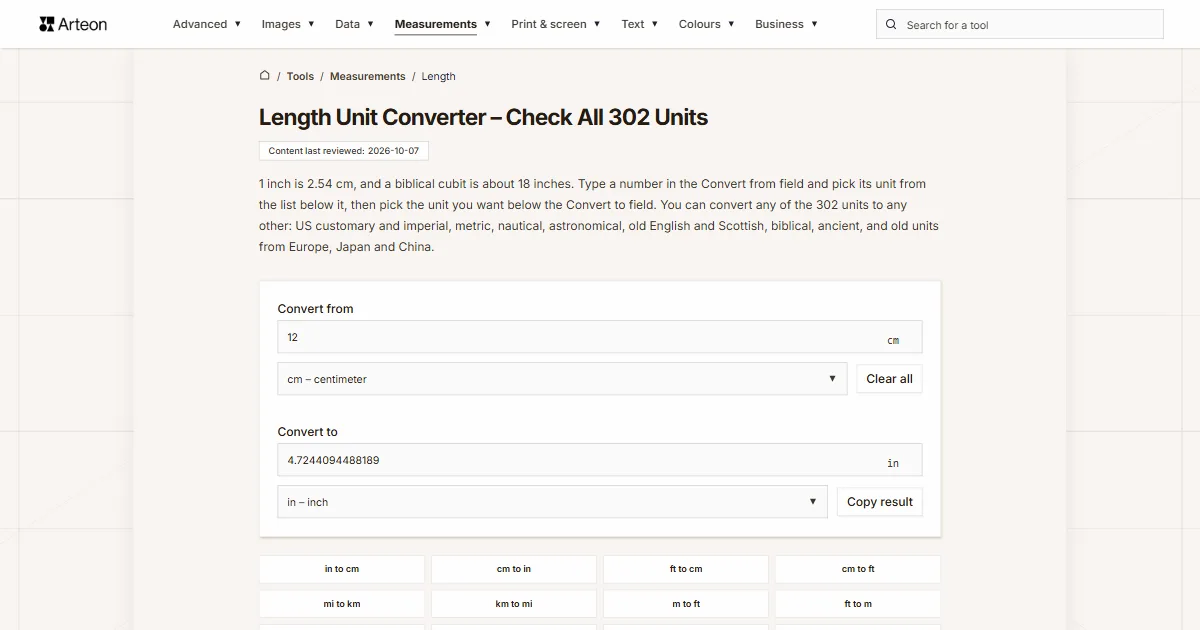
Type a number in the Convert from field and choose its unit from the list below the field, then choose the unit you want below the Convert to field. The result appears as you type. It also works the other way round: type a number in the Convert to field and the converter fills in the first one.
Both lists hold the same 302 units in 30 groups. The most used units come first, followed by imperial and US customary units, US survey units, old British, nautical and biblical units. After them come metric, technical, astronomical and physics units, old units from Poland, Russia and the rest of Europe, Japanese and Chinese units, ancient units and two unusual ones.
You don't have to look for the unit in the list. Type it after the number, for example “6 feet” or “3 rods”, and the converter sets the unit in the list below the field and tells you which one it picked. Both spellings work, so “10 metres” and “10 meters” set the same meter.
Some names cover several units, because a cubit, an ell or a stadion meant a different length in different places and centuries. If you type just “300 cubits”, the converter takes the biblical cubit and notes below the field that there are other cubits on the list. Ells, stadia, varas and fingers work the same way.
Many old units have no single agreed length, because the original standards are lost or the sources disagree. When you pick one of them, a line below the fields shows the value we calculate with and, where the sources differ, the range they give. The result then has only as many digits as the sources can support.
The Copy result button copies the number from the Convert to field, and Clear all empties both fields.
How many centimeters are in an inch, a foot and a yard?
An inch is exactly 2.54 cm, a foot is 30.48 cm, and a yard is 91.44 cm. These figures are exact because since 1959 the yard has been defined as exactly 0.9144 m[1]. The British Weights and Measures Act 1985 derives the other units from it: a foot is a third of a yard, an inch is a thirty-sixth of a yard, and a mile is 1,760 yards[2]. That makes a mile exactly 1,609.344 m.
A mile has 5,280 feet because Parliament set the statute mile at 8 furlongs, or 5,280 feet, in 1593[3]. It is a different unit from the nautical mile, which you will find further down with the other units used at sea.
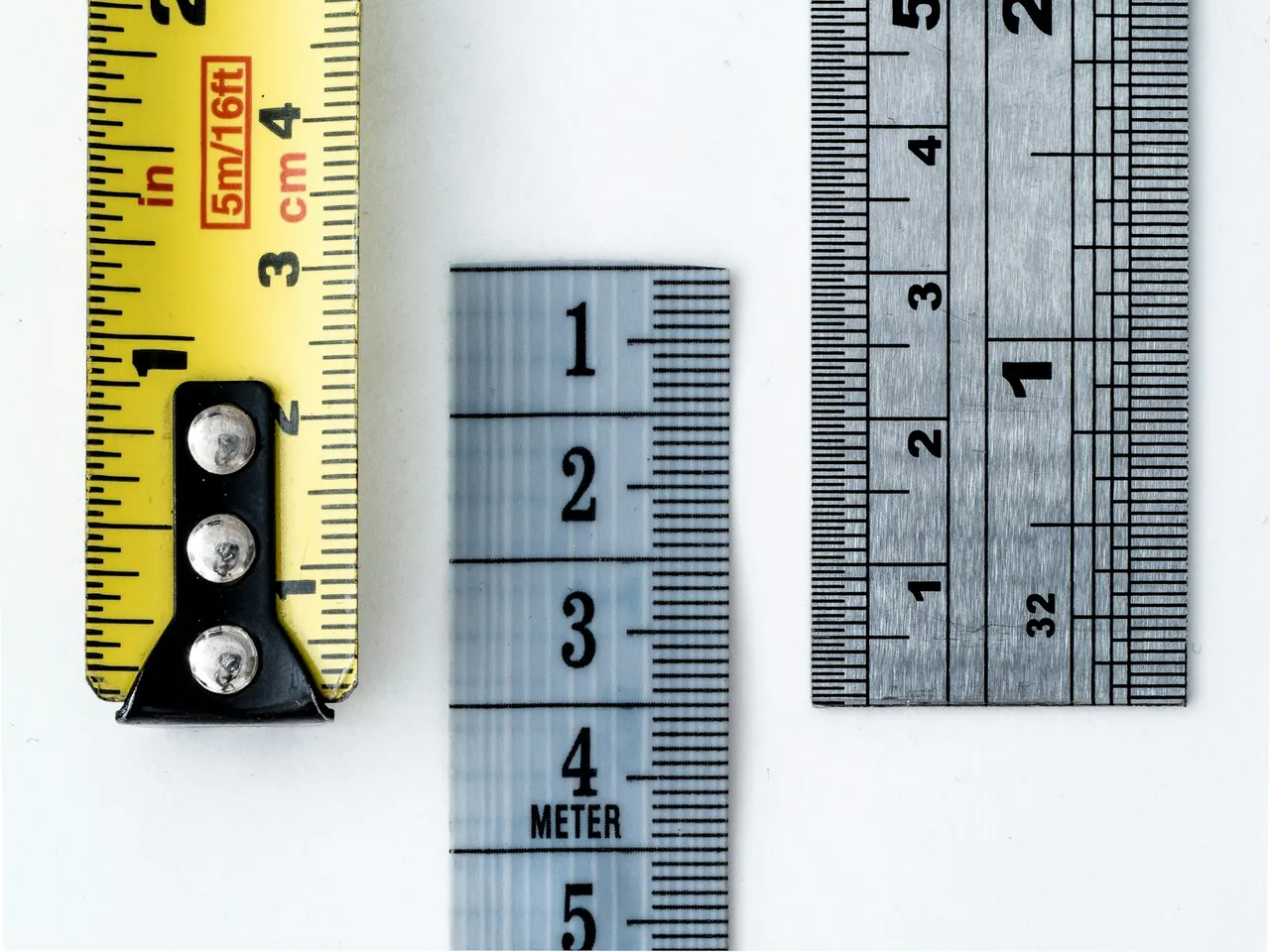
The United States measures everyday lengths in feet and inches, so someone 5 feet 10 inches tall is 177.8 cm tall. The United Kingdom mixes both systems: road signs give distances in miles and yards, while fuel is sold by the liter[4]. Australia moved to metric road signs on 1 July 1974, and almost every sign in the country was changed within a month[5].
To turn inches into centimeters, multiply by 2.54, and to go back, divide by the same number. Tables for single pairs are in the inches to cm converter, the feet to cm converter and the miles to km converter.
How many meters are in the most used units of length?
| Unit | In meters |
|---|---|
| millimeter (mm) | 0.001 m |
| centimeter (cm) | 0.01 m |
| inch (in) | 0.0254 m |
| foot (ft) | 0.3048 m |
| yard (yd) | 0.9144 m |
| meter (m) | 1 m |
| furlong (fur) | 201.168 m |
| kilometer (km) | 1,000 m |
| mile (mi) | about 1,609.34 m |
| nautical mile (NM) | 1,852 m |
What are the metric units of length?
The meter is the base unit of length in the International System of Units (SI). It is defined through the speed of light: a meter is the distance light travels in a vacuum in 1/299,792,458 of a second[6]. In the United Kingdom and Australia the word is spelled metre. The list uses the American spelling, but the field understands both.
Every other unit in the group is the meter with a prefix. Milli means a thousandth, centi a hundredth and kilo a thousand, so a kilometer is 1,000 m. The newest prefixes, ronto and quecto for the very small and ronna and quetta for the very large, were added by the General Conference on Weights and Measures in November 2022[6]. Nanometers and micrometers turn up in science and engineering, for example in the wavelength of light or the thickness of a film.
A micrometer is a millionth of a meter, and many people still call it a micron. In American English this also avoids a mix-up, because a micrometer is the name of a measuring tool as well. The General Conference on Weights and Measures dropped the micron as a separate name in 1967[7]. Type “5 microns” and the converter sets the micrometer.
The Metric, outside the SI group has three units built on the meter. The ångström is a tenth of a nanometer, 1 × 10⁻¹⁰ m, and scientists use it for the sizes of atoms and molecules and the lengths of chemical bonds[8]. The myriameter is 10 km, and so is the Scandinavian mile, which Sweden and Norway have used since 1889. Swedes use it mostly in everyday speech, but in both countries a car's fuel consumption is given in liters per Scandinavian mile, even officially[9].
What are the units of length from smallest to largest?
| Unit | In meters |
|---|---|
| quectometer (qm) | 1 × 10⁻³⁰ m |
| rontometer (rm) | 1 × 10⁻²⁷ m |
| yoctometer (ym) | 1 × 10⁻²⁴ m |
| zeptometer (zm) | 1 × 10⁻²¹ m |
| attometer (am) | 1 × 10⁻¹⁸ m |
| femtometer (fm) | 1 × 10⁻¹⁵ m |
| picometer (pm) | 1 × 10⁻¹² m |
| nanometer (nm) | 1 × 10⁻⁹ m |
| micrometer (µm) | 0.000001 m |
| decimeter (dm) | 0.1 m |
| decameter (dam) | 10 m |
| hectometer (hm) | 100 m |
| megameter (Mm) | 1,000,000 m |
| gigameter (Gm) | 1,000,000,000 m |
| terameter (Tm) | 1,000,000,000,000 m |
| petameter (Pm) | 1 × 10¹⁵ m |
| exameter (Em) | 1 × 10¹⁸ m |
| zettameter (Zm) | 1 × 10²¹ m |
| yottameter (Ym) | 1 × 10²⁴ m |
| ronnameter (Rm) | 1 × 10²⁷ m |
| quettameter (Qm) | 1 × 10³⁰ m |
| ångström (Å) | 1 × 10⁻¹⁰ m |
| myriameter | 10,000 m |
| Scandinavian mile | 10,000 m |
Which imperial and US customary units are still used?
Besides the inch, foot, yard and mile, English-speaking countries kept units that survived in one field each: horses, land surveying, racing and engineering. Apart from the US survey units, all of them are defined exactly through the yard, so the converter calculates them without rounding.
Hand
A hand is 4 inches, or 10.16 cm. Many English-speaking countries measure the height of horses in hands, from the ground to the top of the withers, and in England a statute of Henry VIII fixed the hand at four inches in 1540[10]. In “15.2 hh” the digit after the point counts inches, so it means 15 hands and 2 inches, or 62 inches[10]. The field reads the entry the same way, so “15.2 hh” gives 157.48 cm.
Chain, link, rod and furlong
These units come from land surveying. Gunter's chain is 22 yards[2], or 20.1168 m, and a link is a hundredth of a chain, 20.1168 cm[1]. There are 10 chains in a furlong and 80 in a mile[11]. A cricket pitch is exactly one chain long: the Laws of Cricket give its length as 22 yards, or 20.12 m[12].
The rod, also called a pole or a perch, is 16½ feet, or 5.0292 m[1]. Canoe maps still give portages, the paths where you carry the canoe overland, in rods, and a typical canoe is about one rod long. In parts of the United Kingdom allotment gardens are still measured in square poles, often just called poles[13]. The field reads “perch” and “pole” as the rod.
The furlong is 220 yards[2], an eighth of a mile. It is still used in horse racing in most English-speaking countries, although Australian racing switched to meters in 1972[14]. A 5-furlong sprint is 1,005.84 m, and the furlongs to miles converter turns furlongs into miles.
Fathom and league
The fathom is 6 feet, or 1.8288 m, and the league is 3 miles, or 4.828032 km[1].
US survey foot and US survey mile
Since 1893 the United States has defined the foot through the meter, and at first it was exactly 1200/3937 m[15]. When the international foot of 0.3048 m arrived in 1959, land surveys kept the older value, which became known as the US survey foot. The two differ by two parts per million, which adds up to about an eighth of an inch per mile[16]. NIST and NOAA have retired the survey foot: December 31, 2022 was the last day it should be used, and since January 1, 2023 the international foot has replaced it[15]. It still turns up in older surveys and records, so the list keeps US survey foot and US survey mile.
Mil and microinch
In engineering a mil, also called a thou, is a thousandth of an inch, 0.0254 mm[1]. You will meet it, for example, in the design and manufacture of printed circuit boards[17]. A microinch is a millionth of an inch. In the field, “10 mil”, “10 mils” and “5 thou” all set the thousandth of an inch.
How many meters are in imperial, US customary and technical units?
| Unit | In meters | Where and when |
|---|---|---|
| hand (horse height) | 0.1016 m | |
| link (Gunter's) | 0.201168 m | |
| fathom (ftm) | 1.8288 m | |
| rod (rd) | 5.0292 m | |
| chain (Gunter's) | 20.1168 m | |
| league (lea) | about 4,828.03 m | |
| US survey foot (ft (US survey)) | about 0.304801 m | USA, until the end of 2022 |
| US survey mile | about 1,609.35 m | USA, until the end of 2022 |
| microinch (µin) | 2.54 × 10⁻⁸ m | |
| mil (thou) | 0.0000254 m |
What were the old English, Scottish and Irish units of length?
A barleycorn is a third of an inch. The Composition of Yards and Perches, a statute from around 1300, made the inch equal to three dry, round grains of barley, and the barleycorn is still the basis of shoe sizes in some English-speaking countries. The line is a quarter of a barleycorn, or a twelfth of an inch[18].
The early yard was halved again and again into parts called the half-yard, span, finger and nail[1], so the list has span (9 inches), finger (cloth measure) and nail (cloth measure). Tailors measured cloth in ells: the English ell was 45 inches, or 114.3 cm, and it is obsolete today[19].
Scotland had its own units of length until an Act of the Parliament of Scotland replaced them with English ones in 1685, but many stayed in local use through the 18th and 19th centuries. The Scots ell was 37 inches, and the Scots mile was 5,920 feet, about 1,807 m, though it varied from place to place[20]. The Irish mile was 2,240 yards, about 1.27 statute miles or 2.048 km[21].
How long were the old British units?
| Unit | In centimeters | Where and when |
|---|---|---|
| line (1/12 inch) | about 0.211667 cm | |
| barleycorn | about 0.846667 cm | England, basis of shoe sizes |
| nail (cloth measure) | 5.715 cm | |
| finger (cloth measure) | 11.43 cm | |
| span (9 inches) | 22.86 cm | |
| Scots ell | approx. 94.13 cm | Scotland, until 1685 |
| English ell | 114.3 cm | |
| Scots mile | approx. 181,000 cm | Scotland, until 1685 |
| Irish mile | approx. 204,800 cm | Ireland, until the 19th century |
Which units of length are used at sea?
The international nautical mile is exactly 1,852 m. It corresponds roughly to one minute of arc along a meridian, which is why navigators at sea and in the air use it[22]. An international hydrographic conference in Monaco set its value in 1929, but the United States adopted it only in 1954 and the United Kingdom in 1970[22]. Until then the US nautical mile was 6,080.2 feet, about 1,853.2 m, and the British Admiralty mile was 6,080 feet, or 1,853.184 m[23]. Both old miles are on the list for distances from old charts and logbooks.
A cable is a tenth of a nautical mile, 185.2 m, but the same name covers other lengths too. The traditional British cable is 100 fathoms (182.88 m), and a 2008 Royal Navy handbook gives it as a tenth of a sea mile, or 608 feet[24], which is on the list as Admiralty cable. The US cable is 120 fathoms, or 720 feet (219.456 m)[1].
The fathom measures mostly water depth. A chart gives its soundings in meters or fathoms, sometimes in feet, and shows which units it uses near its title[25]. A shackle was 12½ fathoms before 1949 and has been 15 fathoms, or 27.432 m, since then[26]. At sea a league is three nautical miles, or 5.556 km[27].
How many meters are in the nautical units?
| Unit | In meters | Where and when |
|---|---|---|
| shackle | 27.432 m | anchor chain, since 1949 |
| British cable (100 fathoms) | 182.88 m | United Kingdom, traditional measure |
| cable (international) | 185.2 m | |
| Admiralty cable | about 185.318 m | Royal Navy, 608 feet |
| US cable | 219.456 m | US Navy |
| Admiralty mile | about 1,853.18 m | United Kingdom, until 1970 |
| old US nautical mile | about 1,853.25 m | USA, until 1 July 1954 |
| sea league | 5,556 m |
How far is an astronomical unit, a light-year and a parsec?
The astronomical unit (au) is exactly 149,597,870.7 km, or about 93 million miles. The International Astronomical Union fixed this value in 2012, and it is roughly the average distance between the Earth and the Sun[28]. Sunlight covers it in about 8.32 minutes, which is why the list also has light-second, light-minute, light-hour and light-day.
A light-year is the distance light travels in a vacuum in one Julian year of 365.25 days: 9,460,730,472,580.8 km, or about 5.88 trillion miles[29]. The field understands “ly” as well as the full name, so you can type “4.2 light-years”. The light-years to km converter converts in both directions.
A parsec is the distance at which the radius of the Earth's orbit appears at an angle of one second of arc. The British astronomer Herbert Hall Turner coined the name from “parallax” and “second” in 1913[30]. Since 2015 the International Astronomical Union has defined it as exactly 648,000/π astronomical units[31], about 3.26 light-years. Distances inside our galaxy are often given in kiloparsecs, and distances to other galaxies in megaparsecs and gigaparsecs[30].
The radii of the Earth, Jupiter and the Sun on the list are nominal values that the International Astronomical Union adopted in 2015 for conversions: the equatorial radius of the Earth is 6,378.1 km, that of Jupiter 71,492 km, and the radius of the Sun 695,700 km[32]. If a planet's radius is given as 1.2 Jupiter radii, pick Jupiter radius and the converter shows it in kilometers or miles.
The Physics group holds two constants from the CODATA 2022 values: the Bohr radius, approx. 5.291772105 × 10⁻¹¹ m[33], and the Planck length, approx. 1.616255 × 10⁻³⁵ m[34]. The Bohr radius describes the size of a hydrogen atom, and it is about 3.3 × 10²⁴ Planck lengths. Both values come from measurements with an uncertainty, so the converter treats them as approximate and doesn't add digits the measurements can't give.
How many kilometers are in the astronomical and physics units?
| Unit | In kilometers |
|---|---|
| Earth radius (R⊕) | 6,378.1 km |
| Jupiter radius (RJ) | 71,492 km |
| light-second (ls) | about 299,792 km |
| solar radius (R☉) | 695,700 km |
| light-minute | about 17,987,500 km |
| astronomical unit (au) | about 149,598,000 km |
| light-hour | about 1,079,250,000 km |
| light-day | about 25,902,100,000 km |
| light-year (ly) | about 9,460,730,000,000 km |
| parsec (pc) | about 30,856,800,000,000 km |
| kiloparsec (kpc) | 3.08567758149137 × 10¹⁶ km |
| megaparsec (Mpc) | 3.08567758149137 × 10¹⁹ km |
| gigaparsec (Gpc) | 3.08567758149137 × 10²² km |
| Planck length (ℓP) | approx. 1.616255 × 10⁻³⁸ km |
| Bohr radius (a₀) | approx. 5.291772105 × 10⁻¹⁴ km |
How long is a cubit in the Bible?
The Bible gives lengths in cubits, spans, handbreadths and fingers, but it never says how long a cubit was. The cubit came from the forearm, measured from the elbow to the tip of the middle finger[35]. The Hebrew cubit (ammah) had 2 spans, each span had 3 handbreadths, and each handbreadth had 4 fingers, so a cubit was 24 fingers. The Jewish Encyclopedia of 1906 puts the ancient Hebrew cubit at either 525 or 495 mm[36]. The converter counts the biblical cubit as 18 inches, approx. 45.7 cm, and the line below the fields shows the range the sources give, from 0.44 m to 0.525 m.
According to Genesis, Noah's ark was three hundred cubits long, fifty cubits wide and thirty cubits high (Genesis 6:15)[37]. The footnotes of the New International Version turn the length into about 450 feet, or about 135 meters[38], so they count a cubit as 18 inches. The converter gives approx. 450 ft, or approx. 137 m. You can type “300 cubits” or “300 biblical cubits”. Both set the biblical cubit, and after the shorter entry a note below the field says that the list has other cubits too. Goliath's height was “six cubits and a span” (1 Samuel 17:4)[37], which the NIV footnote gives as about 9 feet 9 inches, or about 3 meters[38]. Type it as “6.5 cubits” and the converter shows approx. 2.97 m.
Handbreadth, finger and the long cubit of Ezekiel
Smaller measures appear in the descriptions of the tabernacle and the temple. Exodus gives the border around the table as “an hand breadth” (Exodus 25:25), and in Jeremiah the pillars of the temple were “four fingers” thick (Jeremiah 52:21)[37]. With an 18-inch cubit a handbreadth is 3 inches and a finger is three quarters of an inch, so both verses describe approx. 7.62 cm. The field understands both: “1 handbreadth” and “4 fingers” set the biblical units.
Ezekiel describes “a measuring reed of six cubits long by the cubit and an hand breadth” (Ezekiel 40:5)[37]. His cubit was a handbreadth longer than the common one, so the two were in the proportion of 7 to 6[36]. The NIV footnote gives this long cubit as about 21 inches, or about 53 cm, and the reed as about 3.2 meters[38]. On the list they are long cubit (Ezekiel), approx. 21 in, and measuring reed (Ezekiel), six long cubits or approx. 3.2 m. The rabbis of the Talmud used yet another cubit. By Zuckermann's calculation, quoted in the Jewish Encyclopedia, it had six handbreadths of 9.34 cm, about 56 cm[36], and that is the value of the Talmudic cubit on the list.
Sabbath day's journey, furlong and mile in the New Testament
The Mount of Olives lay “a sabbath day's journey” from Jerusalem (Acts 1:12)[37]. That was the farthest distance a Jew could walk from home in one direction on the Sabbath, 2,000 cubits[36]. The NIV calls it “a Sabbath day's walk” and gives it in a footnote as about 5/8 mile, or about 1 kilometer[38]. The converter counts the Sabbath day's journey as 2,000 biblical cubits, approx. 914 m, while with the Talmudic cubit it comes to about 1,120 m[36].
Luke places Emmaus “about threescore furlongs” from Jerusalem (Luke 24:13)[37]. The Greek text has sixty stadia[39], and since the Middle Ages the stadium and the furlong have been treated as synonyms[40]. The NIV gives the distance as about seven miles, or about 11 km[38]. If you type “60 furlongs”, the converter takes the English furlong of 220 yards and shows 12.07008 km. For the Greek measure, type “60 stadia”: the converter sets the Attic stadion and shows approx. 11.1 km.
In the Sermon on the Mount, “whosoever shall compel thee to go a mile, go with him twain” (Matthew 5:41)[37]. The Greek word there is μίλιον (milion)[39], the name of the Roman mile in the Greek-speaking part of the Empire[3]. The Roman mile had 1,000 paces, or 5,000 Roman feet[41]. It was approx. 1,480 m, so it was shorter than the statute mile. Before Paul's shipwreck the sailors took soundings and found “twenty fathoms” and then “fifteen fathoms” (Acts 27:28)[37]. The NIV turns them into 120 and 90 feet, or about 37 and 27 meters[38], which means it counts a fathom as 6 feet. The Greek fathom of the original text, orgyia[39], gives almost the same approx. 37 m for twenty fathoms.
In Luke 2:44 Jesus' parents went “a day's journey” on their way home from Jerusalem[37]. That distance had no fixed length. The Talmud defines a day's journey for a man walking at an average pace as ten parasangs, or 80,000 cubits[36], and the converter counts the day's journey that way: approx. 37 km, or approx. 23 mi.
How long are the biblical units in meters?
| Unit | In meters | Where and when |
|---|---|---|
| biblical finger | approx. 0.0191 m | Old Testament, Jeremiah 52:21 |
| handbreadth | approx. 0.0762 m | Old Testament, Exodus 25:25 |
| biblical span | approx. 0.229 m | Old Testament, 1 Samuel 17:4 |
| biblical cubit | approx. 0.457 m | Old Testament, Genesis 6:15 |
| long cubit (Ezekiel) | approx. 0.533 m | Ezekiel 40:5: a cubit and a handbreadth |
| Talmudic cubit | approx. 0.56 m | Talmud, Zuckermann's calculation |
| measuring reed (Ezekiel) | approx. 3.2 m | Ezekiel 40:5: 6 long cubits |
| Sabbath day's journey | approx. 914 m | Acts 1:12: 2,000 cubits |
| day's journey | approx. 37,000 m | Talmud: 10 parasangs; Luke 2:44 |
How long was a Roman mile?
The Roman mile (mille passus) was 1,000 paces of 5 feet each, or 5,000 Roman feet[41]. An accepted modern value of the Roman foot is 296 mm[42], which makes the mile approx. 1,480 m, or approx. 0.92 mi. The English word mile comes from this Latin name for a thousand paces[3]. Along Hadrian's Wall in northern England the Romans built small forts called milecastles about one Roman mile apart, with a stone turret about a third of a Roman mile, some 500 m or 540 yards, on either side of each one[43].
The Roman foot (pes) was divided into 16 fingers (digiti) or 12 inches (unciae)[42]. The English word inch comes from the Latin uncia, which meant a twelfth and was also the Roman ounce[44]. The Roman palm (palmus) was a quarter of a foot, the Roman cubit (cubitum) 1½ feet, the Roman pace (passus) 5 feet, the pertica (decempeda) 10 feet and the actus 120 feet[42].
In Gaul the Romans also measured distances in leagues. The leuga, taken over from the Gauls, was 1½ Roman miles, or 7,500 Roman feet, about 2.2 km, and from it the league spread across Western Europe[27]. On the list it is Gallic league (leuga), approx. 2.22 km.
How many meters were the Roman units of length?
| Unit | In meters | Where and when |
|---|---|---|
| Roman finger (digitus) | approx. 0.0185 m | ancient Rome, 1/16 foot |
| Roman inch (uncia) | approx. 0.0247 m | ancient Rome, 1/12 foot |
| Roman palm (palmus) | approx. 0.074 m | ancient Rome, 1/4 foot |
| Roman foot (pes) | approx. 0.296 m | ancient Rome |
| palmipes | approx. 0.37 m | ancient Rome, 1¼ feet |
| Roman cubit (cubitum) | approx. 0.444 m | ancient Rome, 1½ feet |
| Roman step (gradus) | approx. 0.74 m | ancient Rome, 2½ feet |
| Roman pace (passus) | approx. 1.48 m | ancient Rome, 5 feet |
| pertica (decempeda) | approx. 2.96 m | ancient Rome, 10 feet |
| actus | approx. 35.5 m | ancient Rome, 120 feet |
| Roman mile | approx. 1,480 m | ancient Rome, 1,000 paces; mile of Matthew 5:41 |
| Gallic league (leuga) | approx. 2,220 m | Roman Gaul, 1½ miles |
How long was a Greek stadion and a Persian parasang?
The Greeks also counted from the foot (pous), but its length depended on the place: in Athens it was about 296 mm and on Aegina about 333 mm, while the proportions between the units stayed the same[45]. A foot had 16 fingers (daktyloi) and 4 palms, a span (spithamē) had 12 fingers, a cubit (pēchys) 1½ feet, a fathom (orgyia) 6 feet and a plethron 100 feet[45]. The converter counts all of them from an Attic stadion of 185 m[40], which gives a foot of approx. 30.8 cm, and the line below the fields shows the range of feet the sources give.
Stadion
According to Herodotus a stadion was 600 Greek feet, so it changed with the foot from place to place. Historians have proposed many lengths for it, for example 157 m for the stadion used to measure journeys, 185 m for the Attic one and 192 m for the Olympic one[40]. The list has three of them: Attic stadion, Olympic stadion and stadion of Eratosthenes.
Eratosthenes, a Greek scholar of the 3rd century BC, used the stadion to measure the circumference of the Earth. The distance from Alexandria to Syene, today's Aswan, was reported to be about 5,000 stadia, and he multiplied it by 50 to get roughly 250,000 stadia. Scholars still disagree about which stadion he used. In one reconstruction his original result was about 224,100 stadia, which with a stadion of 180 m comes to 40,338 km, less than 1% from the real value[46]. Lev Firsov compared 81 distances given by Eratosthenes and Strabo with modern measurements and arrived at a stadion of about 157.7 m[40], close to the stadion of Eratosthenes on the list, approx. 158 m.
Parasang
The Greeks also wrote about the Persian parasang. Herodotus defines it as 30 stadia, and Xenophon gives the same length, but in the 6th century AD Agathias noted that the Persians of his time counted only 21 stadia[47]. With 30 stadia a parasang is 5.7 km by the Olympic measure or 5.3 km by the Attic one, which takes the stadion as 600 Athenian feet of 296 mm, but in 1920 Kenneth Mason of the Royal Geographical Society worked out that the parasang in Xenophon's accounts of Babylonia was only 2.4 miles, or 3.9 km[48]. The converter counts approx. 5.5 km.
How many meters were the Greek and Persian units?
| Unit | In meters | Where and when |
|---|---|---|
| Greek finger (daktylos) | approx. 0.0193 m | ancient Greece, 1/16 foot |
| Greek palm (palaistē) | approx. 0.0771 m | ancient Greece, 4 fingers |
| Greek span (spithamē) | approx. 0.231 m | ancient Greece, 12 fingers |
| Greek foot (pous) | approx. 0.308 m | ancient Greece, Attic foot |
| Greek cubit (pēchys) | approx. 0.463 m | ancient Greece, 24 fingers |
| Greek fathom (orgyia) | approx. 1.85 m | ancient Greece; fathom of Acts 27:28 |
| plethron | approx. 30.8 m | ancient Greece, 100 feet |
| stadion of Eratosthenes | approx. 158 m | measurement of the Earth's circumference |
| Attic stadion | approx. 185 m | ancient Greece; furlong of Luke 24:13 (KJV) |
| Olympic stadion | approx. 192 m | Olympia |
| parasang | approx. 5,500 m | ancient Persia, 30 stadia |
How long was an Egyptian royal cubit?
An Egyptian royal cubit was about 52.5 cm. Cubit rods of this length were found in the tomb of Maya, the treasurer of Tutankhamun, at Saqqara and in the tomb of Kha at Thebes. They are divided into palms and fingers[49]. The royal cubit had 7 palms of 4 fingers, the remen 20 fingers, the khet, a rod, 100 royal cubits, and the iteru, a measure of distance along the Nile, 20,000 royal cubits[49]. Lengths in cubits go back to the earliest dynasties: the Palermo stone records that in the reign of Djer the Nile rose 6 cubits and 1 palm, about 3.2 m[49]. Surveyors measured fields with knotted ropes, and a scene in the tomb of Menna at Thebes shows them at work[49].
Mesopotamia
In 1916 the German Assyriologist Eckhard Unger found a copper-alloy bar at Nippur, dated to around 2650 BC, which he took for a measuring standard. Its markings put the Sumerian cubit at about 518.6 mm[35]. The cubit (kuš) had 30 fingers (šu-si), a reed (gi) had 6 cubits and a rod (nindan) 12 cubits[50]. The longest unit of distance was the bēru, more than 10 km. The same word meant a double hour, a twelfth of a day, and an Akkadian letter says that on the 15th day of Nisannu “day and night were equal: six double hours of daylight, six double hours of night”[51]. The converter counts the bēru (double hour) as 21,600 cubits[50], approx. 11 km.
How many meters were the Egyptian and Mesopotamian units?
| Unit | In meters | Where and when |
|---|---|---|
| Egyptian finger (djeba) | approx. 0.0188 m | ancient Egypt, 1/28 royal cubit |
| Egyptian palm (shesep) | approx. 0.075 m | ancient Egypt, 4 fingers |
| remen | approx. 0.375 m | ancient Egypt, 20 fingers |
| short Egyptian cubit | approx. 0.45 m | ancient Egypt, 6 palms |
| Egyptian royal cubit | approx. 0.525 m | ancient Egypt, 7 palms |
| khet (Egyptian rod) | approx. 52.5 m | ancient Egypt, 100 royal cubits |
| iteru | approx. 10,500 m | ancient Egypt, 20,000 royal cubits |
| Sumerian finger (šu-si) | approx. 0.017 m | Mesopotamia, 1/30 cubit |
| Sumerian cubit (kuš) | approx. 0.5 m | Mesopotamia |
| Mesopotamian reed (gi) | approx. 3 m | Mesopotamia, 6 cubits |
| nindan (rod) | approx. 6 m | Mesopotamia, 12 cubits |
| bēru (double hour) | approx. 11,000 m | Mesopotamia, 21,600 cubits |
How long were the toise, the French foot and the arpent?
Before the metric system France measured length in toises. A toise had 6 royal feet (pieds du roi), a foot 12 inches (pouces), an inch 12 lines (lignes) and a line 12 points. In 1668 the old standard of the toise turned out to be deformed, and the toise du Châtelet replaced it[52]. The law of 10 December 1799 made the meter exactly 443.296 French lines, so the royal foot is exactly 4500/13853 m[52]. The converter calculates all these units from that relation: the pied du roi (Paris foot) is about 32.4839 cm and the toise about 1.94904 m.
The league changed from region to region, from 3.268 km in Beauce to 5.849 km in Provence. The lieue ancienne of 10,000 feet was the official league in parts of France until 1674, when the lieue de Paris was set at 2,000 toises. In 1737 two more appeared, the lieue des Postes of 2,200 toises and the lieue tarifaire of 2,400 toises. Perches had 18, 20 or 22 feet[52], and the list has all three: perche du roi (royal perch), perche ordinaire and perche d’arpent (forest perch).
The metric system was very unpopular at first[52], so a decree of 12 February 1812 allowed shops to use customary measures with the old names but metric sizes. The toise became exactly 2 m and the aune, the ell used for cloth, 120 cm. A law of 1837 ended these measures from 1 January 1840[53]. That's why the list has the old and the customary version of each unit: aune usuelle is 120 cm, while aune de Paris (Paris ell) is approx. 118.8 cm.
Quebec and Louisiana
French units lasted longest in North America. Canada's Weights and Measures Act still defines units for certain land in Quebec: the French foot is 12.789 inches, the perch 18 French feet and the arpent 180 French feet[54]. An arpent is 58.471308 m. It is also used in parts of the United States that belonged to French Louisiana, with the same length of about 192 feet. The long, narrow ribbon farms along the rivers of southern Louisiana go back to French settlers of the 18th century[55].
How many meters were the old French and Canadian units?
| Unit | In meters | Where and when |
|---|---|---|
| point du roi | about 0.000187986 m | France, until 1799 |
| Paris line (ligne) | about 0.00225583 m | France, until 1799 |
| ligne usuelle | about 0.00231481 m | France, 1812–1839 |
| Paris inch (pouce) | about 0.0270699 m | France, until 1799 |
| pouce usuel | about 0.0277778 m | France, 1812–1839 |
| pied du roi (Paris foot) | about 0.324839 m | France, until 1799 |
| French foot (Quebec) | about 0.324841 m | Quebec, land descriptions |
| pied usuel | about 0.333333 m | France, 1812–1839 |
| aune de Paris (Paris ell) | approx. 1.188 m | France, 1540–1799 |
| aune usuelle | 1.2 m | France, 1812–1839 |
| brasse (5 French feet) | about 1.6242 m | France, old sea measure |
| toise | about 1.94904 m | France, 1668–1799 |
| toise usuelle | 2 m | France, 1812–1839 |
| perche du roi (royal perch) | about 5.84711 m | France, until 1799 |
| perch (Quebec, perche) | about 5.84713 m | Quebec, land descriptions |
| perche ordinaire | about 6.49679 m | France, until 1799 |
| perche d’arpent (forest perch) | about 7.14647 m | France, until 1799 |
| arpent (linear) | about 58.4713 m | Quebec, land descriptions |
| lieue ancienne (old Paris league) | about 3,248.39 m | France, until 1674 |
| lieue de Paris (Paris league) | about 3,898.07 m | France, 1674–1799 |
| lieue métrique (metric league) | 4,000 m | France, after the metre was introduced |
| lieue des Postes (post league) | about 4,287.88 m | France, 1737–1799 |
| lieue commune (French league) | approx. 4,440 m | 25 leagues to the degree |
| lieue tarifaire (tariff league) | about 4,677.69 m | France, 1737–1799 |
How long is a vara?
The vara was the basic Spanish unit of length, and its size changed with the place and the period. Varas appear in many land deeds in the southern United States, because the land was once part of Mexico, and they were used across Latin America too. In Argentina a vara was about 866 mm, so a typical town lot 10 varas wide is 8.66 m[56]. Spanish tables of 1852 give the metric value of the Castilian vara of Burgos and derive the other units from it: the foot (pie) is a third of a vara, the palm (palmo) a quarter, the cubit (codo) a half, the fathom (braza) 2 varas and the estadal 4 varas[57]. The Castilian vara is 83.5905 cm.
In Texas the vara measured land in Spanish and Mexican surveys and grants. The Handbook of Texas gives it as approximately 33⅓ inches, with 1,900.8 varas to the mile and a labor of 1,000,000 square varas, about 177.1 acres[58]. On the list it is Texas vara, about 84.67 cm, and if you type just “vara”, the converter sets this one and notes that the list has other varas. A line of 1,000 varas is about 2,777.8 feet.
How many meters were the vara, the legua and other Spanish units?
| Unit | In meters | Where and when |
|---|---|---|
| Castilian line (línea) | about 0.00193497 m | Castile, 1852 value |
| Castilian inch (pulgada) | about 0.0232196 m | Castile, 1852 value |
| Castilian palm (palmo) | about 0.208976 m | Castile, 1/4 vara |
| Castilian foot (pie) | 0.278635 m | Castile, 1852 value |
| Castilian cubit (codo) | about 0.417953 m | Castile, 1/2 vara |
| Salvadoran vara | 0.835464 m | El Salvador, land transactions |
| Castilian vara | 0.835905 m | Castile, 1852 value |
| Mexican vara | approx. 0.838 m | Mexico, before the metric system |
| Madrid vara | approx. 0.843 m | Madrid, 1852 tables |
| Texas vara | about 0.846667 m | Texas, Spanish and Mexican land grants |
| Argentine vara | 0.866 m | Buenos Aires, from 1857 |
| Alicante vara | approx. 0.912 m | Alicante, 1852 tables |
| Catalan cana | approx. 1.555 m | Barcelona, 1852 tables |
| Castilian fathom (braza) | 1.67181 m | Castile, 2 varas |
| estadal | 3.34362 m | Castile, 4 varas |
| legua legal | about 4,179.53 m | Castile, 5,000 varas |
| Mexican legua | approx. 4,190 m | Mexico, 5,000 Mexican varas |
| New Granada legua | 5,000 m | Colombia, until the mid-19th century |
| Argentine legua | 5,196 m | Buenos Aires, 1857–1878 |
| legua común (20,000 feet) | 5,572.7 m | Spain, from the 16th century |
| road legua (8,000 varas) | 6,687.24 m | Spain, from 1769 |
How long were the braça and the légua in Portugal and Brazil?
In 1814 Portugal became the second country after France to adopt the metric system officially, but the old units stayed in use in Portugal and in Brazil. Portugal and its colonies finally switched to the metric system in 1852, and Brazil, independent since 1822, in 1862. The braça, the Portuguese fathom, had 2 varas, or 2.2 m, the côvado, the cubit, had 3 palmos, and the league of 20 to the degree was 3 geographic miles[59]. Ten braças are 22 m.
How many meters were the old Portuguese and Brazilian units?
| Unit | In meters | Where and when |
|---|---|---|
| Portuguese line (linha) | approx. 0.00229 m | Portugal, 1/12 polegada |
| Portuguese inch (polegada) | 0.0275 m | Portugal |
| palmo de craveira | 0.22 m | Portugal, 1/5 vara |
| Portuguese foot (pé) | 0.33 m | Portugal |
| côvado (Portuguese ell) | 0.68 m | Portugal |
| Portuguese vara | 1.1 m | Portugal and Brazil |
| passo geométrico | 1.65 m | Portugal, 5 feet |
| toesa | 1.98 m | Portugal, 6 feet |
| braça (Portuguese fathom) | 2.2 m | Portugal and Brazil |
| metric légua | 5,000 m | Portugal, from 1855 |
| légua (20 to the degree) | approx. 5,555.6 m | Portugal, sea league |
| légua (18 to the degree) | approx. 6,172.8 m | Portugal |
| colonial légua (3,000 braças) | 6,600 m | Brazil, colonial period |
How long was a braccio and other old Italian units?
Before unification every Italian state, and often every province, had its own units. A law of 28 July 1861 extended the metric system to the whole Kingdom of Italy, and in 1877 the government published official tables that convert the old units into metric ones. All the Italian units in the converter come from these tables[60].
The Florentine braccio is about 58.36 cm. A commission compared it with the meter in 1808 and got 0.583626 m, and another one recalculated it in 1871 and got 0.583416 m. The difference didn't matter in trade, so the tables give the braccio as 0.5836 m. The Milanese braccio was approx. 59.4936 cm and was divided into 12 inches (once)[60].
In Piedmont the piede liprando had 12 inches, and 6 of these feet made a trabucco. In 1818 the foot grew slightly, from 0.513766 m to 0.514403 m, but some towns kept the old value[60], so the converter calculates with the older foot and shows the range of both below the fields. In the Kingdom of the Two Sicilies a law of 1840 made the canna 10 palms (approx. 2.645503 m) and the mile 700 canne, which makes the Neapolitan mile approx. 1,851.85 m[60].
How many meters were the old Italian units?
| Unit | In meters | Where and when |
|---|---|---|
| Roman palmo (Papal States) | approx. 0.2234218 m | Rome, Papal States |
| Sicilian palm (palmo) | approx. 0.258098 m | Sicily, from 1809 |
| Neapolitan palm (palmo) | approx. 0.26455 m | Kingdom of the Two Sicilies, from 1840 |
| Venetian foot | approx. 0.347735 m | Veneto |
| piede liprando | approx. 0.513766 m | Piedmont |
| Florentine braccio | approx. 0.5836 m | Tuscany |
| Milanese braccio | approx. 0.594936 m | Lombardy |
| Aosta tesa (tesa valdostana) | approx. 1.872 m | Aosta Valley, 6 feet |
| Sicilian canna | approx. 2.064783 m | Sicily, 8 palms |
| Neapolitan canna | approx. 2.645503 m | Naples, 10 palms |
| Piedmontese trabucco | approx. 3.0826 m | Piedmont, 6 piedi liprandi |
| Italian mile (60 to the degree) | approx. 1,851.851 m | Sardinia, roads from 1823 |
| Neapolitan mile | approx. 1,851.85 m | Naples, 700 canne |
How long is a verst?
A verst is 500 sazhens, or 1.0668 km. In the 17th century a verst had 700 sazhens, about 1.49 km, and it became 500 sazhens in the time of Peter the Great[61]. Peter the Great standardized the arshin at exactly 28 English inches, or 71.12 cm[62]. An arshin had 16 vershoks, and 3 arshins made a sazhen of 7 feet, 2.1336 m[62]. The metric system became compulsory in Soviet Russia in 1918, and the Soviet Union officially replaced the old units on 21 July 1925[62]. A distance of 30 versts is 32.004 km.
How many centimeters were the old Russian units?
| Unit | In centimeters | Where and when |
|---|---|---|
| vershok | 4.445 cm | Russia, from 1835 |
| arshin | 71.12 cm | Russia, from 1835 |
| sazhen (Russian fathom) | 213.36 cm | Russia, from 1835 |
| verst | 106,680 cm | Russia, from 1835 |
How long were the old German and Austrian units?
Prussia fixed its units by an ordinance of 16 May 1816. The base was the Rhine foot, also called the Prussian foot, divided into 12 inches of 12 lines. A rod (Rute) had 12 feet, a mile 2,000 rods and a fathom (Faden) 6 feet[63]. The Prussian foot is about 31.3853 cm and the Prussian mile about 7.53248 km.
The weights and measures ordinance of the North German Confederation of 1868 brought in the metric system from 1 January 1872 and kept some old names for metric units: the centimeter became the new inch (Neuzoll), the millimeter the Strich and the decameter the Kette, and the mile was set at 7,500 m[64]. That's why the Neuzoll (new inch) on the list is exactly 1 cm.
In Austria a patent of Maria Theresa introduced the Vienna fathom (Klafter) in 1756. A law of 23 July 1871 brought in the metric system from 1 January 1876 and fixed the fathom at exactly 1.89648384 m. A fathom had 6 feet, a foot 12 inches, and an Austrian mile 4,000 fathoms. The 1871 law also set the Vienna ell at 777.55842 mm, while the cloth ell cut into the wall of St. Stephen's Cathedral in Vienna is 776 mm[65].
How many centimeters were the old German and Austrian units?
| Unit | In centimeters | Where and when |
|---|---|---|
| Strich | 0.1 cm | North German Confederation, from 1868 |
| Prussian line | about 0.217954 cm | Prussia, 1816–1872 |
| Neuzoll (new inch) | 1 cm | North German Confederation, from 1868 |
| Prussian inch (Zoll) | about 2.61545 cm | Prussia, 1816–1872 |
| Bavarian foot | about 29.1859 cm | Bavaria, until 1872 |
| Prussian foot (Rhine foot) | about 31.3853 cm | Prussia, 1816–1872 |
| Prussian ell (Berlin ell) | about 66.6939 cm | Prussia, 1816–1872 |
| Bavarian fathom (Klafter) | about 175.116 cm | Bavaria, until 1872 |
| Prussian fathom (Faden) | about 188.312 cm | Prussia, navy, 1816–1872 |
| Prussian Lachter (mining fathom) | about 209.236 cm | Prussia, mining, 1816–1872 |
| Bavarian rod (Rute) | about 350.231 cm | Bavaria, until 1872 |
| Prussian rod (Rute) | about 376.624 cm | Prussia, 1816–1872 |
| Kette (10 m) | 1,000 cm | North German Confederation, from 1868 |
| Vienna line | about 0.2195 cm | Austria, until 1876 |
| Vienna inch (Zoll) | about 2.63401 cm | Austria, until 1876 |
| Vienna foot (Wiener Fuß) | about 31.6081 cm | Austria, Galicia and Bohemia, until 1876 |
| Vienna ell (Wiener Elle) | about 77.7558 cm | Austria, Galicia and Bohemia, until 1876 |
| Vienna fathom (Wiener Klafter) | about 189.648 cm | Austria, Galicia and Bohemia, until 1876 |
| Vienna rod (Rute) | about 316.081 cm | Austria, until 1876 |
How many kilometers were the German and Austrian miles?
| Unit | In kilometers | Where and when |
|---|---|---|
| Bavarian mile (before 1811) | about 7.41497 km | Bavaria, 25,406 feet |
| German geographic mile | approx. 7.42044 km | 1/15 of a degree of the equator |
| Bavarian mile (1811–1871) | about 7.4716 km | Bavaria, 25,600 feet |
| German mile (7.5 km) | 7.5 km | North German Confederation and German Empire, from 1872 |
| Prussian mile | about 7.53248 km | Prussia, 1816–1872 |
| Austrian post mile | about 7.58594 km | Austria, until 1876 |
What were the old Swiss, Czech and Scandinavian units?
In 1835 twelve Swiss cantons agreed on common measures, which came into use in 1838 and 1839. They were based on the meter: a foot was 30 cm and was divided into 10 inches and 100 lines, a fathom had 6 feet, a rod 10 feet and a Wegstunde, an hour's walk, 16,000 feet, or 4.8 km. Switzerland finally adopted the meter, the liter and the gram in January 1877[66].
The Kingdom of Bohemia had its own system of measures from 1268, until Maria Theresa brought in the Austrian system in 1765[67]. Before 1889 the Swedish mile had 18,000 ells, about 10,689 m, and the Norwegian mile was about 11,298 m[9].
How many meters were the old Swiss, Czech and Scandinavian units?
| Unit | In meters | Where and when |
|---|---|---|
| Swiss line | 0.003 m | Switzerland, 1838–1876 |
| Swiss inch | 0.03 m | Switzerland, 1838–1876 |
| Swiss foot | 0.3 m | Switzerland, 1838–1876 |
| Swiss ell | 0.6 m | Switzerland, 1838–1876 |
| Swiss fathom (Klafter) | 1.8 m | Switzerland, 1838–1876 |
| Swiss rod (Rute) | 3 m | Switzerland, 1838–1876 |
| Wegstunde (hour's walk) | 4,800 m | Switzerland, 1838–1876 |
| Czech inch (palec) | approx. 0.0247 m | Bohemia, until 1764 |
| Czech span (píď) | approx. 0.198 m | Bohemia, until 1764 |
| Czech foot | approx. 0.297 m | Bohemia, until 1764 |
| Prague ell (Czech ell) | approx. 0.593 m | Bohemia, 1268–1764 |
| Czech fathom (sáh) | approx. 1.778 m | Bohemia, until 1764 |
| látro (Czech mining fathom) | approx. 2.074 m | Bohemia, mining, 3.5 ells |
| Czech rod (prut) | approx. 4.742 m | Bohemia, 8 ells |
| provazec (42 ells) | approx. 24.91 m | Bohemia, until 1541 |
| provazec (52 ells) | approx. 30.82 m | Bohemia, from 1541 |
| Czech hon | approx. 153.8 m | Bohemia, 5 provazce |
| Czech mile | approx. 7,003 m | Bohemia |
| old Swedish mile | approx. 10,689 m | Sweden, until 1889 |
| old Norwegian mile | approx. 11,300 m | Norway, until 1889 |
How long was the Polish ell and the other old Polish units?
Old Polish units were based on the ell (łokieć), and its length changed with the period and the region. In 1565 the Sejm set the Kraków ell, divided into 24 inches, for the whole of Poland. In 1764 a treasury commission made the ell kept at the Warsaw town hall the standard, which is now called the crown ell. After the partitions Prussia brought in the Breslau ell in 1796, the Kingdom of Poland used New Polish units from 1 January 1819, and Russian units replaced them on 1 May 1849[68].
The crown ell was 264 Paris lines, or 0.595539 m[68], and the converter counts the Old Polish ell (Warsaw ell) as approx. 59.554 cm. New Polish units had round metric values, so the New Polish ell was exactly 57.6 cm[69]. Old sources give three lengths of the Polish mile, equal to 4, 4½ and 5 Italian miles[70], so the list has a small Polish mile, a medium Polish mile and a great Polish mile. If you type just “Polish mile”, the converter sets the medium one.
How many centimeters were the Polish ell and the other old Polish units?
| Unit | In centimeters | Where and when |
|---|---|---|
| New Polish line | 0.2 cm | Kingdom of Poland, 1819–1849 |
| New Polish inch | 2.4 cm | Kingdom of Poland, 1819–1849 |
| Old Polish inch (cal) | approx. 2.481 cm | Polish–Lithuanian Commonwealth, 1764–1819 |
| New Polish geometric inch | 4.32 cm | Kingdom of Poland, 1819–1849, land and building measures |
| New Polish quarter (ćwierć) | 14.4 cm | Kingdom of Poland, 1819–1849 |
| New Polish foot | 28.8 cm | Kingdom of Poland, 1819–1849 |
| Kraków foot | approx. 29.3 cm | Crown of Poland, until 1764 |
| Old Polish foot (stopa) | approx. 29.78 cm | Polish–Lithuanian Commonwealth, 1764–1819 |
| New Polish geometric foot | 43.2 cm | Kingdom of Poland, 1819–1849, land and building measures |
| New Polish ell | 57.6 cm | Kingdom of Poland, 1819–1849 |
| Chełmno ell (Kulm ell) | approx. 57.62 cm | Chełmno Land and the north of the Crown, from the 14th century |
| Wrocław ell (Breslau ell) | approx. 57.749 cm | Prussian partition, from 1796 |
| Kraków ell | approx. 58.6 cm | Crown of Poland, 14th century to 1764 |
| Old Polish ell (Warsaw ell) | approx. 59.554 cm | Polish–Lithuanian Commonwealth, 1764–1819 |
| Lithuanian ell | approx. 65.5 cm | Grand Duchy of Lithuania |
| New Polish fathom | 172.8 cm | Kingdom of Poland, 1819–1849 |
| Kraków fathom | approx. 176 cm | Crown of Poland, until 1764 |
| Old Polish fathom (sążeń) | approx. 178.7 cm | Polish–Lithuanian Commonwealth, 1764–1819 |
| Lithuanian fathom (sążeń) | approx. 194 cm | Grand Duchy of Lithuania |
| Polish mining fathom | approx. 208 cm | mining, 3.5 ells |
| New Polish rod | 432 cm | Kingdom of Poland, 1819–1849 |
| Chełmno rod | approx. 432 cm | north of the Crown, from the 14th century |
| Kraków rod | approx. 440 cm | south of the Crown, until 1764 |
| Old Polish rod (pręt) | approx. 446.65 cm | Polish–Lithuanian Commonwealth, 1764–1819 |
| New Polish staff (laska) | 864 cm | Kingdom of Poland, 1819–1849 |
| Kraków staff (laska) | approx. 879 cm | Crown of Poland, until 1764 |
| Old Polish staff (laska) | approx. 893.31 cm | Polish–Lithuanian Commonwealth, 1764–1819 |
| New Polish surveyor's cord (sznur) | 4,320 cm | Kingdom of Poland, 1819–1849 |
| Old Polish surveyor's cord (sznur) | approx. 4,467 cm | Polish–Lithuanian Commonwealth, 1764–1819 |
How many meters were the staje and the Polish miles?
| Unit | In meters | Where and when |
|---|---|---|
| staje (Statute) | approx. 50 m | Statute of the Crown, 84 ells |
| staje (3 cords) | approx. 134 m | 225 ells according to Gaworski |
| geometric staje | approx. 248 m | 625 geometric feet according to Solski |
| New Polish staje (1/8 mile) | 1,066.8 m | Kingdom of Poland, 1819–1849 |
| small Polish mile | approx. 6,250 m | 17th century |
| medium Polish mile | approx. 7,030 m | 17th century |
| seven-verst mile | 7,467.6 m | Kingdom of Poland, after 1849 |
| great Polish mile | approx. 7,810 m | 17th century |
| New Polish mile | approx. 8,534 m | Kingdom of Poland, attempt of 1818 |
| Lithuanian mile | approx. 8,910 m | Grand Duchy of Lithuania, 17th century |
How long is a Japanese shaku, a Chinese chi and a Hong Kong chek?
A Japanese shaku is about 30.303 cm, a Chinese chi about 33.33 cm and a Hong Kong chek exactly 37.1475 cm. All three are written with the same character, 尺, so the result depends on which country the text comes from. The field recognizes them by name, for example “6 shaku”, “2 chi” or “1 chek”.
Shaku, sun and ken
Japan signed the Metre Convention in 1885[71], and its Weights and Measures Act of 1891 tied the traditional units to the meter, with a shaku of exactly 10/33 m. A sun (寸) is a tenth of a shaku, a bu (分) a hundredth, a rin (厘) a thousandth and a mō (毛) a ten-thousandth. A jō (丈) has 10 shaku, a ken (間) 6 shaku (about 1.818 m), a chō (町) 60 ken and a ri (里) 36 chō, about 3.927 km. The same act allowed cloth to be measured with the kujirajaku (鯨尺), which is 1.25 ordinary shaku[72].
The metric system became the only legal system in most areas of Japanese life on 1 January 1959, and converting the land registries took until 31 March 1966. The shakuhachi flute is named after its traditional length of 1 shaku and 8 sun, or 54.5 cm[71]. The field reads such an entry too: “1 shaku 8 sun” gives 1.8 shaku.
Chi, li and chek
On 16 February 1929 the Chinese government adopted a Weights and Measures Act that made the metric system the standard and allowed market units based on it for trade. A chi is a third of a meter, and a li has 1,500 chi, or 500 m. This li is not the same unit as the small li, which has a different character and tone[73], so the list has both: li (里, 500 m) and li (釐, 1/1000 chi). The Great Wall is called “the 10,000-li Long Wall” in Chinese[74]. In the People's Republic of China a decree of the State Council of 1959 kept the market system alongside the metric one, and a decree of 1984 allowed it only until the end of 1990[73].
Hong Kong's units are longer. Its Weights and Measures Ordinance sets the chek at 0.371475 m, the tsun at a tenth of a chek and the fan at a tenth of a tsun[75], and the Customs and Excise Department still lists them among commonly used units[76]. In everyday speech in Hong Kong, chek and tsun are also commonly understood as the imperial foot and inch, which are pronounced the same[77].
How many meters are the Japanese, Chinese and Hong Kong units?
| Unit | In meters | Where and when |
|---|---|---|
| mō (毛) | about 0.000030303 m | Japan, 1891 law |
| rin (厘) | about 0.00030303 m | Japan, 1891 law |
| bu (分) | about 0.0030303 m | Japan, 1891 law |
| sun (寸) | about 0.030303 m | Japan, 1891 law |
| shaku (尺) | about 0.30303 m | Japan, 1891 law |
| kujirajaku (鯨尺) | about 0.378788 m | Japan, for measuring cloth |
| ken (間) | about 1.81818 m | Japan, 6 shaku |
| jō (丈) | about 3.0303 m | Japan, 10 shaku |
| chō (町) | about 109.091 m | Japan, 360 shaku |
| ri (里) | about 3,927.27 m | Japan, 12,960 shaku |
| hao (毫) | about 0.0000333333 m | China, 1929 law |
| li (釐, 1/1000 chi) | about 0.000333333 m | China, 1929 law |
| fen (分) | about 0.00333333 m | China, 1929 law |
| fan (分) | 0.00371475 m | Hong Kong |
| cun (寸) | about 0.0333333 m | China, 1929 law |
| tsun (寸) | 0.0371475 m | Hong Kong |
| chi (尺) | about 0.333333 m | China, 1929 law |
| chek (尺) | 0.371475 m | Hong Kong |
| zhang (丈) | about 3.33333 m | China, 10 chi |
| yin (引) | about 33.3333 m | China, 100 chi |
| li (里, 500 m) | 500 m | China, 1,500 chi |
How long is a smoot and a Paris point?
The smoot is a joke unit from MIT. One night in October 1958 the fraternity brothers of Oliver Smoot, who was 5 feet 7 inches tall, laid him end to end across the Massachusetts Avenue bridge between Boston and Cambridge. The bridge came to 364.4 smoots “plus or minus an ear”[78], about 620.1 m, and one smoot is 170.18 cm. Smoot later chaired the American National Standards Institute and was president of the International Organization for Standardization, and since 2011 Google Earth has been able to measure distances in smoots[79].
The Paris point (shoe size) is exactly two-thirds of a centimeter. In continental Europe a shoe size is the length of the last, the form the shoe is made on, in Paris points, and the last is usually 2 to 2½ points longer than the foot[80]. A European size 42 therefore has a last about 28 cm long and fits a foot of about 26.3 to 26.7 cm. In the UK and the US a full size is one barleycorn[80], so the steps between sizes are longer than in Europe.
What can you type in the Convert from field?
| What you type | Unit below the Convert from field | Result in the Convert to field | How we read it |
|---|---|---|---|
| 12 | centimeter (cm) | 4.7244094488189 in | A number without a unit counts in the unit set below the field, here centimeters. |
| 2.5 | centimeter (cm) | 0.984251968503937 in | The point is the decimal separator, so this is two and a half centimeters. |
| .5 | centimeter (cm) | 0.196850393700787 in | A decimal without the zero in front also works and counts as half a centimeter. |
| 1,500 | centimeter (cm) | 590.551181102362 in | A comma followed by three digits separates thousands, so the field holds one thousand five hundred centimeters. A line below the field says “Read as 1500. If you meant 1.5, type 1.5.” |
| 2,5 | centimeter (cm) | 0.984251968503937 in | A comma followed by one or two digits is a decimal comma, as in most of Europe, so this is two and a half centimeters. |
| 3/4 | centimeter (cm) | 0.295275590551181 in | The field calculates a fraction as it is written, so this is three quarters of a centimeter. |
| 1 1/2 | centimeter (cm) | 0.590551181102362 in | The field reads a whole number with a fraction as one and a half. |
| ½ | centimeter (cm) | 0.196850393700787 in | The field counts the fraction character as one half. |
| 1e3 | centimeter (cm) | 393.700787401575 in | The field reads scientific notation from a spreadsheet as one thousand. |
| 1.5 × 10³ | centimeter (cm) | 590.551181102362 in | The field reads a power of ten, as in the converter's own results, as one thousand five hundred, so you can paste a result back. |
| 5 ft 10 in | inch (in) | 70 in | The field turns a height in feet and inches into 70 inches, because in feet alone it would be 5.8333 with threes going on forever. |
| 5′10″ | inch (in) | 70 in | The field reads the same height written with the foot and inch marks in the same way. |
| 5'10 | inch (in) | 70 in | You can leave out the inch mark, because after feet the field expects inches. |
| 15.2 hh | hand (horse height) | 62 in | In a horse's height the digit after the point counts inches, so the field reads 15 hands and 2 inches and sets the hand. |
Sources
- Handbook 44 (2025), Appendices B and C — National Institute of Standards and Technology
- Weights and Measures Act 1985, Schedule 1 — legislation.gov.uk
- Mile — Wikipedia
- Metrication in the United Kingdom — Wikipedia
- Metrication in Australia — Wikipedia
- The International System of Units (SI), 9th edition — Bureau International des Poids et Mesures
- Micrometre — Wikipedia
- Angstrom — Wikipedia
- Mil (in Swedish) — Wikipedia
- Hand (unit) — Wikipedia
- Chain (unit) — Wikipedia
- The Laws of Cricket (2017 Code), Law 6: The pitch — Marylebone Cricket Club
- Rod (unit) — Wikipedia
- Furlong — Wikipedia
- U.S. Survey Foot — National Institute of Standards and Technology
- United States customary units — Wikipedia
- Thousandth of an inch — Wikipedia
- Barleycorn (unit) — Wikipedia
- Ell — Wikipedia
- Scottish units of measurement — Wikipedia
- Irish measure — Wikipedia
- Nautical mile — Wikipedia
- Nautical mile (copy of 18 November 2025) — Encyclopaedia Britannica
- Cable length — Wikipedia
- Fathom — Wikipedia
- List of nautical units of measurement — Wikipedia
- League (unit) — Wikipedia
- IAU 2012 Resolution B2 on the re-definition of the astronomical unit of length — International Astronomical Union
- Light-year — Wikipedia
- Parsec — Wikipedia
- IAU 2015 Resolution B2 on recommended zero points for the absolute and apparent bolometric magnitude scales — arXiv
- IAU 2015 Resolution B3 on recommended nominal conversion constants for selected solar and planetary properties — arXiv
- CODATA 2022: Bohr radius — National Institute of Standards and Technology
- CODATA 2022: Planck length — National Institute of Standards and Technology
- Cubit — Wikipedia
- Weights and Measures, Jewish Encyclopedia (1906) — JewishEncyclopedia.com
- King James Version — Bible Gateway
- New International Version, with footnotes — Bible Gateway
- SBL Greek New Testament (SBLGNT) — Bible Gateway
- Stadion (unit) — Wikipedia
- W. Smith, A Dictionary of Greek and Roman Antiquities (1875), “Milliare” — LacusCurtius, University of Chicago
- Ancient Roman units of measurement — Wikipedia
- Milecastle — Wikipedia
- Inch — Wikipedia
- Ancient Greek units of measurement — Wikipedia
- Eratosthenes — Wikipedia
- W. Smith, A Dictionary of Greek and Roman Antiquities (1875), “Parasanga” — LacusCurtius, University of Chicago
- Parasang — Wikipedia
- Ancient Egyptian units of measurement — Wikipedia
- Ancient Mesopotamian units of measurement — Wikipedia
- The Assyrian Dictionary of the Oriental Institute of the University of Chicago, vol. 2 (B), 1965, “bēru A” — Institute for the Study of Ancient Cultures, University of Chicago
- Traditional French units of measurement — Wikipedia
- Mesures usuelles — Wikipedia
- Weights and Measures Act, R.S.C. 1985, c. W-6, Schedule III — Justice Laws Website, Government of Canada
- Arpent — Wikipedia
- Spanish units of measurement — Wikipedia
- Real Orden de 9 de diciembre de 1852, tables of equivalences (in Spanish) — Centro Español de Metrología (archived copy)
- Vara, Handbook of Texas Online — Texas State Historical Association
- Portuguese units of measurement — Wikipedia
- Tavole di ragguaglio dei pesi e delle misure già in uso nelle varie provincie del regno col sistema metrico decimale, 1877 (in Italian) — Stamperia Reale, Rome
- Verst — Wikipedia
- Historical Russian units of measurement — Wikipedia
- Alte Maße und Gewichte (Preußen) (in German) — Wikipedia
- Maaß- und Gewichtsordnung für den Norddeutschen Bund, 17 August 1868 (in German) — Wikisource
- Alte Maße und Gewichte (Österreich) (in German) — Wikipedia
- A.-M. Dubler, Masse und Gewichte, Historisches Lexikon der Schweiz (in German) — Historisches Lexikon der Schweiz
- Česká měrná soustava (in Czech) — Wikipedia
- J. Borzymiński, “Od starożytności do rewolucji. Łokieć, metr i nie tylko”, Metrologia i Probiernictwo 1–2/2014 (in Polish) — Główny Urząd Miar (Central Office of Measures, Poland)
- Miary nowopolskie (in Polish) — Wikipedia
- E. Stamm, Staropolskie miary, Warsaw 1938 (in Polish) — RCIN, Polish Academy of Sciences
- Japanese units of measurement — Wikipedia
- Weights and Measures Act (度量衡法) of 1891, articles 2–4 (in Japanese) — Wikisource
- Chinese units of measurement — Wikipedia
- Great Wall of China — Wikipedia
- Weights and Measures Ordinance, Cap. 68, First Schedule — Historical Laws of Hong Kong Online, University of Hong Kong
- Weights and Measures — Customs and Excise Department, Hong Kong
- Hong Kong units of measurement — Wikipedia
- P. Gillooly, “Smoot reflects on his measurement feat as 50th anniversary nears”, 2008 — MIT News
- Smoot — Wikipedia
- Shoe size — Wikipedia
- Twenty Thousand Leagues Under the Seas — Wikipedia
- Kilometre — Wikipedia
Every figure in the tables was computed from the unit definitions and checked arithmetically before publication. Historical values and the names of local units come from the sources listed above.
Content last reviewed: · written and checked by the Arteon team
Frequently asked questions about units of length
How far is 20,000 leagues under the sea?
The title of Jules Verne's novel gives the distance traveled under the seas, not the depth. Verne counted in metric leagues of 4 km, so 20,000 leagues are 80,000 km, nearly twice the circumference of the Earth[81]. That's about 49,710 miles. In the list it's the lieue métrique (metric league), and the field also reads "20,000 metric leagues".
What is a klick?
A klick is slang for a kilometer in the US, UK and Canadian militaries[82]. The field understands it, so “5 klicks” sets the kilometer and gives about 3.11 miles.
Can I convert square feet or acres here?
No. Square feet, square yards, acres and square poles measure area, and this converter only handles length. If you type “10 square feet”, the field tells you that “square feet” is not a unit of length.
How do I convert miles per hour to km/h?
Miles per hour measure speed, so this converter won't take them. The number converts the same way as miles to kilometers, though: 60 miles are 96.56064 km, so 60 mph is 96.56064 km/h. Any other speed converts from mph to km/h in the speed unit converter.
Does this converter handle typographic points and pixels?
No. Points, picas, ciceros, em and rem have their own typographic unit converter, and pixels at any DPI are in the pixel and DPI converter. A pixel's size depends on the resolution and em and rem depend on the font size, so these units need extra fields that this converter doesn't have.
Have a question or suggestion?
If a unit is missing or you think a length is wrong, write to us. It helps most if you tell us where the figure comes from.