Convert light-years to kilometers
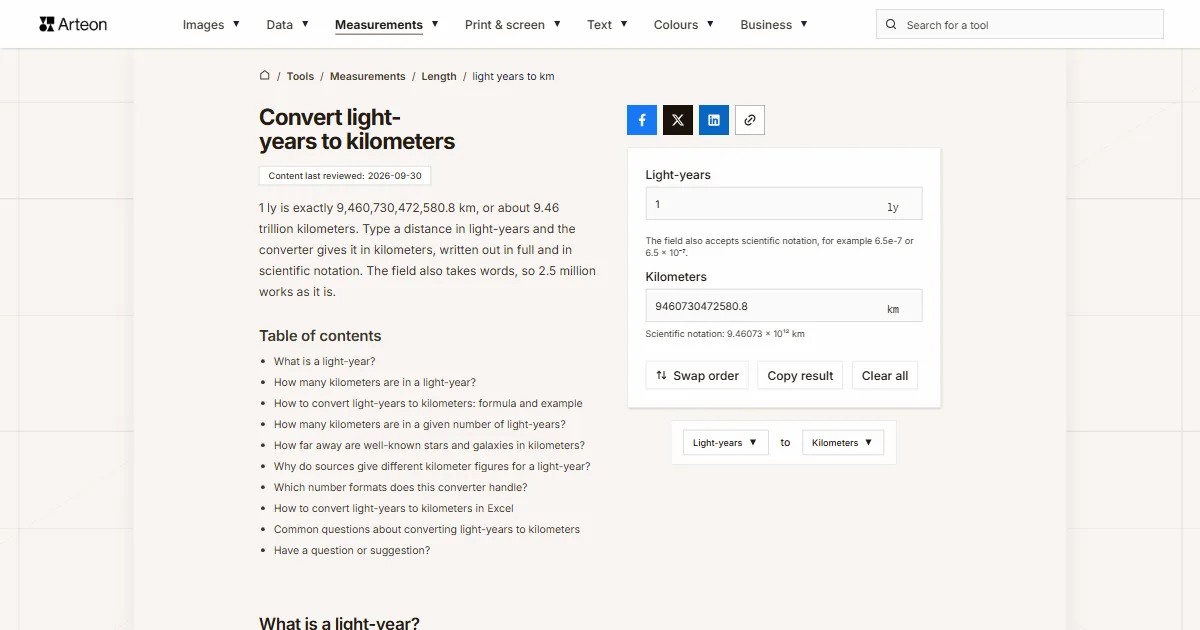
1 ly is exactly 9,460,730,472,580.8 km, or about 9.46 trillion kilometers. Type a distance in light-years and the converter gives it in kilometers, written out in full and in scientific notation. The field also takes words, so 2.5 million works as it is.
The field also accepts scientific notation, for example 6.5e-7 or 6.5 × 10⁻⁷.
What is a light-year?
A light-year is a unit of distance. The International Astronomical Union defines it as the distance light travels in a vacuum in one Julian year of 365.25 days, and gives it the symbol ly[1].
Its length follows from two numbers. A Julian year has 31,557,600 seconds[1], and the speed of light in a vacuum is exactly 299,792,458 m/s[2]. Multiply them and you get a distance that nobody has to measure, because it comes straight from the definition.
You will mostly meet the light-year in popular science books, articles and museum displays. In research papers astronomers usually give star distances in parsecs, and distances inside the Solar System in astronomical units[1]. You can turn the latter into kilometers with the au to km converter.
How many kilometers are in a light-year?
A light-year is exactly 9,460,730,472,580.8 km[1]. Rounded, that is 9.46 trillion kilometers or about 5.88 trillion miles[3]. To get miles for any other distance, run the kilometers through the km to miles converter.
Older British books can trip you up here. Before 1974, a British billion meant a million million, the number that is called a trillion today[4]. A pre-1974 text that puts a light-year at about 9.5 billion kilometers means the same distance as a modern one that says 9.5 trillion.
In scientific notation, which UK schools call standard form, a light-year is 9.4607304725808 × 10¹² km. The exponent 12 tells you how many places the decimal point moves to the right to give the full number. The converter shows this form under the result field in the Scientific notation line, rounded to six digits: 9.46073 × 10¹² km.
How to convert light-years to kilometers: formula and example
Multiply the number of light-years by the length of one light-year: kilometers = light-years × 9,460,730,472,580.8. To go the other way, divide: light-years = kilometers ÷ 9,460,730,472,580.8.
Proxima Centauri, the nearest known star after the Sun, is about 4.24 light-years away[5]. Multiplying gives 40,113,497,203,742.6 km, a little over 40 trillion kilometers. The light reaching Earth from that star today set off more than four years ago.
The converter shows results to fifteen significant digits, because that is how many digits a browser keeps in a number without rounding error. A longer result is rounded at the fifteenth digit and the rest are shown as zeros: 124 light-years gives 1,173,130,578,600,020 km, although the exact product ends in 019.2. If you start from kilometers, use the km to light years converter.
How many kilometers are in a given number of light-years?
| Light-years | Kilometers | Scientific notation |
|---|---|---|
| 0.001 ly | 9,460,730,472.581 km | 9.460730473 × 10⁹ km |
| 0.01 ly | 94,607,304,725.808 km | 9.460730473 × 10¹⁰ km |
| 0.1 ly | 946,073,047,258.08 km | 9.460730473 × 10¹¹ km |
| 0.5 ly | 4,730,365,236,290.4 km | 4.730365236 × 10¹² km |
| 1 ly | 9,460,730,472,580.8 km | 9.460730473 × 10¹² km |
| 2 ly | 18,921,460,945,161.6 km | 1.892146095 × 10¹³ km |
| 3 ly | 28,382,191,417,742.4 km | 2.838219142 × 10¹³ km |
| 4 ly | 37,842,921,890,323.2 km | 3.784292189 × 10¹³ km |
| 4.2 ly | 39,735,067,984,839.4 km | 3.973506798 × 10¹³ km |
| 5 ly | 47,303,652,362,904 km | 4.730365236 × 10¹³ km |
| 10 ly | 94,607,304,725,808 km | 9.460730473 × 10¹³ km |
| 12.5 ly | 118,259,130,907,260 km | 1.182591309 × 10¹⁴ km |
| 20 ly | 189,214,609,451,616 km | 1.892146095 × 10¹⁴ km |
| 25 ly | 236,518,261,814,520 km | 2.365182618 × 10¹⁴ km |
| 40 ly | 378,429,218,903,232 km | 3.784292189 × 10¹⁴ km |
| 50 ly | 473,036,523,629,040 km | 4.730365236 × 10¹⁴ km |
| 100 ly | 946,073,047,258,080 km | 9.460730473 × 10¹⁴ km |
| 500 ly | 4,730,365,236,290,400 km | 4.730365236 × 10¹⁵ km |
| 1,000 ly | 9,460,730,472,580,800 km | 9.460730473 × 10¹⁵ km |
| 10,000 ly | 94,607,304,725,808,000 km | 9.460730473 × 10¹⁶ km |
| 100,000 ly | 946,073,047,258,080,000 km | 9.460730473 × 10¹⁷ km |
| 1,000,000 ly | 9,460,730,472,580,800,000 km | 9.460730473 × 10¹⁸ km |
| 50,000,000 ly | 473,036,523,629,040,000,000 km | 4.730365236 × 10²⁰ km |
| 1,000,000,000 ly | 9,460,730,472,580,800,000,000 km | 9.460730473 × 10²¹ km |
How far away are well-known stars and galaxies in kilometers?
| Object | Distance | Kilometers | Scientific notation |
|---|---|---|---|
| Nushagak (HD 17156), named by the United States | 253 ly | 2,393,564,809,562,940 km | 2.39356481 × 10¹⁵ km |
| Gloas (WASP-13), named by the United Kingdom | 750 ly | 7,095,547,854,435,600 km | 7.095547854 × 10¹⁵ km |
| Bubup (HD 38283), named by Australia | 124 ly | 1,173,130,578,600,020 km | 1.173130579 × 10¹⁵ km |
| Sirius | 8.6 ly | 81,362,282,064,194.9 km | 8.136228206 × 10¹³ km |
| Gaia BH1, the nearest known black hole | 1,560 ly | 14,758,739,537,226,100 km | 1.475873954 × 10¹⁶ km |
| Centre of the Milky Way | 26,000 ly | 245,978,992,287,101,000 km | 2.459789923 × 10¹⁷ km |
| Width of the Milky Way | 100,000 ly | 946,073,047,258,080,000 km | 9.460730473 × 10¹⁷ km |
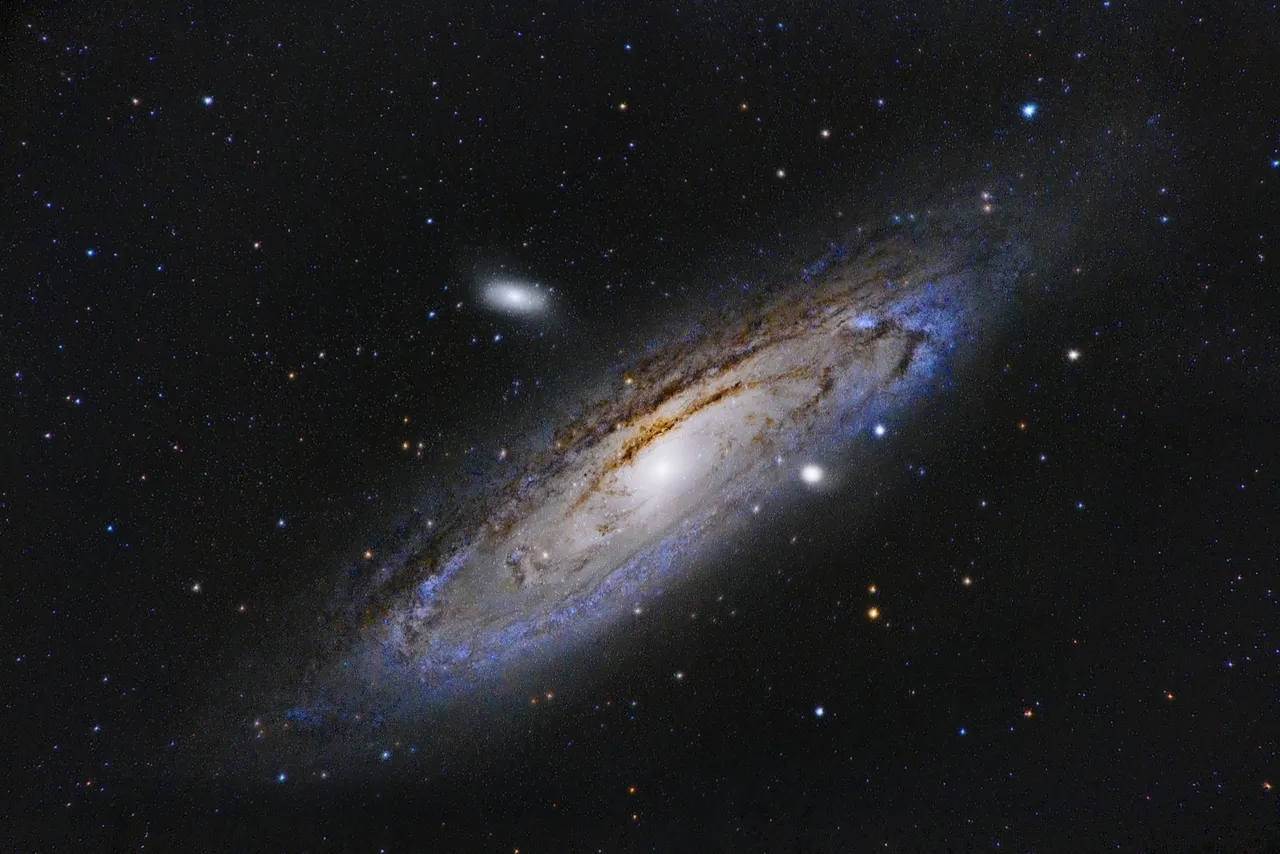
| Andromeda Galaxy | 2,500,000 ly | 23,651,826,181,452,000,000 km | 2.365182618 × 10¹⁹ km |
| Triangulum Galaxy | 3,000,000 ly | 28,382,191,417,742,400,000 km | 2.838219142 × 10¹⁹ km |
Why do sources give different kilometer figures for a light-year?
| Worked out from | Light-year | Difference from the definition |
|---|---|---|
| Julian year, 365.25 days (IAU definition) | 9,460,730,472,580.8 km | exact value |
| Gregorian year, 365.2425 days | 9.460536207 × 10¹² km | 194,265,580.8 km less |
| Tropical year of epoch 1900 and today's speed of light | 9.460528405 × 10¹² km | 202,067,580.8 km less |
| IAU system of constants from 1964 | 9.460530 × 10¹² km | 200,472,580.8 km less |
| Rounded to 9.46 trillion km | 9,460,000,000,000 km | 730,472,580.8 km less |
Which number formats does this converter handle?
| What you type | What the converter shows | How we read it |
|---|---|---|
| 4.24 | 40113497203742.6 km | The decimal point is read exactly as English writes it. |
| 4,24 | 40113497203742.6 km | A comma with two digits after it is read as a decimal comma, the way most of Europe writes it. |
| 1,500 | 14191095708871200 km | A comma followed by three digits is a thousands separator, so the field converts one thousand five hundred light-years. A note under the field shows the other possible reading, 1.5. |
| 1.500 | 14191095708871.2 km | A point is the decimal mark in English, so this reads as one and a half light-years. A note under the field shows the other possible reading, 1500. |
| 2,500,000 | 23651826181452000000 km | Commas between the thousands are skipped, so the field converts two and a half million light-years. |
| 2.5 million | 23651826181452000000 km | The word million multiplies the number by a million, which is how articles and textbooks give galaxy distances. |
| 2.5e6 | 23651826181452000000 km | Scientific notation from a calculator or spreadsheet is read as it stands: 2.5e6 is 2,500,000. |
| 2.5 × 10⁶ | 23651826181452000000 km | Standard form from a textbook, with a multiplication sign and a superscript exponent, works the same as 2.5e6. |
| 1/2 | 4730365236290.4 km | We work out a slash fraction ourselves, so half a light-year needs no conversion to 0.5 first. |
| 2½ | 23651826181452 km | The ½ character copied from a document is added to the number in front of it. |
| 4.24 ly | 40113497203742.6 km | A unit symbol pasted along with the number is left out and only the number is converted. |
How to convert light-years to kilometers in Excel
For a single value the converter is quicker. A whole column of distances takes one formula dragged down the sheet.
The CONVERT function
Excel knows the light-year as "ly", and the prefix k in front of the meter gives kilometers[9]. For a value in cell A1, type =CONVERT(A1,"ly","km"). A plain multiplication, =A1*9460730472580.8, gives the same result.Scientific format for long results
Select the result cells and apply the Scientific format from the Number group on the Home tab[10]. A light-year then shows as 9.46E+12, where E+12 means multiplied by 10¹².The precision limit
Excel keeps numbers to a maximum precision of 15 digits[10]. The light-year constant has fourteen, so it fits. A product with a number of several significant digits, such as 1,234 light-years, has more, and Excel turns the last digits of the result into zeros.
Convert other units to Kilometers
Sources
- Measuring the Universe: The IAU and astronomical units — International Astronomical Union
- The International System of Units (SI Brochure) — BIPM
- Voyager 1: What Is a Light-Day? — NASA
- Long and short scales — Wikipedia
- Light-year — Wikipedia
- HD 17156 — Wikipedia
- WASP-13 — Wikipedia
- HD 38283 — Wikipedia
- CONVERT function — Microsoft
- Display numbers in scientific (exponential) notation — Microsoft
Every figure in the tables was computed from the unit definitions and checked arithmetically before publication. Historical values and the names of local units come from the sources listed above.
Content last reviewed: · written and checked by the Arteon team
Common questions about converting light-years to kilometers
Is a light-year a unit of time?
No. A light-year measures distance, and the word year in the name only tells you how long light takes to cover it. That is why asking how many years are in a light-year has no answer in years, only in kilometers or miles.
How many astronomical units are in a light-year?
About 63,241 astronomical units[1]. An astronomical unit is roughly the average distance between the Earth and the Sun, and the au to km converter gives its exact length in kilometers.
How many light-years are in a parsec?
About 3.26 light-years. The IAU puts a parsec at roughly 30.857 × 10¹² km[1], and dividing that by the length of a light-year gives 3.2616.
How long would it take to drive a light-year?
At a steady 60 mph, about 11.2 million years. Sixty miles an hour is 96.56 km/h, so a car covers about 846,450 km in a Julian year without stopping, and 9,460,730,472,580.8 km divided by that is roughly 11.18 million.
Have a question or suggestion?
If a distance you need is missing from the tables or you spot a mistake in a result, write to us.