Convert kilograms to milligrams
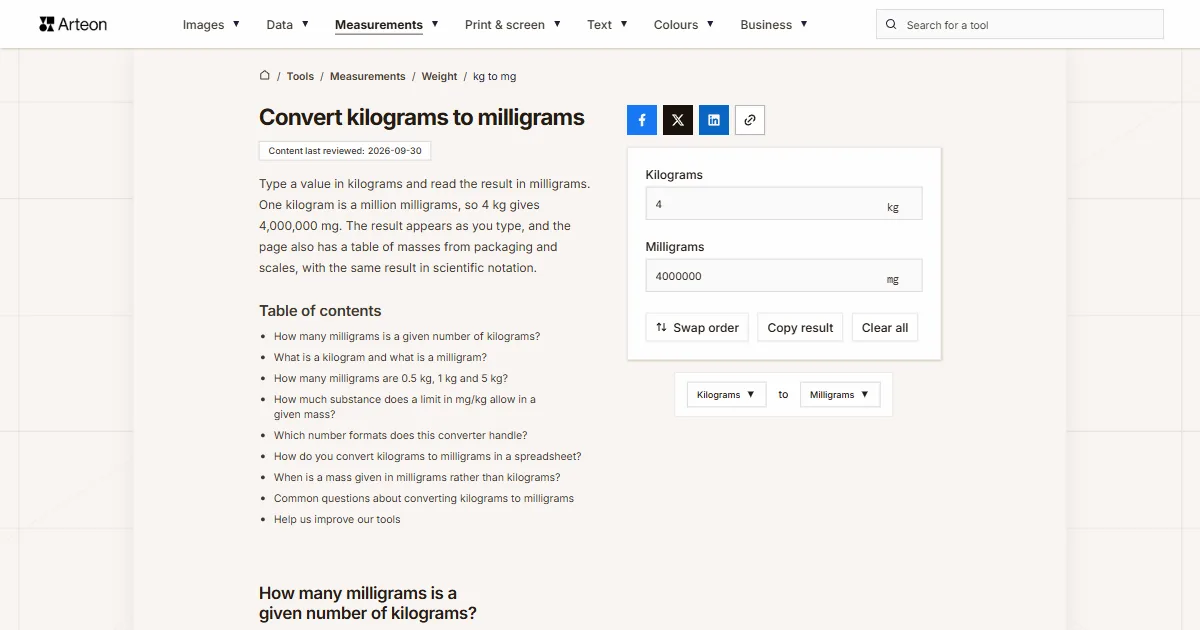
Type a value in kilograms and read the result in milligrams. One kilogram is a million milligrams, so 4 kg gives 4,000,000 mg. The result appears as you type, and the page also has a table of masses from packaging and scales, with the same result in scientific notation.
How many milligrams is a given number of kilograms?
Multiply the number of kilograms by a million and you have the value in milligrams. Four kilograms come to 4,000,000 mg.
Formula: milligrams = kilograms × 1,000,000
The multiplier is round because it is built from two steps of a thousand: a kilogram splits into a thousand grams, and a gram into a thousand milligrams[1].
In your head, add six zeros or move the decimal point six places to the right. Half a kilogram is 500,000 mg. A quarter of a kilogram is 250,000 mg. A hundredth of a kilogram, 0.01 kg, gives 10,000 mg.
Direction matters here, because the answer grows by six orders of magnitude. A body mass of 70 kg written in milligrams is 70,000,000 mg, a figure that reads more easily in scientific notation, and the conversion table has that column.
Below a kilogram the very same multiplier applies. A 0.05 kg weight is 50,000 mg and a 0.001 kg sample is exactly one gram.
For the opposite direction, use the milligrams to kilograms converter.
What is a kilogram and what is a milligram?
The kilogram is the SI base unit of mass, and since 2019 its value has been based on a fixed numerical value of the Planck constant, 6.626 070 15 × 10⁻³⁴ expressed in the unit joule second[2]. A scale reads the same figure after that change as before it; what is new is only the way the standard is realised.
The gram is one thousandth of a kilogram[3], and it is the gram that takes the prefixes, because the name of the base unit already carries kilo. That is where the milligram comes from: the prefix milli means one thousandth[1], so a milligram is a thousandth of a gram and a millionth of a kilogram at the same time.
Both units measure the same physical quantity on a different scale. Kilograms are used for shopping and body mass; milligrams for a dose, a nutrient on a label and a laboratory sample. A laboratory balance reads masses in the milligram range.
The microgram, a millionth of a gram, is a thousand times smaller than the milligram, and the tonne is a thousand times larger than the kilogram. To convert kilograms to grams, use the separate converter.
How many milligrams are 0.5 kg, 1 kg and 5 kg?
| Kilograms | Milligrams | Scientific notation | Grams |
|---|---|---|---|
| 0.001 kg | 1,000 mg | 1 × 10³ mg | 1 g |
| 0.005 kg | 5,000 mg | 5 × 10³ mg | 5 g |
| 0.01 kg | 10,000 mg | 1 × 10⁴ mg | 10 g |
| 0.025 kg | 25,000 mg | 2.5 × 10⁴ mg | 25 g |
| 0.04 kg | 40,000 mg | 4 × 10⁴ mg | 40 g |
| 0.05 kg | 50,000 mg | 5 × 10⁴ mg | 50 g |
| 0.1 kg | 100,000 mg | 1 × 10⁵ mg | 100 g |
| 0.2 kg | 200,000 mg | 2 × 10⁵ mg | 200 g |
| 0.25 kg | 250,000 mg | 2.5 × 10⁵ mg | 250 g |
| 0.4 kg | 400,000 mg | 4 × 10⁵ mg | 400 g |
| 0.5 kg | 500,000 mg | 5 × 10⁵ mg | 500 g |
| 0.55 kg | 550,000 mg | 5.5 × 10⁵ mg | 550 g |
| 0.75 kg | 750,000 mg | 7.5 × 10⁵ mg | 750 g |
| 0.98 kg | 980,000 mg | 9.8 × 10⁵ mg | 980 g |
| 1 kg | 1,000,000 mg | 1 × 10⁶ mg | 1,000 g |
| 1.2 kg | 1,200,000 mg | 1.2 × 10⁶ mg | 1,200 g |
| 1.5 kg | 1,500,000 mg | 1.5 × 10⁶ mg | 1,500 g |
| 2 kg | 2,000,000 mg | 2 × 10⁶ mg | 2,000 g |
| 2.25 kg | 2,250,000 mg | 2.25 × 10⁶ mg | 2,250 g |
| 2.5 kg | 2,500,000 mg | 2.5 × 10⁶ mg | 2,500 g |
| 2.77 kg | 2,770,000 mg | 2.77 × 10⁶ mg | 2,770 g |
| 3 kg | 3,000,000 mg | 3 × 10⁶ mg | 3,000 g |
| 3.1 kg | 3,100,000 mg | 3.1 × 10⁶ mg | 3,100 g |
| 3.5 kg | 3,500,000 mg | 3.5 × 10⁶ mg | 3,500 g |
| 3.92 kg | 3,920,000 mg | 3.92 × 10⁶ mg | 3,920 g |
| 4 kg | 4,000,000 mg | 4 × 10⁶ mg | 4,000 g |
| 4.5 kg | 4,500,000 mg | 4.5 × 10⁶ mg | 4,500 g |
| 5 kg | 5,000,000 mg | 5 × 10⁶ mg | 5,000 g |
| 5.2 kg | 5,200,000 mg | 5.2 × 10⁶ mg | 5,200 g |
| 5.6 kg | 5,600,000 mg | 5.6 × 10⁶ mg | 5,600 g |
| 6 kg | 6,000,000 mg | 6 × 10⁶ mg | 6,000 g |
| 7 kg | 7,000,000 mg | 7 × 10⁶ mg | 7,000 g |
| 8 kg | 8,000,000 mg | 8 × 10⁶ mg | 8,000 g |
| 10 kg | 10,000,000 mg | 1 × 10⁷ mg | 10,000 g |
| 15 kg | 15,000,000 mg | 1.5 × 10⁷ mg | 15,000 g |
| 20 kg | 20,000,000 mg | 2 × 10⁷ mg | 20,000 g |
| 25 kg | 25,000,000 mg | 2.5 × 10⁷ mg | 25,000 g |
| 30 kg | 30,000,000 mg | 3 × 10⁷ mg | 30,000 g |
| 34 kg | 34,000,000 mg | 3.4 × 10⁷ mg | 34,000 g |
| 38 kg | 38,000,000 mg | 3.8 × 10⁷ mg | 38,000 g |
| 50 kg | 50,000,000 mg | 5 × 10⁷ mg | 50,000 g |
| 60 kg | 60,000,000 mg | 6 × 10⁷ mg | 60,000 g |
| 70 kg | 70,000,000 mg | 7 × 10⁷ mg | 70,000 g |
| 75 kg | 75,000,000 mg | 7.5 × 10⁷ mg | 75,000 g |
| 100 kg | 100,000,000 mg | 1 × 10⁸ mg | 100,000 g |
| 500 kg | 500,000,000 mg | 5 × 10⁸ mg | 500,000 g |
| 1,000 kg | 1,000,000,000 mg | 1 × 10⁹ mg | 1,000,000 g |
How much substance does a limit in mg/kg allow in a given mass?
| Limit | In 100 g | In 1 kg | In a 25 kg sack | In a tonne |
|---|---|---|---|---|
| 0.01 mg/kg | 0.001 mg | 0.01 mg | 0.25 mg | 10 mg |
| 0.02 mg/kg | 0.002 mg | 0.02 mg | 0.5 mg | 20 mg |
| 0.05 mg/kg | 0.005 mg | 0.05 mg | 1.25 mg | 50 mg |
| 0.1 mg/kg | 0.01 mg | 0.1 mg | 2.5 mg | 100 mg |
| 0.2 mg/kg | 0.02 mg | 0.2 mg | 5 mg | 200 mg |
| 0.5 mg/kg | 0.05 mg | 0.5 mg | 12.5 mg | 500 mg |
| 1 mg/kg | 0.1 mg | 1 mg | 25 mg | 1,000 mg |
| 2 mg/kg | 0.2 mg | 2 mg | 50 mg | 2,000 mg |
| 5 mg/kg | 0.5 mg | 5 mg | 125 mg | 5,000 mg |
| 10 mg/kg | 1 mg | 10 mg | 250 mg | 10,000 mg |
| 20 mg/kg | 2 mg | 20 mg | 500 mg | 20,000 mg |
| 50 mg/kg | 5 mg | 50 mg | 1,250 mg | 50,000 mg |
Which number formats does this converter handle?
| What you type | What the converter shows | How we read it |
|---|---|---|
| 2.5 | 2500000 mg | The decimal point from the numeric keypad, written the way English writes it |
| 2,5 | 2500000 mg | A comma pasted from a market that writes decimals that way is read as a decimal point, so the result is the same |
| 1,500 | 1500000000 mg | Three digits follow the comma, so we read it as a thousands separator: the field holds one thousand five hundred. A note under the field shows the other possible reading, 1.5. |
| 3/4 | 750000 mg | We work the fraction out ourselves, so there is no need to turn it into a decimal first |
| 3½ | 3500000 mg | The ½ character copied from a recipe or a label is added to the number in front of it |
| 2.5 kg | 2500000 mg | A unit symbol pasted along with the number is no trouble: we take the number and leave the symbol out |
How do you convert kilograms to milligrams in a spreadsheet?
The arithmetic comes down to a single multiplication, and Excel also has a built-in function with a list of units. These steps cover both, along with the way large numbers are written.
Type the number of kilograms into a cell
Say it is in cell A1. There may be more values — put them one under another so the formula from the next step can be dragged down the column.Multiply that cell by a million
In the next cell type=A1*1000000. For 4 kg the sheet shows 4000000, and for 0.25 kg it shows 250000.Or use the CONVERT function
Its syntax isCONVERT(number, from_unit, to_unit)[5]. The gram is coded as "g", kilo as "k" and milli as "m", so the conversion reads=CONVERT(A1,"kg","mg").Keep large numbers readable
Seventy kilograms give 70,000,000 mg, so the column grows wide fast. A cell format with a thousands separator splits the figure every three digits, and scientific format shortens it to 7E+07.
When is a mass given in milligrams rather than kilograms?
The order of magnitude decides, and the aim is a figure that reads without a run of zeros. Vitamin C listed as 80 mg would appear in kilograms as 0.00008 kg, so the label stays with milligrams. A 25 kg sack of cement written in milligrams is 25,000,000 mg, eight digits, so the packaging stays with kilograms.
The same rule applies in the laboratory and in industry. A sample for analysis is weighed out in milligrams, because that is the range a laboratory balance reads, while a delivery of raw material is counted in kilograms or tonnes.
Between the two is the gram, and that is the unit for masses in the middle: a portion of a product, a weighed-out sample, the contents of a pack. For values in grams, use the grams to kilograms converter.
Convert other units to Milligrams
Convert Kilograms to other units
Sources
- Metric (SI) Prefixes — National Institute of Standards and Technology
- SI base unit: kilogram (kg) — International Bureau of Weights and Measures (BIPM)
- Gram — Wikipedia
- Pesticide Registration Manual: Chapter 11 — Tolerance Petitions — United States Environmental Protection Agency
- CONVERT function — Microsoft
Every figure in the tables was computed from the unit definitions and checked arithmetically before publication. Historical values and the names of local units come from the sources listed above.
Content last reviewed: · written and checked by the Arteon team
Common questions about converting kilograms to milligrams
How many milligrams are in 1 kg?
1,000,000 mg. A kilogram splits into a thousand grams and each gram into a thousand milligrams, which makes a million together. Milligrams back into grams go through the mg to g converter.
How many milligrams are in half a kilogram?
500,000 mg. A quarter of a kilogram is 250,000 mg, and 0.1 kg is 100,000 mg.
How do you convert kg to mg in your head?
Add six zeros, or move the decimal point six places to the right. 2 kg becomes 2,000,000 mg and 0.75 kg becomes 750,000 mg.
How many milligrams is a body mass of 70 kg?
70,000,000 mg, or 7 × 10⁷ mg. In practice body mass stays in kilograms, because doses are given in milligrams per kilogram of that mass.
What is the difference between kg and mg in writing?
The prefix. The symbol kg means kilogram, a thousand grams, while mg means milligram, a thousandth of a gram. A million separates them. Both prefixes are written in lower case and attach to the same letter g; capital M is a different prefix, mega, meaning a million.
Will the field take a decimal?
Yes. The field accepts a point or a comma as the decimal mark, and a common fraction such as 1/2 or 2 1/4. The result appears as you type.
How do you write a large number of milligrams in scientific notation?
One kilogram is 1 × 10⁶ mg, ten kilograms is 1 × 10⁷ mg and a hundred kilograms is 1 × 10⁸ mg. The conversion table has a column with that notation.
Help us improve our tools
Have an idea for a feature, found a bug, or want to suggest another tool? Write to us.