Convert yards to inches
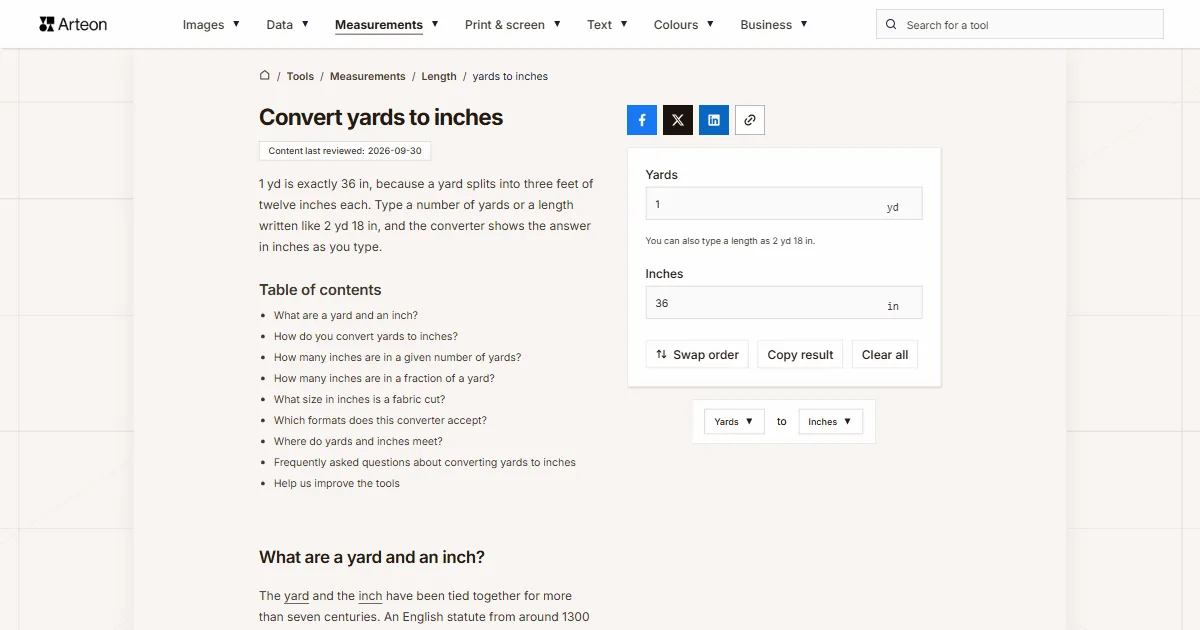
1 yd is exactly 36 in, because a yard splits into three feet of twelve inches each. Type a number of yards or a length written like 2 yd 18 in, and the converter shows the answer in inches as you type.
You can also type a length as 2 yd 18 in.
What are a yard and an inch?
The yard and the inch have been tied together for more than seven centuries. An English statute from around 1300 says that the 36th part of the king's yard makes one inch, neither more nor less, and in the same sentence splits the yard into three feet of twelve inches[1]. That split is still the one you use today, and the yards to feet converter handles its middle step.
What changed is how long the yard itself is. Since 1 July 1959 it has been exactly 0.9144 meters, and the inch, taken as its 36th part, is exactly 25.4 millimeters[2]. The same yard in metric units is covered by the yards to cm converter.
How do you convert yards to inches?
Multiply the number of yards by 36. For 2.5 yards that gives 2.5 × 36 = 90, so 90 inches.
You can also go in two steps: yards times 3 gives feet, and feet times 12 gives inches. For 2.5 yards that's 7.5 feet and then 90 inches. Both routes land on the same number, because 3 × 12 is 36.
A length written as yards and inches works the same way, with the leftover added at the end. 2 yd 18 in is 2 × 36 + 18, which is 90 inches. You can type it into the field just like that, and the converter joins both parts into one number.
Dividing by 36 instead, to get from inches back to yards, is the job of the inches to yards converter.
How many inches are in a given number of yards?
| Yards | Inches | Feet |
|---|---|---|
| 0.125 yd | 4.5 in | 0.375 ft |
| 0.25 yd | 9 in | 0.75 ft |
| 0.5 yd | 18 in | 1.5 ft |
| 0.75 yd | 27 in | 2.25 ft |
| 1 yd | 36 in | 3 ft |
| 1.25 yd | 45 in | 3.75 ft |
| 1.5 yd | 54 in | 4.5 ft |
| 1.75 yd | 63 in | 5.25 ft |
| 2 yd | 72 in | 6 ft |
| 2.25 yd | 81 in | 6.75 ft |
| 2.5 yd | 90 in | 7.5 ft |
| 3 yd | 108 in | 9 ft |
| 3.5 yd | 126 in | 10.5 ft |
| 4 yd | 144 in | 12 ft |
| 4.5 yd | 162 in | 13.5 ft |
| 5 yd | 180 in | 15 ft |
| 6 yd | 216 in | 18 ft |
| 7 yd | 252 in | 21 ft |
| 8 yd | 288 in | 24 ft |
| 9 yd | 324 in | 27 ft |
| 10 yd | 360 in | 30 ft |
| 12 yd | 432 in | 36 ft |
| 15 yd | 540 in | 45 ft |
| 20 yd | 720 in | 60 ft |
| 22 yd | 792 in | 66 ft |
| 25 yd | 900 in | 75 ft |
| 30 yd | 1,080 in | 90 ft |
| 40 yd | 1,440 in | 120 ft |
| 50 yd | 1,800 in | 150 ft |
| 60 yd | 2,160 in | 180 ft |
| 75 yd | 2,700 in | 225 ft |
| 100 yd | 3,600 in | 300 ft |
| 110 yd | 3,960 in | 330 ft |
| 200 yd | 7,200 in | 600 ft |
| 500 yd | 18,000 in | 1,500 ft |
| 1,000 yd | 36,000 in | 3,000 ft |
| 1,760 yd | 63,360 in | 5,280 ft |
How many inches are in a fraction of a yard?
| Fraction of a yard | Inches | Feet and inches |
|---|---|---|
| 1/16 yd | 2.25 in | 0 ft 2.25 in |
| 1/8 yd | 4.5 in | 0 ft 4.5 in |
| 1/6 yd | 6 in | 0 ft 6 in |
| 1/4 yd | 9 in | 0 ft 9 in |
| 1/3 yd | 12 in | 1 ft 0 in |
| 3/8 yd | 13.5 in | 1 ft 1.5 in |
| 1/2 yd | 18 in | 1 ft 6 in |
| 5/8 yd | 22.5 in | 1 ft 10.5 in |
| 2/3 yd | 24 in | 2 ft 0 in |
| 3/4 yd | 27 in | 2 ft 3 in |
| 7/8 yd | 31.5 in | 2 ft 7.5 in |
| 1 yd | 36 in | 3 ft 0 in |
What size in inches is a fabric cut?
| Fabric cut | Length | Size at 45 in wide | Size at 60 in wide |
|---|---|---|---|
| 1 yd | 36 in | 36 × 45 in | 36 × 60 in |
| 1/2 yd | 18 in | 18 × 45 in | 18 × 60 in |
| 1/4 yd | 9 in | 9 × 45 in | 9 × 60 in |
| 1/8 yd | 4.5 in | 4.5 × 45 in | 4.5 × 60 in |
| Fat quarter | 18 in | 18 × 22.5 in | 18 × 30 in |
| Fat eighth | 9 in | 9 × 22.5 in | 9 × 30 in |
Which formats does this converter accept?
| What you type | What the converter shows | Note |
|---|---|---|
| 2.5 | 90 in | A plain number is read as yards, with the period as the decimal point. |
| 1,500 | 54000 in | A comma followed by three digits groups thousands, so the field reads fifteen hundred yards. A note under the field shows the other possible reading, 1.5. |
| 2,5 | 90 in | A comma with fewer than three digits after it is a decimal comma from a European document, so we read two and a half yards. |
| 3/4 | 27 in | We work out a fraction with a slash ourselves, so three quarters of a yard doesn't need to become 0.75 first. |
| 2½ | 90 in | The ½ character copied from a pattern is added to the number in front of it. |
| 1 1/2 yd | 54 in | A mixed number with the yard symbol, the way yardage is written on a pattern envelope, reads as one and a half yards. |
| 1-1/2 yd | 54 in | The hyphen between the whole number and the fraction, a common American way of writing yardage, reads like a space, so this is one and a half yards. |
| 2 yd 18 in | 90 in | Yards and inches are joined into one length: two yards are 72 inches, and 18 inches are added to that. |
| 2 yd 18 | 90 in | The second part always means inches, so you can leave out the in. |
| 2 yards 18 inches | 90 in | Spelled-out unit names are read the same way as the symbols yd and in. |
| 18 in | 18 in | Inches with the symbol are read as inches, so the result matches what you typed. |
| 60" | 60 in | The double quote is the inch mark used for fabric widths, so 60" counts as 60 inches. |
Where do yards and inches meet?
One place they meet is the US classroom. The Grade 4 math standard asks students to express a measurement in a larger unit in terms of a smaller one and to record the pairs in a two-column table[5]. A two-column yards and inches table is exactly that, and the converter checks any row a worksheet adds.
At the fabric counter and the quilting table the two units meet every day. Yardage comes in yards and fractions of a yard, while block sizes, seam allowances and bolt widths are all in inches, so comparing them means bringing everything to inches first. A fat quarter of 18 × 22.5 inches, for example, gives four 9-inch squares with a 4.5-inch strip left over, because 22.5 inches is two 9s plus 4.5.

Convert other units to Inches
Convert Yards to other units
Sources
- Yard — Wikipedia
- SI Units – Length — National Institute of Standards and Technology
- Law 6 – The pitch — Marylebone Cricket Club
- Bolt (cloth) — Wikipedia
- Grade 4 – Measurement & Data — Common Core State Standards Initiative
Every figure in the tables was computed from the unit definitions and checked arithmetically before publication. Historical values and the names of local units come from the sources listed above.
Content last reviewed: · written and checked by the Arteon team
Frequently asked questions about converting yards to inches
Is 36 inches 3 yards?
No. 36 inches is one yard. Three yards are 108 inches, and the 3 you may be thinking of is the number of feet in a yard.
How many 5-inch squares can you cut from a yard of fabric?
From a yard 45 inches wide you get 63: seven rows along the 36-inch length and nine squares across the width. If trimming the selvages leaves between 40 and 45 inches, one square per row drops out and you get 56. For 10-inch squares the same yard gives 3 rows of 4, so 12.
How many square inches are in a square yard?
A square yard has 1,296 square inches, because a square with 36-inch sides covers 36 × 36. This converter handles length, so for area you multiply by 1,296.
How many more inches does a meter have than a yard?
About 3.37 inches. A meter is 39.3701 inches and a yard is 36. Meters to inches are handled by the meters to inches converter.
Help us improve the tools
Write to us if a yard fraction or fabric size you need is missing from the tables. We read every message and update the pages.