Convert astronomical units to kilometers
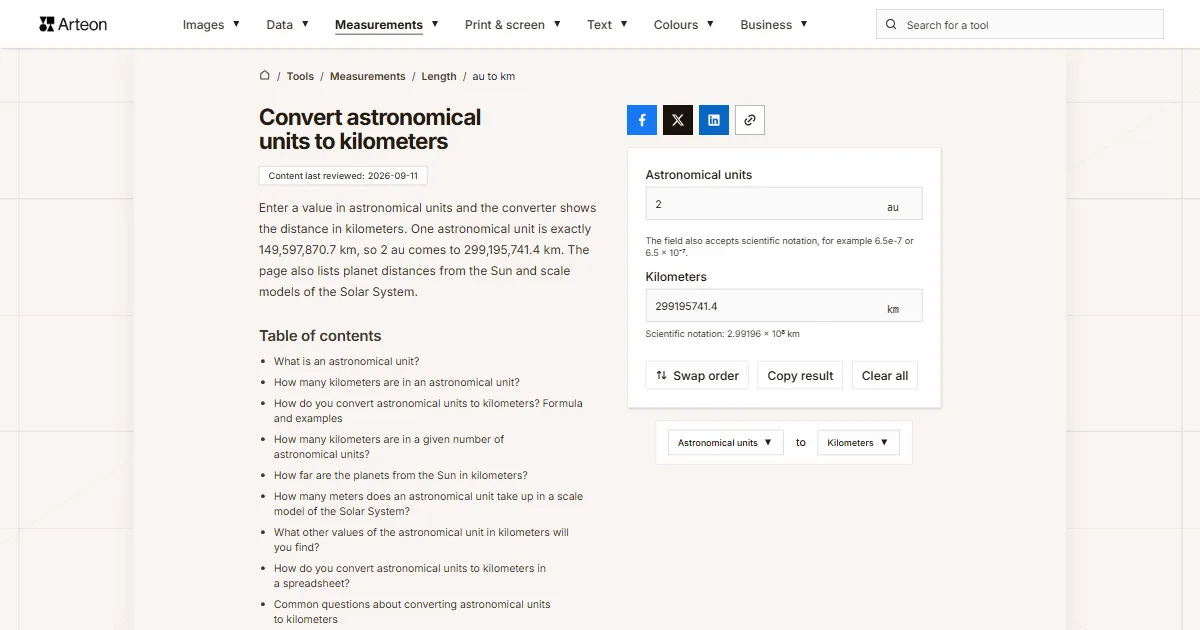
Enter a value in astronomical units and the converter shows the distance in kilometers. One astronomical unit is exactly 149,597,870.7 km, so 2 au comes to 299,195,741.4 km. The page also lists planet distances from the Sun and scale models of the Solar System.
The field also accepts scientific notation, for example 6.5e-7 or 6.5 × 10⁻⁷.
What is an astronomical unit?
The astronomical unit is used mainly to measure distances within the Solar System or around other stars[1]. It was originally conceived as the average distance between Earth and the Sun, the average of Earth's aphelion and perihelion (its farthest and closest points from the Sun)[1].
Since 2012 the unit has had a conventional value of exactly 149,597,870,700 meters. The XXVIII General Assembly of the International Astronomical Union set that value in Resolution B2 and recommended a single symbol for the unit, au[2]. Journals of the American Astronomical Society and the Royal Astronomical Society later adopted that symbol[1].
The astronomical unit is a non-SI unit. The SI Brochure of the International Bureau of Weights and Measures lists it in its table of non-SI units with the value 1 au = 149,597,870,700 m[3].
How many kilometers are in an astronomical unit?
An astronomical unit is exactly 149,597,870.7 kilometers. That figure is the definition in meters divided by 1,000.
Rounded, the unit is 150 million kilometers, or 93 million miles[4]. With the exact value, two astronomical units come to 299,195,741.4 kilometers. Half an astronomical unit is 74,798,935.35 kilometers.
Ten astronomical units equal 1,495,978,707 kilometers. For whole tens you only move the decimal point of the constant to the right, so no written multiplication is needed.
In scientific notation one astronomical unit is 1.495978707 × 10⁸ km. The notation keeps one digit before the decimal point, and the exponent gives the number of places the point moves to the right.
Light travels one astronomical unit in about 499 seconds, slightly more than 8 minutes 19 seconds[1].
The converter above works in both directions and updates the result as you type. It shows small values with ten significant digits, counted from the first non-zero digit.
How do you convert astronomical units to kilometers? Formula and examples
The conversion uses one constant: an astronomical unit is 149,597,870.7 kilometers. To turn astronomical units into kilometers, multiply by that constant.
The formula: kilometers = astronomical units × 149,597,870.7. The other way: astronomical units = kilometers ÷ 149,597,870.7.
Three examples show different scales. The semi-major axis of Jupiter's orbit is about 5.2 astronomical units[5]. Multiplied by the constant, that gives 777,908,927.64 kilometers. A value of 0.04 au is 5,983,914.828 kilometers. One hundred astronomical units come to 14,959,787,070 kilometers, almost 15 billion.
For a result in meters, multiply by 149,597,870,700, or convert kilometers with the km to meters converter. You can convert a distance given in kilometers into astronomical units with the km to au converter.
How many kilometers are in a given number of astronomical units?
| Astronomical units | Kilometers | Scientific notation |
|---|---|---|
| 0.001 au | 149,597.8707 km | 1.495978707 × 10⁵ km |
| 0.01 au | 1,495,978.707 km | 1.495978707 × 10⁶ km |
| 0.04 au | 5,983,914.828 km | 5.983914828 × 10⁶ km |
| 0.05 au | 7,479,893.535 km | 7.479893535 × 10⁶ km |
| 0.1 au | 14,959,787.07 km | 1.495978707 × 10⁷ km |
| 0.2 au | 29,919,574.14 km | 2.991957414 × 10⁷ km |
| 0.25 au | 37,399,467.675 km | 3.739946767 × 10⁷ km |
| 0.3 au | 44,879,361.21 km | 4.487936121 × 10⁷ km |
| 0.39 au | 58,343,169.573 km | 5.834316957 × 10⁷ km |
| 0.4 au | 59,839,148.28 km | 5.983914828 × 10⁷ km |
| 0.5 au | 74,798,935.35 km | 7.479893535 × 10⁷ km |
| 0.72 au | 107,710,466.904 km | 1.077104669 × 10⁸ km |
| 0.75 au | 112,198,403.025 km | 1.12198403 × 10⁸ km |
| 1 au | 149,597,870.7 km | 1.495978707 × 10⁸ km |
| 1.5 au | 224,396,806.05 km | 2.24396806 × 10⁸ km |
| 1.52 au | 227,388,763.464 km | 2.273887635 × 10⁸ km |
| 1.8 au | 269,276,167.26 km | 2.692761673 × 10⁸ km |
| 2 au | 299,195,741.4 km | 2.991957414 × 10⁸ km |
| 2.5 au | 373,994,676.75 km | 3.739946768 × 10⁸ km |
| 2.77 au | 414,386,101.839 km | 4.143861018 × 10⁸ km |
| 3 au | 448,793,612.1 km | 4.487936121 × 10⁸ km |
| 4 au | 598,391,482.8 km | 5.983914828 × 10⁸ km |
| 5 au | 747,989,353.5 km | 7.479893535 × 10⁸ km |
| 5.2 au | 777,908,927.64 km | 7.779089276 × 10⁸ km |
| 6 au | 897,587,224.2 km | 8.975872242 × 10⁸ km |
| 8 au | 1,196,782,965.6 km | 1.196782966 × 10⁹ km |
| 9.54 au | 1,427,163,686.478 km | 1.427163686 × 10⁹ km |
| 10 au | 1,495,978,707 km | 1.495978707 × 10⁹ km |
| 15 au | 2,243,968,060.5 km | 2.243968061 × 10⁹ km |
| 19.2 au | 2,872,279,117.44 km | 2.872279117 × 10⁹ km |
| 20 au | 2,991,957,414 km | 2.991957414 × 10⁹ km |
| 25 au | 3,739,946,767.5 km | 3.739946767 × 10⁹ km |
| 30 au | 4,487,936,121 km | 4.487936121 × 10⁹ km |
| 30.07 au | 4,498,407,971.949 km | 4.498407972 × 10⁹ km |
| 39.5 au | 5,909,115,892.65 km | 5.909115893 × 10⁹ km |
| 40 au | 5,983,914,828 km | 5.983914828 × 10⁹ km |
| 50 au | 7,479,893,535 km | 7.479893535 × 10⁹ km |
| 100 au | 14,959,787,070 km | 1.495978707 × 10¹⁰ km |
| 170 au | 25,431,638,019 km | 2.543163802 × 10¹⁰ km |
| 500 au | 74,798,935,350 km | 7.479893535 × 10¹⁰ km |
| 1,000 au | 149,597,870,700 km | 1.495978707 × 10¹¹ km |
How far are the planets from the Sun in kilometers?
| Planet | Semi-major axis | Kilometers | Millions of kilometers |
|---|---|---|---|
| Mercury | 0.38709927 au | 57,909,227 km | 57.9 million km |
| Venus | 0.72333566 au | 108,209,475 km | 108.2 million km |
| Earth (Earth–Moon barycenter) | 1.00000261 au | 149,598,261 km | 149.6 million km |
| Mars | 1.52371034 au | 227,943,822 km | 227.9 million km |
| Jupiter | 5.202887 au | 778,340,817 km | 778.3 million km |
| Saturn | 9.53667594 au | 1,426,666,414 km | 1,426.7 million km |
| Uranus | 19.18916464 au | 2,870,658,171 km | 2,870.7 million km |
| Neptune | 30.06992276 au | 4,498,396,417 km | 4,498.4 million km |
How many meters does an astronomical unit take up in a scale model of the Solar System?
| Model scale | One astronomical unit in the model | Neptune in the model |
|---|---|---|
| 1:100,000,000 | 1.496 km | 44.98 km |
| 1:1,000,000,000 | 149.6 m | 4.498 km |
| 1:10,000,000,000 | 14.96 m | 449.8 m |
| 1:100,000,000,000 | 1.496 m | 44.98 m |
| 1:1,000,000,000,000 | 14.96 cm | 4.498 m |
What other values of the astronomical unit in kilometers will you find?
| Source of the value | Value | Difference from the 2012 definition |
|---|---|---|
| International Bureau of Weights and Measures, 2006 | 149,597,870.691 km | 9 m less |
| IAU System of Astronomical Constants, 2009 | 149,597,870.7 km ± 3 m | same figure with a 3 m uncertainty |
| IAU definition, 2012 | 149,597,870.7 km | exact value |
| Rounded figure | 150,000,000 km | 402,129.3 km more |
How do you convert astronomical units to kilometers in a spreadsheet?
For a single value the converter is quicker. For a whole column of distances, a spreadsheet does the job with one formula copied down the column.
Excel: multiply by the constant
The CONVERT function handles light-years, entered as "ly", and parsecs, entered as "pc"[7]. Astronomical units need a plain multiplication. With a value in cell A1, type =A1*149597870.7 and the result is in kilometers.Scientific format for long results
Results have nine or more digits, and a shorter format makes them easier to read. Select the cells, go to Home, in the Number group click the small More button next to Number, and in the Category list click Scientific. Excel then shows 1.50E+08 instead of 149597870.7[8].Checking precision
Excel keeps numbers to a maximum precision of 15 digits[8]. The constant 149597870.7 has ten digits, so it stays within that limit. Type 1 in cell A1 and check that the formula returns 149597870.7.
Convert other units to Kilometers
Sources
- Astronomical unit — Wikipedia
- Resolution B2 on the re-definition of the astronomical unit of length — International Astronomical Union
- The International System of Units (SI Brochure), Table 8 — Bureau International des Poids et Mesures
- Light-year — Wikipedia
- Approximate Positions of the Planets — NASA Jet Propulsion Laboratory
- Voyage on the National Mall — Voyage Scale Model Solar System
- CONVERT function — Microsoft
- Display numbers in scientific (exponential) notation — Microsoft
Every figure in the tables was computed from the unit definitions and checked arithmetically before publication. Historical values and the names of local units come from the sources listed above.
Content last reviewed: · written and checked by the Arteon team
Common questions about converting astronomical units to kilometers
How many km is 1 au?
One astronomical unit is exactly 149,597,870.7 km. That value has applied since 2012, when the International Astronomical Union set the unit at 149,597,870,700 meters.
Is an astronomical unit the distance from Earth to the Sun?
Approximately. The unit has a fixed length, while Earth's distance from the Sun varies over the year between 0.9832898912 and 1.0167103335 au[1]. In kilometers that is roughly 147.1 to 152.1 million. To turn a distance in kilometers back into astronomical units, use the km to au converter.
Why do some calculators give 149,597,870.691 km?
That is the value the International Bureau of Weights and Measures reported in 2006, before the 2012 definition. It differs from today's value by 9 meters, so the result for one astronomical unit changes only in the tenth significant digit.
Why does the astronomical unit have a conventional value?
Distance measurements in the Solar System became precise enough that astronomy no longer needs distance ratios. The 2012 resolution of the International Astronomical Union gives this reason and fixes the unit as a conventional length of 149,597,870,700 meters.
How do you write an astronomical unit in kilometers in scientific notation?
One astronomical unit is 1.495978707 × 10⁸ km. The converter shows this under the result field in the Scientific notation line, rounded to six digits: 1.49598 × 10⁸ km.
Can I type decimals and scientific notation?
Yes. You can type a decimal such as 1.52, as well as 1.5e8 or 1.5 × 10⁸. The result appears as you type, with no separate button to click.
Have a question or suggestion?
If you spotted an error in the tables or have an idea to improve the converter, write to us — we reply within 24 hours.