Convert decimeters to kilometers
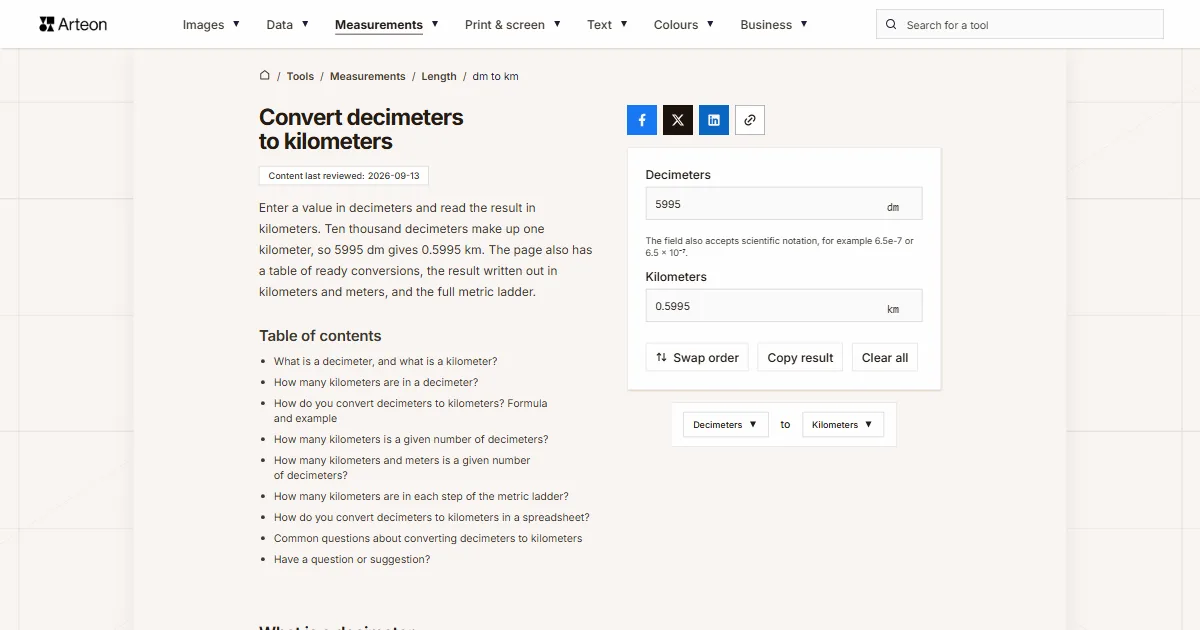
Enter a value in decimeters and read the result in kilometers. Ten thousand decimeters make up one kilometer, so 5995 dm gives 0.5995 km. The page also has a table of ready conversions, the result written out in kilometers and meters, and the full metric ladder.
The field also accepts scientific notation, for example 6.5e-7 or 6.5 × 10⁻⁷.
What is a decimeter, and what is a kilometer?
The decimeter is the first submultiple of the meter: the English article defines it as "a unit of length in the International System of Units, equal to one tenth of a metre, ten centimetres, one hundred millimetres, and 3.937 inches"[1]. The value comes from the SI prefix deci-, which stands for one tenth[2].
The decimeter describes lengths measured at close range, and the same article names three settings where it is the working unit: the liter is defined as one cubic decimeter, the path length in a polarimeter is given in decimeters, and ship's draft markings are shown in decimeters in most of the world[1].
The kilometer measures distances on land. The prefix kilo- stands for a thousand, so a kilometer is a thousand meters[2], and the English article calls it the preferred unit for distances between places in most of the world, with the United States, the United Kingdom and Liberia using the statute mile for that purpose[3].
Four steps of ten separate the decimeter from the kilometer, and the steps between them are the meter, the decameter and the hectometer. The two in the middle have their own symbols, dam and hm[2].
The result can be written in two ways. The decimal form can be typed into a spreadsheet and used in further arithmetic. The form with whole kilometers and the remainder in meters describes a stretch of road the way people say it out loud.

How many kilometers are in a decimeter?
A decimeter is 0.0001 kilometers. Ten decimeters give 0.001 km, and a hundred decimeters give 0.01 km.
Every conversion in this direction comes down to dividing the number of decimeters by ten thousand. A thousand decimeters is 0.1 km, or a hundred meters. Five thousand decimeters give 0.5 km. Ten thousand decimeters give a full kilometer.
Below ten thousand the result starts with a zero and a decimal point. A value of 77.8 dm is 0.00778 km. A value of 1552 dm is 0.1552 km. A value of 5995 dm is 0.5995 km.
The same result can be given in whole kilometers with the remainder in meters. A value of 15,028 dm is 1.5028 km, which is 1 km and 502.8 m.
The converter above works both ways and shows the result while you type. Below 0.01 kilometers it repeats the result under the field on a line labeled Scientific notation, which turns an answer with three zeros after the point into 1 × 10⁻⁴ km.
How do you convert decimeters to kilometers? Formula and example
The conversion rests on a fixed relation: ten thousand decimeters make up one kilometer. To turn decimeters into kilometers you divide their number by ten thousand.
The full formula: kilometers = decimeters ÷ 10,000. The other way round: decimeters = kilometers × 10,000.
Three examples of different size come out of that formula. A value of 400 dm divided by ten thousand gives 0.04 km. A value of 748 dm gives 0.0748 km. A value of 90,000 dm gives 9 km.
In writing, the division changes only the position of the decimal point. The digits stay as they are and the point moves four places to the left. 71 dm becomes 0.0071 km, and 43,000 dm becomes 4.3 km. You fill the missing places before the first digit with zeros.
The result can also be written as a common fraction, because the divisor never changes. A value of 301 dm is 301/10,000 km, and in decimal form 0.0301 km.
The other way round the operation is reversed: you multiply by ten thousand and the point moves four places to the right. That is what the kilometers to decimeters converter does. If your value is written in centimeters, use the centimeters to decimeters converter, and for the step from meters use the meters to kilometers converter.
How many kilometers is a given number of decimeters?
| Decimeters | Kilometers | Meters |
|---|---|---|
| 0.936 dm | 0.0000936 km | 0.0936 m |
| 1 dm | 0.0001 km | 0.1 m |
| 4 dm | 0.0004 km | 0.4 m |
| 7 dm | 0.0007 km | 0.7 m |
| 8 dm | 0.0008 km | 0.8 m |
| 9.2 dm | 0.00092 km | 0.92 m |
| 10 dm | 0.001 km | 1 m |
| 16 dm | 0.0016 km | 1.6 m |
| 20 dm | 0.002 km | 2 m |
| 32 dm | 0.0032 km | 3.2 m |
| 34 dm | 0.0034 km | 3.4 m |
| 44 dm | 0.0044 km | 4.4 m |
| 45 dm | 0.0045 km | 4.5 m |
| 60 dm | 0.006 km | 6 m |
| 63 dm | 0.0063 km | 6.3 m |
| 64 dm | 0.0064 km | 6.4 m |
| 65 dm | 0.0065 km | 6.5 m |
| 70 dm | 0.007 km | 7 m |
| 71 dm | 0.0071 km | 7.1 m |
| 72 dm | 0.0072 km | 7.2 m |
| 77 dm | 0.0077 km | 7.7 m |
| 77.8 dm | 0.00778 km | 7.78 m |
| 78 dm | 0.0078 km | 7.8 m |
| 83 dm | 0.0083 km | 8.3 m |
| 87 dm | 0.0087 km | 8.7 m |
| 88 dm | 0.0088 km | 8.8 m |
| 90 dm | 0.009 km | 9 m |
| 94 dm | 0.0094 km | 9.4 m |
| 96 dm | 0.0096 km | 9.6 m |
| 97 dm | 0.0097 km | 9.7 m |
| 100 dm | 0.01 km | 10 m |
| 264 dm | 0.0264 km | 26.4 m |
| 275 dm | 0.0275 km | 27.5 m |
| 300 dm | 0.03 km | 30 m |
| 320 dm | 0.032 km | 32 m |
| 345 dm | 0.0345 km | 34.5 m |
| 359 dm | 0.0359 km | 35.9 m |
| 400 dm | 0.04 km | 40 m |
| 453 dm | 0.0453 km | 45.3 m |
| 500 dm | 0.05 km | 50 m |
| 575.2 dm | 0.05752 km | 57.52 m |
| 748 dm | 0.0748 km | 74.8 m |
| 805 dm | 0.0805 km | 80.5 m |
| 1,000 dm | 0.1 km | 100 m |
| 1,552 dm | 0.1552 km | 155.2 m |
| 2,000 dm | 0.2 km | 200 m |
| 3,000 dm | 0.3 km | 300 m |
| 5,000 dm | 0.5 km | 500 m |
| 5,995 dm | 0.5995 km | 599.5 m |
| 10,000 dm | 1 km | 1,000 m |
| 15,028 dm | 1.5028 km | 1,502.8 m |
| 30,000 dm | 3 km | 3,000 m |
| 43,000 dm | 4.3 km | 4,300 m |
| 60,000 dm | 6 km | 6,000 m |
| 90,000 dm | 9 km | 9,000 m |
How many kilometers and meters is a given number of decimeters?
| Decimeters | Kilometers and meters | Kilometers |
|---|---|---|
| 1,552 dm | 155.2 m | 0.1552 km |
| 5,995 dm | 599.5 m | 0.5995 km |
| 12,000 dm | 1 km 200 m | 1.2 km |
| 14,090 dm | 1 km 409 m | 1.409 km |
| 15,028 dm | 1 km 502.8 m | 1.5028 km |
| 22,500 dm | 2 km 250 m | 2.25 km |
| 43,000 dm | 4 km 300 m | 4.3 km |
| 55,300 dm | 5 km 530 m | 5.53 km |
| 64,300 dm | 6 km 430 m | 6.43 km |
| 329,000 dm | 32 km 900 m | 32.9 km |
How many kilometers are in each step of the metric ladder?
| Unit | Symbol | Kilometers | Decimeters |
|---|---|---|---|
| Millimeter | mm | 0.000001 km | 0.01 dm |
| Centimeter | cm | 0.00001 km | 0.1 dm |
| Decimeter | dm | 0.0001 km | 1 dm |
| Meter | m | 0.001 km | 10 dm |
| Decameter | dam | 0.01 km | 100 dm |
| Hectometer | hm | 0.1 km | 1,000 dm |
| Kilometer | km | 1 km | 10,000 dm |
How do you convert decimeters to kilometers in a spreadsheet?
For a single value the field above is quicker, and for a whole column of readings one formula dragged down in a spreadsheet is enough.
Excel: the CONVERT function
In English Excel you write CONVERT(number,from_unit,to_unit). The unit code for the meter is "m", and the prefix goes in front of it: "d" for deci, "k" for kilo. For a value in cell A1 the formula reads =CONVERT(A1,"dm","km")[4]. The same page states that these prefixes can be prepended to any metric unit[4].Plain division, if you would rather skip the function
The formula =A1/10000 gives the same result and works in every spreadsheet, Google Sheets and LibreOffice Calc included. For a column of readings set four decimal places, so that values below one kilometer stay on screen in full.Kilometers and meters in two columns
You build the form with whole kilometers and a remainder in meters from two columns. The formula =A1/10000 gives kilometers and the formula =A1/10 gives meters. For a value of 15028 in cell A1 the first column shows 1.5028 and the second 1502.8. The part before the point of the first result is the whole kilometers, and what is left over is 502.8 meters.Check the result on a single cell
Before you drag the formula down the whole column, type 5995 into cell A1 and check that the result comes to 0.5995. A #VALUE! message where the result should be means Excel reads the content of cell A1 as text, for example when a unit has been typed next to the value. Leave just the number in the cell[4].
Convert other units to Kilometers
Convert Decimeters to other units
Sources
- Decimetre — Wikipedia
- SI prefixes — Bureau International des Poids et Mesures
- Kilometre — Wikipedia
- CONVERT function — Microsoft
Every figure in the tables was computed from the unit definitions and checked arithmetically before publication. Historical values and the names of local units come from the sources listed above.
Content last reviewed: · written and checked by the Arteon team
Common questions about converting decimeters to kilometers
How many kilometers are in 1 decimeter?
A decimeter is 0.0001 kilometers. The number follows from two prefixes: deci- stands for one tenth and kilo- for a thousand, so a tenth of a meter is a ten-thousandth of a kilometer.
How many kilometers are in 77.8 dm?
That is 0.00778 kilometers, which is 7.78 meters. In scientific notation the same number reads 7.78 × 10⁻³ km.
How many kilometers are in 5995 dm?
That is 0.5995 kilometers, which is 599.5 meters. Another 4005 decimeters complete the first whole kilometer.
How do you write 301 dm in kilometers as a common fraction?
The divisor is fixed at ten thousand, so 301 dm is 301/10,000 km. The fraction cannot be reduced, because 301 factors into 7 and 43 while 10,000 factors into twos and fives. In decimal form the same value is 0.0301 km, which is 30.1 meters.
How do you convert decimeters to kilometers without a calculator?
Move the decimal point four places to the left. 400 dm becomes 0.04 km, and 90,000 dm becomes 9 km.
How many kilometers are in 1000 dm?
A thousand decimeters is 0.1 kilometers, which is a hundred meters. Ten times that, 10,000 dm, gives a full kilometer.
What formats can I type into the decimeter field?
The field takes a decimal point or a comma, a fraction such as 1/2, and scientific notation such as 7.78e1. The result appears as you type, with no separate button to press.
Have a question or suggestion?
If you spotted an error in the tables or have an idea to improve the converter, write to us — we reply within 24 hours.