Convert decimeters to centimeters
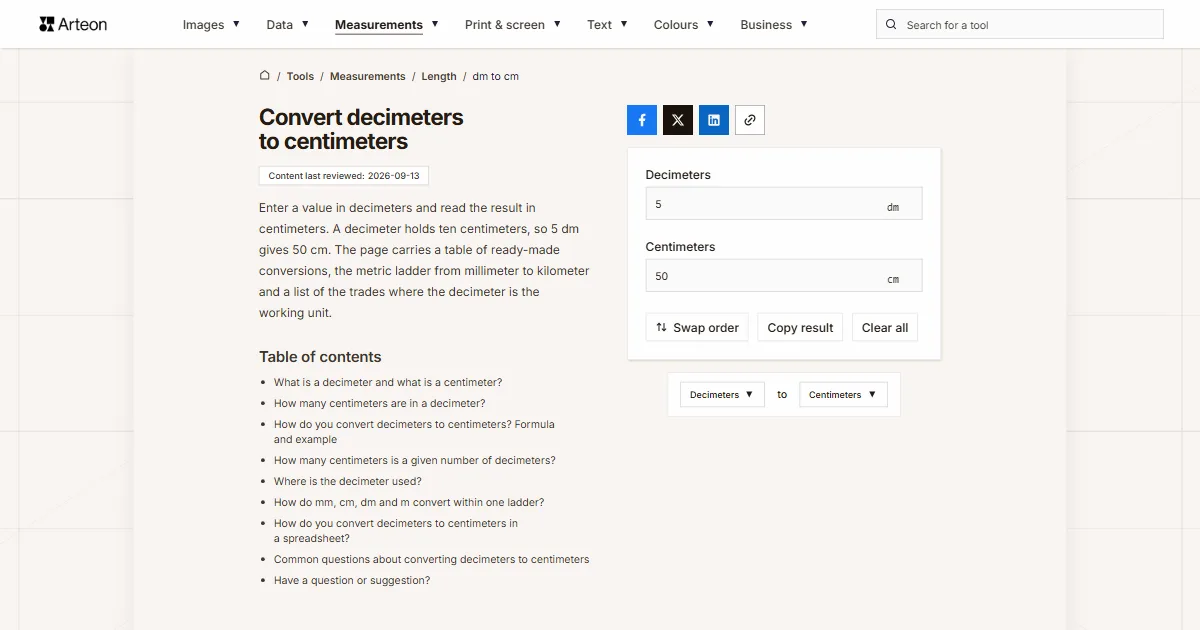
Enter a value in decimeters and read the result in centimeters. A decimeter holds ten centimeters, so 5 dm gives 50 cm. The page carries a table of ready-made conversions, the metric ladder from millimeter to kilometer and a list of the trades where the decimeter is the working unit.
What is a decimeter and what is a centimeter?
Both units come from the meter and the only thing that separates them is the SI prefix. The prefix deci- stands for one tenth and the prefix centi- for one hundredth[1]. A decimeter is therefore one tenth of a meter and a centimeter is one hundredth of it.
That single fact fixes the whole relationship. A decimeter holds ten centimeters and one hundred millimeters, and it measures 3.937 inches[2]. In the metric ladder it sits between the centimeter and the meter, one step of ten in either direction.
The decimeter also feeds a derived unit that everybody uses. A cube one decimeter along each edge holds one liter, because the SI defines the liter as the cubic decimeter[3]. A square one decimeter along each side is a square decimeter, which is one hundred square centimeters.
British and American spelling part company here: the international spelling is decimetre and the American one decimeter[2]. Both describe the same length, and both appear on product sheets written for a worldwide market.
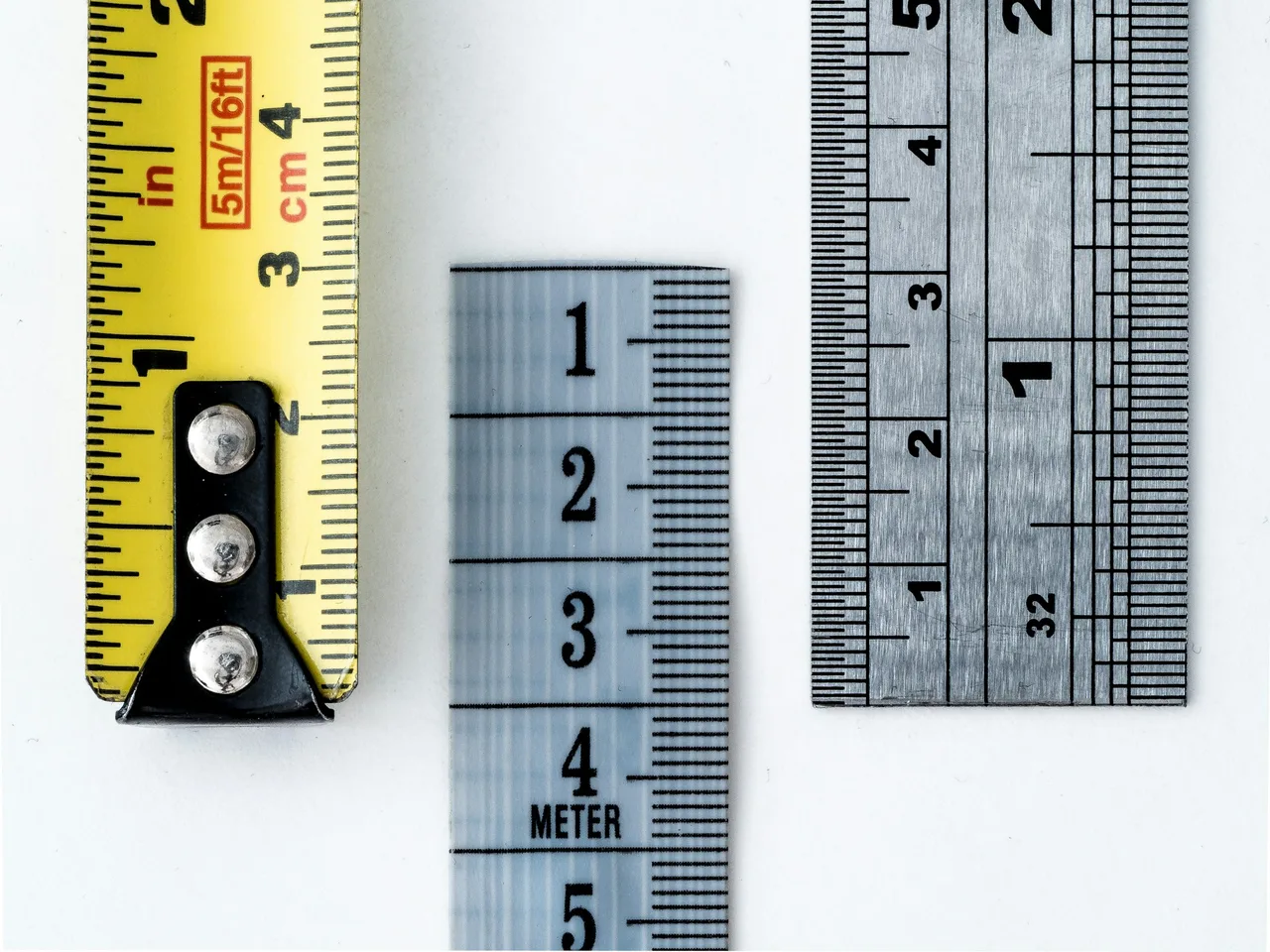
How many centimeters are in a decimeter?
A decimeter has 10 centimeters. Two decimeters give 20 centimeters and five decimeters give 50 centimeters.
Every conversion in this direction comes down to multiplying the number of decimeters by ten. Half a decimeter is 5 centimeters. A quarter of a decimeter gives 2.5 centimeters. Ten decimeters make 100 centimeters, which is exactly one meter.
For whole decimeters you add a single zero to the figure, so those values you can quote from memory. Seven decimeters is 70 centimeters. Twelve decimeters gives 120 centimeters. With a decimal value the point itself moves one place to the right, so 1.5 dm becomes 15 cm and 0.48 dm becomes 4.8 cm.
The same arithmetic carries values of any size. A length of 53.6 dm is 536 cm. One hundred and thirty-five decimeters gives 1,350 cm.
The converter works in both directions and shows the result while you are still typing, so none of these numbers has to be remembered.
How do you convert decimeters to centimeters? Formula and example
The conversion rests on one fixed relationship: one decimeter is 10 centimeters. To turn decimeters into centimeters you multiply their number by ten.
The full formula: centimeters = decimeters × 10. The other way round: decimeters = centimeters ÷ 10.
Three examples of different size follow from that formula. Three decimeters multiplied by ten give 30 centimeters. Eight decimeters is 80 centimeters. Twenty decimeters gives 200 centimeters, which is exactly two meters.
On paper the multiplication is a single move. The digits stay as they are and the decimal point shifts one place to the right. From 2.5 decimeters you get 25 centimeters, and from 0.3 decimeters you get 3 centimeters. Any gap left by the shift is filled with a zero.
Going the other way the operation is reversed: you divide by ten and the point travels one place to the left. That is exactly what the centimeters to decimeters converter does. If your figure is written in millimeters, the millimeters to centimeters converter handles it, and for the step up to meters there is the centimeters to meters converter.
How many centimeters is a given number of decimeters?
| Decimeters | Centimeters | Millimeters |
|---|---|---|
| 0.05 dm | 0.5 cm | 5 mm |
| 0.1 dm | 1 cm | 10 mm |
| 0.2 dm | 2 cm | 20 mm |
| 0.3 dm | 3 cm | 30 mm |
| 0.48 dm | 4.8 cm | 48 mm |
| 0.5 dm | 5 cm | 50 mm |
| 0.8 dm | 8 cm | 80 mm |
| 1 dm | 10 cm | 100 mm |
| 1.5 dm | 15 cm | 150 mm |
| 2 dm | 20 cm | 200 mm |
| 2.1 dm | 21 cm | 210 mm |
| 2.3 dm | 23 cm | 230 mm |
| 2.5 dm | 25 cm | 250 mm |
| 3 dm | 30 cm | 300 mm |
| 3.7 dm | 37 cm | 370 mm |
| 4 dm | 40 cm | 400 mm |
| 4.2 dm | 42 cm | 420 mm |
| 5 dm | 50 cm | 500 mm |
| 6 dm | 60 cm | 600 mm |
| 6.5 dm | 65 cm | 650 mm |
| 7 dm | 70 cm | 700 mm |
| 8 dm | 80 cm | 800 mm |
| 9 dm | 90 cm | 900 mm |
| 10 dm | 100 cm | 1,000 mm |
| 12 dm | 120 cm | 1,200 mm |
| 15 dm | 150 cm | 1,500 mm |
| 20 dm | 200 cm | 2,000 mm |
| 21 dm | 210 cm | 2,100 mm |
| 25 dm | 250 cm | 2,500 mm |
| 35 dm | 350 cm | 3,500 mm |
| 40 dm | 400 cm | 4,000 mm |
| 44 dm | 440 cm | 4,400 mm |
| 45 dm | 450 cm | 4,500 mm |
| 53.6 dm | 536 cm | 5,360 mm |
| 55 dm | 550 cm | 5,500 mm |
| 60 dm | 600 cm | 6,000 mm |
| 63 dm | 630 cm | 6,300 mm |
| 90 dm | 900 cm | 9,000 mm |
| 135 dm | 1,350 cm | 13,500 mm |
| 510 dm | 5,100 cm | 51,000 mm |
Where is the decimeter used?
| Field | What is given in decimeters | The same in centimeters |
|---|---|---|
| Shipping | Draft marks on the hull, each one decimeter high | 10 cm of mark height |
| Tanning | Hide area measured in square decimeters | 1 dm² is a 10 × 10 cm square |
| Chemistry | Path length of the light through a polarimeter tube | a 1 dm tube is 10 cm long |
| Volume | The liter as the cubic decimeter | 1 dm³ is a cube 10 cm along each edge |
| Everyday object | A standard CD, 120 millimeters across, is 1.2 decimeters wide | 12 cm of diameter |
How do mm, cm, dm and m convert within one ladder?
| Unit | Symbol | Centimeters | Millimeters |
|---|---|---|---|
| Millimeter | mm | 0.1 cm | 1 mm |
| Centimeter | cm | 1 cm | 10 mm |
| Decimeter | dm | 10 cm | 100 mm |
| Meter | m | 100 cm | 1,000 mm |
| Decameter | dam | 1,000 cm | 10,000 mm |
| Hectometer | hm | 10,000 cm | 100,000 mm |
| Kilometer | km | 100,000 cm | 1,000,000 mm |
How do you convert decimeters to centimeters in a spreadsheet?
For a single value the field above is quicker, but for a whole column of dimensions a spreadsheet does the job with one formula dragged down.
Excel: the CONVERT function
The syntax is CONVERT(number, from_unit, to_unit). The unit code for the meter is "m" and prefixes go in front of it: "d" for deci and "c" for centi. For a value in cell A1 the formula is therefore =CONVERT(A1,"dm","cm"), and the same prefix list covers every other metric unit in the function[8].Plain multiplication if you would rather skip the function
The formula =A1*10 returns the same result and works in every spreadsheet, Google Sheets and LibreOffice Calc included. Set one decimal place on the column so that a value such as 4.8 keeps that form on screen.The result with its unit in the same cell
If the abbreviation has to sit next to the figure, use =A1*10&" cm". The result then counts as text, so keep a plain number column of its own if you still want to sum or sort it.Checking the result on a single cell
Before you drag the formula down the column, put 1.5 into cell A1 and check that the answer reads 15. A #VALUE! message in place of the result means Excel is not reading cell A1 as a number, which happens when a unit has been typed next to the figure. Leave the cell holding just the number[8].
Convert other units to Centimeters
Convert Decimeters to other units
Sources
- SI prefixes — Bureau International des Poids et Mesures
- Decimetre — Wikipedia
- The International System of Units (SI), 9th edition, table of non-SI units accepted for use with the SI — Bureau International des Poids et Mesures
- Draft (hull) — Wikipedia
- OIML R 136-1: Instruments for measuring the areas of leathers — Organisation Internationale de Métrologie Légale
- Specific rotation — Wikipedia
- Compact disc — Wikipedia
- CONVERT function — Microsoft
Every figure in the tables was computed from the unit definitions and checked arithmetically before publication. Historical values and the names of local units come from the sources listed above.
Content last reviewed: · written and checked by the Arteon team
Common questions about converting decimeters to centimeters
How many centimeters are in 1 decimeter?
A decimeter has 10 centimeters. The figure comes from two prefixes: deci- means one tenth and centi- one hundredth, so one tenth of a meter holds ten of its hundredths.
How many centimeters is 5 dm?
Five decimeters is 50 centimeters. Eight decimeters gives 80 centimeters. Ten decimeters gives 100 centimeters, which is exactly one meter.
How many centimeters is half a decimeter?
Half a decimeter is 5 centimeters. A quarter of a decimeter gives 2.5 centimeters and three quarters of a decimeter gives 7.5 centimeters.
How many inches is a decimeter?
A decimeter is 3.937 inches, because one inch is exactly 2.54 centimeters and a decimeter holds ten of them. That puts it a little under four inches.
How do you convert dm to cm without a calculator?
Move the decimal point one place to the right. With a whole number that comes to the same thing as adding a zero: 6 dm turns into 60 cm and 0.7 dm turns into 7 cm.
How many millimeters are in a decimeter?
A decimeter has 100 millimeters. There are two steps of ten between the decimeter and the millimeter, so the multiplier is one hundred. The millimeter column sits in the conversion table on this page.
Does the field take decimal values?
Yes. You can type 1.5 or 1,5 and also a simple fraction such as 1/2. The result appears as you type, with no separate button to press.
Have a question or suggestion?
If you spotted an error in the tables or have an idea to improve the converter, write to us — we reply within 24 hours.