Convert decimeters to meters
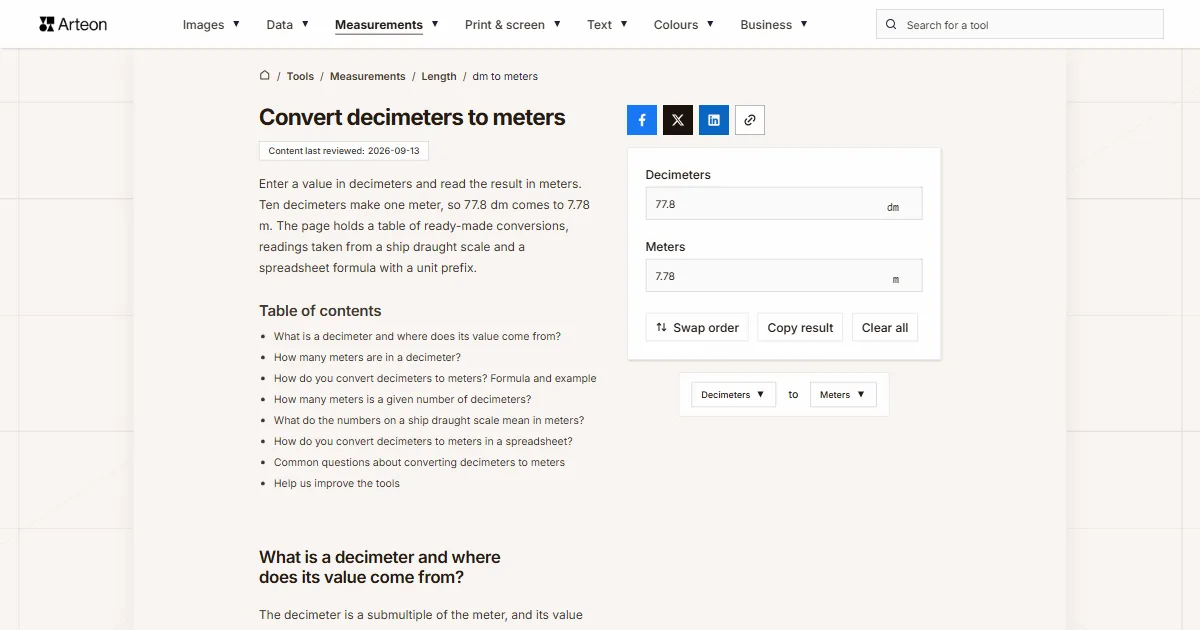
Enter a value in decimeters and read the result in meters. Ten decimeters make one meter, so 77.8 dm comes to 7.78 m. The page holds a table of ready-made conversions, readings taken from a ship draught scale and a spreadsheet formula with a unit prefix.
What is a decimeter and where does its value come from?
The decimeter is a submultiple of the meter, and its value comes from the prefix. The prefix deci means one tenth and is written with the letter d[1], so one decimeter is a tenth of a meter and at the same time ten centimeters.
The meter itself is the point of reference in this arithmetic. It serves as the SI base unit of length, and the speed of light now fixes its value: the definition takes light in vacuum to travel 299,792,458 meters in one second, with the second itself described by a transition frequency in the caesium atom[2]. The same accuracy holds for the decimeter, because a single multiplier separates it from the meter.
One derived form of the decimeter is in daily use, though rarely under that name. A cube one decimeter along each edge is a cubic decimeter, and in 1964 the General Conference on Weights and Measures allowed a special name for it: the litre. The same resolution abrogated the 1901 definition of the litre[3]. For volume in litres and millilitres, use the millilitres to litres converter.
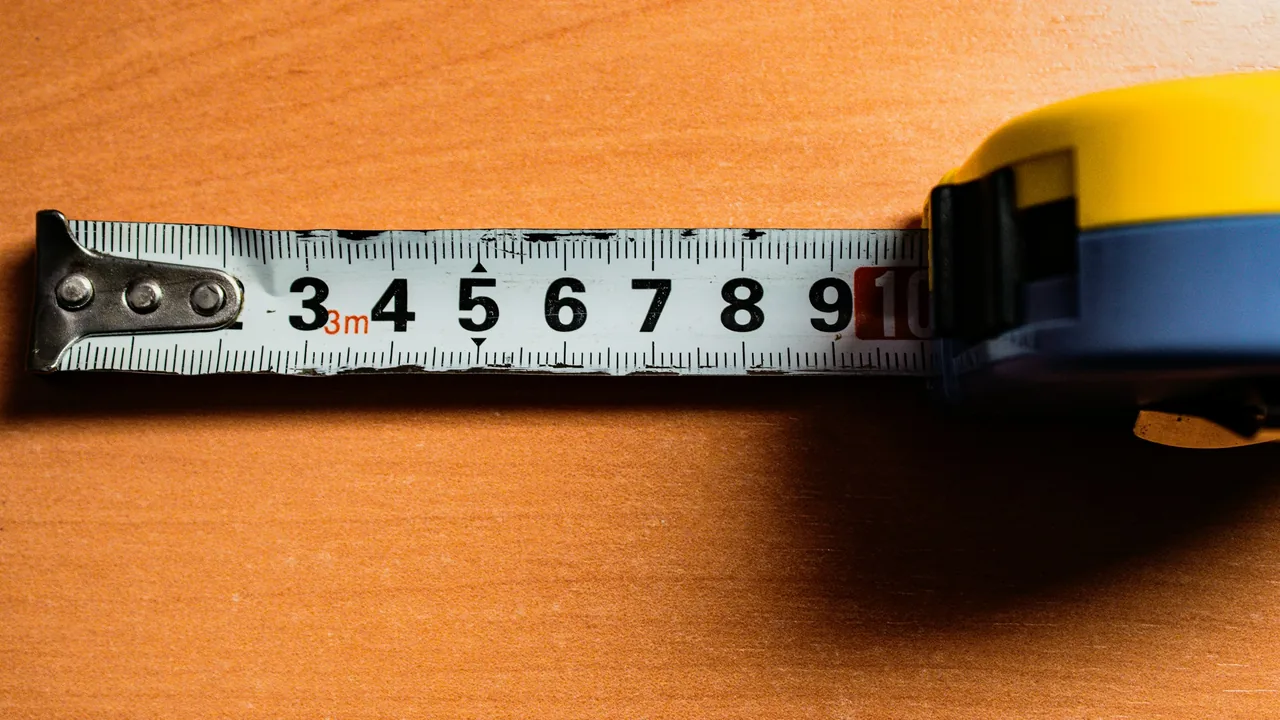
In length measurement the decimeter is still used in a few professional fields. The path length in a specific rotation measurement is given in decimeters, and draught markings on a ship are shown in decimeters across most of the world[4]. A standard CD measures 120 millimeters across, which is 1.2 decimeters[4].
How many meters are in a decimeter?
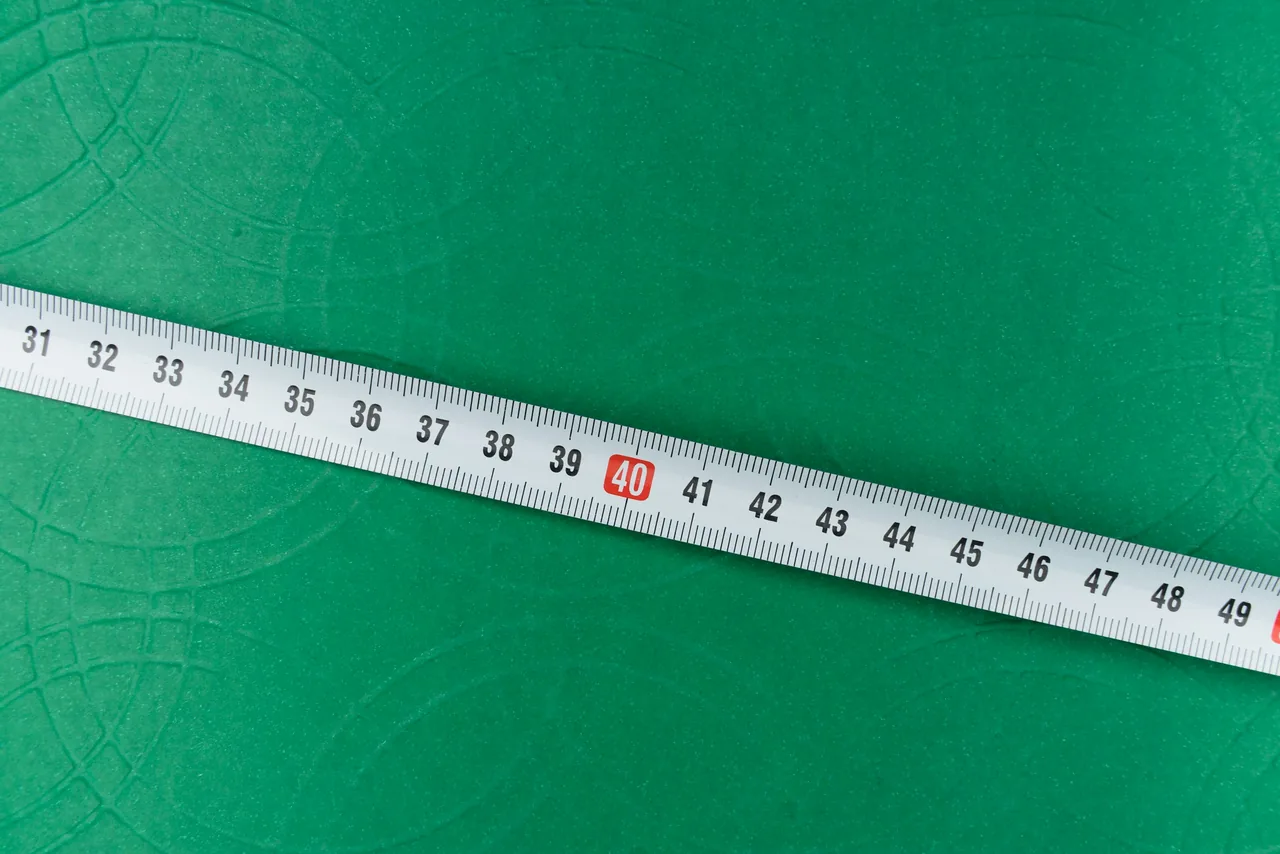
A decimeter is 0.1 meters. Ten decimeters make one meter, so a single decimeter is a tenth of it.
Every conversion in this direction comes down to dividing the number of decimeters by ten. Five decimeters is 0.5 meters. Twenty decimeters gives 2 meters. Seventy-eight decimeters is 7.8 meters.
For numbers ending in zero you get the result by striking that zero out, so you can give those values from memory. Thirty decimeters gives 3 meters. Ninety decimeters is 9 meters. For every other number the decimal point moves one place to the left, so 77.8 dm turns into 7.78 m and 7 dm turns into 0.7 m.
The same arithmetic works at any size. One thousand five hundred and fifty-two decimeters is 155.2 meters. Five thousand six hundred decimeters gives 560 meters.
The result appears in the field next to it as you type, and the Swap order button turns the conversion around to meters and decimeters.
How do you convert decimeters to meters? Formula and example
The conversion rests on a fixed relation: ten decimeters make one meter. To turn decimeters into meters, you divide their number by ten.
The full formula: meters = decimeters ÷ 10. The other way round: decimeters = meters × 10.
Three examples of different size follow from that formula. Twenty-five decimeters divided by ten gives 2.5 meters. One hundred decimeters is 10 meters. Four hundred decimeters gives 40 meters.
In writing, the division comes down to a single move. The digits stay the same and the decimal point shifts one place to the left. From 63 decimeters you get 6.3 meters, and from 7 decimeters 0.7 meters. With a single-digit number a zero appears before the point.
The other way round the operation is reversed: you multiply by ten and the decimal point shifts one place to the right. That is what the meters to decimeters converter does. If your value is written in centimeters, the centimeters to meters converter handles it, and for the step up to kilometers there is the meters to kilometers converter.
How many meters is a given number of decimeters?
| Decimeters | Meters | Centimeters | Millimeters |
|---|---|---|---|
| 0.5 dm | 0.05 m | 5 cm | 50 mm |
| 1 dm | 0.1 m | 10 cm | 100 mm |
| 2 dm | 0.2 m | 20 cm | 200 mm |
| 2.5 dm | 0.25 m | 25 cm | 250 mm |
| 3 dm | 0.3 m | 30 cm | 300 mm |
| 4 dm | 0.4 m | 40 cm | 400 mm |
| 5 dm | 0.5 m | 50 cm | 500 mm |
| 6 dm | 0.6 m | 60 cm | 600 mm |
| 7 dm | 0.7 m | 70 cm | 700 mm |
| 7.8 dm | 0.78 m | 78 cm | 780 mm |
| 8 dm | 0.8 m | 80 cm | 800 mm |
| 9 dm | 0.9 m | 90 cm | 900 mm |
| 10 dm | 1 m | 100 cm | 1,000 mm |
| 12 dm | 1.2 m | 120 cm | 1,200 mm |
| 15 dm | 1.5 m | 150 cm | 1,500 mm |
| 20 dm | 2 m | 200 cm | 2,000 mm |
| 25 dm | 2.5 m | 250 cm | 2,500 mm |
| 30 dm | 3 m | 300 cm | 3,000 mm |
| 35 dm | 3.5 m | 350 cm | 3,500 mm |
| 40 dm | 4 m | 400 cm | 4,000 mm |
| 50 dm | 5 m | 500 cm | 5,000 mm |
| 60 dm | 6 m | 600 cm | 6,000 mm |
| 70 dm | 7 m | 700 cm | 7,000 mm |
| 77 dm | 7.7 m | 770 cm | 7,700 mm |
| 77.8 dm | 7.78 m | 778 cm | 7,780 mm |
| 80 dm | 8 m | 800 cm | 8,000 mm |
| 90 dm | 9 m | 900 cm | 9,000 mm |
| 100 dm | 10 m | 1,000 cm | 10,000 mm |
| 120 dm | 12 m | 1,200 cm | 12,000 mm |
| 150 dm | 15 m | 1,500 cm | 15,000 mm |
| 200 dm | 20 m | 2,000 cm | 20,000 mm |
| 250 dm | 25 m | 2,500 cm | 25,000 mm |
| 300 dm | 30 m | 3,000 cm | 30,000 mm |
| 400 dm | 40 m | 4,000 cm | 40,000 mm |
| 500 dm | 50 m | 5,000 cm | 50,000 mm |
| 1,000 dm | 100 m | 10,000 cm | 100,000 mm |
| 1,552 dm | 155.2 m | 15,520 cm | 155,200 mm |
| 5,600 dm | 560 m | 56,000 cm | 560,000 mm |
What do the numbers on a ship draught scale mean in meters?
| Scale reading | Meters | Centimeters |
|---|---|---|
| 5 dm | 0.5 m | 50 cm |
| 10 dm | 1 m | 100 cm |
| 15 dm | 1.5 m | 150 cm |
| 20 dm | 2 m | 200 cm |
| 25 dm | 2.5 m | 250 cm |
| 30 dm | 3 m | 300 cm |
| 35 dm | 3.5 m | 350 cm |
| 40 dm | 4 m | 400 cm |
How do you convert decimeters to meters in a spreadsheet?
For one value the field above is quicker, but for a column of readings copied off a measurement the spreadsheet will do it with one formula dragged down.
Excel: the CONVERT function
In Excel you write CONVERT(number,from_unit,to_unit). The unit code for the meter is "m", and you put the prefix in front of it — the letter "d" for deci. For a value in cell A1 the formula therefore reads =CONVERT(A1,"dm","m")[6]. The documentation states that the abbreviated prefixes may be prepended to any metric from_unit or to_unit[6].Dividing by ten, if you would rather skip the function
The formula =A1/10 gives the same result and works in every spreadsheet, including Google Sheets and LibreOffice Calc. Dividing by ten adds one decimal place, so set the cell to show one more decimal place than the value you typed.Checking the formula on a single cell
Before you drag the formula down the whole column, type 778 into cell A1 and check that the result reads 77.8. A #VALUE! message in place of the result means Excel does not read the contents of A1 as a number, which happens when a unit has been typed in beside the value. Keep only the number in the cell[6].
Convert other units to Meters
Convert Decimeters to other units
Sources
- SI prefixes — Bureau International des Poids et Mesures
- Definitions of the SI base units — National Institute of Standards and Technology
- Resolution 6 of the 12th CGPM (1964) — Bureau International des Poids et Mesures
- Decimetre — Wikipedia
- ES-TRIN 2025/1, Article 4.04 — CESNI
- CONVERT function — Microsoft
Every figure in the tables was computed from the unit definitions and checked arithmetically before publication. Historical values and the names of local units come from the sources listed above.
Content last reviewed: · written and checked by the Arteon team
Common questions about converting decimeters to meters
How many meters is 1 decimeter?
One decimeter is 0.1 meters. A meter divides into ten such lengths, and each of them covers ten centimeters.
How many meters is 10 dm?
Ten decimeters is exactly 1 meter. Twenty decimeters gives 2 meters, and one hundred decimeters gives 10 meters.
How much is 77.8 dm in meters?
That is 7.78 meters. The decimal point moves one place to the left, so the digits stay the same and the result is ten times smaller than the number of decimeters.
How many meters is 5,600 dm?
That is 560 meters. With a number ending in zeros you only strike one zero out to get the result in meters.
What do you divide decimeters by to get meters?
By ten. One step in the metric series means a multiplier of ten, and there is exactly one such step between the decimeter and the meter.
What does the result look like for fewer than ten decimeters?
It starts with a zero and a point: 7 dm is 0.7 m and 3 dm is 0.3 m. Half a decimeter gives 0.05 m, and even a very small entry such as 0.001 dm shows in the field as 0.0001 m.
How do you enter a value with a decimal point or a comma?
The field takes either, and 77.8 gives the same result as 77,8. The number of meters appears beside it as you type, with no separate button to press.
Help us improve the tools
Do you have an idea for a new feature, have you found a bug, or would you like to suggest another tool? Write to us — we reply within 24 hours.