Convert inches to meters
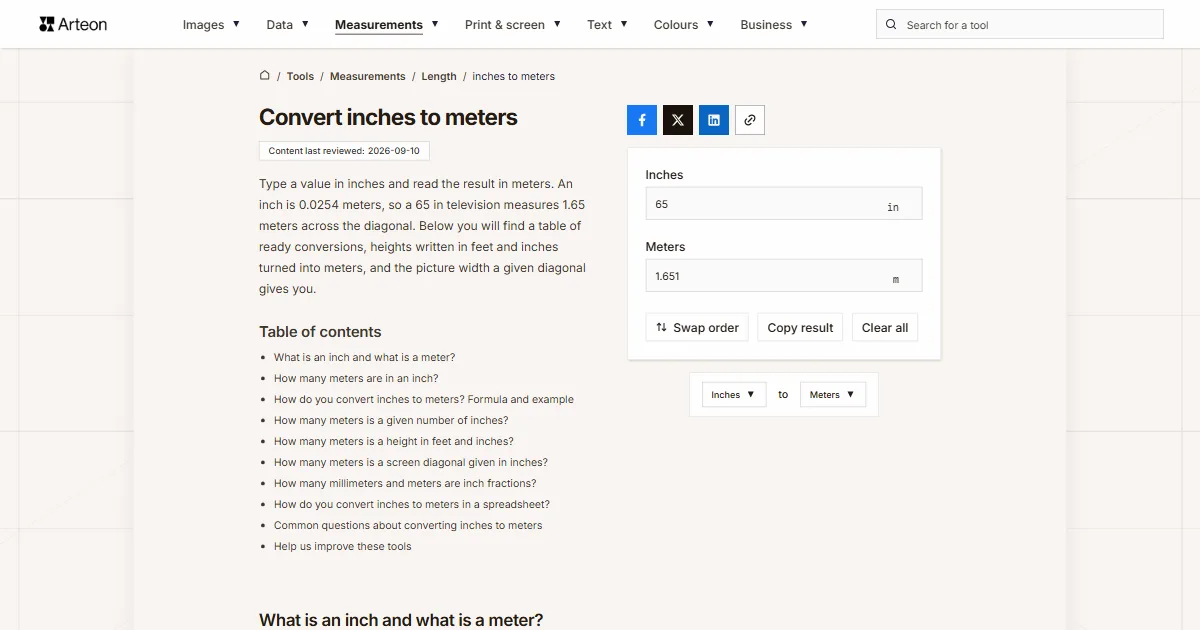
Type a value in inches and read the result in meters. An inch is 0.0254 meters, so a 65 in television measures 1.65 meters across the diagonal. Below you will find a table of ready conversions, heights written in feet and inches turned into meters, and the picture width a given diagonal gives you.
What is an inch and what is a meter?
The inch is a length unit of the imperial and US customary systems, written with a double prime, as in 65″. Since 1 July 1959 an inch has measured exactly 25.4 millimeters, which is 0.0254 meters[1]. The value was taken from the meter, so every conversion on this page comes out without rounding.
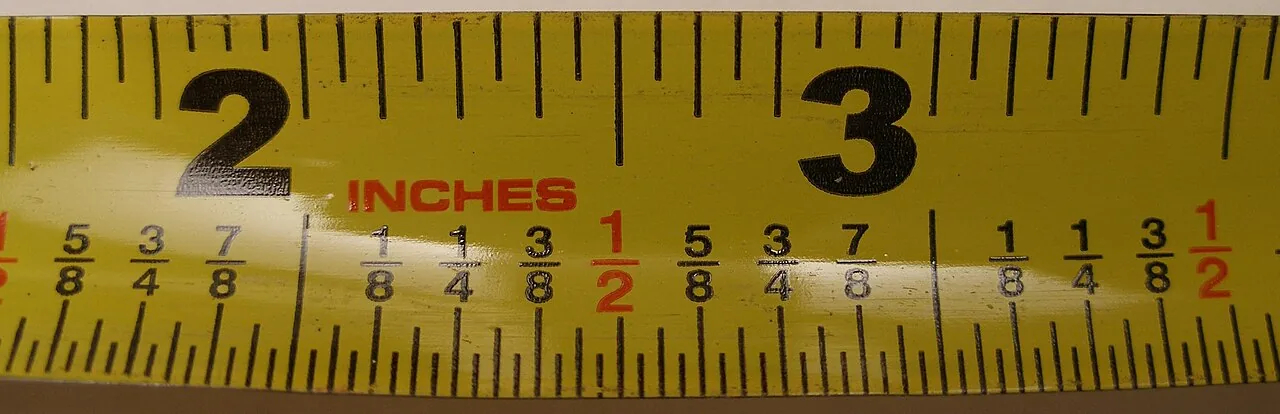
The inch is divided by halving. The next marks down are a half, a quarter, an eighth and a sixteenth, and that is exactly how the graduations on a US tape measure are laid out. It is where a reading such as 5 3/8 in comes from, and that reading answers to 136.53 millimeters. Twelve inches make a foot and thirty-six make a yard.
The meter is the SI base unit and it is what sets the value of the inch. Since 1983 a meter has been the distance light travels in vacuum in 1/299 792 458 of a second, and the 2019 revision of the SI restated that wording[2]. In the United States both units are in daily use, with inches on lumber, pipe threads, screen diagonals and body height, and meters in science, medicine and athletics[3]. In the European Union an inch figure may stand beside the metric one as a supplementary indication, and Directive 2009/3/EC removed the deadline that once limited this[4].
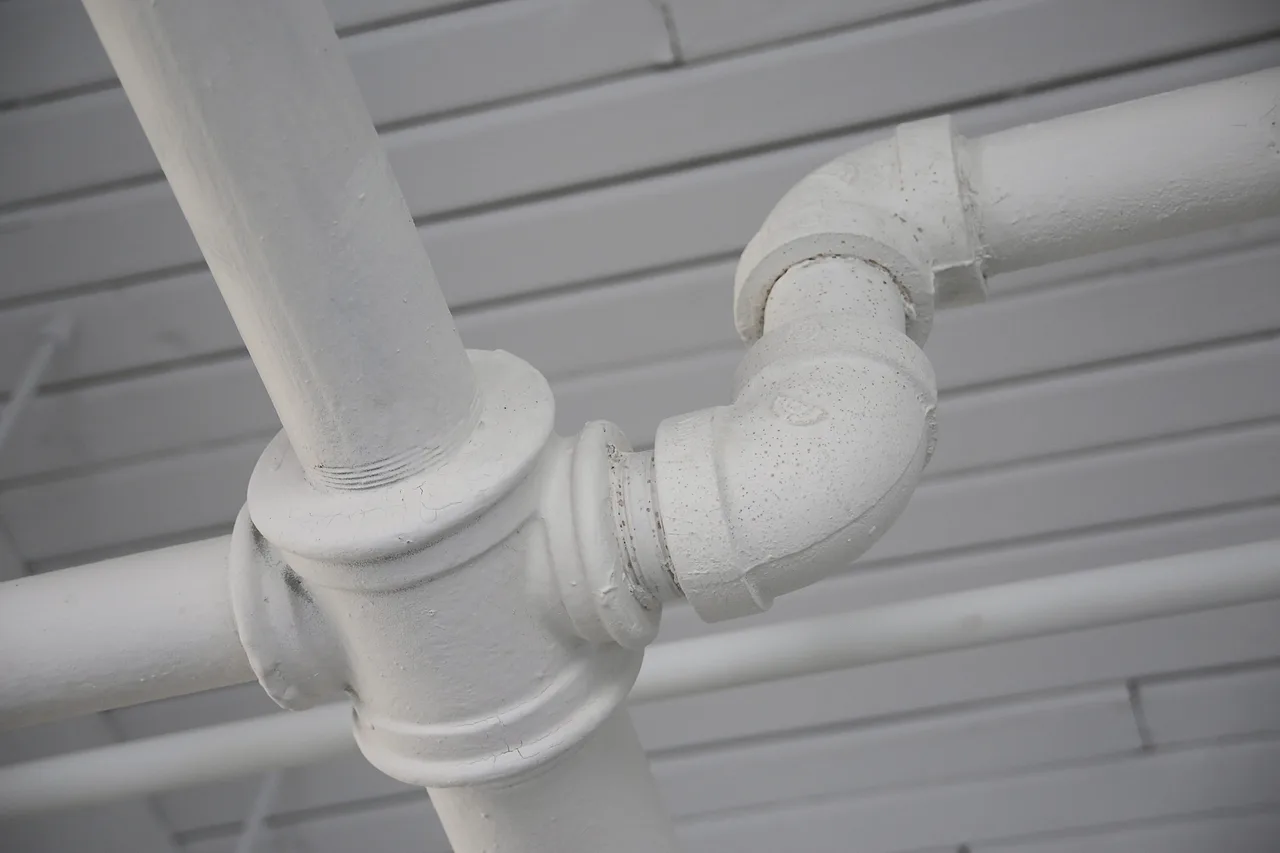
Pipe sizes carry the word inch in a different sense. A G 1 thread measures 33.249 millimeters across, and G 1/2 measures 20.955 millimeters. The number goes back to the bore of the older steel pipe the thread was made for, and walls have grown thinner since[5]. The inch figure is a trade name there, and the real dimension comes from a thread table.
How many meters are in an inch?
An inch is 0.0254 meters, or 2.54 centimeters. It takes 39.37 inches to make a full meter.
A single inch turns into such a small number of meters that the conversion earns its keep from a few dozen inches upwards. Twelve inches, a foot, come to 0.3048 meters. Thirty-six inches, a yard, come to 0.9144 meters. Sixty inches, five feet, come to 1.524 meters.
The range from sixty to seventy-five inches covers adult height, because that is how height is written in the United States. A height of 68 inches is 1.7272 meters. A height of 72 inches is exactly six feet, which is 1.8288 meters.
Screen diagonals form the second busy range. A set described as 55-inch measures 1.397 meters across the diagonal, and at a 16:9 ratio its picture is 1.22 meters wide.
How do you convert inches to meters? Formula and example
The formula has one step: multiply the number of inches by 0.0254.
The multiplier is an exact value, because that is what an inch measures by definition. Dividing by 39.3700787 gives the same answer, except that this number is already rounded and drifts in the later decimal places at large values.
Here is one worked example. Take 65 inches, the diagonal a television carries in its model name. Multiply 65 by 0.0254 and you get 1.651. The screen therefore measures 1.65 meters across.
A dimension written in feet and inches becomes plain inches in one step before it goes into the field above. Multiply the feet by twelve and add the inches. So 5 ft 9 in gives 60 plus 9, which is 69 inches. That works out at 1.7526 meters.
The meters to inches converter works the other way. For smaller dimensions reach for inches to centimeters or inches to millimeters, and for feet on their own take feet to meters.
How many meters is a given number of inches?
| Inches | Meters |
|---|---|
| 1 in | 0.0254 m |
| 2 in | 0.0508 m |
| 3 in | 0.0762 m |
| 4 in | 0.1016 m |
| 5 in | 0.1270 m |
| 6 in | 0.1524 m |
| 7 in | 0.1778 m |
| 8 in | 0.2032 m |
| 9 in | 0.2286 m |
| 10 in | 0.2540 m |
| 11 in | 0.2794 m |
| 12 in | 0.3048 m |
| 14 in | 0.3556 m |
| 16 in | 0.4064 m |
| 18 in | 0.4572 m |
| 20 in | 0.5080 m |
| 22 in | 0.5588 m |
| 24 in | 0.6096 m |
| 26 in | 0.6604 m |
| 27 in | 0.6858 m |
| 28 in | 0.7112 m |
| 29 in | 0.7366 m |
| 30 in | 0.7620 m |
| 32 in | 0.8128 m |
| 34 in | 0.8636 m |
| 36 in | 0.9144 m |
| 39.3701 in | 1.0000 m |
| 40 in | 1.0160 m |
| 42 in | 1.0668 m |
| 45 in | 1.1430 m |
| 48 in | 1.2192 m |
| 50 in | 1.2700 m |
| 54 in | 1.3716 m |
| 55 in | 1.3970 m |
| 58 in | 1.4732 m |
| 60 in | 1.5240 m |
| 62 in | 1.5748 m |
| 63 in | 1.6002 m |
| 64 in | 1.6256 m |
| 65 in | 1.6510 m |
| 66 in | 1.6764 m |
| 67 in | 1.7018 m |
| 68 in | 1.7272 m |
| 70 in | 1.7780 m |
| 72 in | 1.8288 m |
| 75 in | 1.9050 m |
| 80 in | 2.0320 m |
| 84 in | 2.1336 m |
| 90 in | 2.2860 m |
| 96 in | 2.4384 m |
| 100 in | 2.5400 m |
| 108 in | 2.7432 m |
| 120 in | 3.0480 m |
| 144 in | 3.6576 m |
| 180 in | 4.5720 m |
| 240 in | 6.0960 m |
How many meters is a height in feet and inches?
| Height | Meters | In plain inches |
|---|---|---|
| 4 ft | 1.2192 m | 48 in |
| 4 ft 4 in | 1.3208 m | 52 in |
| 4 ft 8 in | 1.4224 m | 56 in |
| 4 ft 10 in | 1.4732 m | 58 in |
| 5 ft | 1.5240 m | 60 in |
| 5 ft 1 in | 1.5494 m | 61 in |
| 5 ft 2 in | 1.5748 m | 62 in |
| 5 ft 3 in | 1.6002 m | 63 in |
| 5 ft 4 in | 1.6256 m | 64 in |
| 5 ft 5 in | 1.6510 m | 65 in |
| 5 ft 6 in | 1.6764 m | 66 in |
| 5 ft 7 in | 1.7018 m | 67 in |
| 5 ft 8 in | 1.7272 m | 68 in |
| 5 ft 9 in | 1.7526 m | 69 in |
| 5 ft 10 in | 1.7780 m | 70 in |
| 5 ft 11 in | 1.8034 m | 71 in |
| 6 ft | 1.8288 m | 72 in |
| 6 ft 1 in | 1.8542 m | 73 in |
| 6 ft 2 in | 1.8796 m | 74 in |
| 6 ft 3 in | 1.9050 m | 75 in |
| 6 ft 4 in | 1.9304 m | 76 in |
| 6 ft 6 in | 1.9812 m | 78 in |
| 6 ft 8 in | 2.0320 m | 80 in |
| 7 ft | 2.1336 m | 84 in |
How many meters is a screen diagonal given in inches?
| Diagonal | Diagonal in meters | Picture width at 16:9 |
|---|---|---|
| 24 in | 0.61 m | 0.53 m |
| 27 in | 0.69 m | 0.60 m |
| 32 in | 0.81 m | 0.71 m |
| 40 in | 1.02 m | 0.89 m |
| 43 in | 1.09 m | 0.95 m |
| 50 in | 1.27 m | 1.11 m |
| 55 in | 1.40 m | 1.22 m |
| 65 in | 1.65 m | 1.44 m |
| 75 in | 1.91 m | 1.66 m |
| 85 in | 2.16 m | 1.88 m |
| 98 in | 2.49 m | 2.17 m |
| 120 in | 3.05 m | 2.66 m |
How many millimeters and meters are inch fractions?
| Inch fraction | As a decimal | Millimeters | Meters |
|---|---|---|---|
| 1/16 | 0.0625 | 1.588 mm | 0.00159 m |
| 1/8 | 0.1250 | 3.175 mm | 0.00318 m |
| 3/16 | 0.1875 | 4.763 mm | 0.00476 m |
| 1/4 | 0.2500 | 6.350 mm | 0.00635 m |
| 5/16 | 0.3125 | 7.938 mm | 0.00794 m |
| 3/8 | 0.3750 | 9.525 mm | 0.00953 m |
| 1/2 | 0.5000 | 12.700 mm | 0.01270 m |
| 5/8 | 0.6250 | 15.875 mm | 0.01588 m |
| 3/4 | 0.7500 | 19.050 mm | 0.01905 m |
| 7/8 | 0.8750 | 22.225 mm | 0.02223 m |
How do you convert inches to meters in a spreadsheet?
For a single value the field above is quicker, but for a whole column of catalogue dimensions a spreadsheet does the job with one formula dragged down.
Excel: the CONVERT function
CONVERT takes three arguments: the number, the unit you start from and the unit you want. An inch is "in" and a meter is "m", so for a value in cell A1 the formula reads =CONVERT(A1,"in","m"). The same function and the same unit codes work in Google Sheets.Plain multiplication, if you would rather skip the function
The formula =A1*0.0254 returns the same number and works in every spreadsheet, LibreOffice Calc included. The multiplier comes straight from the definition of the inch, so the result is exact.Feet and inches from two columns
When your dimensions are split into feet in column A and inches in column B, the formula =(A1*12+B1)*0.0254 returns meters. A reading of 5 ft 9 in gives 1.7526 meters.Check the result on a single cell
Before you drag the formula down the column, put the value 39.3701 in cell A1 and check that the result starts with 1. A #VALUE! message in place of the result means Excel does not read the content of cell A1 as a number, for example when a unit has been typed next to the value. Leave just the number in the cell[6].
Convert other units to Meters
Convert Inches to other units
Sources
- SI Units – Length — National Institute of Standards and Technology
- SI base unit: metre (m) — Bureau International des Poids et Mesures
- Inch — Wikipedia
- Directive 2009/3/EC of the European Parliament and of the Council — EUR-Lex
- British Standard Pipe — Wikipedia
- How to correct a #VALUE! error — Microsoft
Every figure in the tables was computed from the unit definitions and checked arithmetically before publication. Historical values and the names of local units come from the sources listed above.
Content last reviewed: · written and checked by the Arteon team
Common questions about converting inches to meters
How many meters are in one inch?
An inch is 0.0254 meters, or 2.54 centimeters. The value is exact and has applied in every country since 1959.
What is the formula for inches to meters?
Multiply the number of inches by 0.0254. Dividing by 39.3700787 gives the same answer, except that this divisor is already rounded while the multiplier comes straight from the definition of the inch.
How do I enter a dimension given in feet and inches?
Multiply the feet by twelve, add the inches and put the sum in the field above. A reading of 5 ft 9 in gives 69 inches, which is 1.7526 meters. Ready values sit in the height table above.
How many meters is 60 inches?
It is 1.524 meters, exactly five feet. The same figure turns up in US height notation and in screen sizes, since a 60-inch television measures 1.524 meters across the diagonal.
Does the field accept a fraction written with a slash?
Yes. You can type 3/4 or 1/2 as it stands and the converter will work from it. Inch fractions carry a power of two in the denominator, because the inch is divided by halving.
Where does the value 0.0254 meters come from?
From the yard. The 1959 agreement fixed the yard at 0.9144 meters, and an inch is one thirty-sixth of it. Dividing 0.9144 by 36 lands on 0.0254 meters.
How many meters is a 55-inch television?
The diagonal comes to 1.397 meters. At a 16:9 ratio the picture itself is 1.22 meters wide and 0.68 meters tall, and the casing adds a bezel on top of that.
How do I estimate meters in my head?
Divide the inches by four, then divide the answer by ten. For 68 inches that gives 17 and then 1.7 meters, against an exact 1.7272 meters. That is close enough for a conversation, and for a dimension on a drawing you have the field above.
Help us improve these tools
Have an idea for a new feature, found a bug or want to suggest another tool? Write to us — we reply within 24 hours.