Volume Unit Converter – Check All 260 Units
1 US cup is 236.5882365 mL and 1 imperial gallon is 4.54609 L. Each of the 260 units converts to any other: cups and spoons, US and imperial measures, cubic feet and acre-feet, barrels and bottles, metric units and old measures from Europe, Japan, China, the ancient world and the Bible.
How do I convert units of volume?
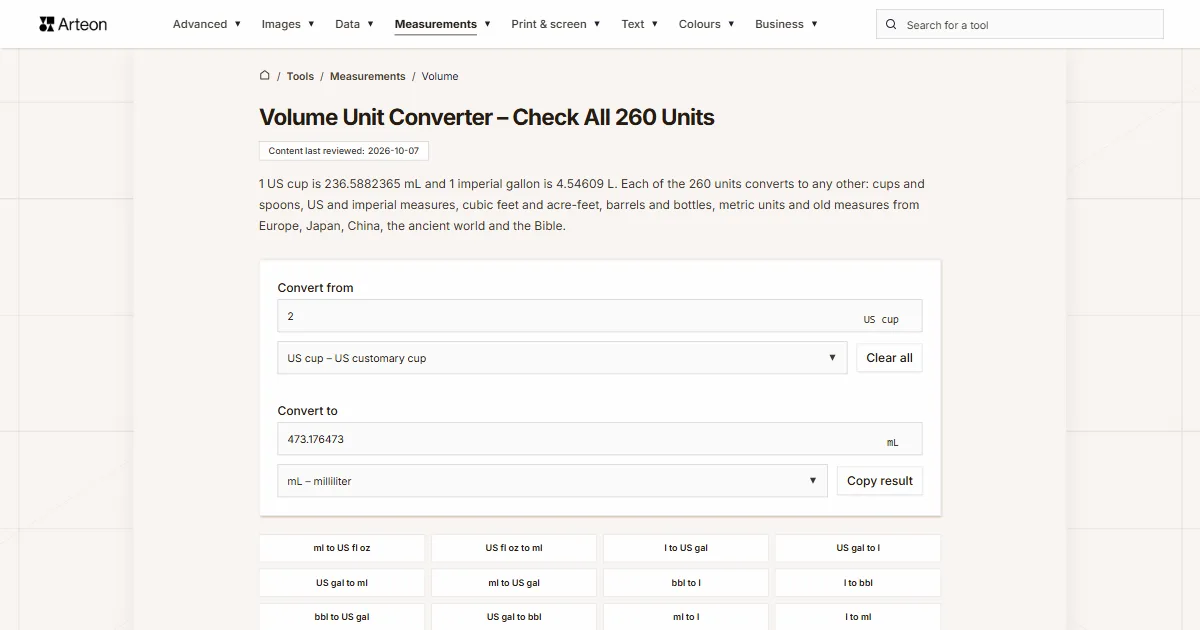
Type a number in the Convert from field and pick its unit from the list below the field, then pick the unit you want under Convert to. The result appears as you type. It works the other way round too: type a number in the Convert to field and the converter fills in the first one.
Both lists hold the same 260 units in 31 groups. The most used units come first, followed by cooking measures, US liquid, imperial and US dry measures, cubic inches, feet and yards, barrels and old British units, and then metric units, apothecaries' and shipping units, wine bottles, old measures from other countries, Japanese, Chinese, ancient, biblical and unusual units.
You don't have to look for a unit in the list. Type it with the number, for example “3 tbsp”, “8 fl oz” or “5 m3”, and the converter sets the unit next to the field and tells you below it which one it chose. Cubic units work with or without the superscript, so “ft3”, “ft^3” and “ft³” all mean cubic feet.
Some names cover several units. A gallon is 20% larger in Britain than in the US, and a pint can be liquid or dry. When you type a number with just “gallon” or “pint”, the converter picks the US unit and adds a line below the field saying that the other versions are in the list. Old units without a single agreed value show the value we use and, where sources give one, the range.
The Copy result button copies the number from the Convert to field, and Clear all empties both fields.
How many milliliters are in a cup?
A US customary cup holds 236.5882365 mL, which is half a US pint, or 8 US fluid ounces[1]. Nutrition labels in the US round it to 240 mL, and the same rule sets the teaspoon at 5 mL and the tablespoon at 15 mL[2]. Australia, New Zealand and Canada cook with a metric cup of 250 mL[3], and Japan with a cup of 200 mL[4]. Older British recipes measured with everyday vessels such as the breakfast cup, typically 8 imperial fluid ounces, a rough size next to the exact US cup[3].
Spoons follow the same split. A US tablespoon holds about 14.79 mL and a US teaspoon about 4.93 mL, so three teaspoons make a tablespoon. The international metric tablespoon holds 15 mL, and in most places a tablespoon is three teaspoons. Australia is the exception: its tablespoon holds 20 mL, or four teaspoons[5]. A metric dessert spoon holds 10 mL, two teaspoons[6].
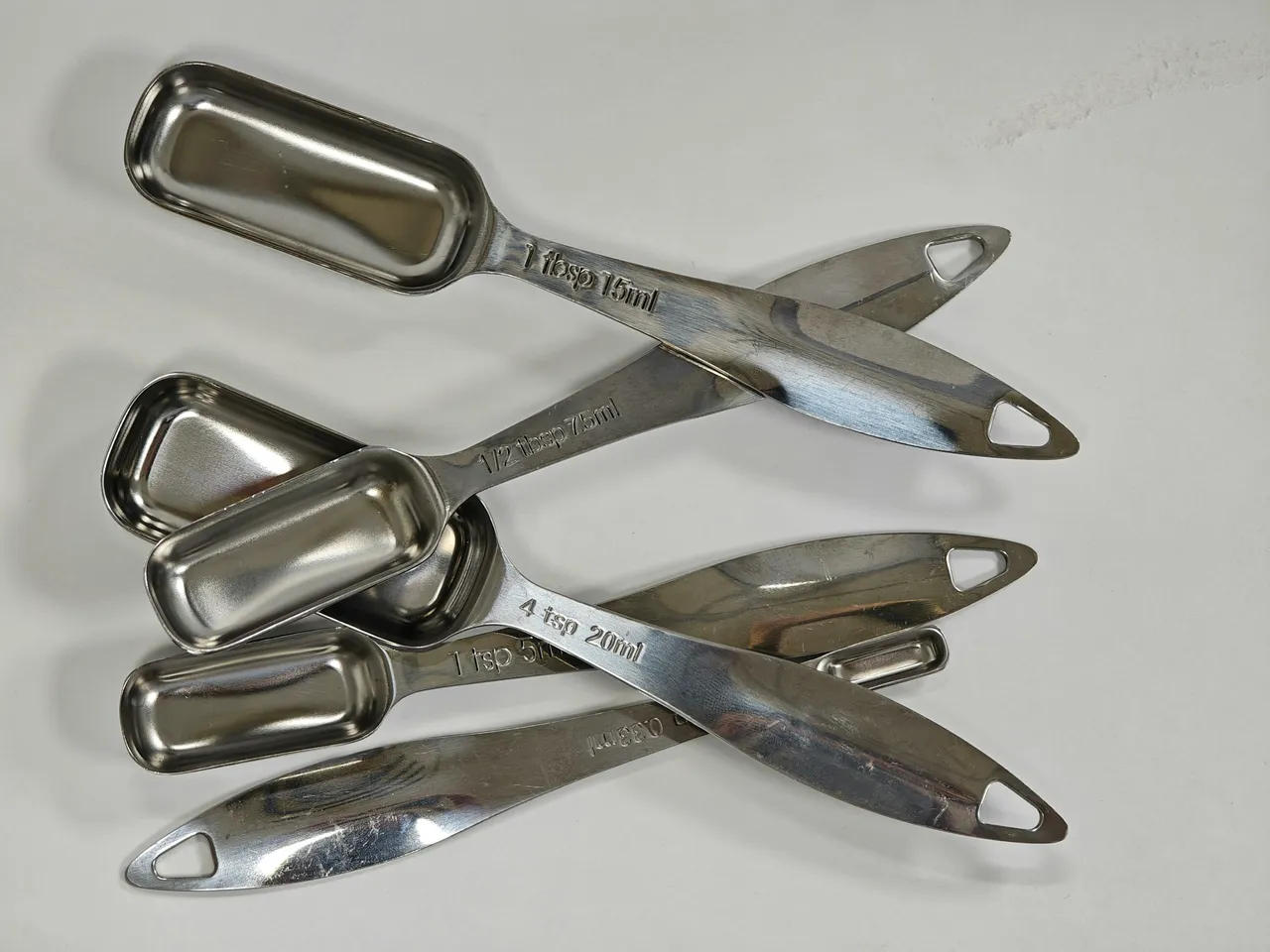
American recipes also use a dash, a pinch and a smidgen: 1/8, 1/16 and 1/32 of a teaspoon. No standards body defines them, so treat them as a rough guide[7]. The single-pair converters cups to mL, tablespoons to mL and teaspoons to mL have ready-made tables for the most common amounts.
How many milliliters are in each cooking measure?
| Unit | Milliliters |
|---|---|
| smidgen | approx. 0.15 mL |
| pinch | approx. 0.31 mL |
| dash | approx. 0.62 mL |
| dessert spoon (dsp) | 10 mL |
| Australian tablespoon (AU tbsp) | 20 mL |
| German Tasse | approx. 125 mL |
| Japanese cup | 200 mL |
| US legal cup (240 ml) | 240 mL |
How many liters are in a US gallon and an imperial gallon?
A US gallon holds 3.785411784 L and an imperial gallon 4.54609 L, about 20% more. The American colonists kept the English wine gallon of 231 cubic inches, while Britain replaced it in 1824 with the imperial gallon, the volume of 10 pounds of water[8]. British law now defines the imperial gallon as exactly 4.546 09 cubic decimeters[9].
The smaller units split differently too. The US gallon has 128 fluid ounces and the imperial gallon 160[1], so a US pint holds 16 US fluid ounces and an imperial pint 20 imperial ones. That makes a pint of beer in a British pub about 568 mL, against about 473 mL for a US pint. A US fluid ounce is about 29.57 mL and an imperial fluid ounce about 28.41 mL. In both systems a quart is a quarter of a gallon and a gill a quarter of a pint.
The US also keeps a separate set of dry measures. The bushel of 2,150.42 cubic inches, about 35.24 L, splits into 4 pecks and 32 dry quarts[1]. A dry quart is about 16% larger than a liquid quart, so a quart of berries and a quart of milk are not the same volume.
The fifth, a fifth of a US gallon or about 757 mL, was the standard liquor bottle in the US until 1980. The 750 mL bottle that replaced it is still sometimes called a “metric fifth”[10]. For gallons alone, the gallons to liters converter switches between the US and imperial gallon.
How many liters are in US liquid and dry measures?
| Unit | Liters |
|---|---|
| US gill (US gi) | about 0.118294 L |
| fifth | about 0.757082 L |
| US dry pint (US dry pt) | about 0.55061 L |
| US dry quart (US dry qt) | about 1.10122 L |
| US dry gallon (US dry gal) | about 4.40488 L |
| US peck (pk) | about 8.80977 L |
| US bushel (bu) | about 35.2391 L |
| cranberry barrel | about 95.471 L |
| US dry barrel | about 115.627 L |
How many liters are in British imperial measures?
| Unit | Liters |
|---|---|
| imperial gill (UK gi) | about 0.142065 L |
| imperial quart (UK qt) | about 1.13652 L |
| imperial peck | 9.09218 L |
| imperial bushel | about 36.3687 L |
| imperial quarter | about 290.95 L |
How many gallons are in a cubic foot?
A cubic foot holds about 7.481 US gallons, or 28.316846592 L. A cubic inch is 16.387064 cm³ and a cubic yard 27 cubic feet, or about 0.7646 m³[1]. Engine displacement in the US was often given in cubic inches, written CID[11], so a 350 CID engine is 5.7354724 L.
Several trade units are built on the cubic foot. A board foot of lumber is a board one inch thick and one foot square, 144 cubic inches[12]. A cord of firewood is a stack 4 feet high, 4 feet wide and 8 feet long, 128 cubic feet[13][1]. An acre-foot is the water that covers an acre one foot deep, about 1,233.5 m³, and reservoir capacities in the western US are often given in thousands of acre-feet[14]. An acre-inch is a twelfth of an acre-foot.
Natural gas prices in the US are quoted per Ccf, a hundred cubic feet, or per Mcf, a thousand cubic feet[15]. One Ccf is about 2.83 m³. Shipping uses the cubic foot as well. A register ton is 100 cubic feet, and gross register tonnage gave a ship's total internal volume in these tons[16]. A measurement ton, or freight ton, is 40 cubic feet and sets the charge for cargo lighter than seawater[17]. Britain's water ton is 224 imperial gallons[1].
How many liters are in cubic inches, feet and yards?
| Unit | Liters |
|---|---|
| board foot (FBM) | about 2.35974 L |
| Ccf (100 cubic feet) | about 2,831.68 L |
| Mcf (1,000 cubic feet) | about 28,316.8 L |
| acre-inch | about 102,790 L |
| acre-foot (ac-ft) | about 1,233,480 L |
How many cubic meters are in shipping tons?
| Unit | Cubic meters |
|---|---|
| water ton | about 1.01832 m³ |
| measurement ton (40 cubic feet) | about 1.13267 m³ |
| register ton (RT) | about 2.83168 m³ |
How many gallons are in a barrel?
It depends on the barrel. By custom, an oil barrel holds 42 US gallons, 158.987294928 L, and that is the barrel used for crude oil and petroleum statistics. Federal beer tax counts a barrel as 31 gallons, many state laws fix the “barrel for liquids” at 31½ gallons, and federal law also recognizes a 40-gallon barrel for proof spirits[1]. Beer kegs are fractions of the 31-gallon barrel: halves, thirds, quarters, sixths and eighths[18], so a half-barrel keg holds 15.5 gallons.
British breweries count in imperial gallons. A beer barrel is 36 imperial gallons, 163.65924 L. A firkin is a quarter barrel, 9 gallons, and the most common cask for cask ale; a kilderkin is half a barrel, and a pin half a firkin. A beer hogshead is 54 gallons[19]. The old English wine casks used wine gallons instead: a hogshead of 63 and a tun of 252[20].
French winemakers age wine in 225-liter Bordeaux barriques and 228-liter Burgundy pièces, and a Burgundy feuillette holds 114 liters, half a pièce[21]. The barrels to gallons converter handles the oil and beer barrels on their own.
How many liters are in barrels and casks?
| Unit | Liters |
|---|---|
| pin (4.5 gallons) | about 20.4574 L |
| firkin | about 40.9148 L |
| kilderkin | about 81.8296 L |
| Burgundy feuillette | 114 L |
| US beer barrel | about 117.348 L |
| US liquid barrel | about 119.24 L |
| UK beer barrel | about 163.659 L |
| Bordeaux barrique | 225 L |
| Burgundy pièce | 228 L |
| wine hogshead | about 238.481 L |
| beer hogshead | about 245.489 L |
| tun | about 953.924 L |
How many liters are in a magnum and other Champagne bottles?
A standard bottle of wine or Champagne holds 0.75 L, a half bottle 0.375 L and a magnum two bottles, 1.5 L. Larger Champagne bottles carry biblical and historical names: a jeroboam holds 3 L, a rehoboam 4.5 L, a methuselah 6 L, a salmanazar 9 L, a balthazar 12 L and a nebuchadnezzar 15 L. Beyond those come the solomon (18 L), the primat (27 L) and the melchizedek (30 L), which holds 40 standard bottles[22].
How many liters are in wine and Champagne bottles?
| Unit | Liters |
|---|---|
| half bottle (demi) | 0.375 L |
| wine bottle | 0.75 L |
| magnum | 1.5 L |
| jeroboam | 3 L |
| rehoboam | 4.5 L |
| methuselah | 6 L |
| salmanazar | 9 L |
| balthazar | 12 L |
| nebuchadnezzar | 15 L |
| solomon (melchior) | 18 L |
| primat | 27 L |
| melchizedek | 30 L |
How many liters are in a cubic meter?
A cubic meter holds 1,000 L. The liter is simply another name for the cubic decimeter, so a cubic centimeter equals a milliliter[23]. That is why “cc” on a syringe and mL on a measuring cup mean the same amount. Each step between cubic units is a factor of 1,000, because length, width and height all change at once: a cube one meter across holds 10 × 10 × 10 cubes one decimeter across.
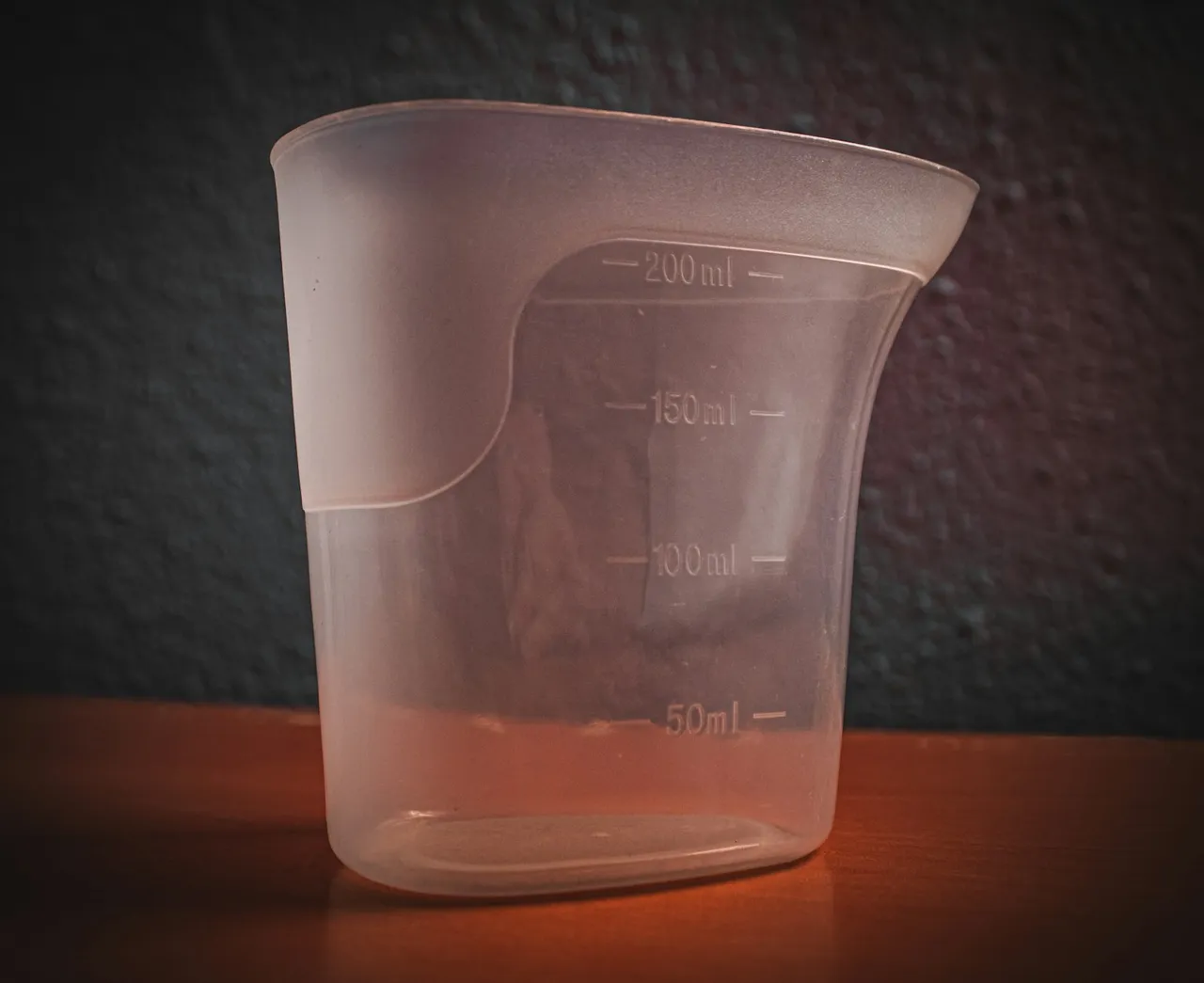
The liter may be written with a lowercase l or a capital L. The capital was allowed in 1979 so that l would not be mistaken for the digit 1, and L is the preferred symbol in the United States[23]. The converter reads both, as well as mL and ml.
Liters take the same prefixes as meters. Lab pipettes measure microliters, and blood tests report the average size of a red blood cell (MCV) in femtoliters, the same as cubic micrometers. A billion cubic meters, the unit of natural gas statistics often written bcm, is exactly one cubic kilometer, 1,000,000,000 m³.
How many liters are in metric units of volume?
| Unit | Liters |
|---|---|
| femtoliter (fL) | 1 × 10⁻¹⁵ L |
| picoliter (pL) | 1 × 10⁻¹² L |
| nanoliter (nL) | 1 × 10⁻⁹ L |
| cubic millimeter (mm³) | 0.000001 L |
| microliter (µL) | 0.000001 L |
| cubic centimeter (cm³) | 0.001 L |
| milliliter (mL) | 0.001 L |
| centiliter (cL) | 0.01 L |
| deciliter (dL) | 0.1 L |
| cubic decimeter (dm³) | 1 L |
| liter (L) | 1 L |
| liter of 1901–1964 | approx. 1.000028 L |
| decaliter (daL) | 10 L |
| hectoliter (hL) | 100 L |
| cubic meter (m³) | 1,000 L |
| kiloliter (kL) | 1,000 L |
| stere (st) | 1,000 L |
| cubic decameter (dam³) | 1,000,000 L |
| megaliter (ML) | 1,000,000 L |
| cubic hectometer (hm³) | 1,000,000,000 L |
| gigaliter (GL) | 1,000,000,000 L |
| cubic kilometer (km³) | 1,000,000,000,000 L |
What is a stere of firewood?
A stere is one cubic meter of stacked firewood, gaps between the logs included. France calls it the stère and Germany the Ster, and the solid wood in it is usually about 0.65 to 0.7 cubic meter[24]. A North American cord, about 3.62 m³, holds about 3.6 steres.
What are minims, fluid drams and drops?
Pharmacists in Britain and the US once measured medicine in minims and fluid drams, and British pharmacists in fluid scruples as well[1]. A fluid dram is an eighth of a fluid ounce and a minim a sixtieth of a fluid dram, so a US fluid dram is about 3.697 mL and a US minim about 0.0616 mL.
Pharmacists now round a drop to 0.05 mL, 20 drops to the milliliter[25]. A real drop depends on the liquid and the dropper, so treat a result in drops as a guide and follow the dosing instructions on the medicine. The drops to mL converter covers the same conversion with a table.
How many milliliters are in apothecaries' measures?
| Unit | Milliliters |
|---|---|
| drop | approx. 0.05 mL |
| imperial minim | about 0.0591939 mL |
| US minim | about 0.0616115 mL |
| imperial fluid scruple | about 1.18388 mL |
| imperial fluid drachm | about 3.55163 mL |
| US fluid dram (fl dr) | about 3.69669 mL |
What old British and Irish measures does the converter know?
Before 1824 England used several gallons at once. The ale gallon held 282 cubic inches, about 4.621 L, the wine gallon 231 cubic inches, and the corn gallon, an eighth of the Winchester bushel, about 268.8 cubic inches[8]. The wine gallon survives as the US gallon, and the corn gallon became the US dry gallon. Ireland counted a gallon as 217.6 cubic inches[26], and Scotland served ale by a pint of about 1.7 liters[27], roughly three English pints.
How many liters were old British and Irish measures?
| Unit | Liters | Where and when |
|---|---|---|
| Scots pint | approx. 1.696 L | Scotland, ale, until the 19th century |
| Irish gallon | about 3.56583 L | Ireland, 217.6 cubic inches |
| ale gallon | about 4.62115 L | England, until 1824 |
What were the old volume measures of Europe?
Poland and Russia
Poland's basic measure was the garniec. A reform in 1764 fixed the Crown garniec at 3.77 liters, and in 1766 Lithuania got its own garniec of 2.82 liters. A barrel of liquid held 72 garniec and a korzec of grain 32[28]. Congress Poland rounded these to metric values in 1819: a garniec of 4 liters, a korzec of 128 liters and a kwarta of exactly one liter[29]. Russia measured liquids by the vedro, or bucket, which from 1835 held 30 pounds of distilled water, 750.57 cubic inches[30].
Germany, Austria and Switzerland
A Bavarian law of 1869 made the Bavarian Maß the 208th part of the Bavarian Scheffel, about 1.069 L[31]. In Vienna the Maß held 1.414724 liters, the Seidel a quarter of that and the Eimer 40 Maß, while grain was measured by the Metzen of 61.48682 liters[32]. Bohemia took over the Austrian measures in 1765[33], and Galicia used them too[34].
France, Spain, Portugal and Italy
The Paris pinte held 48 cubic inches of the French royal foot, about 0.952 L, and a muid of wine 288 pintes[35]. Spanish tables of 1852 give the Castilian cántara of wine as 16.133 liters and the fanega of grain as 55.501 liters[36]. Lisbon measured wine in canadas of 1.4 liters and grain in alqueires of 13.8 liters[37]. Every Italian state had its own measures before unification, and official tables of 1877 gave their metric values[38]; the Florentine barile of wine held 45.584 liters, split into 20 fiaschi[39].
How many liters were old European measures?
| Unit | Liters | Where and when |
|---|---|---|
| Old Polish kwaterka | approx. 0.236 L | Crown of Poland, 1764–1819 |
| New Polish kwaterka | 0.25 L | Congress Poland, 1819–1849 |
| Old Polish kwarta | approx. 0.943 L | Crown of Poland, 1764–1819 |
| New Polish kwarta | 1 L | Congress Poland, 1819–1849 |
| Lithuanian garniec | approx. 2.82 L | Lithuania, from 1766 |
| Old Polish garniec (Crown) | approx. 3.77 L | Crown of Poland, 1764–1819 |
| New Polish garniec | 4 L | Congress Poland, 1819–1849 |
| New Polish cubic foot | about 23.8879 L | Congress Poland, 1819–1849 |
| Old Polish ćwierć | approx. 30.2 L | Crown of Poland, 1764–1819 |
| New Polish ćwierć | 32 L | Congress Poland, 1819–1849 |
| antał | approx. 68 L | Poland, quarter of a barrel, before 1764 |
| New Polish beczka (barrel) | 100 L | Congress Poland, 1819–1849 |
| Old Polish korzec (Warsaw) | approx. 121 L | Crown of Poland, 1764–1819 |
| New Polish korzec | 128 L | Congress Poland, 1819–1849 |
| New Polish cubic ell | about 191.103 L | Congress Poland, 1819–1849 |
| stągiew | 200 L | Congress Poland, 1819–1849 |
| Old Polish beczka (barrel) | approx. 271 L | Crown of Poland, 1764–1819 |
| sąg (Polish cord) | about 2,579.89 L | firewood, Congress Poland, 1819–1849 |
| Old Polish łaszt (last) | approx. 3,620 L | 30 Warsaw korzec, 1764–1819 |
| New Polish łaszt (last) | 3,840 L | Congress Poland, 1819–1849 |
| charka | approx. 0.123 L | Russia, 1835–1918 |
| shtof | approx. 1.23 L | Russia, 1835–1918 |
| Russian garnets | approx. 3.28 L | Russia, 1835–1918 |
| vedro (Russian bucket) | approx. 12.3 L | Russia, 1835–1918 |
| chetverik | approx. 26.24 L | Russia, 1835–1918 |
| chetvert | approx. 209.9 L | Russia, 1835–1918 |
| bochka (Russian barrel) | approx. 492 L | Russia, 40 vedra |
| Schoppen (half liter) | 0.5 L | North German Confederation, from 1868 |
| Bavarian Maß | about 1.06903 L | Bavaria, 1811–1871 |
| Prussian quart | about 1.14503 L | Prussia, 1816–1872 |
| Prussian Metze | about 3.43509 L | Prussia, 1816–1872 |
| Prussian anker | about 34.3509 L | Prussia, 1816–1872 |
| Bavarian Metzen | about 37.0596 L | Bavaria, 1811–1871 |
| metric Scheffel (50 l) | 50 L | North German Confederation, from 1868 |
| Prussian Scheffel | about 54.9615 L | Prussia, 1816–1872 |
| Bavarian Eimer (Visiereimer) | about 68.4177 L | Bavaria, 64 Maß |
| Prussian Eimer | about 68.7018 L | Prussia, 1816–1872 |
| Prussian ohm (aam) | about 137.404 L | Prussia, 1816–1872 |
| Prussian Oxhoft | about 206.106 L | Prussia, 1816–1872 |
| Bavarian Scheffel | about 222.358 L | Bavaria, 1811–1871 |
| Prussian Fuder | about 824.422 L | Prussia, 1816–1872 |
| Prussian Wispel | about 1,319.08 L | Prussia, 1816–1872 |
| Vienna Pfiff | about 0.176841 L | Austria, until 1876 |
| Vienna Seidel | 0.353681 L | Austria, until 1876 |
| Vienna Krügel | about 0.530522 L | Austria, until 1876 |
| Vienna Halbe | 0.707362 L | Austria, until 1876 |
| Vienna Maß | about 1.41472 L | Austria, Galicia and Bohemia, until 1876 |
| Vienna Massel | about 3.84293 L | Austria, until 1876 |
| Vienna Eimer | about 56.589 L | Austria, Galicia and Bohemia, until 1876 |
| Vienna Metzen | about 61.4868 L | Austria, Galicia and Bohemia, until 1876 |
| Vienna Muth | about 1,844.6 L | Austria, 30 Metzen |
| Swiss Schoppen | 0.375 L | Switzerland, 1838–1876 |
| Swiss Maß | 1.5 L | Switzerland, 1838–1876 |
| Swiss Viertel | 15 L | Switzerland, grain, 1838–1876 |
| Swiss Eimer | 37.5 L | Switzerland, 1838–1876 |
| Swiss Malter | 150 L | Switzerland, grain, 1838–1876 |
| Swiss Saum | 150 L | Switzerland, wine, 1838–1876 |
| Czech žejdlík | approx. 0.48 L | Bohemia, before 1764 |
| Czech pinta | approx. 1.9 L | Bohemia, 16th century to 1764 |
| Czech věrtel | approx. 23.4 L | Bohemia, quarter of a korec |
| Prague korec | approx. 93.5 L | Bohemia, from 1764 |
| roquille | about 0.0297546 L | Paris, until 1793 |
| posson | about 0.119018 L | Paris, until 1793 |
| demiard | about 0.238036 L | Paris, until 1793 |
| chopine | about 0.476073 L | Paris, until 1793 |
| litron | about 0.793455 L | Paris, grain, until 1793 |
| Paris pinte | about 0.952146 L | Paris, until 1793 |
| velte | about 7.61717 L | Paris, until 1793 |
| boisseau usuel (12.5 l) | 12.5 L | France, 1812–1840 |
| Paris boisseau | about 12.6953 L | Paris, grain, until 1793 |
| minot | about 38.0858 L | Paris, grain, until 1793 |
| quartaut | about 68.5545 L | Paris, wine, until 1793 |
| Paris feuillette | about 137.109 L | Paris, wine, until 1793 |
| setier | about 152.343 L | Paris, grain, until 1793 |
| Paris muid (wine) | about 274.218 L | Paris, wine, until 1793 |
| Paris muid (grain) | about 1,828.12 L | Paris, grain, until 1793 |
| cuartillo (liquids) | about 0.504156 L | Castile, until 1852 |
| cuartillo (grain) | about 1.15627 L | Castile, until 1852 |
| azumbre | about 2.01663 L | Castile, until 1852 |
| celemín | about 4.62508 L | Castile, grain, until 1852 |
| arroba of oil | 12.563 L | Castile, until 1852 |
| cántara (wine arroba) | 16.133 L | Castile, until 1852 |
| fanega | 55.501 L | Castile, grain, until 1852 |
| quartilho | approx. 0.35 L | Lisbon, liquids |
| selamim | approx. 0.431 L | Lisbon, grain |
| maquia | approx. 0.863 L | Lisbon, grain |
| canada (Portuguese) | approx. 1.4 L | Lisbon, liquids |
| pote | approx. 8.4 L | Lisbon, liquids |
| alqueire | approx. 13.8 L | Lisbon, grain |
| almude | approx. 16.8 L | Lisbon, liquids |
| fanga | approx. 55.2 L | Lisbon, grain |
| pipa | approx. 420 L | Lisbon, wine |
| moio | approx. 828 L | Lisbon, grain |
| tonel | approx. 840 L | Lisbon, wine |
| Roman boccale | about 1.82318 L | Rome, wine, 1877 tables |
| Florentine fiasco | 2.2792 L | Florence, wine, 1877 tables |
| Milanese staio | 18.2793 L | Milan, grain, 1877 tables |
| Piedmontese emina | about 23.055 L | Piedmont, grain, from 1818 |
| Florentine staio | 24.3629 L | Florence, grain, 1877 tables |
| Neapolitan barile | about 43.625 L | Naples, wine, 1877 tables |
| Florentine barile | 45.584 L | Florence, wine, 1877 tables |
| Piedmontese brenta | about 49.3069 L | Piedmont, wine, from 1818 |
| Neapolitan tomolo | about 55.5451 L | Naples, grain, from 1840 |
| Roman barile | 58.3416 L | Rome, wine, 1877 tables |
| Milanese brenta | 75.5544 L | Milan, wine, 1877 tables |
| Sicilian salma | about 275.089 L | Sicily, grain, from 1809 |
| Roman rubbio | about 294.465 L | Rome, grain, 1877 tables |
How many milliliters is a Japanese gō?
A gō holds about 180.4 mL. Japan's Weights and Measures Act of 1891 fixed the shō at 2401/1331 liters, about 1.804 L, and made the gō a tenth of it, the to ten shō and the koku a hundred[40]. The gō is still the serving size for rice and sake, and sake and shochu are sold in 1.8-liter bottles called isshōbin, “one-shō bottles”[41]. The 180 mL cup that comes with rice cookers is a rounded gō[3]. China set its market units in 1929 so that the sheng is exactly one liter[42].
How many liters are Japanese and Chinese units?
| Unit | Liters | Where and when |
|---|---|---|
| shaku (勺) | about 0.0180391 L | Japan, from 1891 |
| gō (合) | about 0.180391 L | Japan, from 1891 |
| shō (升) | about 1.80391 L | Japan, from 1891 |
| to (斗) | about 18.0391 L | Japan, from 1891 |
| koku (石) | about 180.391 L | Japan, from 1891 |
| shao (勺) | 0.01 L | China, from 1929 |
| ge (合) | 0.1 L | China, from 1929 |
| sheng (升) | 1 L | China, from 1929 |
| dou (斗) | 10 L | China, from 1929 |
| dan (石) | 100 L | China, from 1929 |
How much did a Roman amphora hold?
The Roman amphora was a cubic Roman foot. The congius was an eighth of it and the sextarius a sixth of a congius, but surviving measuring vessels differ, and scholars put the sextarius between 500 and 580 mL[43]. The converter takes the Roman foot as 0.296 m, the same as in our length converter, which gives an amphora of approx. 25.9 L. Grain was measured by the modius, a third of an amphora.
Greek liquid measures started from the xestes, equal to the Roman sextarius: a chous held 6 xestai and a metretes 12 choes. Grain was measured by the choinix of 2 xestai and the medimnos of 48 choinikes[44]. In Egypt the heqat of about 4.8 liters measured grain, and the Rhind Mathematical Papyrus says a heqat makes 10 hinu[45]. In Mesopotamia the base unit was the sila of about one liter, and a gur held 300 sila[46].
How many liters were ancient units?
| Unit | Liters | Where and when |
|---|---|---|
| ligula | approx. 0.0113 L | Rome |
| cyathus | approx. 0.045 L | Rome |
| acetabulum | approx. 0.0675 L | Rome |
| quartarius | approx. 0.135 L | Rome |
| hemina | approx. 0.27 L | Rome |
| sextarius | approx. 0.54 L | Rome |
| congius | approx. 3.24 L | Rome |
| semodius | approx. 4.32 L | Rome, grain |
| modius | approx. 8.64 L | Rome, grain |
| urna | approx. 13 L | Rome |
| Roman amphora | approx. 25.9 L | Rome, one cubic foot |
| culleus | approx. 519 L | Rome, 20 amphorae |
| kyathos | approx. 0.045 L | Athens |
| kotyle | approx. 0.27 L | Athens |
| xestes | approx. 0.54 L | Athens, equal to the sextarius |
| choinix | approx. 1.08 L | Athens, grain |
| chous | approx. 3.24 L | Athens |
| metretes (Greek amphora) | approx. 38.9 L | Athens, wine and oil |
| medimnos | approx. 51.9 L | Athens, grain |
| ro | approx. 0.015 L | Egypt |
| hinu (henu) | approx. 0.48 L | Egypt |
| heqat | approx. 4.8 L | Egypt, grain |
| oipe | approx. 19 L | Egypt, New Kingdom |
| khar (sack) | approx. 77 L | Egypt, New Kingdom |
| deny (cubic cubit) | approx. 140 L | Egypt |
| sila | approx. 1 L | Mesopotamia |
| ban | approx. 10 L | Mesopotamia |
| barig | approx. 60 L | Mesopotamia |
| gur | approx. 300 L | Mesopotamia |
How much is an ephah, a bath and a homer?
The Bible measures grain by the ephah and liquids by the bath. Ezekiel says the two are the same size, each a tenth of a homer (Ezekiel 45:11), and that ten baths make a cor (Ezekiel 45:14). An omer is a tenth of an ephah (Exodus 16:36). Smaller measures are the seah, the kab, the hin and the log[47].
No single value exists for the bath. NIV footnotes put it at about 6 gallons or 22 liters[48], while the Jewish Encyclopedia gives 36.44 liters[47]. The converter counts the bath as approx. 22 L and shows the range from the sources below the fields. In Isaiah 5:10 ten acres of vineyard yield only a bath of wine, and the bronze Sea of Solomon's temple held two thousand baths (1 Kings 7:26), about 44,000 liters by the NIV footnote[48].
The New Testament uses Greek and Roman measures. The six stone jars at Cana held two or three metretes each (John 2:6), which the King James Version renders as “two or three firkins apiece”[49][50] and the NIV as twenty to thirty gallons[48]. In Luke 16:6–7 the debtors owe a hundred baths of oil and a hundred cors of wheat[50]. The NIV renders the oil as nine hundred gallons, about 3,000 liters, so here it counts a bath as about 9 gallons[48]. The “bushel” of Matthew 5:15 in the King James Version is the Roman modius, and the “measure of wheat” of Revelation 6:6 is a choinix[49][50].
How many liters are biblical measures?
| Unit | Liters | Where and when |
|---|---|---|
| log | approx. 0.31 L | Leviticus 14:10 |
| kab (cab) | approx. 1.2 L | 2 Kings 6:25 |
| omer | approx. 2.2 L | Exodus 16:36 |
| hin | approx. 3.7 L | Exodus 29:40 |
| seah | approx. 7.3 L | 2 Kings 7:1 |
| ephah | approx. 22 L | dry measure, Isaiah 5:10 |
| bath | approx. 22 L | liquid measure, Isaiah 5:10 |
| lethech | approx. 110 L | Hosea 3:2 |
| homer (cor) | approx. 220 L | Ezekiel 45:11 |
What unusual volume units does the converter know?
The Olympic swimming pool serves as an informal unit for large volumes: 50 meters long, 25 meters wide and, at a nominal depth of 2 meters, 2,500 cubic meters of water[51]. Australians compare water volumes with Sydney Harbour: one sydharb is about 562 gigaliters[52], or approx. 220,000 Olympic pools.
What can I type in the Convert from field?
| What you type | Unit set in Convert from | Result in Convert to | How we read it |
|---|---|---|---|
| 2 | US customary cup (US cup) | 473.176473 mL | A number without a unit counts in the unit chosen next to the field, here US cups. |
| 1.5 | US customary cup (US cup) | 354.88235475 mL | A dot is the decimal point, so this is one and a half cups. |
| 1,500 | US customary cup (US cup) | 354,882.35475 mL | A comma before three digits separates thousands, so this is fifteen hundred cups. |
| 3/4 | US customary cup (US cup) | 177.441177375 mL | A fraction counts as written, three quarters of a cup. |
| 1 1/2 | US customary cup (US cup) | 354.88235475 mL | A whole number with a fraction reads as one and a half. |
| ½ | US customary cup (US cup) | 118.29411825 mL | The fraction character counts as a half. |
| 3 tbsp | US customary tablespoon (US tbsp) | 44.36029434375 mL | The unit after the number switches the field to US tablespoons, and a line below the field says that other tablespoons exist. |
| 8 fl oz | US fluid ounce (US fl oz) | 236.5882365 mL | Fluid ounces switch the field to US fluid ounces. |
| 2 pints | US liquid pint (US pt) | 946.352946 mL | A plain “pint” means the US liquid pint, and the line below the field mentions the other pints. |
| 5 ft3 | cubic foot (ft³) | 141,584.23296 mL | Cubic feet typed without the superscript switch the field to cubic feet. |
| 350 CID | cubic inch (in³) | 5,735.4724 mL | Engine displacement in cubic inches switches the field to cubic inches. |
| 1.5 × 10³ | US customary cup (US cup) | 354,882.35475 mL | A power of ten, as the converter writes very large results, reads as fifteen hundred. |
Sources
- Handbook 44 (2026), Appendix C — National Institute of Standards and Technology
- 21 CFR 101.9 Nutrition labeling of food, (b)(5)(viii) — Legal Information Institute, Cornell Law School
- Cup (unit) — Wikipedia
- 計量カップ (Japanese) — Wikipedia
- Tablespoon — Wikipedia
- Dessert spoon — Wikipedia
- Cooking weights and measures — Wikipedia
- Gallon — Wikipedia
- Weights and Measures Act 1985, Schedule 1 — legislation.gov.uk
- Fifth (unit) — Wikipedia
- Cubic inch — Wikipedia
- Board foot — Wikipedia
- Cord (unit) — Wikipedia
- Acre-foot — Wikipedia
- How do I convert natural gas prices in dollars per cubic feet to dollars per Btu or therm? — U.S. Energy Information Administration
- Gross register tonnage — Wikipedia
- Ton, section Units of volume — Wikipedia
- 27 CFR 25.156 Rates of tax — Legal Information Institute, Cornell Law School
- English brewery cask units — Wikipedia
- English wine cask units — Wikipedia
- Tonneau (récipient) (French) — Wikipedia
- Bouteille de champagne (French) — Wikipedia
- NIST Special Publication 330, Section 4: Non-SI units that are accepted for use with the SI — National Institute of Standards and Technology
- Metr przestrzenny (Polish) — Wikipedia
- Drop (unit) — Wikipedia
- Irish measure — Wikipedia
- Scottish units of measurement — Wikipedia
- Гарнец, Brockhaus and Efron Encyclopedic Dictionary (Russian) — Wikisource
- Miary nowopolskie (Polish) — Wikipedia
- Ведро, Brockhaus and Efron Encyclopedic Dictionary (Russian) — Wikisource
- Alte Maße und Gewichte (Bayern) (German) — Wikipedia
- Maßeinheit (German) — Wien Geschichte Wiki, City of Vienna
- Česká měrná soustava (Czech) — Wikipedia
- Miary austriackie (Polish) — Wikipedia
- Anciennes unités de mesure françaises (French) — Wikipedia
- Real Orden de 9 de diciembre de 1852, tablas de correspondencia recíproca (Spanish) — Centro Español de Metrología, Internet Archive copy
- Antigas unidades de medida portuguesas (Portuguese) — Wikipedia
- Tavole di ragguaglio dei pesi e delle misure già in uso nelle varie provincie del regno col sistema metrico decimale, 1877 (Italian) — Stamperia Reale, Rome
- Antiche unità di misura del circondario di Firenze (Italian) — Wikipedia
- 度量衡法, Weights and Measures Act of 1891 (Japanese) — Wikisource
- Japanese units of measurement — Wikipedia
- 度量衡法, Weights and Measures Act of 1929 (Chinese) — Wikisource
- Ancient Roman units of measurement — Wikipedia
- Ancient Greek units of measurement — Wikipedia
- Ancient Egyptian units of measurement — Wikipedia
- Ancient Mesopotamian units of measurement — Wikipedia
- Weights and Measures, Jewish Encyclopedia (1906) — JewishEncyclopedia.com
- New International Version, verses and footnotes — Bible Gateway
- King James Version — Bible Gateway
- SBL Greek New Testament: John 2:6; Luke 16:6–7; Matthew 5:15; Revelation 6:6 — Bible Gateway
- Olympic-size swimming pool — Wikipedia
- List of non-coherent units of measurement — Wikipedia
- The International System of Units (SI), 9th edition, Appendix 1 — Bureau International des Poids et Mesures
- Kubikmeter (German) — Wikipedia
Every figure in the tables was computed from the unit definitions and checked arithmetically before publication. Historical values and the names of local units come from the sources listed above.
Content last reviewed: · written and checked by the Arteon team
Frequently asked questions about units of volume
Does a liter of water weigh exactly a kilogram?
Almost. From 1901 to 1964 the liter was defined as the volume of a kilogram of water, and it was about 28 parts in a million larger than a cubic decimeter[53]. Today a liter is exactly a cubic decimeter, and a cubic meter of water at 3.98 °C has a mass of 999.975 kg[54]. The old liter is in the list as liter of 1901–1964.
How do I convert cups of flour to grams?
This converter can’t, because the weight depends on what is in the cup. Multiply the volume by the density of the ingredient, or use a recipe that gives grams.
Can it convert square feet to cubic feet?
No. Square feet measure area, and you also need a depth to get a volume. Multiply the area in square feet by the depth in feet: a 100-square-foot slab 4 inches deep is 100 × 4/12 ≈ 33.3 cubic feet. If you type “5 square feet”, the converter tells you it is not a unit of volume.
Have a question or a suggestion?
If a unit is missing or you spot a wrong value, write to us. A source for the value helps us most.