Convert cups to fluid ounces
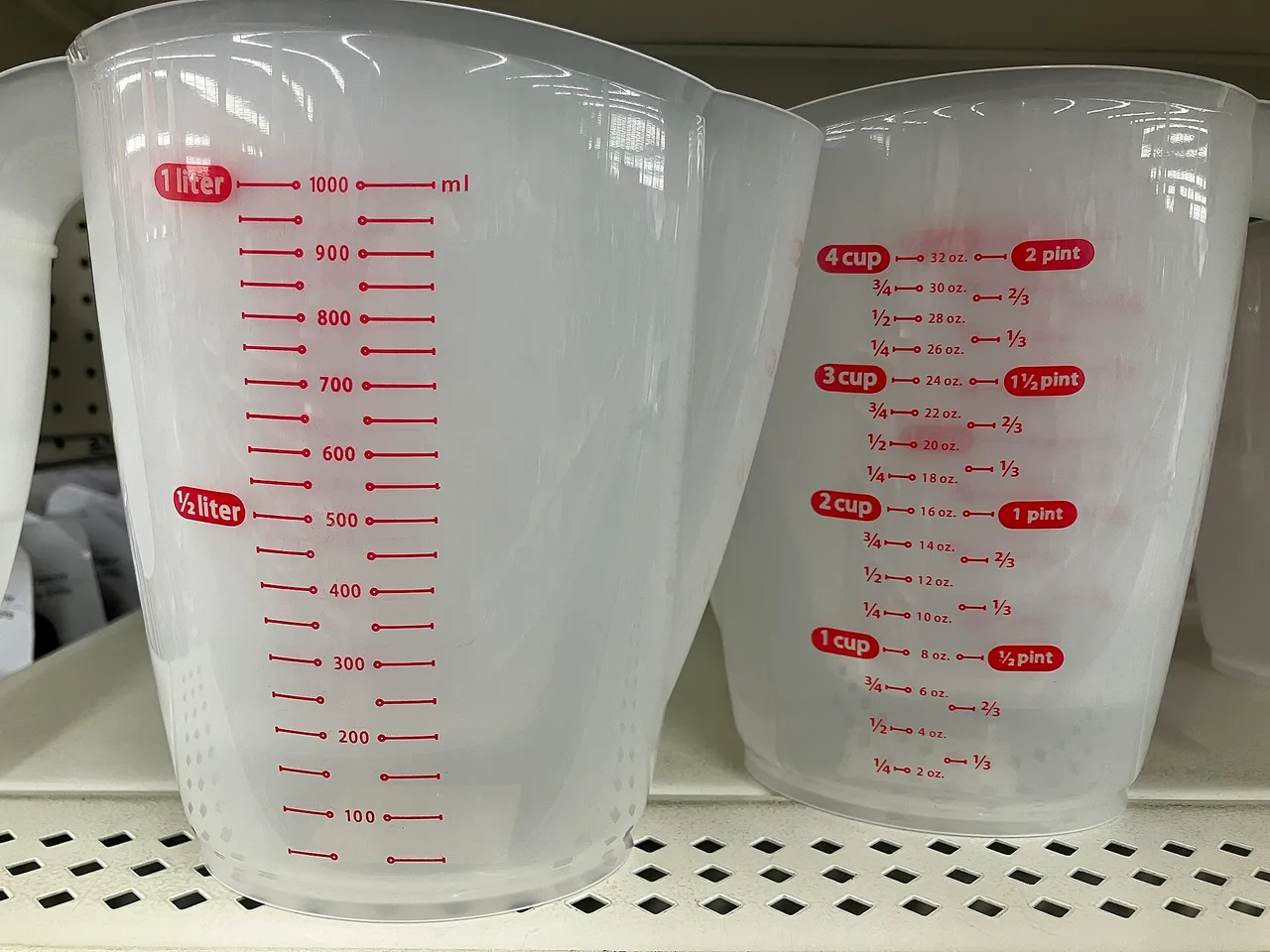
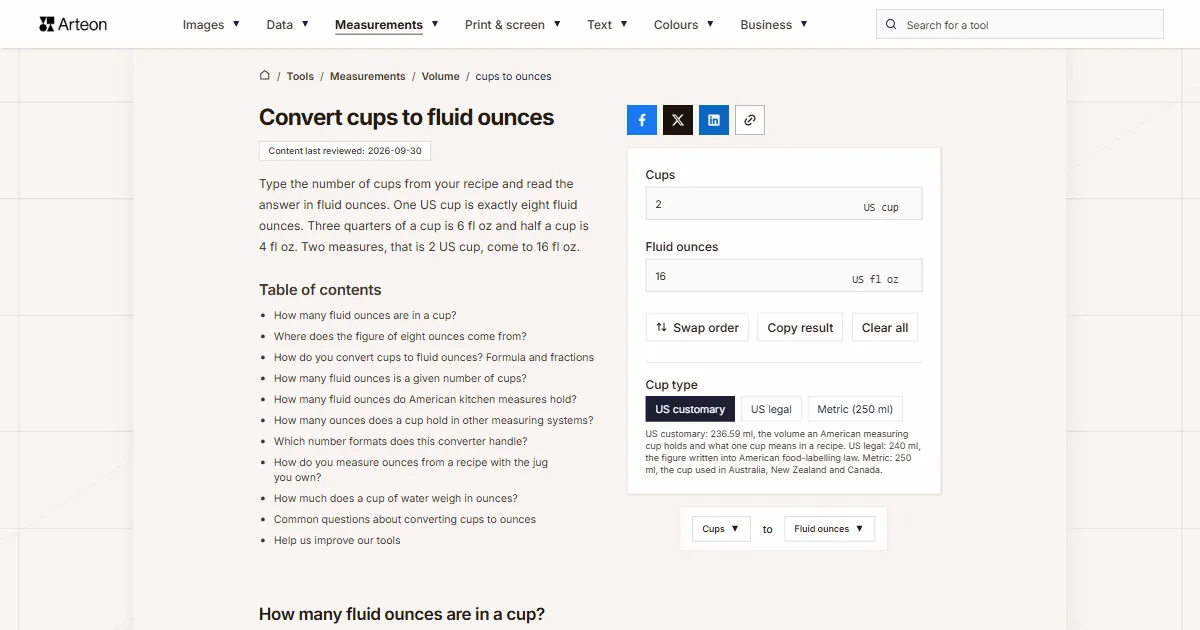
Type the number of cups from your recipe and read the answer in fluid ounces. One US cup is exactly eight fluid ounces. Three quarters of a cup is 6 fl oz and half a cup is 4 fl oz. Two measures, that is 2 US cup, come to 16 fl oz.
How many fluid ounces are in a cup?
One US cup holds exactly 8 fluid ounces. The American measurement institute NIST prints that equality as the definition of the cup and marks it as exact[1].
The cup is a unit of volume used in American recipes and it is measured with a vessel of fixed capacity. The fluid ounce (fl oz) measures the same quantity and holds 29.5735 millilitres. The ounce on a scale carries the same word and measures mass instead — the ounces to grams converter handles that one.
The labelling cup holds exactly 240 millilitres[2], which comes to 8.12 fluid ounces. The metric cup holds exactly 250 millilitres, which comes to 8.45 fluid ounces. You pick the measure with the Cup type switcher under the converter fields.
The converter starts on the US customary cup, because that is what a recipe and a measuring cup sold in the United States both mean. The reverse calculation is handled by the ounces to cups converter.
Where does the figure of eight ounces come from?
The whole American series of volume measures is built on the gallon, and the gallon has a fixed size: exactly 231 cubic inches[1]. An inch is exactly 2.54 centimetres, so that arithmetic puts the gallon at 3.785411784 litres.
The gallon splits into 128 fluid ounces and, separately, into 16 cups. Put those two divisions together and the figure eight follows. One hundred and twenty-eight ounces divided by sixteen cups gives eight ounces per cup.
The same arithmetic gives the cup in millilitres. Divide the gallon of 3,785.411784 millilitres by sixteen and you get 236.5882365 millilitres, which is what an American measuring cup holds. The cups to ml converter does that calculation in full.
The same series has three measures larger than the cup. A US pint holds two cups and 16 ounces. A quart holds four cups and 32 ounces. A gallon holds sixteen cups and 128 ounces.
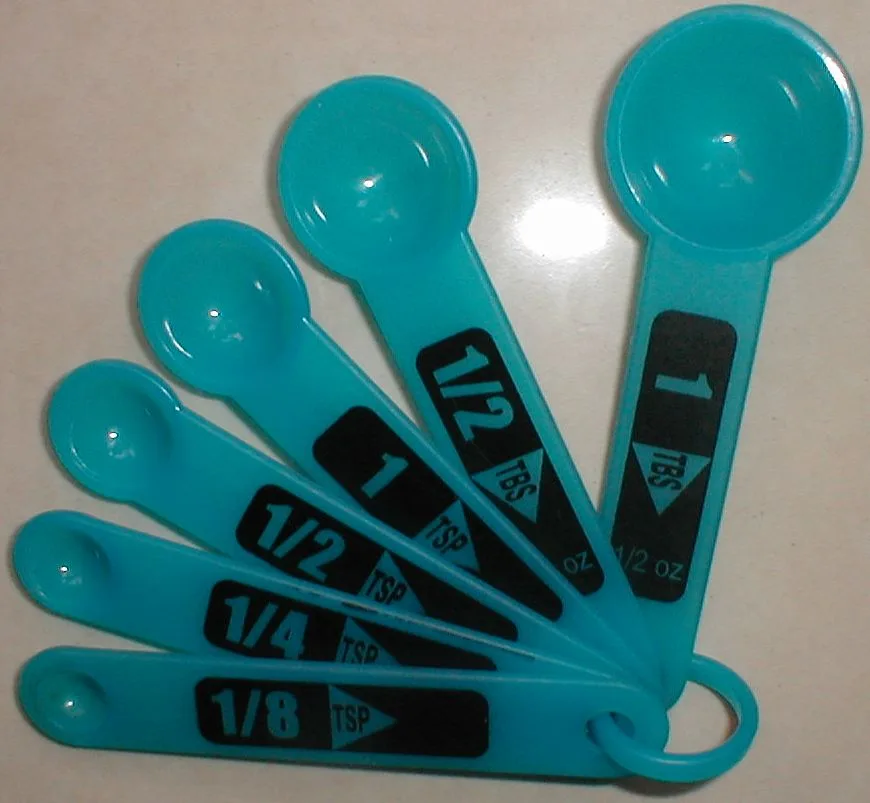
The same series also has measures smaller than the cup. A US tablespoon holds half a fluid ounce and a teaspoon holds a sixth of one.
How do you convert cups to fluid ounces? Formula and fractions
Multiply the number of cups by eight.
The formula is fluid ounces = cups × 8 for the US customary cup. The labelling cup uses 8.1154 and the metric cup 8.4535.
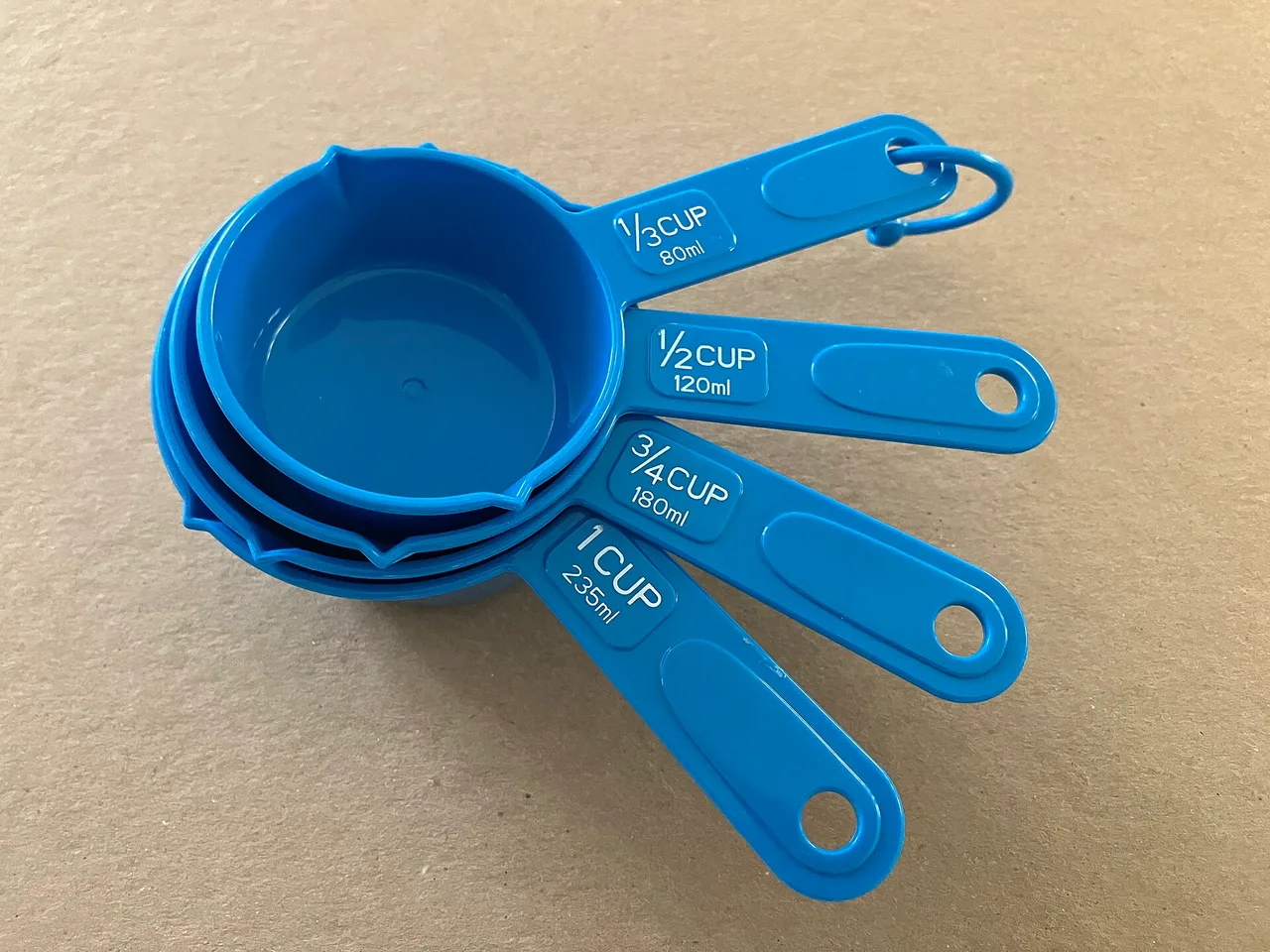
American recipes state volume in fractions, because a measuring set is sold in exactly those sizes: 1/4, 1/3, 1/2 and 1 cup, with 2/3 and 3/4 marked on the graduations[3]. The converter field therefore takes a fraction straight from the recipe.
Type 3/4 and you get 6 ounces. Type 2 1/2, with a space between the whole number and the fraction, and you get 20 ounces. Decimals work the same way, and the comma and the full stop are interchangeable, so 2.5 and 2,5 give the same answer.
Three fractions land on round numbers under the US customary cup. Half a cup is 4 ounces. A quarter cup is 2 ounces. An eighth of a cup is one ounce.
A volume written in millilitres is handled by the ml to ounces converter, and a volume written in tablespoons by the tablespoons to ml converter.
How many fluid ounces is a given number of cups?
| Cups | US customary cup | US legal cup | Metric cup |
|---|---|---|---|
| 1/16 | 0.5 fl oz | 0.51 fl oz | 0.53 fl oz |
| 1/8 | 1 fl oz | 1.01 fl oz | 1.06 fl oz |
| 1/6 | 1.33 fl oz | 1.35 fl oz | 1.41 fl oz |
| 1/4 | 2 fl oz | 2.03 fl oz | 2.11 fl oz |
| 1/3 | 2.67 fl oz | 2.71 fl oz | 2.82 fl oz |
| 3/8 | 3 fl oz | 3.04 fl oz | 3.17 fl oz |
| 1/2 | 4 fl oz | 4.06 fl oz | 4.23 fl oz |
| 5/8 | 5 fl oz | 5.07 fl oz | 5.28 fl oz |
| 2/3 | 5.33 fl oz | 5.41 fl oz | 5.64 fl oz |
| 3/4 | 6 fl oz | 6.09 fl oz | 6.34 fl oz |
| 7/8 | 7 fl oz | 7.1 fl oz | 7.4 fl oz |
| 1 | 8 fl oz | 8.12 fl oz | 8.45 fl oz |
| 1 1/4 | 10 fl oz | 10.14 fl oz | 10.57 fl oz |
| 1 1/3 | 10.67 fl oz | 10.82 fl oz | 11.27 fl oz |
| 1 1/2 | 12 fl oz | 12.17 fl oz | 12.68 fl oz |
| 1 2/3 | 13.33 fl oz | 13.53 fl oz | 14.09 fl oz |
| 1 3/4 | 14 fl oz | 14.2 fl oz | 14.79 fl oz |
| 2 | 16 fl oz | 16.23 fl oz | 16.91 fl oz |
| 2 1/4 | 18 fl oz | 18.26 fl oz | 19.02 fl oz |
| 2 1/3 | 18.67 fl oz | 18.94 fl oz | 19.72 fl oz |
| 2 1/2 | 20 fl oz | 20.29 fl oz | 21.13 fl oz |
| 2 2/3 | 21.33 fl oz | 21.64 fl oz | 22.54 fl oz |
| 2 3/4 | 22 fl oz | 22.32 fl oz | 23.25 fl oz |
| 3 | 24 fl oz | 24.35 fl oz | 25.36 fl oz |
| 3 1/4 | 26 fl oz | 26.37 fl oz | 27.47 fl oz |
| 3 1/2 | 28 fl oz | 28.4 fl oz | 29.59 fl oz |
| 3 3/4 | 30 fl oz | 30.43 fl oz | 31.7 fl oz |
| 4 | 32 fl oz | 32.46 fl oz | 33.81 fl oz |
| 4 1/2 | 36 fl oz | 36.52 fl oz | 38.04 fl oz |
| 5 | 40 fl oz | 40.58 fl oz | 42.27 fl oz |
| 5 1/2 | 44 fl oz | 44.63 fl oz | 46.49 fl oz |
| 6 | 48 fl oz | 48.69 fl oz | 50.72 fl oz |
| 6 1/2 | 52 fl oz | 52.75 fl oz | 54.95 fl oz |
| 7 | 56 fl oz | 56.81 fl oz | 59.17 fl oz |
| 7 1/2 | 60 fl oz | 60.87 fl oz | 63.4 fl oz |
| 8 | 64 fl oz | 64.92 fl oz | 67.63 fl oz |
| 9 | 72 fl oz | 73.04 fl oz | 76.08 fl oz |
| 10 | 80 fl oz | 81.15 fl oz | 84.54 fl oz |
| 11 | 88 fl oz | 89.27 fl oz | 92.99 fl oz |
| 12 | 96 fl oz | 97.38 fl oz | 101.44 fl oz |
| 14 | 112 fl oz | 113.62 fl oz | 118.35 fl oz |
| 16 | 128 fl oz | 129.85 fl oz | 135.26 fl oz |
| 20 | 160 fl oz | 162.31 fl oz | 169.07 fl oz |
| 24 | 192 fl oz | 194.77 fl oz | 202.88 fl oz |
| 32 | 256 fl oz | 259.69 fl oz | 270.51 fl oz |
How many fluid ounces do American kitchen measures hold?
| Measure | Fluid ounces | Millilitres | US cups |
|---|---|---|---|
| 1 US teaspoon | 0.1667 fl oz | 4.93 ml | 0.0208 |
| 1 US tablespoon | 0.5 fl oz | 14.79 ml | 0.0625 |
| 1/4 cup | 2 fl oz | 59.15 ml | 0.25 |
| 1/3 cup | 2.6667 fl oz | 78.86 ml | 0.3333 |
| 1/2 cup | 4 fl oz | 118.29 ml | 0.5 |
| 2/3 cup | 5.3333 fl oz | 157.73 ml | 0.6667 |
| 3/4 cup | 6 fl oz | 177.44 ml | 0.75 |
| 1 US cup | 8 fl oz | 236.59 ml | 1 |
| 1 US pint | 16 fl oz | 473.18 ml | 2 |
| 1 US quart | 32 fl oz | 946.35 ml | 4 |
| 1 US gallon | 128 fl oz | 3,785.41 ml | 16 |
| 1 imperial pint | 19.2152 fl oz | 568.26 ml | 2.4019 |
How many ounces does a cup hold in other measuring systems?
| Cup type | Millilitres | US fluid ounces | Imperial fluid ounces | Where you meet it |
|---|---|---|---|---|
| US customary cup | 236.5882365 ml | 8 fl oz | 8.3267 | United States: recipes and measuring sets |
| US legal cup | 240 ml | 8.1154 fl oz | 8.4468 | United States: nutrition facts panels |
| Metric cup | 250 ml | 8.4535 fl oz | 8.7988 | Australia, New Zealand and Canada |
| Pre-metric Canadian cup | 227.3045 ml | 7.6861 fl oz | 8 | Canada until the 1970s |
| Japanese cup | 200 ml | 6.7628 fl oz | 7.039 | Japan: kitchen recipes |
| Gō | 180.3907 ml | 6.0997 fl oz | 6.3489 | Japan: rice and sake |
| British cup of 1894 | 170.4784 ml | 5.7646 fl oz | 6 | Victorian British cookery books |
| Drip coffee maker cup | 147.8676 ml | 5 fl oz | 5.2042 | Drip coffee makers and their carafes |
| Tumbler from old British recipes | 284.1306 ml | 9.6076 fl oz | 10 | Britain: an 1894 household book, half an imperial pint |
Which number formats does this converter handle?
| What you type | What the converter shows | How we read it |
|---|---|---|
| 2.5 | 20 US fl oz | The point is the decimal separator, so this is two and a half cups. |
| 2,5 | 20 US fl oz | A comma followed by one digit is a European decimal comma, so we read it as two and a half. |
| 1,500 | 12000 US fl oz | Three digits after the comma mark a thousands separator, so we count one thousand five hundred cups. A note under the field says: Read as 1500. If you meant 1.5, type 1.5. |
| 1 500 | 12000 US fl oz | A space between the thousands is skipped, so this is one thousand five hundred cups as well. |
| 3/4 | 6 US fl oz | We convert a fraction with a slash directly, so it doesn’t need to become 0.75 first. |
| 1½ | 12 US fl oz | A ½ character copied from a recipe or a label is added to the number in front of it. |
| 2 cups | 16 US fl oz | A unit pasted along with the number is ignored, and we convert the value alone. |
How do you measure ounces from a recipe with the jug you own?
An American recipe assumes a jug graduated in fluid ounces, and the same volumes come out of equipment sold anywhere else.
With a jug marked in millilitres
Multiply the ounces by 29.57 and pour up to that mark. Eight ounces is 236.59 millilitres. Four ounces gives 118.29 millilitres. One ounce is just under 30 millilitres. Read the level at eye height along the bottom of the meniscus, which is what the spout and the graduations on a liquid measure are there for[3].With a metric cup from an Australian recipe
A metric cup holds 250 millilitres, which is 8.45 US fluid ounces. When a recipe calls for eight ounces, a metric cup filled to the brim carries 13.41 millilitres more. Set the switcher to Metric and the figure on screen already accounts for it.With tablespoons
One fluid ounce is exactly two US tablespoons, because that tablespoon holds half an ounce. Four ounces come to eight tablespoons and a whole cup to sixteen. A metric tablespoon holds 15 millilitres, so one ounce works out at 1.97 of them and two of them run 0.43 millilitres over.With a kitchen scale for water and milk
A fluid ounce of water weighs about 29.6 grams, so eight ounces of water come to roughly 237 grams. A scale repeats the same result every time, whichever measuring vessel sits in the drawer.
How much does a cup of water weigh in ounces?
A cup filled with water holds 8 fluid ounces, and the water inside it weighs about 8.35 ounces. Both figures describe the same glass: the first states volume, the second states mass.
The two numbers sit close together because of density. Water weighs roughly one gram per millilitre and a fluid ounce holds 29.57 millilitres, so a fluid ounce of water weighs about 29.6 grams. An ounce on the scale weighs 28.349523125 grams[6], which is 1.22 grams less, and that gap turns eight ounces of volume into 8.35 ounces of weight.
Water, milk and juice all have a density close to one gram per millilitre, so their two figures stay close. Dry goods have a lower density, because air sits between the grains, and the same cup then carries less mass.
A recipe that gives a liquid in ounces means fluid ounces, and a measuring jug answers it. A recipe that gives cheese or chocolate in ounces means mass, and a kitchen scale answers that one.
Convert other units to Fluid ounces
Convert Cups to other units
Sources
- Handbook 44 – 2026, Appendix C. General Tables of Units of Measurement — National Institute of Standards and Technology
- 21 CFR 101.9 — Nutrition labeling of food — Legal Information Institute, Cornell Law School
- Measuring cup — Wikipedia
- Fluid ounce — Wikipedia
- Cup (unit) — Wikipedia
- Ounce — Wikipedia
- The Units of Measurement Regulations 1995 — legislation.gov.uk
- How many fluid ounces does my drip-coffee maker carafe yield? — De'Longhi
Every figure in the tables was computed from the unit definitions and checked arithmetically before publication. Historical values and the names of local units come from the sources listed above.
Content last reviewed: · written and checked by the Arteon team
Common questions about converting cups to ounces
Does an ounce in a recipe mean volume or weight?
The ingredient decides. For water, milk, juice and oil the ounce means volume and it is written fl oz. For cheese, chocolate and pasta it means mass and it is written oz. The ounces to grams converter turns that second figure into grams.
How many ounces is a cup in a British recipe?
British recipes give volume in millilitres. The figure of 284 millilitres, sometimes quoted as a British cup, is 10 imperial fluid ounces, which is half a pint. An 1894 British household book gives that as the usual capacity of a tumbler, a drinking glass named in old recipes[5]. The imperial fluid ounce itself kept its last permitted trade use for drinks in returnable containers, and that use lapsed on 1 January 2000[7].
How many ounces is an Australian cup?
An Australian cup holds 250 millilitres, which is 8.45 US fluid ounces. New Zealand and Canada use the same measure, and the Cup type switcher offers it as the Metric option.
How many ounces does a twelve-cup coffee carafe hold?
About 60 fluid ounces, because De’Longhi counts a cup of coffee as five ounces[8]. In kitchen measures that comes to 7.5 US cups.
Why does the labelling cup give a different ounce count from the cup in the drawer?
American food labelling law fixes the cup at exactly 240 millilitres and the fluid ounce at exactly 30 millilitres[2]. Under that wording eight ounces come to exactly 240 millilitres. This converter uses the real ounce of 29.5735 millilitres, so the same 240 millilitres work out at 8.12 ounces.
Do water and milk convert the same way?
Yes. Both are measured by volume, so eight ounces of water and eight ounces of milk fill the same 236.59 millilitres. The difference shows up on a scale, because milk is slightly denser than water.
Help us improve our tools
Got an idea for a new feature, found a bug or want to suggest another tool? Write to us.