Convert psi to kPa
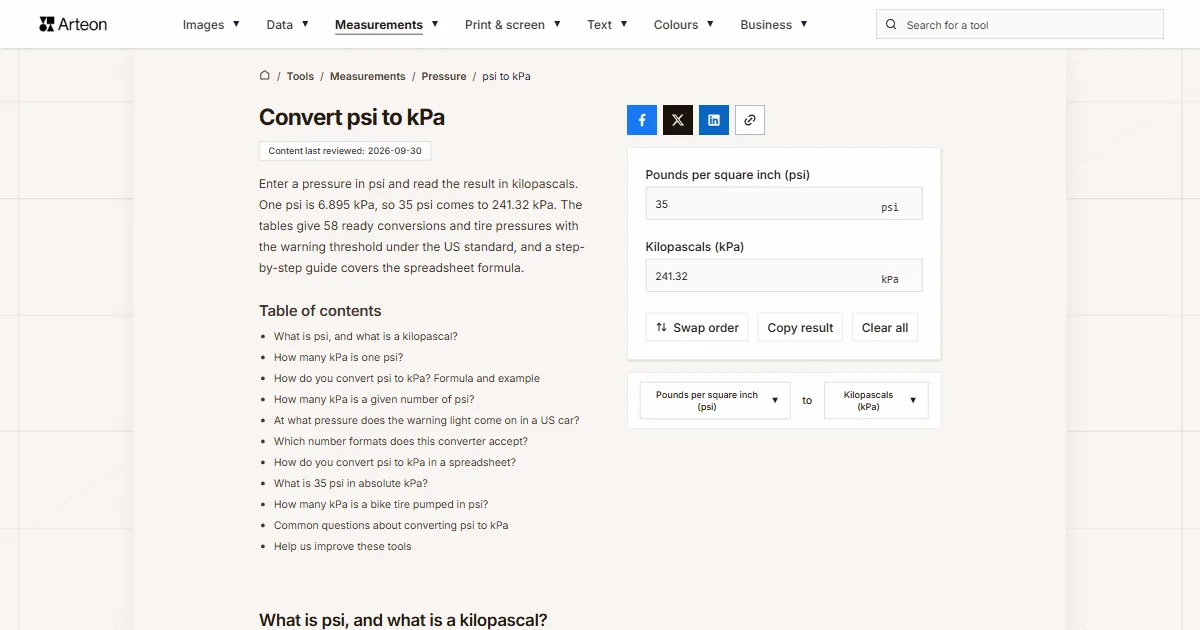
Enter a pressure in psi and read the result in kilopascals. One psi is 6.895 kPa, so 35 psi comes to 241.32 kPa. The tables give 58 ready conversions and tire pressures with the warning threshold under the US standard, and a step-by-step guide covers the spreadsheet formula.
What is psi, and what is a kilopascal?
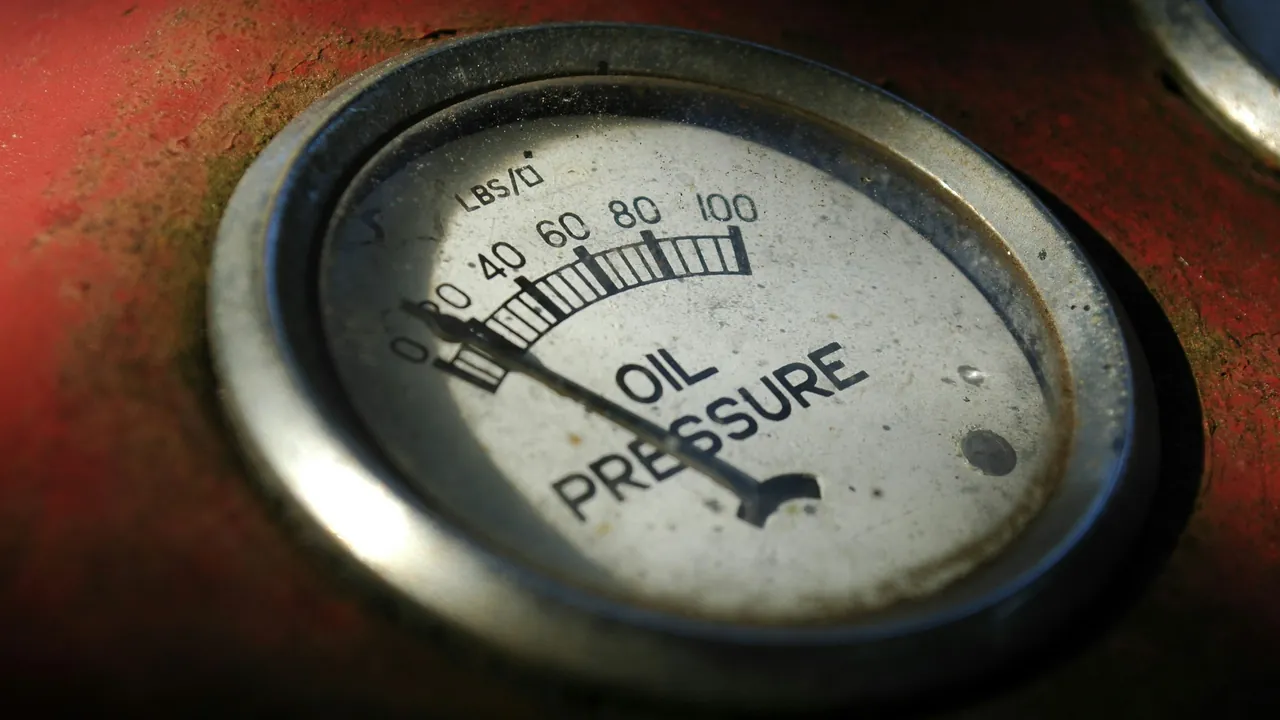
Psi is short for pound-force per square inch. The unit describes the pressure produced when a force of one pound acts on an area of one square inch[1].
A pound-force is the weight of a mass of one pound, which is exactly 0.45359237 kilograms. The weight is taken at standard gravity, 9.80665 m/s²[2]. That definition and the length of the inch give the value that the NIST conversion table lists as 6.894757 kPa[3].
Psi remains in widespread use in the United States and Canada, for example for tire pressure[4].
A kilopascal, in turn, is a thousand pascals, and the pascal is the SI unit of pressure equal to one newton per square meter[5].
How many kPa is one psi?
One psi is 6.894757 kPa. To convert psi to kilopascals, multiply the number of psi by this value from the NIST conversion table[3]. The result in kilopascals is therefore almost seven times the number of psi.
English Wikipedia gives 32 psi as a common gauge pressure for a car tire[1], which converts to 220.63 kPa. A value of 30 psi is 206.84 kPa. A value of 35 psi equals 241.32 kPa.
The converter multiplies as you type and shows the result to hundredths of a kilopascal. The field also accepts decimals, so 32.5 psi becomes 224.08 kPa. With small values the result has more decimal places, so half a psi shows as 3.447 kPa.
Tire pressure values are gauge pressure by convention[4]. The multiplication keeps the type of pressure, so gauge pressure from a gauge gives gauge pressure in kilopascals, and absolute pressure gives absolute pressure. Converting one into the other is shown in the example of 35 psi in absolute kilopascals.
How do you convert psi to kPa? Formula and example
Formula: kPa = psi × 6.894757
Take 44 psi. Multiplying by 6.894757 gives 303.37 kPa.
The figure of 44 psi also appears in the US standard FMVSS 138. Among the maximum inflation pressures of P-metric standard load tires, the standard lists 44 psi and writes 300 kPa next to it[6]. The two figures in the standard are therefore 3.37 kPa apart.
For the other direction, from kilopascals to psi, use the kPa to psi converter, and the psi to bar converter gives the value in bar.
How many kPa is a given number of psi?
| Psi | Kilopascals |
|---|---|
| 0.5 psi | 3.447 kPa |
| 1 psi | 6.895 kPa |
| 2 psi | 13.79 kPa |
| 3 psi | 20.68 kPa |
| 4 psi | 27.58 kPa |
| 5 psi | 34.47 kPa |
| 6 psi | 41.37 kPa |
| 7 psi | 48.26 kPa |
| 8 psi | 55.16 kPa |
| 10 psi | 68.95 kPa |
| 12 psi | 82.74 kPa |
| 14 psi | 96.53 kPa |
| 14.7 psi | 101.35 kPa |
| 15 psi | 103.42 kPa |
| 20 psi | 137.9 kPa |
| 22 psi | 151.68 kPa |
| 25 psi | 172.37 kPa |
| 26 psi | 179.26 kPa |
| 28 psi | 193.05 kPa |
| 29 psi | 199.95 kPa |
| 30 psi | 206.84 kPa |
| 31 psi | 213.74 kPa |
| 32 psi | 220.63 kPa |
| 33 psi | 227.53 kPa |
| 34 psi | 234.42 kPa |
| 35 psi | 241.32 kPa |
| 36 psi | 248.21 kPa |
| 37 psi | 255.11 kPa |
| 38 psi | 262 kPa |
| 40 psi | 275.79 kPa |
| 42 psi | 289.58 kPa |
| 43.5 psi | 299.92 kPa |
| 44 psi | 303.37 kPa |
| 45 psi | 310.26 kPa |
| 50 psi | 344.74 kPa |
| 55 psi | 379.21 kPa |
| 58 psi | 399.9 kPa |
| 60 psi | 413.69 kPa |
| 65 psi | 448.16 kPa |
| 70 psi | 482.63 kPa |
| 75 psi | 517.11 kPa |
| 80 psi | 551.58 kPa |
| 90 psi | 620.53 kPa |
| 100 psi | 689.48 kPa |
| 110 psi | 758.42 kPa |
| 120 psi | 827.37 kPa |
| 125 psi | 861.84 kPa |
| 130 psi | 896.32 kPa |
| 150 psi | 1,034.21 kPa |
| 200 psi | 1,378.95 kPa |
| 250 psi | 1,723.69 kPa |
| 300 psi | 2,068.43 kPa |
| 500 psi | 3,447.38 kPa |
| 1,000 psi | 6,894.76 kPa |
| 2,000 psi | 13,789.51 kPa |
| 3,000 psi | 20,684.27 kPa |
| 5,000 psi | 34,473.79 kPa |
| 6,000 psi | 41,368.54 kPa |
At what pressure does the warning light come on in a US car?
| Recommended pressure | Kilopascals | Warning at (psi) | Warning at (kPa) |
|---|---|---|---|
| 28 psi | 193.05 kPa | 21 psi | 144.79 kPa |
| 29 psi | 199.95 kPa | 21.75 psi | 149.96 kPa |
| 30 psi | 206.84 kPa | 22.5 psi | 155.13 kPa |
| 31 psi | 213.74 kPa | 23.25 psi | 160.3 kPa |
| 32 psi | 220.63 kPa | 24 psi | 165.47 kPa |
| 33 psi | 227.53 kPa | 24.75 psi | 170.65 kPa |
| 34 psi | 234.42 kPa | 25.5 psi | 175.82 kPa |
| 35 psi | 241.32 kPa | 26.25 psi | 180.99 kPa |
| 36 psi | 248.21 kPa | 27 psi | 186.16 kPa |
| 37 psi | 255.11 kPa | 27.75 psi | 191.33 kPa |
| 38 psi | 262 kPa | 28.5 psi | 196.5 kPa |
| 39 psi | 268.9 kPa | 29.25 psi | 201.67 kPa |
| 40 psi | 275.79 kPa | 30 psi | 206.84 kPa |
| 41 psi | 282.69 kPa | 30.75 psi | 212.01 kPa |
| 42 psi | 289.58 kPa | 31.5 psi | 217.18 kPa |
| 44 psi | 303.37 kPa | 33 psi | 227.53 kPa |
Which number formats does this converter accept?
| What you type | What the converter shows | Note |
|---|---|---|
| 35 | 241.32 kPa | A plain number is read as psi, because that’s what the field is labeled. |
| 35 psi | 241.32 kPa | The psi symbol pasted along with the number is skipped, in capitals too. |
| 35 psig | 241.32 kPa | The psig suffix marks a gauge reading. The field skips it, and the result stays gauge pressure, only in kilopascals. |
| 14.7 psia | 101.35 kPa | The psia suffix marks absolute pressure. The field skips it, so the result is in absolute kilopascals. |
| 2.4 bar | 240 kPa | A pressure in bar is converted by the field itself, first to psi and then to kilopascals. |
| 2.5 | 17.24 kPa | The period is your decimal point, and that’s exactly how we read it. |
| 2,5 | 17.24 kPa | A comma with fewer than three digits after it is a decimal comma from a European document, so we read two and a half psi. |
| 1.500 | 10.34 kPa | A single period is always read as a decimal point, so the field takes one and a half psi. A note under the field says: Read as 1.5. If you meant 1500, type 1500. |
| 1,500 | 10342.14 kPa | A comma followed by three digits groups thousands, so the field reads fifteen hundred psi. A note under the field says: Read as 1500. If you meant 1.5, type 1.5. |
| 1/2 | 3.447 kPa | A fraction with a slash is worked out for you, so half a psi doesn’t need to become 0.5 first. |
| -10 | -68.95 kPa | A minus sign is accepted, so a vacuum gauge reading in psi converts too. |
| -80 kPa | -80 kPa | A value with the kPa symbol is recognized and comes back unchanged, minus sign included, as long as the minus sits right against the number. |
| - 80 kPa | The result field stays empty. | A minus separated by a space isn’t joined to the number, so nothing is calculated. Type the minus right before the digit. |
How do you convert psi to kPa in a spreadsheet?
For a single value the converter field is enough. A spreadsheet converts a whole column of pressures with one formula dragged down.
Excel: the CONVERT function
The syntax is CONVERT(number,from_unit,to_unit). Psi has the code "psi" and the pascal has the code "Pa". The prefix k can be added to any metric unit, so for a value in cell A1 you enter =CONVERT(A1,"psi","kPa")[7].Unit codes with the right capitalization
Excel treats unit names and prefixes as case-sensitive[7]. The kilopascal code works as "kPa", with a lowercase k and a capital P, while "kpa" or "PSI" returns the #N/A error.Plain multiplication if you prefer no function
The formula =A1*6.894757 uses the multiplier from the NIST conversion table and works in any spreadsheet, including Google Sheets and LibreOffice Calc.Checking the result on one cell
Before you drag the formula down the column, enter 35 in cell A1. The result should start with 241.3165. Rounded to hundredths that is 241.32 kPa, the value in the 35 psi row of the table.
What is 35 psi in absolute kPa?
A reading of 35 psi from a gauge is 342.64 kPa in absolute kilopascals. The result comes from adding atmospheric pressure to 241.32 kPa of gauge pressure. For atmospheric pressure we use the standard atmosphere, which a 1954 resolution of the General Conference on Weights and Measures set at 101.325 kPa[8].
Gauge pressure is measured relative to ambient pressure, and absolute pressure relative to vacuum[4]. The difference shows up in the mountains. When a car drives higher, air pressure drops, so the gauge pressure in the tire rises, while the absolute pressure stays essentially unchanged[4].
NIST advises attaching information about the conditions of measurement to the name of the quantity and leaving the unit symbol without additions[9]. English Wikipedia notes that the letters in psia and psig are appended to the unit to show the zero reference, and that NIST discourages this practice[4].
How many kPa is a bike tire pumped in psi?
Trek’s pressure chart for its Bontrager tires lists every range in psi first and in bar second. The AW1 Hard-Case Lite road tire in 700x28 takes 80–115 psi, and the GR1 Comp gravel tire in 700x40 takes 30–50 psi[10].
In kilopascals, 80–115 psi is 551.58–792.9 kPa and 30–50 psi is 206.84–344.74 kPa. A road tire pumped to 100 psi therefore holds 689.48 kPa, and a gravel tire at 40 psi holds 275.79 kPa.
Convert other units to Kilopascals (kPa)
Convert Pounds per square inch (psi) to other units
Sources
- Pound per square inch — Wikipedia
- Pound (force) — Wikipedia
- NIST Guide to the SI, Appendix B.9: Factors for units listed by kind of quantity or field of science — National Institute of Standards and Technology
- Pressure measurement — Wikipedia
- SI: A concise summary of the International System of Units — Bureau International des Poids et Mesures
- 49 CFR § 571.138 — Standard No. 138; Tire pressure monitoring systems — Legal Information Institute, Cornell Law School
- CONVERT function — Microsoft
- Resolution 4 of the 10th CGPM (1954): Definition of the standard atmosphere — Bureau International des Poids et Mesures
- NIST Guide to the SI, Chapter 7: Rules and Style Conventions for Expressing Values of Quantities — National Institute of Standards and Technology
- Bontrager tire pressures — Trek Bicycle
- UN Regulation No 141 — Uniform provisions concerning the approval of vehicles with regard to their Tyre Pressure Monitoring Systems (TPMS) — EUR-Lex
Every figure in the tables was computed from the unit definitions and checked arithmetically before publication. Historical values and the names of local units come from the sources listed above.
Content last reviewed: · written and checked by the Arteon team
Common questions about converting psi to kPa
Is 30 psi too low if the manufacturer recommends 34 psi?
Under FMVSS 138 the warning light for such a tire must come on once the pressure falls to 25.5 psi[6]. A pressure of 30 psi is above that threshold. It is still 4 psi, or 27.58 kPa, below the recommended 34 psi.
How do you convert psi to kPa in your head?
Multiply the number of psi by 6.9. The result comes out less than one tenth of a percent above the exact value. For 35 psi the mental calculation gives 241.5 kPa, and the converter shows 241.32 kPa.
What is the difference between a kilopascal and a megapascal?
A megapascal is a thousand kilopascals, because the mega prefix means a million and kilo means a thousand[5]. For high pressures the megapascal figure is shorter. A pressure of 3,000 psi is 20,684.27 kPa. In megapascals that is 20.68 MPa.
Does the tire pressure warning work the same in Europe as in the US?
The thresholds differ. The US standard FMVSS 138 counts a 25 percent drop from the recommended cold inflation pressure[6]. UN Regulation No. 141 counts a 20 percent drop in operating pressure, with a minimum of 150 kPa[11]. A table of thresholds in kilopascals is on the kPa to psi converter page.
Help us improve these tools
Have an idea for a feature, found a bug or want to suggest another tool? Write to us.