Convert millimeters to nanometers
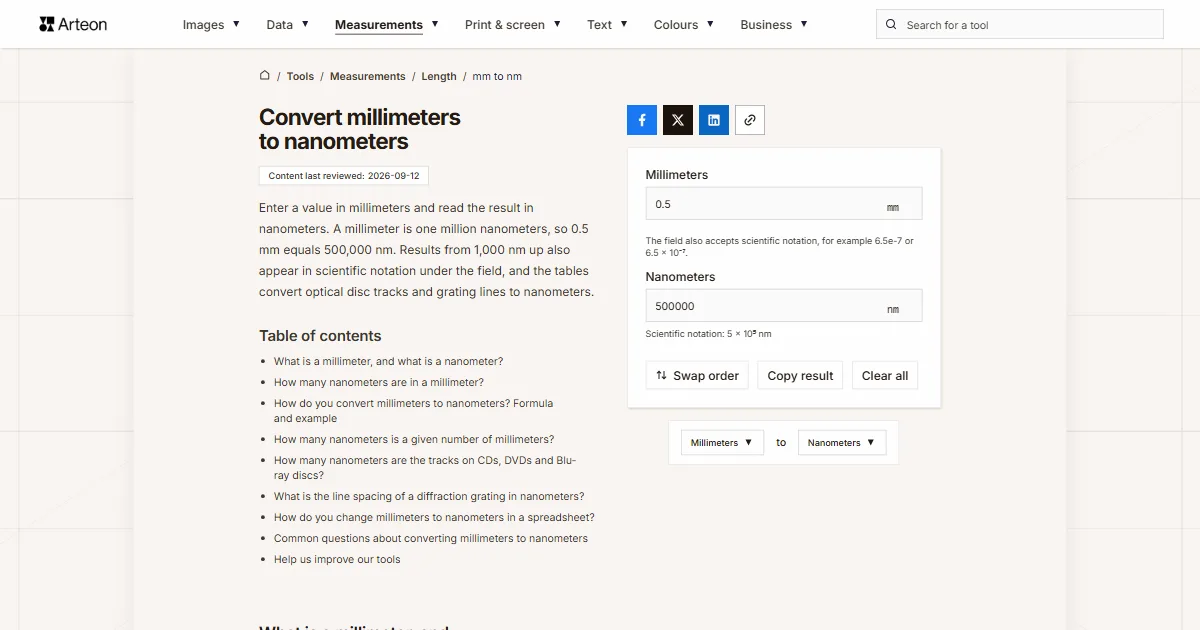
Enter a value in millimeters and read the result in nanometers. A millimeter is one million nanometers, so 0.5 mm equals 500,000 nm. Results from 1,000 nm up also appear in scientific notation under the field, and the tables convert optical disc tracks and grating lines to nanometers.
The field also accepts scientific notation, for example 6.5e-7 or 6.5 × 10⁻⁷.
What is a millimeter, and what is a nanometer?
A millimeter is one thousandth of a meter, and a nanometer is one billionth of a meter. Both names come from SI prefixes: milli- stands for 10⁻³ and nano- for 10⁻⁹. The prefix nano- has belonged to the SI since 1960, when the General Conference on Weights and Measures set the list of prefixes for the new system of units[1].
A nanometer is therefore one millionth of a millimeter. The intermediate unit is the micrometer, one thousandth of a millimeter[2], which equals 1,000 nanometers.
Sizes you can see with the naked eye, such as the thickness of a CD, are given in millimeters. Details of the recording on its surface, such as the distance between tracks, measure hundreds and thousands of nanometers.
How many nanometers are in a millimeter?
A millimeter is 1,000,000 nanometers. To convert millimeters to nanometers, multiply the number of millimeters by one million, so 0.5 mm equals 500,000 nm. A size given in hundredths of a millimeter, such as 0.05 mm, becomes 50,000 nm.
The factor comes straight from the prefixes. A millimeter is 10⁻³ meter and a nanometer is 10⁻⁹ meter[1]. The exponents differ by six, so a millimeter equals 10⁶, or one million, nanometers.
Multiplying by one million moves the decimal point six places to the right. That turns 0.1 mm into 100,000 nm. From 0.0016 mm you get 1,600 nm. With whole numbers you add six zeros, so 3 mm is 3,000,000 nm.
The converter at the top of the page does this as you type. When the result is at least 1,000 nanometers, it also shows the result in scientific notation under the field, for example 5 × 10⁵ nm.
How do you convert millimeters to nanometers? Formula and example
The formula has one form: nanometers = millimeters × 1,000,000. You can split the calculation into two multiplications by 1,000: the first turns millimeters into micrometers, and the second turns micrometers into nanometers.
Take the track pitch of a DVD, which is 0.00074 mm[3]. The first multiplication gives 0.74 µm. The second gives 740 nm.
In scientific notation you add six to the exponent. 7.4 × 10⁻⁴ mm becomes 7.4 × 10² nm, because minus four plus six is two.
To convert nanometers back to millimeters, use the nanometers to millimeters converter. The factor of one million also applies to kilometers, because a kilometer is one million millimeters, as the kilometers to millimeters converter shows. For the same size in meters, use the millimeters to meters converter. A dimension given in inches can first be changed to millimeters with the inches to millimeters converter.
How many nanometers is a given number of millimeters?
| Millimeters | Nanometers | Scientific notation |
|---|---|---|
| 0.0001 mm | 100 nm | 1 × 10² nm |
| 0.0005 mm | 500 nm | 5 × 10² nm |
| 0.001 mm | 1,000 nm | 1 × 10³ nm |
| 0.005 mm | 5,000 nm | 5 × 10³ nm |
| 0.01 mm | 10,000 nm | 1 × 10⁴ nm |
| 0.02 mm | 20,000 nm | 2 × 10⁴ nm |
| 0.04 mm | 40,000 nm | 4 × 10⁴ nm |
| 0.05 mm | 50,000 nm | 5 × 10⁴ nm |
| 0.1 mm | 100,000 nm | 1 × 10⁵ nm |
| 0.2 mm | 200,000 nm | 2 × 10⁵ nm |
| 0.25 mm | 250,000 nm | 2.5 × 10⁵ nm |
| 0.3 mm | 300,000 nm | 3 × 10⁵ nm |
| 0.4 mm | 400,000 nm | 4 × 10⁵ nm |
| 0.5 mm | 500,000 nm | 5 × 10⁵ nm |
| 1 mm | 1,000,000 nm | 1 × 10⁶ nm |
| 1.5 mm | 1,500,000 nm | 1.5 × 10⁶ nm |
| 2 mm | 2,000,000 nm | 2 × 10⁶ nm |
| 2.5 mm | 2,500,000 nm | 2.5 × 10⁶ nm |
| 5 mm | 5,000,000 nm | 5 × 10⁶ nm |
| 7.5 mm | 7,500,000 nm | 7.5 × 10⁶ nm |
| 8.4 mm | 8,400,000 nm | 8.4 × 10⁶ nm |
| 10 mm | 10,000,000 nm | 1 × 10⁷ nm |
| 20 mm | 20,000,000 nm | 2 × 10⁷ nm |
| 50 mm | 50,000,000 nm | 5 × 10⁷ nm |
| 100 mm | 100,000,000 nm | 1 × 10⁸ nm |
| 500 mm | 500,000,000 nm | 5 × 10⁸ nm |
| 1,000 mm | 1,000,000,000 nm | 1 × 10⁹ nm |
How many nanometers are the tracks on CDs, DVDs and Blu-ray discs?
| Dimension | In millimeters | In nanometers |
|---|---|---|
| CD thickness | 1.2 mm | 1,200,000 nm |
| CD track pitch | 0.0016 mm | 1,600 nm |
| CD pit width | 0.0005 mm | 500 nm |
| DVD track pitch | 0.00074 mm | 740 nm |
| Blu-ray track pitch | 0.00032 mm | 320 nm |

What is the line spacing of a diffraction grating in nanometers?
| Grating density | Spacing in millimeters | Spacing in nanometers |
|---|---|---|
| 100 lines per millimeter | 0.01 mm | 10,000 nm |
| 300 lines per millimeter | 0.0033333 mm | 3,333.3 nm |
| 600 lines per millimeter | 0.0016667 mm | 1,666.7 nm |
| 1,000 lines per millimeter | 0.001 mm | 1,000 nm |
| 1,200 lines per millimeter | 0.00083333 mm | 833.3 nm |
| 1,800 lines per millimeter | 0.00055556 mm | 555.6 nm |
| 2,400 lines per millimeter | 0.00041667 mm | 416.7 nm |
How do you change millimeters to nanometers in a spreadsheet?
For a column of dimensions you set up the calculation once and fill the formula down. The spreadsheet can also calculate grating line spacing directly from line density.
Excel: CONVERT with the units mm and nm
The formula =CONVERT(A1,"mm","nm") converts the millimeters in cell A1 to nanometers. The unit “nm” combines the prefix n, for nano, with the meter symbol, and Excel treats uppercase and lowercase letters in it as different[6].Multiplying by one million without a function
The formula =A1*1000000 gives the same result as CONVERT. With the factor entered once in cell B1, the formula =A1*$B$1 works for the whole column.Grating line spacing from line density
When column A contains the number of lines per millimeter, the formula =1000000/A1 returns the spacing between lines directly in nanometers. For a grating with 600 lines per millimeter the result is about 1,666.7 nm.The Scientific format for large results
In Excel, select the results, open the formatting dialog with the More button next to Number on the Home tab, and choose the Scientific category. One million then appears as 1.00E+06, which is 1 × 10⁶[7].
Convert Millimeters to other units
Sources
- Resolution 12 of the 11th CGPM (1960): Système International d’Unités, list of prefixes — Bureau International des Poids et Mesures
- Micrometre — Wikipedia
- Blu-ray (DVD and Blu-ray track pitch, 650 nm DVD laser) — Wikipedia
- Compact disc — Wikipedia
- Diffraction grating — Wikipedia
- CONVERT function — Microsoft
- Display numbers in scientific (exponential) notation — Microsoft
Every figure in the tables was computed from the unit definitions and checked arithmetically before publication. Historical values and the names of local units come from the sources listed above.
Content last reviewed: · written and checked by the Arteon team
Common questions about converting millimeters to nanometers
How many nanometers are in an inch?
An inch is exactly 25.4 mm, which is 25,400,000 nanometers, or 2.54 × 10⁷ nm in scientific notation.
Is a millimeter exactly one million nanometers?
Yes. Both units come from SI prefixes, which are exact powers of ten, so one million is an exact value.
How do I paste a result from a spreadsheet written as 1.60E-03?
Paste it straight into the millimeter field. The converter reads it as 0.0016 mm and returns 1,600 nm, and the number before the letter E can use either a dot or a comma as the decimal mark.
Help us improve our tools
Got an idea for a new feature, found a bug or want to suggest another tool? Write to us — we reply within 24 hours.