Convert millimeters to kilometers
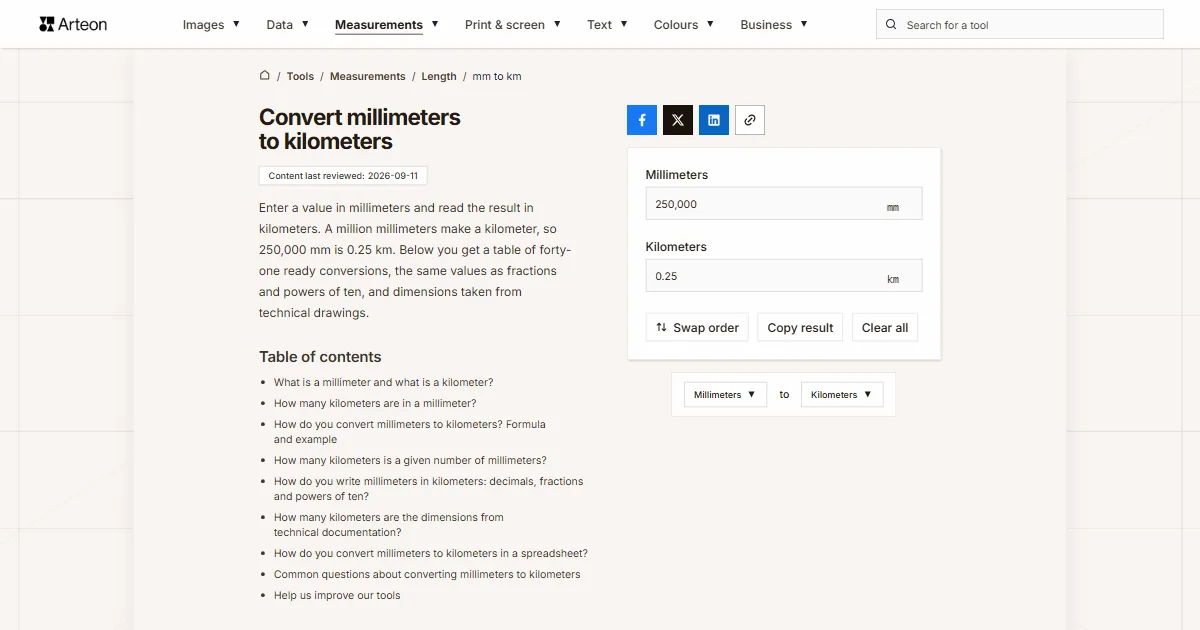
Enter a value in millimeters and read the result in kilometers. A million millimeters make a kilometer, so 250,000 mm is 0.25 km. Below you get a table of forty-one ready conversions, the same values as fractions and powers of ten, and dimensions taken from technical drawings.
What is a millimeter and what is a kilometer?
A millimeter is the smallest division on an ordinary ruler and a thousandth of a meter, written mm. It takes its value from the prefix milli-, which in the SI means exactly one thousandth[1].
The kilometer sits at the opposite end of the same scale. The prefix kilo- means a thousand, so a kilometer is a thousand meters with the symbol km[1]. The meter, the shared reference point of both units, has since 1983 been the length of the path traveled by light in a vacuum in 1/299,792,458 of a second[2].
So the result in kilometers is a million times smaller than the millimeter figure, and it opens with a zero and a decimal point. A dimension of 250 mm is 0.00025 km, and that notation is correct.

How many kilometers are in a millimeter?
A millimeter is 0.000001 kilometers. To turn millimeters into kilometers you divide the millimeter figure by a million, so 250,000 mm gives 0.25 km. The divisor stays the same for every dimension.
It comes from combining two prefixes. A kilometer is a thousand meters, and every meter divides into a thousand millimeters[1]. A thousand multiplied by a thousand makes a million, so the divisor carries six zeros and the decimal point moves the same number of places.
In decimal writing this comes down to moving the decimal point six places to the left. A value of 12,345 mm turns into 0.012345 km this way. A value of 1,000 mm, that is one meter, gives 0.001 km. A value of 500 mm, half a meter, gives 0.0005 km.
The field at the top of the page runs the same calculation as you type and shows up to eight decimal places, so half a millimeter appears on screen as 0.0000005 km.
How do you convert millimeters to kilometers? Formula and example
The formula has one shape: kilometers = millimeters ÷ 1,000,000. The same calculation is also written as a multiplication by 0.000001, because dividing by a million and multiplying by one millionth give an identical result.
Take a dimension of 56,500 mm. Divide it by a million and you get 0.0565 km. Shorter dimensions give a smaller result still. A dimension of 96 mm gives 0.000096 km, a figure with four zeros after the decimal point.
Scientific notation shortens those zeros. A millimeter takes the form 1 × 10⁻⁶ km, since one millionth is ten raised to the power of minus six. The same millimeter can also be given as the common fraction 1/1,000,000 km.
The same dimension in meters comes from the millimeters to meters converter. The way back is shown by the kilometers to millimeters converter, and the step in between by the millimeters to centimeters converter.

How many kilometers is a given number of millimeters?
| Millimeters | Kilometers |
|---|---|
| 1 mm | 0.000001 km |
| 5 mm | 0.000005 km |
| 10 mm | 0.00001 km |
| 20 mm | 0.00002 km |
| 40 mm | 0.00004 km |
| 42 mm | 0.000042 km |
| 50 mm | 0.00005 km |
| 60 mm | 0.00006 km |
| 96 mm | 0.000096 km |
| 100 mm | 0.0001 km |
| 250 mm | 0.00025 km |
| 500 mm | 0.0005 km |
| 1,000 mm | 0.001 km |
| 1,500 mm | 0.0015 km |
| 2,000 mm | 0.002 km |
| 2,500 mm | 0.0025 km |
| 3,000 mm | 0.003 km |
| 3,500 mm | 0.0035 km |
| 4,000 mm | 0.004 km |
| 4,800 mm | 0.0048 km |
| 5,000 mm | 0.005 km |
| 5,500 mm | 0.0055 km |
| 10,000 mm | 0.01 km |
| 12,345 mm | 0.012345 km |
| 13,000 mm | 0.013 km |
| 20,000 mm | 0.02 km |
| 25,000 mm | 0.025 km |
| 28,578 mm | 0.028578 km |
| 30,000 mm | 0.03 km |
| 50,000 mm | 0.05 km |
| 54,000 mm | 0.054 km |
| 56,500 mm | 0.0565 km |
| 59,932 mm | 0.059932 km |
| 62,000 mm | 0.062 km |
| 67,500 mm | 0.0675 km |
| 74,201 mm | 0.074201 km |
| 100,000 mm | 0.1 km |
| 245,565 mm | 0.245565 km |
| 500,000 mm | 0.5 km |
| 1,000,000 mm | 1 km |
| 5,000,000 mm | 5 km |
How do you write millimeters in kilometers: decimals, fractions and powers of ten?
| Millimeters | Kilometers as a decimal | Kilometers as a fraction | Scientific notation |
|---|---|---|---|
| 1 mm | 0.000001 km | 1/1,000,000 km | 1 × 10⁻⁶ km |
| 2 mm | 0.000002 km | 1/500,000 km | 2 × 10⁻⁶ km |
| 5 mm | 0.000005 km | 1/200,000 km | 5 × 10⁻⁶ km |
| 10 mm | 0.00001 km | 1/100,000 km | 1 × 10⁻⁵ km |
| 100 mm | 0.0001 km | 1/10,000 km | 1 × 10⁻⁴ km |
| 1,000 mm | 0.001 km | 1/1,000 km | 1 × 10⁻³ km |
| 10,000 mm | 0.01 km | 1/100 km | 1 × 10⁻² km |
| 100,000 mm | 0.1 km | 1/10 km | 1 × 10⁻¹ km |
| 500,000 mm | 0.5 km | 1/2 km | 5 × 10⁻¹ km |
How many kilometers are the dimensions from technical documentation?
| Dimension | In millimeters | In kilometers |
|---|---|---|
| A4 sheet, longer side | 297 mm | 0.000297 km |
| A0 sheet, longer side | 1,189 mm | 0.001189 km |
| Standard gauge track | 1,435 mm | 0.001435 km |
| Irish gauge track | 1,600 mm | 0.0016 km |
| Twenty-foot container, length | 6,058 mm | 0.006058 km |
| Forty-foot container, length | 12,192 mm | 0.012192 km |
| Container width | 2,438 mm | 0.002438 km |
How do you convert millimeters to kilometers in a spreadsheet?
For a single value the field above is quicker. For a whole column of dimensions the spreadsheet handles it with one formula dragged down.
Excel: the CONVERT function
In English Excel the formula reads =CONVERT(A1,"mm","km"). The unit code is built from the prefix and the symbol of the meter, so "mm" is the millimeter and "km" the kilometer. The prefixes m and k may precede any metric unit argument, and unit names and prefixes are case-sensitive[7]. The syntax is CONVERT(number, from_unit, to_unit).Plain division when you would rather skip the function
The formula =A1/1000000 returns the same result and works in every spreadsheet, Google Sheets and LibreOffice Calc included. Raise the number of decimal places alongside it, because at two places every value below 5,000 mm rounds to 0.00.Scientific notation instead of a long run of zeros
Select the cells holding the results, go to Home, open the Format Cells dialog and in the Category list click Scientific[8]. The sheet then shows 1.00E-06 in place of 0.000001, and orders of magnitude become comparable at a glance.Checking the column on a single value
Type 1000000 into cell A1 and see whether the formula returns 1. That one result you can check without doing any arithmetic, which makes it a good trial before you drag the formula down. A #VALUE! message in place of the result means Excel does not read the content of cell A1 as a number, for example when a unit has been typed next to the value. Leave just the number in the cell[9].
Convert other units to Kilometers
Convert Millimeters to other units
Sources
- Metric (SI) Prefixes — National Institute of Standards and Technology
- SI Units – Length (definitions of the meter since 1793) — National Institute of Standards and Technology
- Standard-gauge railway (1,435 mm) — Wikipedia
- Intermodal container (external dimensions under ISO 668) — Wikipedia
- Irish gauge (1,600 mm) — Wikipedia
- International standard paper sizes (ISO 216) — University of Cambridge, Computer Laboratory
- CONVERT function — Microsoft
- Display numbers in scientific (exponential) notation — Microsoft
- How to correct a #VALUE! error — Microsoft
Every figure in the tables was computed from the unit definitions and checked arithmetically before publication. Historical values and the names of local units come from the sources listed above.
Content last reviewed: · written and checked by the Arteon team
Common questions about converting millimeters to kilometers
How many kilometers are in 1 mm?
A millimeter is 0.000001 kilometers, that is one millionth. It is also written as 1 × 10⁻⁶ km.
How many kilometers are in 1,000 mm?
A thousand millimeters is 0.001 kilometers. The same length has a name of its own: it is one meter. Meters back into millimeters go through the meters to mm converter.
How many kilometers are in 100,000 mm?
A hundred thousand millimeters is 0.1 kilometers, or 100 meters. Ten such stretches make up a full kilometer. Meters go into kilometers through the meters to km converter.
What do you divide millimeters by to get kilometers?
By 1,000,000. The divisor is made of a thousand millimeters in a meter and a thousand meters in a kilometer.
How many kilometers are in 12,345 mm?
A value of 12,345 mm gives 0.012345 km. The digits stay the same and only the decimal point moves six places to the left.
How do you convert millimeters to kilometers in your head?
Move the decimal point six places to the left. The figure 56,500 becomes 0.0565 and the figure 500 becomes 0.0005. You fill the missing places with zeros right after the point.
Can the result be smaller than one millionth of a kilometer?
Yes. Half a millimeter gives 0.0000005 km and a tenth of a millimeter gives 0.0000001 km. The field shows up to eight decimal places, so both values are visible on it.
How do you write a millimeter in kilometers as a common fraction?
A millimeter is 1/1,000,000 of a kilometer. For other values the fraction reduces: 10 mm gives 1/100,000 km and 500,000 mm gives 1/2 km.
Help us improve our tools
Got an idea for a new feature, found a bug or want to suggest another tool? Write to us — we reply within 24 hours.