Convert millimeters to decimeters
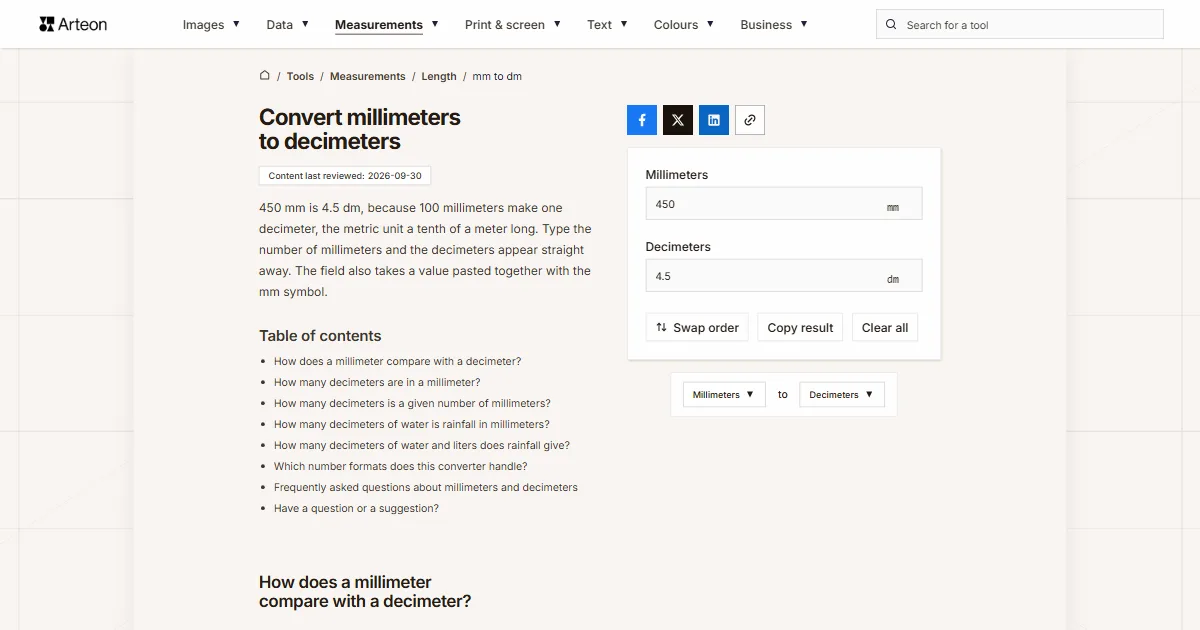
450 mm is 4.5 dm, because 100 millimeters make one decimeter, the metric unit a tenth of a meter long. Type the number of millimeters and the decimeters appear straight away. The field also takes a value pasted together with the mm symbol.
How does a millimeter compare with a decimeter?
A millimeter is one thousandth of a meter, and a centimeter holds ten of them[1]. A decimeter is ten centimeters, so it takes 100 millimeters to make one, and a single millimeter is 0.01 dm. In inches, a millimeter is about 0.03937 in, since the inch is defined as exactly 25.4 mm[1].
One word causes mix-ups in American English. Some people shorten millimeter to mil, but in the United States a mil traditionally means a thousandth of an inch[1], which is about 0.0254 mm. If a US spec sheet gives a thickness in mils, that number is not in millimeters, and this converter would read it as millimeters anyway. For a plain metric size, such as a cabinet listed as 600 mm wide, the result is 6 dm, or 60 cm with the mm to cm converter.
How many decimeters are in a millimeter?
A millimeter is 0.01 decimeters. Divide the number of millimeters by 100: decimeters = millimeters ÷ 100.
Dividing by 100 moves the decimal point two places to the left. 450 mm becomes 4.5 dm, 75 mm becomes 0.75 dm and 2,000 mm becomes 20 dm. With a small number you add zeros in front: 5 mm is 0.05 dm and half a millimeter is 0.005 dm.
A quick sense check helps: every full 100 mm is one decimeter, so 1,000 mm is 10 dm, which is one meter. To go back from decimeters, use the dm to mm converter.
How many decimeters is a given number of millimeters?
| Millimeters | Decimeters | Centimeters |
|---|---|---|
| 0.5 mm | 0.005 dm | 0.05 cm |
| 1 mm | 0.01 dm | 0.1 cm |
| 2 mm | 0.02 dm | 0.2 cm |
| 3 mm | 0.03 dm | 0.3 cm |
| 5 mm | 0.05 dm | 0.5 cm |
| 10 mm | 0.1 dm | 1 cm |
| 25 mm | 0.25 dm | 2.5 cm |
| 50 mm | 0.5 dm | 5 cm |
| 75 mm | 0.75 dm | 7.5 cm |
| 100 mm | 1 dm | 10 cm |
| 150 mm | 1.5 dm | 15 cm |
| 200 mm | 2 dm | 20 cm |
| 250 mm | 2.5 dm | 25 cm |
| 300 mm | 3 dm | 30 cm |
| 450 mm | 4.5 dm | 45 cm |
| 500 mm | 5 dm | 50 cm |
| 600 mm | 6 dm | 60 cm |
| 750 mm | 7.5 dm | 75 cm |
| 1,000 mm | 10 dm | 100 cm |
| 2,000 mm | 20 dm | 200 cm |
How many decimeters of water is rainfall in millimeters?
Rainfall is measured as the depth of water that would cover flat ground, and in metric countries that depth is given in millimeters. The same number also works as liters per square meter, because 1 L = 1 dm³ = 1 mm·m²[2]. That is where the decimeter comes in: a liter is a cube of 1 dm, and spread over a square meter, which is 100 dm², it makes a layer 0.01 dm deep, which is 1 mm.
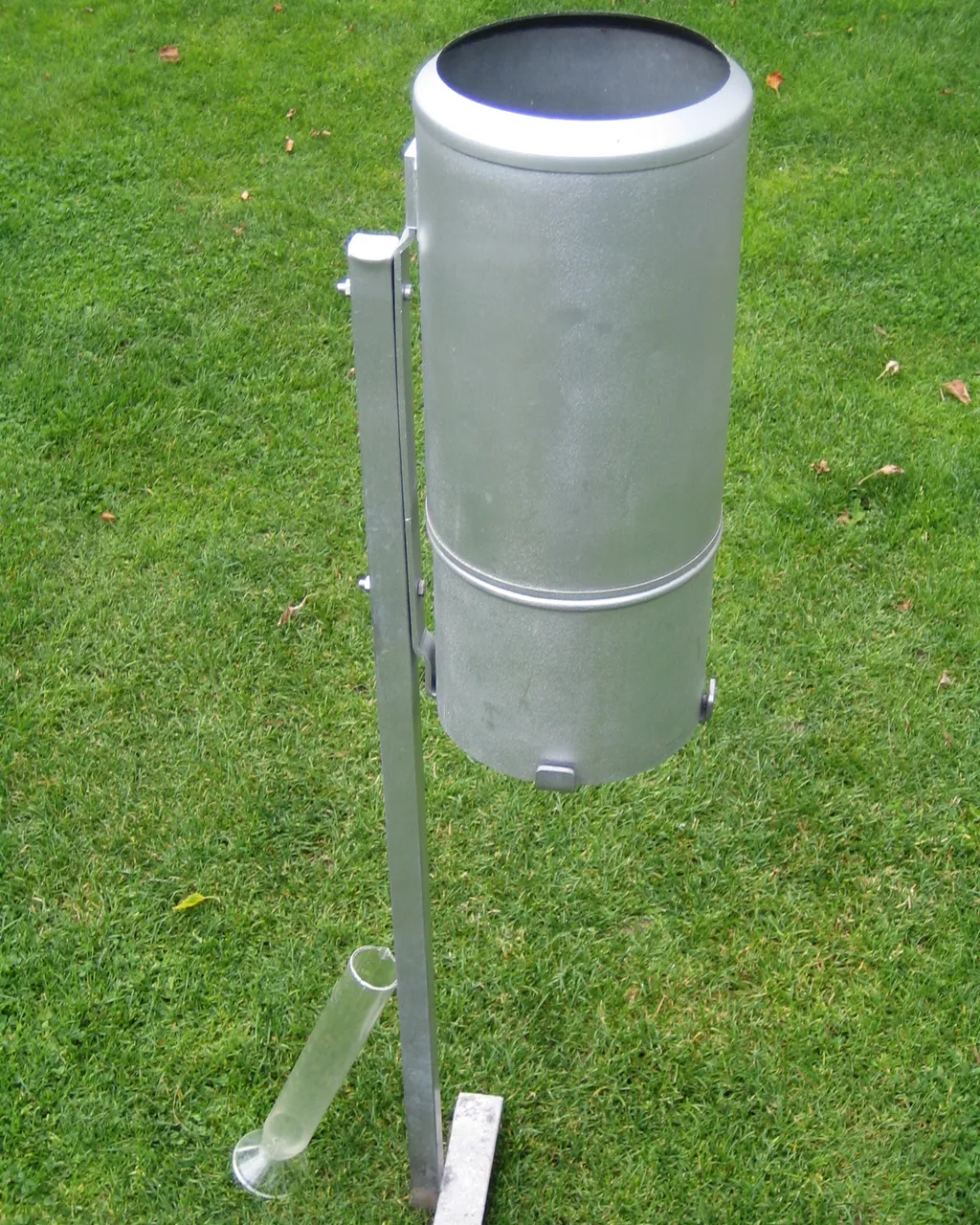
So 100 mm of rain is a layer of water 1 dm deep, or 100 liters on every square meter. Where imperial units are in use, rainfall is usually reported in inches instead[2], and one inch of rain is 25.4 mm, or 0.254 dm.
How many decimeters of water and liters does rainfall give?
| Rainfall | Water depth | Liters per 1 m² |
|---|---|---|
| 1 mm | 0.01 dm | 1 L/m² |
| 5 mm | 0.05 dm | 5 L/m² |
| 10 mm | 0.1 dm | 10 L/m² |
| 25 mm | 0.25 dm | 25 L/m² |
| 50 mm | 0.5 dm | 50 L/m² |
| 100 mm | 1 dm | 100 L/m² |
| 500 mm | 5 dm | 500 L/m² |
| 1,000 mm | 10 dm | 1,000 L/m² |
Which number formats does this converter handle?
| What you type | What the converter shows | Note |
|---|---|---|
| 45.1 | 0.451 dm | The decimal point is how English writes decimals, and that is how we read it. |
| 45,1 | 0.451 dm | A comma pasted from a European document is read as a decimal point, so the result stays the same. |
| 1,500 | 15 dm | Three digits follow the comma, so we read it as a thousands separator and convert one thousand five hundred millimeters. A note under the field shows the other possible reading, 1.5. |
| 1 500 | 15 dm | A space between the thousands, common in scientific writing, is ignored, so this is also one thousand five hundred. |
| 3/4 | 0.0075 dm | We work out a fraction written with a slash ourselves, so you do not need to turn it into a decimal first. |
| ½ | 0.005 dm | A lone ½ character, copied for example from a product description, is read as half a millimeter. |
| 450 mm | 4.5 dm | A size copied from a catalog together with the mm symbol does no harm, because we take the number and leave the symbol out. |
Convert other units to Decimeters
Convert Millimeters to other units
Sources
- Millimetre — Wikipedia
- Precipitation — Wikipedia
- CONVERT function — Microsoft
Every figure in the tables was computed from the unit definitions and checked arithmetically before publication. Historical values and the names of local units come from the sources listed above.
Content last reviewed: · written and checked by the Arteon team
Frequently asked questions about millimeters and decimeters
Is a millimeter bigger than a decimeter?
No. A millimeter is 100 times shorter than a decimeter, so a length in millimeters always turns into a smaller number of decimeters.
Will the converter show a result for a very small value?
Yes. A hundredth of a millimeter, which digital calipers often measure to[1], shows as 0.0001 dm. For even smaller entries the converter adds decimal places instead of showing zero.
How do I convert mm to dm in Excel?
Use the CONVERT function and put the prefix in front of the meter code: "m" stands for milli and "d" for deci. The formula =CONVERT(A1,"mm","dm") turns the value in cell A1 into decimeters[3]. A plain =A1/100 gives the same result.
How many square decimeters are in a square millimeter?
A square millimeter is 0.0001 dm², because for area you divide by 100 twice. This converter handles length only, so use that rule for an area given in mm².
Have a question or a suggestion?
Write to us if the converter is missing a unit you need, or if something on this page needs fixing.