Convert bar to psi
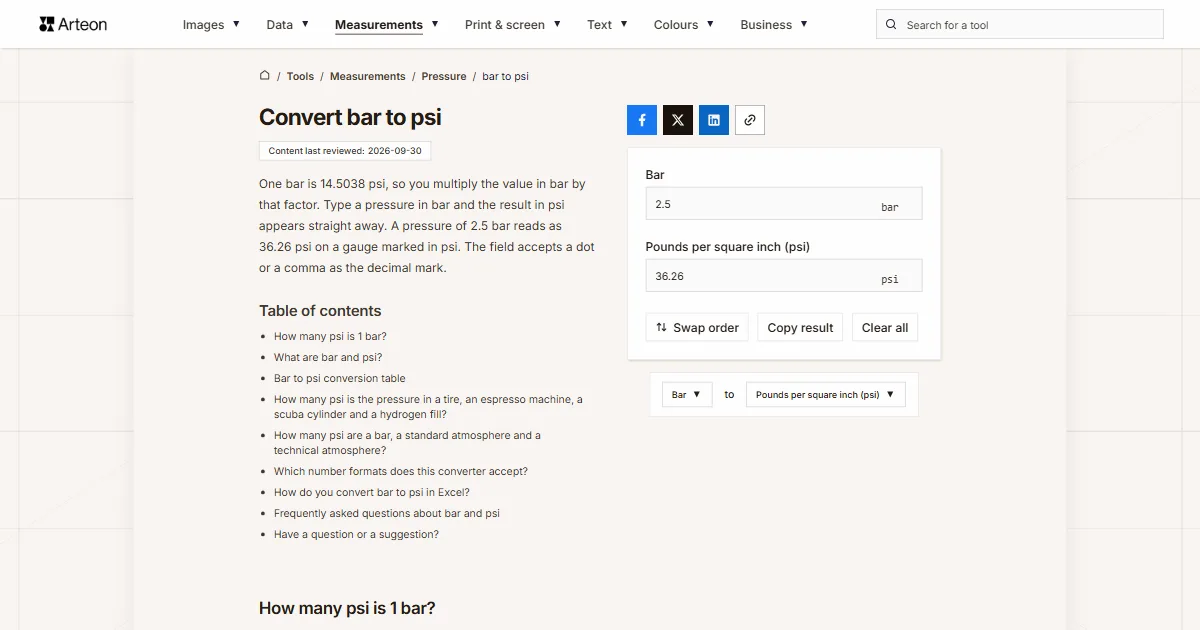
One bar is 14.5038 psi, so you multiply the value in bar by that factor. Type a pressure in bar and the result in psi appears straight away. A pressure of 2.5 bar reads as 36.26 psi on a gauge marked in psi. The field accepts a dot or a comma as the decimal mark.
How many psi is 1 bar?
One bar is 14.5038 psi. Multiply the number of bar by this factor: psi = bar × 14.5038[1]. The formula also covers fractions and pressures with a minus sign.
The formula gives the values you read off a gauge marked in psi. Two bar is 29.01 psi. A pressure of 2.5 bar gives 36.26 psi. Eight bar comes to 116.03 psi.
For a quick estimate in your head, a factor of 14.5 is enough. At 2.5 bar it gives 36.25 psi, one hundredth below the exact result. The factor 14.5 understates the result by 0.026%. Up to 20 bar the difference stays under a tenth of a psi.
The full factor has this many decimal places because the two units come from different systems of measurement. A bar is exactly 100,000 pascals[1]. One psi is 6,894.757 pascals, rounded[1]. Dividing the first number by the second gives 14.5038.
To turn a pressure given in psi into bar, use the psi to bar converter.
What are bar and psi?
The bar is a unit of pressure equal to 100,000 pascals, or 100 kilopascals[1]. It is not an SI unit, and the NIST guide to the SI records that in 1978 the International Committee for Weights and Measures (CIPM) considered it permissible to keep using the bar alongside the SI, because of established practice in certain fields and countries[2].
One bar is roughly the air pressure at the Earth's surface. A column of water 10 meters high exerts a similar pressure[3].
Psi stands for pound-force per square inch. The unit is based on avoirdupois units and is used primarily in the United States[4]. In the UK, the RAC points out that most car owners' manuals quote tire pressure in both bar and psi[5].
A pound-force is the weight of one pound under standard gravity. The pound is exactly 0.45359237 kilograms[6]. Multiplied by standard gravity of 9.80665 m/s², that gives 4.4482216152605 newtons[6]. That force acting on a square one inch on each side gives one psi.
Bar to psi conversion table
| Bar | Psi |
|---|---|
| 0.1 bar | 1.45 psi |
| 0.2 bar | 2.9 psi |
| 0.3 bar | 4.35 psi |
| 0.5 bar | 7.25 psi |
| 0.8 bar | 11.6 psi |
| 1 bar | 14.5 psi |
| 1.1 bar | 15.95 psi |
| 1.2 bar | 17.4 psi |
| 1.3 bar | 18.85 psi |
| 1.5 bar | 21.76 psi |
| 1.6 bar | 23.21 psi |
| 1.8 bar | 26.11 psi |
| 2 bar | 29.01 psi |
| 2.1 bar | 30.46 psi |
| 2.2 bar | 31.91 psi |
| 2.3 bar | 33.36 psi |
| 2.4 bar | 34.81 psi |
| 2.5 bar | 36.26 psi |
| 2.6 bar | 37.71 psi |
| 2.7 bar | 39.16 psi |
| 2.8 bar | 40.61 psi |
| 3 bar | 43.51 psi |
| 3.5 bar | 50.76 psi |
| 4 bar | 58.02 psi |
| 4.5 bar | 65.27 psi |
| 5 bar | 72.52 psi |
| 5.5 bar | 79.77 psi |
| 6 bar | 87.02 psi |
| 6.5 bar | 94.27 psi |
| 7 bar | 101.53 psi |
| 8 bar | 116.03 psi |
| 9 bar | 130.53 psi |
| 10 bar | 145.04 psi |
| 12 bar | 174.05 psi |
| 15 bar | 217.56 psi |
| 16 bar | 232.06 psi |
| 20 bar | 290.08 psi |
| 25 bar | 362.59 psi |
| 40 bar | 580.15 psi |
| 60 bar | 870.23 psi |
| 100 bar | 1,450.38 psi |
| 150 bar | 2,175.57 psi |
| 200 bar | 2,900.75 psi |
| 232 bar | 3,364.88 psi |
| 250 bar | 3,625.94 psi |
| 300 bar | 4,351.13 psi |
| 350 bar | 5,076.32 psi |
| 400 bar | 5,801.51 psi |
| 500 bar | 7,251.89 psi |
| 700 bar | 10,152.64 psi |
| 1,000 bar | 14,503.77 psi |
How many psi is the pressure in a tire, an espresso machine, a scuba cylinder and a hydrogen fill?
| Bar | Psi | Where you meet this pressure |
|---|---|---|
| 2.3 bar | 33.36 psi | Tire overpressure shown by a gauge at a gas station |
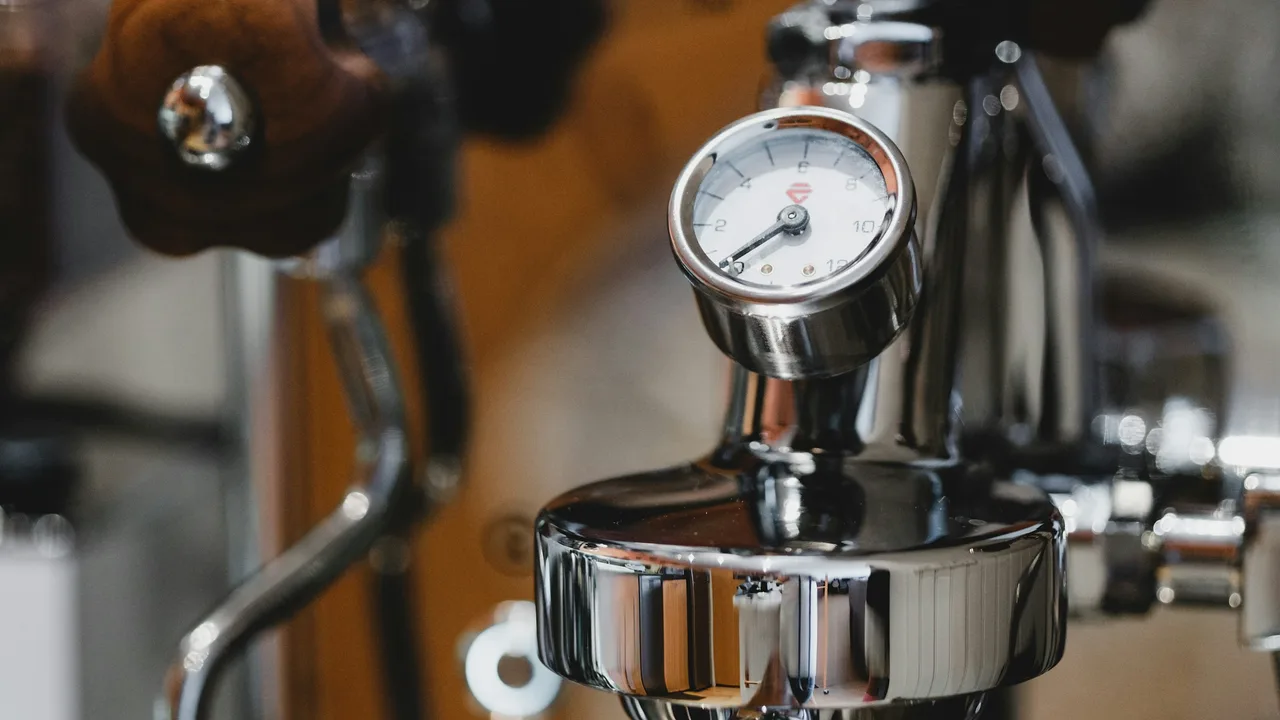
| 8 bar | 116.03 psi | Minimum extraction pressure for traditional Italian espresso |
| 9 bar | 130.53 psi | The pressure at which the espresso machine test instrument recreates the resistance of the coffee in the portafilter |
| 200 bar | 2,900.75 psi | A full standard scuba tank |
| 207 bar | 3,002.28 psi | Aluminum S80 cylinder with a working pressure of 3,000 psi |
| 232 bar | 3,364.88 psi | A popular working pressure for steel and aluminum cylinders |
| 300 bar | 4,351.13 psi | The top of the working pressure range for scuba cylinders |
| 350 bar | 5,076.32 psi | Hydrogen refueling to the H35 standard, which is 35 MPa |
| 700 bar | 10,152.64 psi | Hydrogen refueling to the H70 standard, which is 70 MPa |
How many psi are a bar, a standard atmosphere and a technical atmosphere?
| Unit | Symbol | Value in bar | Value in psi |
|---|---|---|---|
| Bar | bar | 1 bar | 14.5038 psi |
| Standard atmosphere | atm | 1.01325 bar | 14.6959 psi |
| Technical atmosphere | at, kgf/cm² | 0.980665 bar | 14.2233 psi |
Which number formats does this converter accept?
| What you type | What the converter shows | Note |
|---|---|---|
| 2.5 | 36.26 psi | A plain number is read as bar, because that's how the field is labeled. |
| 2,5 | 36.26 psi | A comma with fewer than three digits after it is a decimal comma from a European document, so the result is the same. |
| 2.5 bar | 36.26 psi | The unit symbol pasted along with the number is skipped. |
| 250 kPa | 36.26 psi | Kilopascals from a tire placard are converted to bar first, so 250 kPa gives the same result as 2.5 bar. |
| 1.500 | 21.76 psi | A single period is a decimal point, so we read one and a half bar. A note under the field says “Read as 1.5. If you meant 1500, type 1500.” |
| 1,500 | 21755.66 psi | A comma followed by three digits groups thousands, so the field reads fifteen hundred bar. A note under the field says “Read as 1500. If you meant 1.5, type 1.5.” |
| 1 500 | 21755.66 psi | A space between the thousands is skipped, so this is fifteen hundred bar as well. |
| 2 1/2 | 36.26 psi | We work out a slash fraction ourselves, so the mixed number reads as two and a half bar. |
| -0.8 | -11.6 psi | A minus sign marks vacuum, a gauge reading below the pressure of the surroundings, and the factor stays the same. |
| -80 kPa | -11.6 psi | The minus sign stays when the entry uses a different unit from the field. |
How do you convert bar to psi in Excel?
The CONVERT function has a code for psi, and bar goes in as kilopascals. The steps use a pressure of 2.5 bar as the example.
Enter the pressure in bar
Type the number of bar into a cell, for example 2.5 in cell A2.Turn bar into kilopascals inside the formula
The pressure table of the CONVERT function covers Pascal (Pa), Atmosphere (atm), mm of Mercury (mmHg), PSI (psi) and Torr (Torr). The prefix kilo, written as k, can be added to any metric unit[11]. One bar is 100 kilopascals, so you multiply the number of bar by 100 in the formula.Enter the formula with the unit codes
The syntax is CONVERT(number,from_unit,to_unit). The formula =CONVERT(A2*100,"kPa","psi") returns 36.2594 for 2.5 bar, which is 36.26 psi when rounded.Drag the formula down the column
Each following row then converts its own value from column A, so the whole list of pressures turns into psi without typing the formula again.
Convert other units to Pounds per square inch (psi)
Convert Bar to other units
Sources
- NIST Guide to the SI, Appendix B.8: Factors for Units Listed Alphabetically — National Institute of Standards and Technology
- NIST Guide to the SI, Chapter 5: Units Outside the SI — National Institute of Standards and Technology
- Bar (Einheit) — Wikipedia
- Pound per square inch — Wikipedia
- How to convert Bar to PSI: a tyre pressure guide — RAC
- Pound (force) — Wikipedia
- Disciplinare Caffè Espresso Italiano Tradizionale (2018) — Consorzio di Tutela del Caffè Espresso Italiano Tradizionale
- Bar (unit) — Wikipedia
- Diving cylinder — Wikipedia
- Gaseous Dispensing — Hydrogen Fuel Cell Partnership (H2FCP)
- CONVERT function — Microsoft
Every figure in the tables was computed from the unit definitions and checked arithmetically before publication. Historical values and the names of local units come from the sources listed above.
Content last reviewed: · written and checked by the Arteon team
Frequently asked questions about bar and psi
How do I convert bar to psi in my head?
Multiply the number of bar by 14.5. For 2.4 bar you get 34.8 psi. The exact result is 34.81 psi, so the estimate is off by one hundredth of a psi.
How many psi are a millibar and a hectopascal?
A millibar is a thousandth of a bar, or 0.0145 psi. A hectopascal has the same value, because 1 mbar = 1 hPa, and hectopascals are now often used for air pressure[3].
Do barg and bara use the same factor?
Yes. The suffix g marks gauge pressure, measured from atmospheric pressure, and the suffix a marks absolute pressure, measured from a vacuum[4][8]. The factor 14.5038 is the same in both notations, so 2 barg is 29.01 psig. The table in the psi to bar converter gives examples of moving from gauge to absolute pressure.
How do I enter an atmosphere in the CONVERT function?
The pressure table of the CONVERT function gives two codes for the atmosphere, atm and at, so both return the same result[11]. You can enter a technical atmosphere of 98,066.5 Pa through pascals: =CONVERT(A2*98066.5,"Pa","psi").
Have a question or a suggestion?
Write to us if you want to convert another pressure unit or you spot a value in the tables that needs fixing.