Convert quarts to millilitres
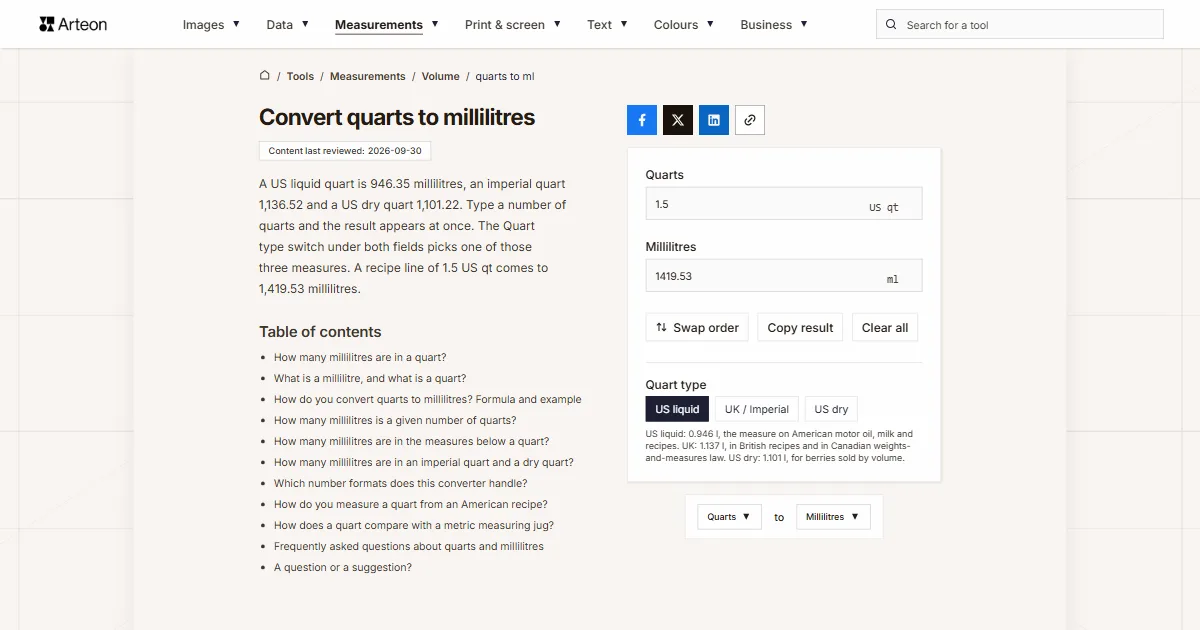
A US liquid quart is 946.35 millilitres, an imperial quart 1,136.52 and a US dry quart 1,101.22. Type a number of quarts and the result appears at once. The Quart type switch under both fields picks one of those three measures. A recipe line of 1.5 US qt comes to 1,419.53 millilitres.
How many millilitres are in a quart?
One US liquid quart is 946.35 millilitres[1]. Multiply the number of quarts by 946.352946: millilitres = quarts × 946.352946.
The answer moves with the measure in front of you. An imperial quart holds 1,136.52 millilitres, 190.17 millilitres more than the US one. A US dry quart holds 1,101.22 millilitres[1] and belongs to the American ladder of dry measures[2]. The Quart type switch under the fields picks it, and the multiplier follows.
Rounding to a whole millilitre is enough for cooking, and the result field carries two decimal places.
The other direction is in the millilitres to quarts converter, and the answer in litres comes from the quarts to liters converter.
What is a millilitre, and what is a quart?
A millilitre is a thousandth of a litre and, at the same time, a cubic centimetre: a cube one centimetre on a side. That equality has held since 1964, when the General Conference on Weights and Measures ruled that the word litre may serve as a special name for the cubic decimetre[3]. A syringe marked cc and a jug marked ml therefore measure the same volume.
A liquid quart belongs to the US customary system and is a quarter of a gallon. The American table of measures gives the gallon as 231 cubic inches, the quart as 57.75 and the inch as exactly 2.54 centimetres[2]. Those three figures give exactly 946.352946 millilitres.
A quart splits further into two pints, four cups and 32 fluid ounces.
How do you convert quarts to millilitres? Formula and example
Take an American soup recipe calling for six quarts of stock. Six times 946.352946 gives 5,678.12 millilitres. That is 5.68 litres, so a six-litre pot holds it.
The same sum can be written as dimensional analysis. Multiply the number of quarts by a fraction of 946.352946 millilitres over one quart, the quarts cancel above and below the line, and millilitres are left. It reads: 6 qt × (946.352946 ml ÷ 1 qt) = 5,678.12 ml.
For the imperial and the dry quart the Quart type switch puts in the multiplier itself, and it recalculates the result when you change the measure after typing a value.
The oz to ml converter turns a fluid ounce, the thirty-second part of a quart, into millilitres.
How many millilitres is a given number of quarts?
| Quarts | US liquid quart | Imperial quart | US dry quart |
|---|---|---|---|
| 0.25 qt | 236.59 ml | 284.13 ml | 275.31 ml |
| 0.5 qt | 473.18 ml | 568.26 ml | 550.61 ml |
| 0.6 qt | 567.81 ml | 681.91 ml | 660.73 ml |
| 0.75 qt | 709.76 ml | 852.39 ml | 825.92 ml |
| 1 qt | 946.35 ml | 1,136.52 ml | 1,101.22 ml |
| 1.25 qt | 1,182.94 ml | 1,420.65 ml | 1,376.53 ml |
| 1.5 qt | 1,419.53 ml | 1,704.78 ml | 1,651.83 ml |
| 1.75 qt | 1,656.12 ml | 1,988.91 ml | 1,927.14 ml |
| 2 qt | 1,892.71 ml | 2,273.05 ml | 2,202.44 ml |
| 2.5 qt | 2,365.88 ml | 2,841.31 ml | 2,753.05 ml |
| 3 qt | 2,839.06 ml | 3,409.57 ml | 3,303.66 ml |
| 3.5 qt | 3,312.24 ml | 3,977.83 ml | 3,854.27 ml |
| 4 qt | 3,785.41 ml | 4,546.09 ml | 4,404.88 ml |
| 4.5 qt | 4,258.59 ml | 5,114.35 ml | 4,955.49 ml |
| 5 qt | 4,731.76 ml | 5,682.61 ml | 5,506.10 ml |
| 5.5 qt | 5,204.94 ml | 6,250.87 ml | 6,056.72 ml |
| 6 qt | 5,678.12 ml | 6,819.14 ml | 6,607.33 ml |
| 6.5 qt | 6,151.29 ml | 7,387.40 ml | 7,157.94 ml |
| 7 qt | 6,624.47 ml | 7,955.66 ml | 7,708.55 ml |
| 7.5 qt | 7,097.65 ml | 8,523.92 ml | 8,259.16 ml |
| 8 qt | 7,570.82 ml | 9,092.18 ml | 8,809.77 ml |
| 8.5 qt | 8,044.00 ml | 9,660.44 ml | 9,360.38 ml |
| 9 qt | 8,517.18 ml | 10,228.70 ml | 9,910.99 ml |
| 9.5 qt | 8,990.35 ml | 10,796.96 ml | 10,461.60 ml |
| 10 qt | 9,463.53 ml | 11,365.23 ml | 11,012.21 ml |
| 12 qt | 11,356.24 ml | 13,638.27 ml | 13,214.65 ml |
| 16 qt | 15,141.65 ml | 18,184.36 ml | 17,619.54 ml |
| 20 qt | 18,927.06 ml | 22,730.45 ml | 22,024.42 ml |
How many millilitres are in the measures below a quart?
| US measure | Millilitres | How many fit in a quart |
|---|---|---|
| Liquid quart | 946.35 ml | 1 |
| Pint | 473.18 ml | 2 |
| Cup | 236.59 ml | 4 |
| Fluid ounce | 29.57 ml | 32 |
| Tablespoon | 14.79 ml | 64 |
| Teaspoon | 4.93 ml | 192 |
How many millilitres are in an imperial quart and a dry quart?
| Quart type | Millilitres | Cubic inches | Where the value comes from | Option on the switch |
|---|---|---|---|---|
| US liquid | 946.352946 ml | 57.75 | A quarter of the US gallon, which measures exactly 231 cubic inches | US liquid |
| Imperial (UK) | 1,136.5225 ml | 69.3549 | A quarter of the imperial gallon, fixed at 4.54609 litres | UK / Imperial |
| US dry | 1,101.220942715 ml | 67.2006 | A thirty-second part of the US bushel | US dry |
Which number formats does this converter handle?
| What you type | What the converter shows | How we read it |
|---|---|---|
| 2.5 | 2365.88 ml | The point is the decimal separator, so this is two and a half quarts. |
| 2,5 | 2365.88 ml | A comma followed by one digit is a European decimal comma, so we read it as two and a half. |
| 1,500 | 1419529.42 ml | Three digits after the comma mark a thousands separator, so we count one thousand five hundred quarts. The note “Read as 1500. If you meant 1.5, type 1.5.” appears under the field. |
| 1.500 | 1419.53 ml | A single point is always read as the decimal point, so this is one and a half quarts. The note “Read as 1.5. If you meant 1500, type 1500.” appears under the field. |
| 1 500 | 1419529.42 ml | A space between the thousands is skipped, so this is one thousand five hundred quarts as well. |
| 3/4 | 709.76 ml | We convert a fraction with a slash directly, so it doesn’t need to become 0.75 first. |
| 1½ | 1419.53 ml | A ½ character copied from a recipe or a label is added to the number in front of it. |
| 2 qt | 1892.71 ml | A unit copied from a label along with the number is ignored, and we convert the value alone. |
How do you measure a quart from an American recipe?
The steps run from picking the measure to the number you pour into a jug with a metric scale.
Pick the quart type
A recipe published in the United States counts in liquid quarts, and a British recipe from before metrication in imperial quarts. You pick the measure with the Quart type switch under the fields, and the line under the switch gives the capacity of all three.Type the number of quarts
The result appears as you type.Pour the result with the jug you have
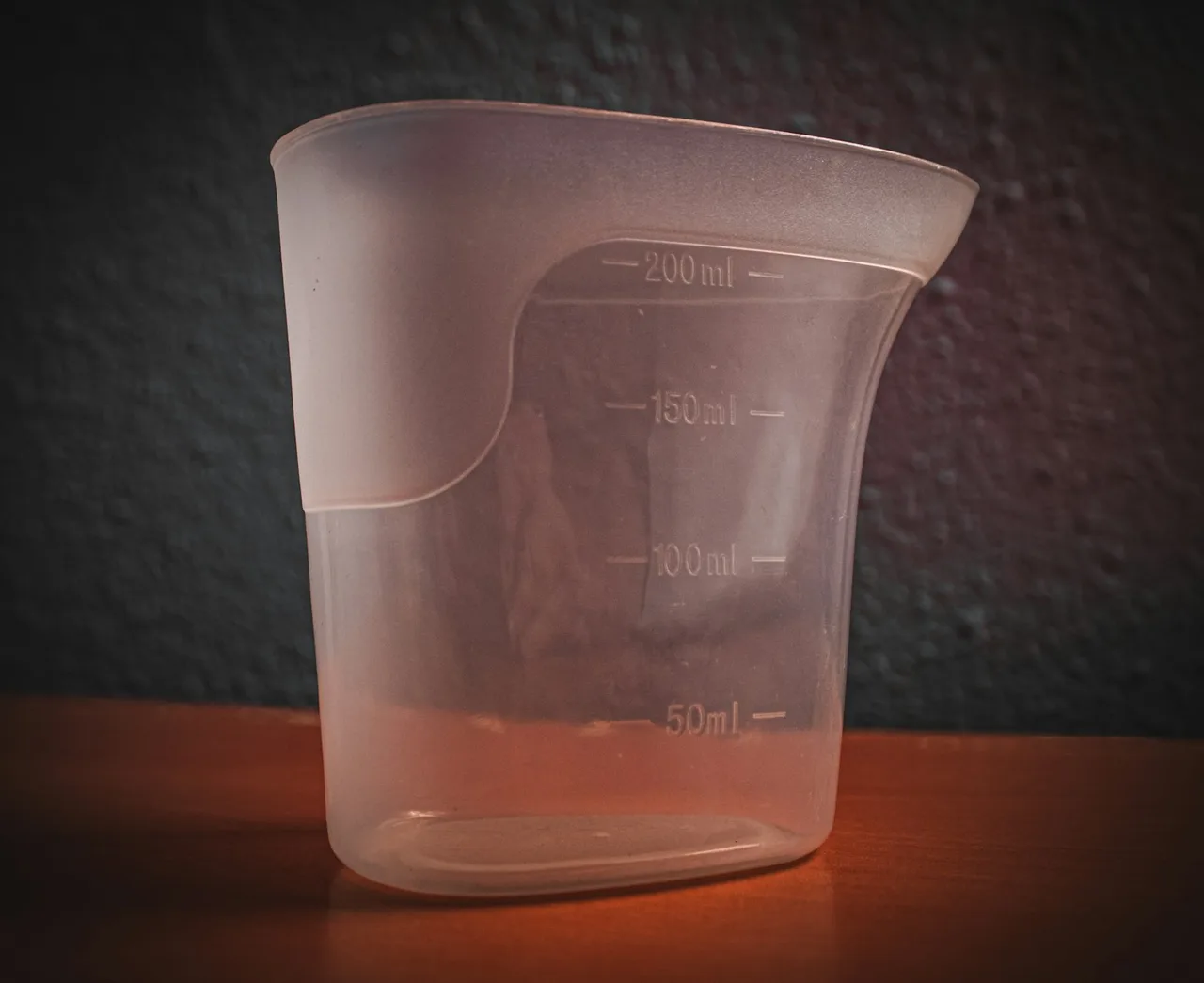
A jug with a metric scale takes the value straight. One quart sits 3.65 millilitres below the 950 mark, which is less than a teaspoon, so for cooking it is enough to fill to that mark.Carry the number onward
The Copy result button puts the value on the clipboard. The Swap order button turns the converter round to millilitres into quarts, and the Clear all button empties both fields.
How does a quart compare with a metric measuring jug?
A one-litre jug holds 1,000 millilitres, 53.65 millilitres more than a US liquid quart. Filled to the litre mark and poured into a recipe written in quarts, it adds 3.63 US tablespoons.
The half-litre mark sits 26.82 millilitres above half a quart, which is 473.18 millilitres. At the quarter mark the gap narrows to 13.41 millilitres against a US cup of 236.59 millilitres.
A jug printed with both scales settles this without arithmetic, because the US side carries cups and fluid ounces while the metric side carries millilitres. Where only the metric scale is printed, the converter supplies the second reading, and the cups to ml converter handles the smaller steps.
Convert other units to Millilitres
Convert Quarts to other units
Sources
- NIST Special Publication 811, Appendix B.9 — conversion factors — National Institute of Standards and Technology
- NIST Handbook 44, Appendix C — General Tables of Units of Measurement — National Institute of Standards and Technology
- Resolution 6 of the 12th CGPM (1964) on the litre — Bureau International des Poids et Mesures
Every figure in the tables was computed from the unit definitions and checked arithmetically before publication. Historical values and the names of local units come from the sources listed above.
Content last reviewed: · written and checked by the Arteon team
Frequently asked questions about quarts and millilitres
Why is the imperial answer larger?
A question or a suggestion?
Write to us if the converter is missing a unit you need, or if one of the numbers looks out of date.