Find out how many years of education your text needs
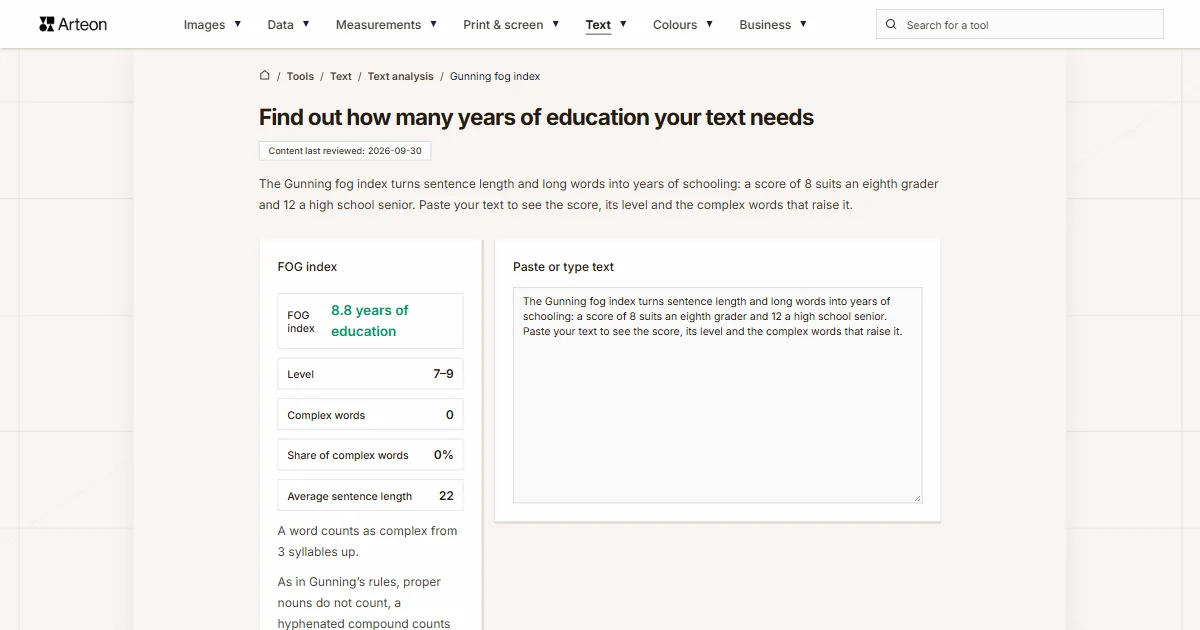
The Gunning fog index turns sentence length and long words into years of schooling: a score of 8 suits an eighth grader and 12 a high school senior. Paste your text to see the score, its level and the complex words that raise it.
FOG index
The index appears here once the text has at least three words.
A word counts as complex from 3 syllables up.
As in Gunning’s rules, proper nouns do not count, a hyphenated compound counts only when one of its parts is complex, and an -ed or -es ending does not make a word complex.
What is the Gunning fog index?
The Gunning fog index estimates how many years of formal education a reader needs to understand a text on the first reading[1]. A score of 12 matches a US high school senior, and a score of 8 matches an eighth grader. Robert Gunning, an American businessman who had worked in newspaper and textbook publishing, published the formula in 1952[1].
Gunning was working on clearer writing years before he had a formula. In 1944 he founded the first consulting firm that specialized in readability. Over the next few years he worked with more than 60 large city daily newspapers and with popular magazines, helping their writers and editors write for their readers[2].
The index rests on two numbers that a program can count without understanding the text: the average sentence length and the share of words with three or more syllables. The calculator above counts both as you type and lists the long words that push the score up.
How do you calculate the Gunning fog index?
Add the average sentence length to the percentage of complex words, then multiply the sum by 0.4[1]. The average sentence length is the number of words divided by the number of sentences. The percentage of complex words is their number divided by the number of words, times 100. Words and sentences follow the same rules as in our word and character counter, so both tools give the same totals.
Take this passage: “Our new library opens on Monday. It offers comfortable reading rooms and a large collection of international magazines.” It has 18 words in 2 sentences, so the average sentence is 9 words long. Five of the words have three or more syllables: library, comfortable, collection, international and magazines. That makes 27.8% complex words. The two numbers add up to 36.8, and 0.4 times 36.8 gives a fog index of 14.7.
Which words count as complex?
A complex word has three or more syllables[1]. Gunning left out three kinds of long words that readers handle easily: proper nouns, compounds made of short words such as housekeeper, and verbs whose third syllable is the -es or -ed ending, such as donated and trespasses[3].
The calculator applies these rules wherever the spelling shows them. A word that starts with a capital letter in the middle of a sentence counts as a proper noun. The first word of a sentence is judged by its syllables, as Gunning's rule says[3]. A hyphenated compound counts only when one of its parts has three syllables, so well-known stays easy and self-explanatory is complex. Compounds written as one word, such as housekeeper, are counted by their syllables like any other word.
Sentences end at a period, a question mark, an exclamation mark or an ellipsis, and an abbreviation such as Mr. or Dr. doesn't end one. Gunning's 1952 method also counted each clause as a sentence. That step was dropped in the 1980s, and later guides generally recommend the sentence count alone[1]. To see the older result, put a period between the independent clauses before you paste the text.
What does your fog score mean?
| Fog index | US reading level | England and Wales |
|---|---|---|
| 6 | Sixth grade | Year 7 |
| 7 | Seventh grade | Year 8 |
| 8 | Eighth grade | Year 9 |
| 9 | High school freshman | Year 10 |
| 10 | High school sophomore | Year 11 |
| 11 | High school junior | Year 12 |
| 12 | High school senior | Year 13 |
| 13 | College freshman | First year at university |
| 14 | College sophomore | Second year at university |
| 15 | College junior | Third year at university |
| 16 | College senior | Postgraduate study |
| 17 | College graduate | Postgraduate study |
How do sentence length and word length change the score?
| Passage | Average sentence length | Share of complex words | Fog index |
|---|---|---|---|
| Short sentences, short words | 3.3 words | 0% | 1.3 |
| One long sentence, short words | 27 words | 0% | 10.8 |
| Short sentences, long words | 3 words | 88.9% | 36.8 |
| Clause from an insurance policy | 23 words | 34.8% | 23.1 |
What fog scores did Gunning find in magazines?
| Magazine group | Approximate circulation | Fog index |
|---|---|---|
| Class magazines | Fewer than 1 million | 12 |
| News magazines | About 3 million | 10 |
| Reader's Digest | 8 million | 9 |
| Slicks | More than 10 million | 8 |
| Pulps | More than 10 million | 6 |
Can you compare fog scores across languages?
| Language | Complex word | Average sentence length | Share of complex words | Fog index |
|---|---|---|---|---|
| English | 3 syllables or more | 14.7 words | 8.1% | 9.1 |
| French | 3 syllables or more | 15.3 words | 13.7% | 11.6 |
| Spanish | 3 syllables or more | 15.2 words | 26.1% | 16.5 |
| Italian | 3 syllables or more | 14.7 words | 27% | 16.6 |
| Polish | 4 syllables or more | 13.2 words | 7.7% | 8.4 |
| Polish, counted like English | 3 syllables or more | 13.2 words | 26% | 15.7 |
What text does this calculator accept, and how does it score it?
| What you paste | Complex words | Fog index | How we count it |
|---|---|---|---|
| “The ticket costs 12 dollars and 50 cents.” | none | 3.2 | Numbers count as words, just as in the word counter, but they have no syllables, so they never come out complex |
| “Mr. Robinson arrived early. The meeting started at nine.” | none | 1.8 | The period after “Mr.” is not read as the end of a sentence, so Robinson stands mid-sentence and counts as a proper noun |
| “She donated books and created a reading club.” | none | 3.2 | Donated and created reach three syllables only through the -ed ending, so Gunning’s rule leaves them out |
| “A well-known author wrote a self-explanatory guide.” | self-explanatory | 8.5 | A hyphenated compound counts as complex when one of its parts has three syllables |
| “<p>Short text here.</p><p>One more line here.</p>” | none | 1.4 | We skip HTML tags, and we treat the end of a paragraph as the end of a sentence |
| “WASHINGTON IS BEAUTIFUL TODAY.” | WASHINGTON, BEAUTIFUL | 21.6 | In a sentence typed in capitals we judge every word by its syllables, exactly as in lowercase |
| “Hello there” | – | no score | We give an index from three words upward, and with a shorter text we say so plainly: “The index appears here once the text has at least three words.” |
| “Привет, как дела у тебя сегодня?” | – | no score | The index rests on counting syllables in the Latin and Greek alphabets, so for Cyrillic we show the message “The index works for texts written in the Latin or Greek alphabet.” instead of a number |
How do you check the fog index in three steps?
The calculation runs in your browser, so the text stays on your device.
1. Paste a full passage
Paste your text into the Paste or type text field. Gunning's method takes about 100 words of whole paragraphs without skipping any sentence, and the score appears from three words.2. Read the result
The FOG index panel shows the score in years of education, the Level, Complex words, the Share of complex words and the Average sentence length.3. Edit and check again
The Which words raise the index card lists every complex word. The score updates as you type, and Copy result copies the score together with the words “years of education”.
Which change lowers the score more?
When sentences are long, splitting one of them lowers the score more than replacing one long word. Both parts of the formula enter the sum with the same weight, and the difference comes from how far one edit moves each of them.
Take a passage of 100 words. Each complex word in it equals one percentage point, so replacing one with a shorter word lowers the index by 0.4. If the same passage has five sentences, the average sentence is 20 words long. Split one sentence in two, and the average drops to 16.7 words, which lowers the index by 1.3.
The calculator shows which edit your text needs. A high Share of complex words calls for shorter words from the Which words raise the index card. A long Average sentence length calls for more periods.
What fog score should you aim for?
Texts for a wide audience generally need a fog index below 12, and texts that almost everyone has to understand need one below 8[1]. Gunning's magazine counts show the same pattern. Reader's Digest, the slicks and the pulps, each read by millions, scored between 6 and 9, while class magazines with fewer than a million readers reached 12[2].
We measured this page with the same calculator. Its running text, without tables and captions, scores 10.5 with an average sentence of 17.6 words. For a second view of the same text, check it with the Flesch Reading Ease score, which works with syllables per word instead of counting complex words.

Why is the fog score higher than other grade levels?
Gunning built his formula on reading tests where the reader had to answer 90 percent of the questions correctly. Only the SMOG formula uses a stricter criterion, and the grades predicted by these two formulas tend to be higher than those of other formulas[2]. We saw this on the introductions of 312 tools on this site: in English they score 9.1 on the fog index and 6.7 on the Flesch-Kincaid grade level.
Programs also count syllables and sentences in different ways, which moves the result even when they use the same formula[2]. Microsoft Word shows the Flesch Reading Ease score and the Flesch-Kincaid grade level in its readability statistics, so a fog score for a Word document comes from pasting the text into a calculator like this one[6].
What does the fog index leave out?
The formula sees only how long the sentences and words are. Some long words are familiar to almost every reader, and some short words are rare, yet the index judges both by their syllables[1]. The formula also has no way to judge meaning, so a text of short words can still be hard to follow. On a screen, how easily the letters can be read also depends on color, and the color contrast checker tests text and background against the WCAG levels.
The table of passages shows the effect. Three correct, short sentences scored 36.8, because nearly every word in them was long. The score tells you how much effort the wording asks of a reader, and the reading time calculator tells you how many minutes the text takes.
The index was also built for English. The same tool introductions on this site score 9.1 in English, 11.6 in French, 16.5 in Spanish and 16.6 in Italian, because Romance languages use more long words for the same content. The other language versions of this page explain what that means for each language.
Sources
- Gunning fog index — Wikipedia
- The Principles of Readability — W. H. DuBay, Impact Information, 2004 (ERIC ED490073)
- Gunning's Fog Index — Guilford College, Writing Manual
- Year 7 — Wikipedia
- Pulp magazine — Wikipedia
- Get your document's readability and level statistics in Microsoft Word — Microsoft Support
The results in the tables were computed by this tool's own function and checked by an automated test before publication. The rules, standards and figures the text relies on come from the sources listed above.
Content last reviewed: · written and checked by the Arteon team
Frequently asked questions about the Gunning fog index
What is a good Gunning fog score?
Below 12 for a wide audience and below 8 for text that almost everyone has to understand. Gunning measured the magazines with the largest circulation of his time between 6 and 9.
How many syllables does a complex word have?
Three or more. Gunning did not count proper nouns, compounds of short words or verbs that reach three syllables only through the -ed or -es ending.
Why is my fog score higher than my Flesch-Kincaid grade?
Gunning built his formula on tests where readers answered 90 percent of the questions correctly, a stricter criterion than most readability formulas use, and a stricter criterion predicts higher grades. On the introductions of our tools the fog index gave 9.1 and the Flesch-Kincaid grade level 6.7.
Does Microsoft Word show the Gunning fog index?
Word's readability statistics show the Flesch Reading Ease score and the Flesch-Kincaid grade level. For the fog index, copy the text from Word and paste it into the calculator on this page.
How much text do I need for a reliable score?
The calculator shows a score from three words. Gunning's method uses a passage of about 100 words made of whole paragraphs, because a few sentences can swing the average a lot. For a page title or meta description, length matters more, and the meta title and description checker measures it.
Does the fog index work for other languages?
It was built for English. The same texts on this site score 9.1 in English and 16.5 in Spanish, so compare a score only with scores of texts in the same language.
Is my text sent to a server?
The calculation runs in your browser, and the text stays on your device.
Help us improve our tools
Have an idea for a new feature, found a bug, or want to suggest another tool that would make your work easier? Write to us.
Explore other useful tools

Meta title & description checker
Check title and description length in pixels. Live Google preview and optimization tips.
PNG to JPG
Convert PNG files to JPG in your browser. No file limits, no signup, no server uploads.

Favicon generator
Create a complete favicon.ico set for your website from one image. All required sizes, no login.
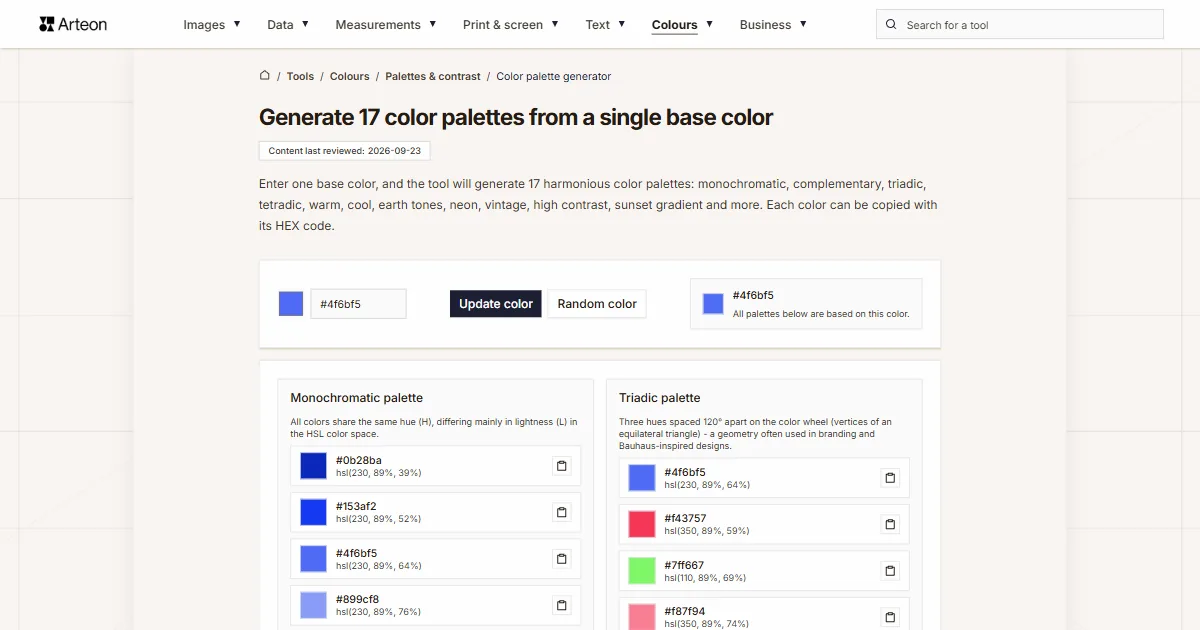
Color palette generator
Generate 17 palettes from one color: monochromatic, complementary, triadic and more. HEX codes.
WebP to JPG
Convert WebP files to universally compatible JPG. Works in every app and platform.
Color contrast checker
Check text and background contrast per WCAG 2.1 AA and AAA. Automatic color correction.
Free QR code generator
Create a QR code for a website, vCard business card or print. Export PNG and SVG, no registration.
Word & character counter
Count words, characters with and without spaces, sentences, paragraphs and the average sentence length.
Lorem Ipsum Generator
Free Lorem Ipsum generator — 8 text styles, paragraphs, sentences or words. Copy in one click.