Convert centiliters to milliliters
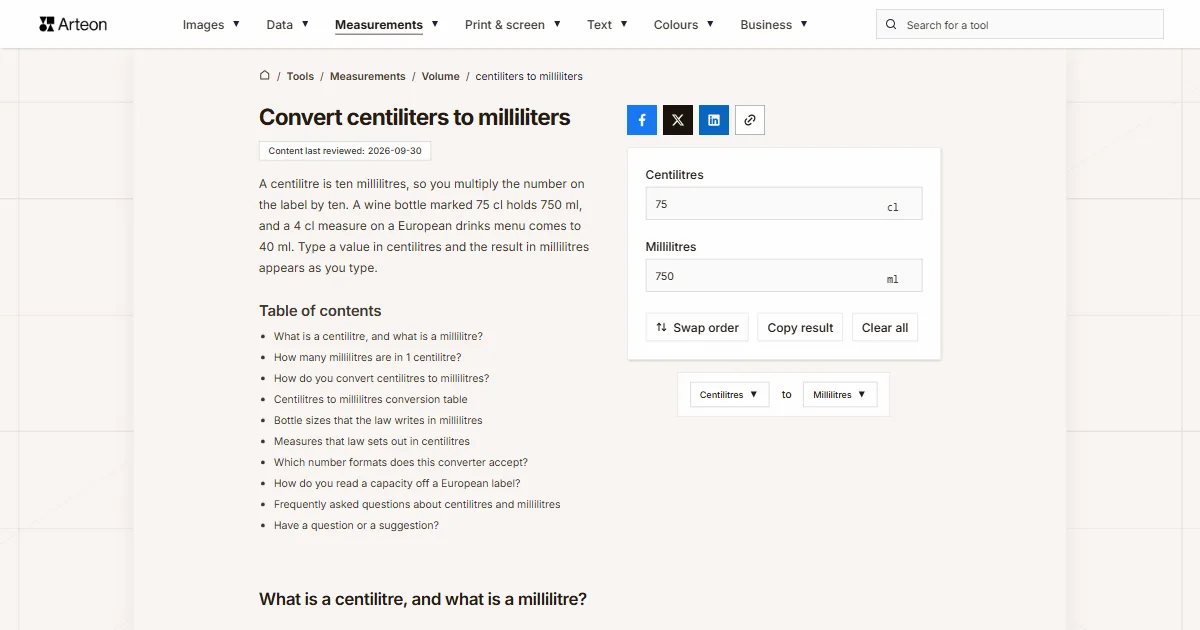
A centilitre is ten millilitres, so you multiply the number on the label by ten. A wine bottle marked 75 cl holds 750 ml, and a 4 cl measure on a European drinks menu comes to 40 ml. Type a value in centilitres and the result in millilitres appears as you type.
What is a centilitre, and what is a millilitre?
A centilitre is one hundredth of a litre. The name has two parts: the SI prefix centi, which stands for one hundredth, or 10⁻², and the name of the unit itself.[1] The same prefix turns up in the centimetre, where it works in exactly the same way.
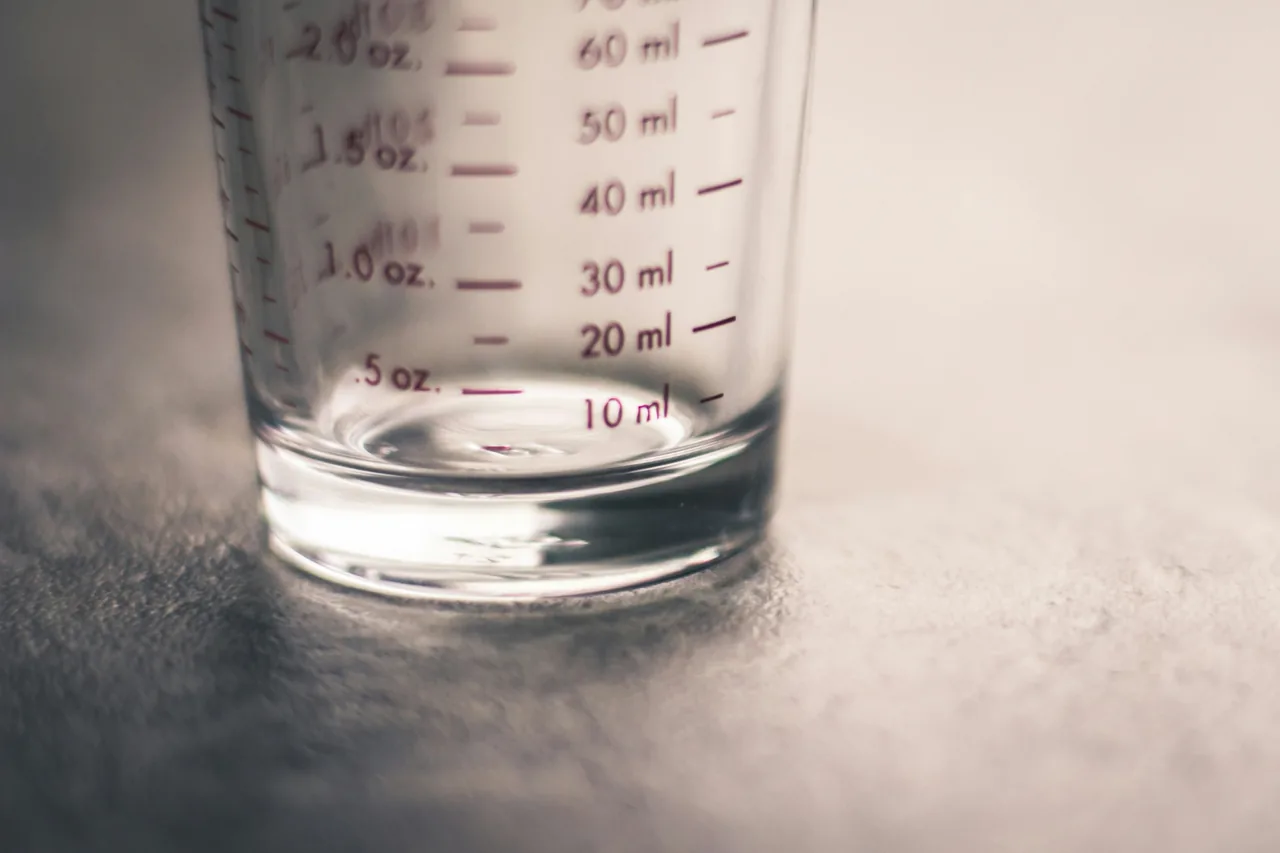
A millilitre describes one thousandth of a litre and equals the volume of one cubic centimetre. It is the unit printed on a syringe scale and on a kitchen measuring jug, so a figure given in millilitres can be measured out with equipment you already own.
The litre belongs to the units accepted for use with the SI rather than to the SI itself. The SI Brochure gives one litre as one cubic decimetre,[2] and the submultiples of the litre, centilitres and millilitres among them, inherit that definition.
Labels carry two spellings of the same symbol: cl and cL. Resolution 6 of the 16th General Conference on Weights and Measures adopted the capital L in 1979 so that the litre symbol could be told apart from the digit one.[2] Both forms mean the same thing, and the converter treats them alike.
How many millilitres are in 1 centilitre?
One centilitre is 10 millilitres. To turn centilitres into millilitres, you multiply by ten. Three values show how that works in practice. Five centilitres come to 50 millilitres. Thirty-three centilitres, the figure on a drinks can, come to 330 millilitres. Seventy-five centilitres from a wine label come to 750 millilitres. In decimal notation the whole calculation amounts to moving the point one place to the right.
That ten comes from the gap between two prefixes. Centi describes one hundredth, or 10⁻², and milli one thousandth, or 10⁻³.[1] Exactly one order of magnitude separates them, whatever the country and whatever the product.
The answer does not depend on what is in the bottle. A centilitre of water, of oil and of spirit each comes to 10 millilitres, because both units measure volume. How much that volume weighs depends on the density of the liquid, and that is a separate calculation.
How do you convert centilitres to millilitres?
The formula has one term: millilitres = centilitres × 10. For a bottle marked 37.5 cl the arithmetic runs 37.5 × 10 = 375 ml. For a 2 cl measure it gives 20 ml.
The field takes a fraction in two forms. The decimal 37.5 and the common fraction 37 1/2 return the same answer. Values below one centilitre work too, so 0.13 cl converts to 1.3 ml.
For the other direction, use the millilitres to centilitres converter. When the capacity is given in a larger unit, use the centilitres to litres converter, and for recipes counted in hundreds of millilitres the decilitres to millilitres converter.
Centilitres to millilitres conversion table
| Centilitres | Millilitres | Litres |
|---|---|---|
| 0.5 cl | 5 ml | 0.005 l |
| 1 cl | 10 ml | 0.01 l |
| 2 cl | 20 ml | 0.02 l |
| 2.5 cl | 25 ml | 0.025 l |
| 3 cl | 30 ml | 0.03 l |
| 4 cl | 40 ml | 0.04 l |
| 5 cl | 50 ml | 0.05 l |
| 6 cl | 60 ml | 0.06 l |
| 7.5 cl | 75 ml | 0.075 l |
| 10 cl | 100 ml | 0.1 l |
| 12 cl | 120 ml | 0.12 l |
| 15 cl | 150 ml | 0.15 l |
| 20 cl | 200 ml | 0.2 l |
| 25 cl | 250 ml | 0.25 l |
| 30 cl | 300 ml | 0.3 l |
| 33 cl | 330 ml | 0.33 l |
| 35 cl | 350 ml | 0.35 l |
| 37.5 cl | 375 ml | 0.375 l |
| 40 cl | 400 ml | 0.4 l |
| 50 cl | 500 ml | 0.5 l |
| 60 cl | 600 ml | 0.6 l |
| 70 cl | 700 ml | 0.7 l |
| 75 cl | 750 ml | 0.75 l |
| 100 cl | 1,000 ml | 1 l |
| 150 cl | 1,500 ml | 1.5 l |
| 200 cl | 2,000 ml | 2 l |
Bottle sizes that the law writes in millilitres
| Wording on the label | Nominal quantity in the directive | Type of pack |
|---|---|---|
| 10 cl | 100 ml | Smallest bottle of still wine and of a spirit drink |
| 12.5 cl | 125 ml | Smallest bottle of sparkling wine |
| 18.7 cl | 187 ml | Single-serve bottle of still wine |
| 20 cl | 200 ml | Small bottle of sparkling wine and of a spirit drink |
| 25 cl | 250 ml | Quarter-litre bottle of still wine |
| 35 cl | 350 ml | Small bottle of a spirit drink |
| 37.5 cl | 375 ml | Half bottle of wine |
| 50 cl | 500 ml | Half-litre bottle of wine and of a spirit drink |
| 70 cl | 700 ml | Standard bottle of gin, whisky, rum and vodka |
| 75 cl | 750 ml | Standard wine bottle |
| 100 cl | 1,000 ml | Litre bottle |
| 150 cl | 1,500 ml | Magnum, the largest nominal quantity for wine |
| 175 cl | 1,750 ml | Large bottle of a spirit drink |
| 200 cl | 2,000 ml | Largest nominal quantity for spirit drinks |
Measures that law sets out in centilitres
| Centilitres | Millilitres | The law that sets this measure |
|---|---|---|
| 1 cl | 10 ml | Germany, § 27 MessEV |
| 2 cl | 20 ml | Germany, § 27 MessEV |
| 2.5 cl | 25 ml | United Kingdom, the 1994 order |
| 3.5 cl | 35 ml | United Kingdom, the 1994 order |
| 4 cl | 40 ml | Germany, § 27 MessEV |
| 5 cl | 50 ml | Germany, § 27 MessEV |
| 10 cl | 100 ml | Germany, § 27 MessEV |
Which number formats does this converter accept?
| What you type | What the converter shows | How we read it |
|---|---|---|
| 4 | 40 ml | A number on its own is read as centilitres, because that is the unit on the field. |
| 4cl | 40 ml | The cl symbol pasted with the number, with or without a space, is skipped, and so is the word centilitres. |
| 2.5 | 25 ml | The decimal point separates the fraction, exactly as you would expect. |
| 2,5 | 25 ml | A comma followed by one digit can only be a decimal comma, so we read it as two and a half. |
| 1,500 | 15,000 ml | A comma before three digits groups thousands in English, so this is fifteen hundred centilitres. A note under the field shows the other possible reading, 1.5. |
| 1.500 | 15 ml | A single point is always read as a decimal point, so the field counts one and a half centilitres. A note under the field shows the other possible reading, 1500. |
| 1 500 | 15,000 ml | A space between the thousands, as written in much of Europe and in SI style, gives the same result as 1,500. |
| 3/4 | 7.5 ml | We work out a fraction with a slash for you, so three quarters of a centilitre needs no conversion to 0.75 first. |
| 2½ | 25 ml | A ½ sign copied from a label or a recipe is added to the number in front of it. |
| 0.75 l | 750 ml | Litres from a label are converted to centilitres: the field enters 75 and says so in a line under it. |
How do you read a capacity off a European label?
Four steps that turn the figure on a bottle bought abroad into the millilitres used by a recipe or shown on a measuring jug.
Find the figure next to cl or cL
The net quantity appears on the label as a number and a unit symbol. The spellings cl and cL stand for the same unit,[2] so you convert either of them the same way. When the label gives the quantity in litres, that value goes into the litres to millilitres converter.Multiply the figure by ten
For a whole number you simply add a zero: 70 cl gives 700 ml. For a decimal you move the point one place to the right, so 37.5 cl gives 375 ml.Compare the answer with the nominal quantities
Still wine sold in the European Union comes in one of eight capacities, and spirit drinks in one of nine.[4] An answer of 750 ml or 700 ml therefore points to a standard bottle rather than an unusual one.For a bottle from the American market, work in millilitres
United States law lists the permitted bottle sizes for distilled spirits in litres and millilitres, from 50 ml up to 3.75 l.[7] A bottle made for that market therefore states its capacity in millilitres or litres, which you can compare directly with the millilitres column.
Convert other units to Millilitres
Convert Centilitres to other units
Sources
- Metric (SI) prefixes — National Institute of Standards and Technology
- The SI Brochure, 9th edition (2019) — non-SI units accepted for use with the SI and rules for writing unit symbols — Bureau International des Poids et Mesures (BIPM)
- Regulation (EU) No 1169/2011 on the provision of food information to consumers — Article 23 on net quantity — EUR-Lex, European Union
- Directive 2007/45/EC laying down rules on nominal quantities for prepacked products — EUR-Lex, European Union
- § 27 Mess- und Eichverordnung — nominal volumes permitted for German serving measures — Bundesministerium der Justiz, gesetze-im-internet.de
- The Weights and Measures (Intoxicating Liquor) (Amendment) Order 1994 — The National Archives, legislation.gov.uk
- 27 CFR § 5.203 — authorized standards of fill for distilled spirits in the United States — Legal Information Institute, Cornell Law School
Every figure in the tables was computed from the unit definitions and checked arithmetically before publication. Historical values and the names of local units come from the sources listed above.
Content last reviewed: · written and checked by the Arteon team
Frequently asked questions about centilitres and millilitres
Is a centilitre different in the United Kingdom and the United States?
A centilitre has one value everywhere, because it comes straight from the litre and an SI prefix. Separate US and imperial versions exist for units such as the gallon and the fluid ounce, while the centilitre works out the same wherever you are.
How does a centilitre differ from a decilitre?
A decilitre is one tenth of a litre, or 100 millilitres, while a centilitre is one hundredth of a litre, or 10 millilitres. One decilitre therefore holds ten centilitres.
Have a question or a suggestion?
If you have spotted a mistake in the tables or have an idea for improving the converter, write to us.