Convert kilograms to decigrams
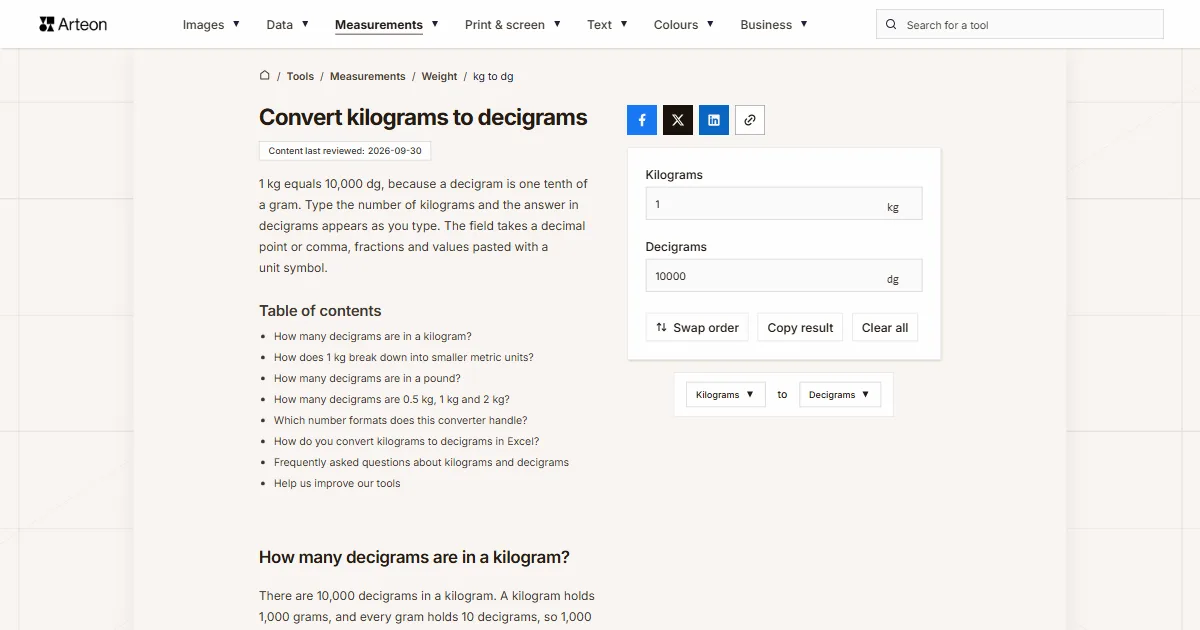
1 kg equals 10,000 dg, because a decigram is one tenth of a gram. Type the number of kilograms and the answer in decigrams appears as you type. The field takes a decimal point or comma, fractions and values pasted with a unit symbol.
How many decigrams are in a kilogram?
There are 10,000 decigrams in a kilogram. A kilogram holds 1,000 grams, and every gram holds 10 decigrams, so 1,000 × 10 gives 10,000.
Formula: decigrams = kilograms × 10,000
In your head, move the decimal point four places to the right and add zeros when you run out of digits. 3.5 kg becomes 35,000 dg this way, and 0.25 kg becomes 2,500 dg.
If you need to go the other way, the dg to kg converter divides by 10,000.
How does 1 kg break down into smaller metric units?
| Unit | How many make 1 kg | One unit in kilograms |
|---|---|---|
| Hectogram (hg) | 10 hg | 0.1 kg |
| Dekagram (dag) | 100 dag | 0.01 kg |
| Gram (g) | 1,000 g | 0.001 kg |
| Decigram (dg) | 10,000 dg | 0.0001 kg |
| Centigram (cg) | 100,000 cg | 0.00001 kg |
| Milligram (mg) | 1,000,000 mg | 0.000001 kg |
How many decigrams are in a pound?
About 4,535.9 dg. NIST gives one avoirdupois pound as 0.4535924 kg[2], and multiplying that by 10,000 gives the decigrams. Half a pound is about 2,268 dg, and a quarter pound about 1,134 dg.
How many decigrams are 0.5 kg, 1 kg and 2 kg?
| Kilograms | Decigrams | Grams |
|---|---|---|
| 0.001 kg | 10 dg | 1 g |
| 0.005 kg | 50 dg | 5 g |
| 0.01 kg | 100 dg | 10 g |
| 0.02 kg | 200 dg | 20 g |
| 0.05 kg | 500 dg | 50 g |
| 0.1 kg | 1,000 dg | 100 g |
| 0.125 kg | 1,250 dg | 125 g |
| 0.2 kg | 2,000 dg | 200 g |
| 0.25 kg | 2,500 dg | 250 g |
| 0.5 kg | 5,000 dg | 500 g |
| 0.75 kg | 7,500 dg | 750 g |
| 1 kg | 10,000 dg | 1,000 g |
| 1.5 kg | 15,000 dg | 1,500 g |
| 2 kg | 20,000 dg | 2,000 g |
| 2.5 kg | 25,000 dg | 2,500 g |
| 3 kg | 30,000 dg | 3,000 g |
| 3.5 kg | 35,000 dg | 3,500 g |
| 5 kg | 50,000 dg | 5,000 g |
| 10 kg | 100,000 dg | 10,000 g |
| 25 kg | 250,000 dg | 25,000 g |
Which number formats does this converter handle?
| What you type | What the converter shows | Note |
|---|---|---|
| 0.25 | 2500 dg | A decimal point, written the way English writes decimals. |
| 0,25 | 2500 dg | A comma followed by two digits is read as a decimal comma, so the result stays the same. |
| 1,500 | 15000000 dg | Three digits follow the comma, so we read it as a thousands separator and count one thousand five hundred kilograms. A note under the field shows the other possible reading, 1.5. |
| 3/4 | 7500 dg | Three quarters of a kilogram from a recipe works without turning it into 0.75 first. |
| 1½ | 15000 dg | The ½ character is added to the number in front of it, so one and a half kilograms gives 15,000 dg. |
| 0.5 kg | 5000 dg | The kg symbol pasted with the number is the unit of the field, so we keep just the number. |
| 250 g | 2500 dg | Grams pasted into the field become 0.25 kg first, and a line under the field says so, so the pack does not turn into 250 kg. |
How do you convert kilograms to decigrams in Excel?
One multiplication is enough. The built-in function helps when the next column holds other mass units too.
Put the kilograms in column A
Start in cell A1 and type the other values below it.Multiply the cell by 10,000
In cell B1, type=A1*10000and drag the formula down. For 0.25 kg the sheet shows 2500, and for 3.5 kg it shows 35000.Or use the CONVERT function
The formula=CONVERT(A1,"kg","dg")gives the same result. The function builds the unit from a prefix and the gram, and it writes deci as "d"[3].
Convert Kilograms to other units
Sources
- Metric (SI) Prefixes — National Institute of Standards and Technology
- NIST Guide to the SI, Appendix B.8: Factors for Units Listed Alphabetically — National Institute of Standards and Technology
- CONVERT function — Microsoft
Every figure in the tables was computed from the unit definitions and checked arithmetically before publication. Historical values and the names of local units come from the sources listed above.
Content last reviewed: · written and checked by the Arteon team
Frequently asked questions about kilograms and decigrams
How many decigrams are in a gram?
Ten. A decigram is one tenth of a gram, so half a gram is 5 dg and 2.5 g is 25 dg.
Is a decigram the same as a dekagram?
No. A dekagram (dag) is 10 g and a decigram (dg) is 0.1 g, so one dekagram equals 100 decigrams. The symbols differ by a single letter, which makes them easy to mix up in homework.
How do you write 10,000 dg with a power of ten?
10,000 dg is 1 × 10⁴ dg. Five kilograms is 5 × 10⁴ dg, and 25 kg is 2.5 × 10⁵ dg.
Can the answer in decigrams have decimals?
Yes, when the kilograms have more than four decimal places. One milligram is 0.000001 kg, and the converter shows it as 0.01 dg.
Help us improve our tools
Have an idea for a new feature, spotted a bug, or want to suggest another tool? Write to us.