Convert kilometers to millimeters
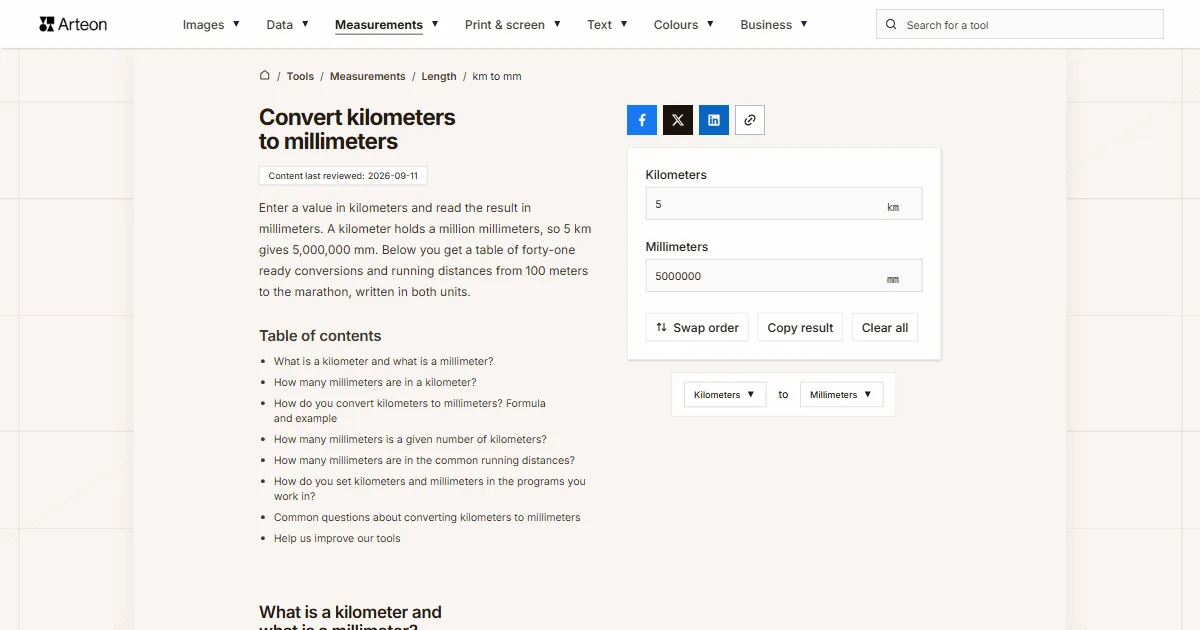
Enter a value in kilometers and read the result in millimeters. A kilometer holds a million millimeters, so 5 km gives 5,000,000 mm. Below you get a table of forty-one ready conversions and running distances from 100 meters to the marathon, written in both units.
What is a kilometer and what is a millimeter?
Both units take their value from a prefix attached to the meter. The prefix kilo- means a thousand, so a kilometer is a thousand meters and carries the symbol km. The prefix milli- means one thousandth, so a millimeter is a thousandth of a meter with the symbol mm[1].
The reference point for both is the meter, one of the seven base units of the SI. Since 1983 it has been defined as the length of the path traveled by light in a vacuum in 1/299,792,458 of a second[2]. Until 1960 the meter was disseminated using bars made of platinum and iridium[2].
Each of them is used somewhere else. The kilometer describes distance: the length of a route, a 5K or 10K race and the reading on a trip odometer. The millimeter describes detail: sheet thickness, drill diameter and dimensions on a metric drawing. Six orders of magnitude separate the two uses, which is why the converted number is so long.

How many millimeters are in a kilometer?
A kilometer holds 1,000,000 millimeters. To turn kilometers into millimeters you multiply the number of kilometers by a million, so 5 km gives 5,000,000 mm. The multiplier stays the same for a whole route or a hundredth of it.
The million comes from combining two prefixes. A kilometer is a thousand meters, and every meter divides into a thousand millimeters. A thousand multiplied by a thousand makes a million, which is why the millimeter count of a kilometer carries six zeros[1].
In decimal writing this comes down to moving the decimal point six places to the right. A value of 2.5 km turns into 2,500,000 mm this way. A value of 0.4 km gives 400,000 mm, because once the point has moved you add five zeros after the four.
The field at the top of the page runs the same calculation as you type. It takes a period, a comma and common fractions alike, so 1/2 and 0.5 return the same result.
How do you convert kilometers to millimeters? Formula and example
The formula has one shape: millimeters = kilometers × 1,000,000. You can split the same calculation into two steps when you want to see meters on the way: multiply by a thousand for meters, then by a thousand again for millimeters.
Take a distance of 3 km. Multiply 3 by a million and you get 3,000,000 mm. Values with a decimal point work the same way. A distance of 6.89 km gives 6,890,000 mm, because the point moves six places to the right and you fill the remaining places with zeros.
Scientific notation shortens the long strings of zeros. A kilometer becomes 1 × 10⁶ mm, since a million is ten raised to the sixth power. A distance of 872 km written this way takes the form 8.72 × 10⁸ mm.
The same distance in meters comes from the kilometers to meters converter. The way back is shown by the millimeters to kilometers converter, and the step in between by the kilometers to centimeters converter.
How many millimeters is a given number of kilometers?
| Kilometers | Millimeters |
|---|---|
| 0.001 km | 1,000 mm |
| 0.005 km | 5,000 mm |
| 0.01 km | 10,000 mm |
| 0.02 km | 20,000 mm |
| 0.05 km | 50,000 mm |
| 0.1 km | 100,000 mm |
| 0.2 km | 200,000 mm |
| 0.25 km | 250,000 mm |
| 0.3 km | 300,000 mm |
| 0.4 km | 400,000 mm |
| 0.5 km | 500,000 mm |
| 0.75 km | 750,000 mm |
| 1 km | 1,000,000 mm |
| 1.5 km | 1,500,000 mm |
| 2 km | 2,000,000 mm |
| 2.5 km | 2,500,000 mm |
| 3 km | 3,000,000 mm |
| 4 km | 4,000,000 mm |
| 5 km | 5,000,000 mm |
| 6 km | 6,000,000 mm |
| 6.89 km | 6,890,000 mm |
| 8 km | 8,000,000 mm |
| 9 km | 9,000,000 mm |
| 10 km | 10,000,000 mm |
| 15 km | 15,000,000 mm |
| 20 km | 20,000,000 mm |
| 25 km | 25,000,000 mm |
| 30 km | 30,000,000 mm |
| 35 km | 35,000,000 mm |
| 40 km | 40,000,000 mm |
| 50 km | 50,000,000 mm |
| 56 km | 56,000,000 mm |
| 60 km | 60,000,000 mm |
| 80 km | 80,000,000 mm |
| 100 km | 100,000,000 mm |
| 150 km | 150,000,000 mm |
| 200 km | 200,000,000 mm |
| 250 km | 250,000,000 mm |
| 500 km | 500,000,000 mm |
| 872 km | 872,000,000 mm |
| 1,000 km | 1,000,000,000 mm |
How many millimeters are in the common running distances?
| Distance | In kilometers | In millimeters |
|---|---|---|
| 100-meter sprint | 0.1 km | 100,000 mm |
| One lap of a running track | 0.4 km | 400,000 mm |
| 1500-meter run | 1.5 km | 1,500,000 mm |
| 5-kilometer race | 5 km | 5,000,000 mm |
| 10-kilometer race | 10 km | 10,000,000 mm |
| Half marathon | 21.0975 km | 21,097,500 mm |
| Marathon | 42.195 km | 42,195,000 mm |
| 100-kilometer ultramarathon | 100 km | 100,000,000 mm |
How do you set kilometers and millimeters in the programs you work in?
For a single value the field above is quicker. For a map heading to print, or for a whole column of distances, you set the unit once inside the program.
QGIS 3.44: a scale bar in kilometers on a layout measured in millimeters
With a custom page format in a print layout you choose the unit for the page size, and millimeters are one of the options[5]. The scale bar under the map is set separately and can describe the ground in kilometers. In the scale bar panel, the Label for units field defines the text used to describe the units of the scale bar, for example m or km, and the Label unit multiplier field specifies how many scale bar units go into one labeled unit. With the bar set to meters, a multiplier of 1,000 produces labels in kilometers[6].Spreadsheet: the CONVERT function
In English Excel the formula reads =CONVERT(A1,"km","mm"). The unit code is built from the prefix and the symbol of the meter, so "km" is the kilometer and "mm" the millimeter. The prefixes k and m may precede any metric unit argument, and unit names and prefixes are case-sensitive[7]. The syntax is CONVERT(number, from_unit, to_unit).Plain multiplication when you would rather skip the function
The formula =A1*1000000 returns the same result and works in every spreadsheet, Google Sheets and LibreOffice Calc included. Turn on the thousands separator alongside it: with eight digits, a break every three characters lets you read the order of magnitude without counting zeros.Checking the column on a single value
Type 1 into cell A1 and see whether the formula returns 1000000. That one result you can check without doing any arithmetic, which makes it a good trial before you drag the formula down. A #VALUE! message in place of the result means Excel does not read the content of cell A1 as a number, for example when a unit has been typed next to the value. Leave just the number in the cell[8].
Convert other units to Millimeters
Convert Kilometers to other units
Sources
- Metric (SI) Prefixes — National Institute of Standards and Technology
- SI Units – Length (definitions of the meter since 1793) — National Institute of Standards and Technology
- Running track (length of one lap) — Wikipedia
- Marathon (the 42.195 km standard distance) — Wikipedia
- QGIS 3.44 Documentation: Overview of the Print Layout — QGIS Project
- QGIS 3.44 Documentation: The Scale Bar Item — QGIS Project
- CONVERT function — Microsoft
- How to correct a #VALUE! error — Microsoft
Every figure in the tables was computed from the unit definitions and checked arithmetically before publication. Historical values and the names of local units come from the sources listed above.
Content last reviewed: · written and checked by the Arteon team
Common questions about converting kilometers to millimeters
How many millimeters are in 1 km?
A kilometer holds 1,000,000 millimeters. A thousand meters, each of them a thousand millimeters, add up to a million.
How many millimeters are in half a kilometer?
Half a kilometer is 500,000 millimeters. Half of a million follows straight from splitting the full kilometer in two.
How many millimeters are in 0.1 km?
A tenth of a kilometer is 100,000 millimeters. The same length is 100 meters. Meters go into millimeters through the meters to mm converter.
How do you write a kilometer in millimeters in scientific notation?
A kilometer is 1 × 10⁶ mm, because a million is ten raised to the sixth power. For other values only the figure in front of the power changes: 5 km is 5 × 10⁶ mm.
How many zeros does the millimeter count of a kilometer have?
Six. Three of them come from the prefix kilo-, that is from a thousand meters, and three more from dividing the meter into a thousand millimeters. The second step, millimeters back to meters, has its own mm to meters converter.
How do you convert kilometers to millimeters in your head?
Move the decimal point six places to the right. The figure 2.5 becomes 2,500,000 and the figure 0.07 becomes 70,000. Six places come from the million, which carries six zeros.
How many millimeters is a marathon?
A marathon measures 42.195 km, which is 42,195,000 millimeters. A half marathon gives half of that figure, so 21,097,500 millimeters.
Can the field take a common fraction?
Yes. The field takes entries such as 1/2 or 3 1/4 and treats them exactly like decimal values. A period and a comma work interchangeably.
Help us improve our tools
Got an idea for a new feature, found a bug or want to suggest another tool? Write to us — we reply within 24 hours.