Convert kilometres to yards
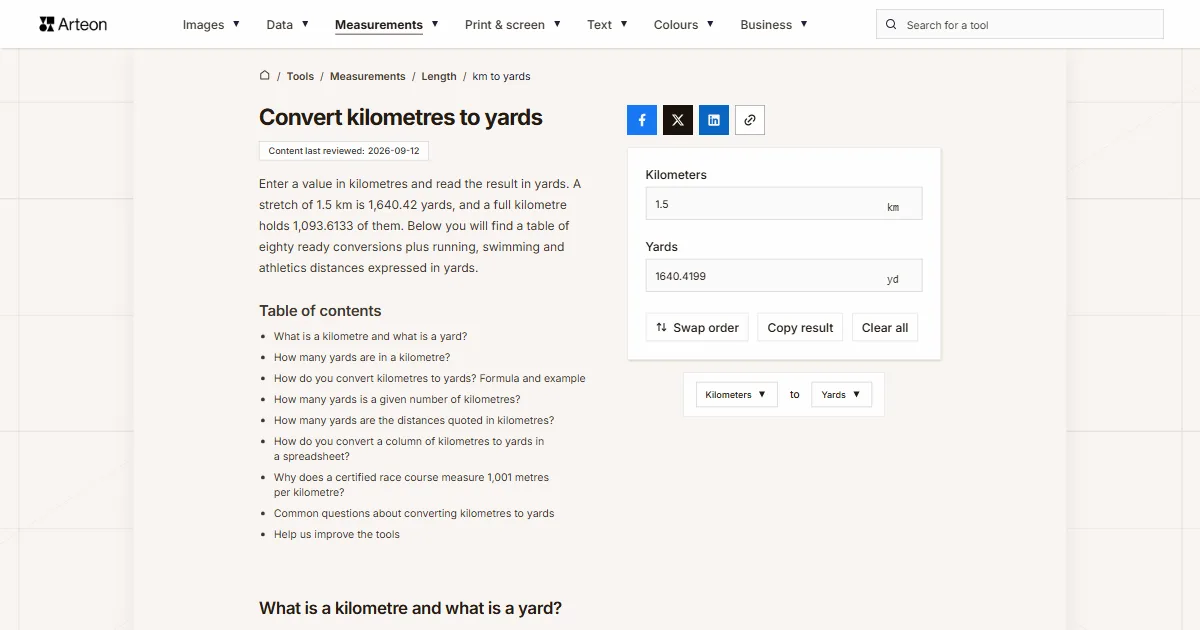
Enter a value in kilometres and read the result in yards. A stretch of 1.5 km is 1,640.42 yards, and a full kilometre holds 1,093.6133 of them. Below you will find a table of eighty ready conversions plus running, swimming and athletics distances expressed in yards.
What is a kilometre and what is a yard?
A kilometre is the metre with the kilo prefix, which means one thousand metres. The metre itself is the SI base unit of length, and its value follows from the speed of light in vacuum[1]. The same prefix sits behind the kilometres to metres converter.
The yard comes from the imperial and US customary systems and measures exactly 0.9144 metres today. That value was set by the international yard and pound agreement, effective 1 July 1959[2]. A yard holds three feet, and a statute mile holds 1,760 yards.
Because both units are described through the metre, the conversion is exact. The result lands on a non-whole number, because a kilometre holds 1,093.6133 yards and the yard grew up apart from the decimal system.
How many yards are in a kilometre?
A kilometre holds 1,093.6133 yards. To turn kilometres into yards you divide the value by 0.0009144 or multiply it by 1,093.6133 — both routes give the same answer. A thousand yards only reaches 914.4 metres, so it falls 85.6 metres short of a kilometre.
Longer distances use the same multiplier. One and a half kilometres is 1,640.42 yards. Five kilometres gives 5,468.07 yards. Ten kilometres comes to 10,936.13 yards, and twenty kilometres to 21,872.27 yards. Every further five kilometres adds 5,468.07 yards to the result.
Fractions of a kilometre work the same way. One hundred metres, or 0.1 kilometres, is 109.36 yards. Four hundred metres, one lap of the track, gives 437.45 yards. Twenty-five metres, one length of a short course pool, comes to 27.34 yards, so forty such lengths make up an even kilometre.
The conversion the other way is handled by the yards to kilometres converter, which multiplies by 0.0009144.
How do you convert kilometres to yards? Formula and example
The calculation has one step: multiply the number of kilometres by 1,093.6133. When you would rather go through metres, multiply the kilometres by a thousand and divide the result by 0.9144.
Take a 5 kilometre road race. Five times 1,093.6133 gives 5,468.07 yards. In a 25-yard pool that same distance is 218.7 lengths, and in a 25-metre pool it is exactly 200.
Fractions of a kilometre go straight into the field with a full stop. A value of 1.9 gives 2,077.87 yards, and 3.8 gives 4,155.73 yards.
Over longer stretches other pairs of units suit better. Kilometres to metres are handled by the kilometres to metres converter, and kilometres to miles by the kilometres to miles converter.
How many yards is a given number of kilometres?
| Kilometres | Yards | Metres |
|---|---|---|
| 0.1 km | 109.36 yd | 100 m |
| 0.2 km | 218.72 yd | 200 m |
| 0.3 km | 328.08 yd | 300 m |
| 0.4 km | 437.45 yd | 400 m |
| 0.5 km | 546.81 yd | 500 m |
| 0.6 km | 656.17 yd | 600 m |
| 0.7 km | 765.53 yd | 700 m |
| 0.75 km | 820.21 yd | 750 m |
| 0.8 km | 874.89 yd | 800 m |
| 0.9 km | 984.25 yd | 900 m |
| 1 km | 1,093.61 yd | 1,000 m |
| 1.2 km | 1,312.34 yd | 1,200 m |
| 1.3 km | 1,421.7 yd | 1,300 m |
| 1.4 km | 1,531.06 yd | 1,400 m |
| 1.5 km | 1,640.42 yd | 1,500 m |
| 1.6 km | 1,749.78 yd | 1,600 m |
| 1.9 km | 2,077.87 yd | 1,900 m |
| 2 km | 2,187.23 yd | 2,000 m |
| 2.1 km | 2,296.59 yd | 2,100 m |
| 2.5 km | 2,734.03 yd | 2,500 m |
| 2.7 km | 2,952.76 yd | 2,700 m |
| 2.8 km | 3,062.12 yd | 2,800 m |
| 3 km | 3,280.84 yd | 3,000 m |
| 3.5 km | 3,827.65 yd | 3,500 m |
| 3.8 km | 4,155.73 yd | 3,800 m |
| 4 km | 4,374.45 yd | 4,000 m |
| 4.5 km | 4,921.26 yd | 4,500 m |
| 4.6 km | 5,030.62 yd | 4,600 m |
| 4.8 km | 5,249.34 yd | 4,800 m |
| 5 km | 5,468.07 yd | 5,000 m |
| 5.5 km | 6,014.87 yd | 5,500 m |
| 6 km | 6,561.68 yd | 6,000 m |
| 6.5 km | 7,108.49 yd | 6,500 m |
| 6.7 km | 7,327.21 yd | 6,700 m |
| 7 km | 7,655.29 yd | 7,000 m |
| 7.5 km | 8,202.1 yd | 7,500 m |
| 8 km | 8,748.91 yd | 8,000 m |
| 8.5 km | 9,295.71 yd | 8,500 m |
| 9 km | 9,842.52 yd | 9,000 m |
| 9.5 km | 10,389.33 yd | 9,500 m |
| 10 km | 10,936.13 yd | 10,000 m |
| 12 km | 13,123.36 yd | 12,000 m |
| 15 km | 16,404.2 yd | 15,000 m |
| 20 km | 21,872.27 yd | 20,000 m |
| 21.0975 km | 23,072.51 yd | 21,097.5 m |
| 25 km | 27,340.33 yd | 25,000 m |
| 26 km | 28,433.95 yd | 26,000 m |
| 29 km | 31,714.79 yd | 29,000 m |
| 30 km | 32,808.4 yd | 30,000 m |
| 32 km | 34,995.63 yd | 32,000 m |
| 33.3 km | 36,417.32 yd | 33,300 m |
| 34 km | 37,182.85 yd | 34,000 m |
| 35 km | 38,276.47 yd | 35,000 m |
| 40 km | 43,744.53 yd | 40,000 m |
| 41 km | 44,838.15 yd | 41,000 m |
| 42.195 km | 46,145.01 yd | 42,195 m |
| 44 km | 48,118.99 yd | 44,000 m |
| 45 km | 49,212.6 yd | 45,000 m |
| 49 km | 53,587.05 yd | 49,000 m |
| 50 km | 54,680.66 yd | 50,000 m |
| 52 km | 56,867.89 yd | 52,000 m |
| 54 km | 59,055.12 yd | 54,000 m |
| 59 km | 64,523.18 yd | 59,000 m |
| 60 km | 65,616.8 yd | 60,000 m |
| 65 km | 71,084.86 yd | 65,000 m |
| 68 km | 74,365.7 yd | 68,000 m |
| 70 km | 76,552.93 yd | 70,000 m |
| 75 km | 82,021 yd | 75,000 m |
| 80 km | 87,489.06 yd | 80,000 m |
| 85 km | 92,957.13 yd | 85,000 m |
| 95 km | 103,893.26 yd | 95,000 m |
| 100 km | 109,361.33 yd | 100,000 m |
| 125 km | 136,701.66 yd | 125,000 m |
| 200 km | 218,722.66 yd | 200,000 m |
| 250 km | 273,403.32 yd | 250,000 m |
| 300 km | 328,083.99 yd | 300,000 m |
| 400 km | 437,445.32 yd | 400,000 m |
| 500 km | 546,806.65 yd | 500,000 m |
| 750 km | 820,209.97 yd | 750,000 m |
| 1,000 km | 1,093,613.3 yd | 1,000,000 m |
How many yards are the distances quoted in kilometres?
| Distance | Kilometres | Yards | Metres |
|---|---|---|---|
| Five kilometre road race | 5 km | 5,468.07 yd | 5,000 m |
| Ten kilometre road race | 10 km | 10,936.13 yd | 10,000 m |
| Fifteen kilometre road race | 15 km | 16,404.2 yd | 15,000 m |
| Ten mile road race | 16.09344 km | 17,600 yd | 16,093.44 m |
| Twenty kilometre road race | 20 km | 21,872.27 yd | 20,000 m |
| Half marathon | 21.0975 km | 23,072.51 yd | 21,097.5 m |
| Twenty-five kilometre road race | 25 km | 27,340.33 yd | 25,000 m |
| Thirty kilometre road race | 30 km | 32,808.4 yd | 30,000 m |
| Marathon | 42.195 km | 46,145.01 yd | 42,195 m |
| Fifty kilometre road race | 50 km | 54,680.66 yd | 50,000 m |
| Hundred kilometre road race | 100 km | 109,361.33 yd | 100,000 m |
| Road mile | 1.609344 km | 1,760 yd | 1,609.34 m |
| One lap of a standard track | 0.4 km | 437.45 yd | 400 m |
| Length of a long course pool | 0.05 km | 54.68 yd | 50 m |
| Length of a short course metres pool | 0.025 km | 27.34 yd | 25 m |
How do you convert a column of kilometres to yards in a spreadsheet?
For a single value the field above is quicker. For a whole column of distances it is easier to write the formula once and drag it down.
Enter the unit conversion function
In English Excel the function is called CONVERT, and its syntax is CONVERT(number,from_unit,to_unit)[6]. Other language versions carry a translated name, and several of them separate the arguments with a semicolon.Give both unit codes
The kilometre is written as the metre with the kilo prefix, that is "km", and the yard is written as "yd". For a value in cell A1 the formula reads =CONVERT(A1,"km","yd").Or multiply without the function
The formula =A1*1093.6133 gives the same result and works in Google Sheets and LibreOffice Calc as well. That route helps when the file is going to someone whose office suite runs in another language.Check the formula on one value
Before you drag it down the whole column, put 1 into cell A1 and check that the result reads 1093.6133. Only then stretch the formula downwards.
Why does a certified race course measure 1,001 metres per kilometre?
A road race course is measured with a bicycle carrying a calibrated counter, and a margin of 0.1 percent is added to the measurement. That gives every kilometre of the course a measured length of 1,001 metres[4]. The margin guards against a later re-measurement coming out shorter than the distance in the name of the race.
In yards the effect is easier to see. A nominal kilometre is 1,093.6133 yards, while a kilometre laid out with the margin is 1,094.7069 yards. The difference reaches 1.0936 yards per kilometre, or 46.1 yards over a full marathon.
The measurement accuracy carries the same limit: 0.1 percent, that is 42 metres over the marathon distance[3], which in yards works out to 46 yards of tolerance over the whole course.
Convert other units to Yards
Convert Kilometers to other units
Sources
- SI base unit: metre (m) — Bureau International des Poids et Mesures
- SI Units – Length — National Institute of Standards and Technology
- Competition and Technical Rules 2026 — World Athletics
- The Measurement of Road Race Courses — World Athletics and AIMS
- 2026 Rules & Regulations — USA Swimming
- CONVERT function — Microsoft
Every figure in the tables was computed from the unit definitions and checked arithmetically before publication. Historical values and the names of local units come from the sources listed above.
Content last reviewed: · written and checked by the Arteon team
Common questions about converting kilometres to yards
What is the formula for converting kilometres to yards?
Multiply the number of kilometres by 1,093.6133. For 2.5 kilometres the sum reads: 2.5 × 1,093.6133 = 2,734.03 yd.
How many yards is half a kilometre?
Half a kilometre is 546.81 yards. Five hundred yards gives 457.2 metres, which is 42.8 metres less than half a kilometre.
Is a kilometre a thousand yards?
A kilometre holds 1,093.6133 yards, so it adds another 93.61 yards on top of a round thousand.
How much longer is a metre than a yard?
By 8.56 centimetres. Put the other way round, a metre is 1.0936 yards and a yard is 0.9144 metres.
How many lengths of a 25-yard pool fit into a kilometre?
A kilometre is 43.74 lengths of that pool, because one length is 22.86 metres. In a 25-metre pool it comes to exactly 40 lengths.
Does the field take fractions of a kilometre?
Yes. Type them with a full stop, for example 1.9 or 3.8, because the English version of the page reads the separator used in the language you are viewing it in.
Why does the result show four decimal places?
A kilometre gives 1,093.6132983 yards, so two decimal places would cut the figure to 1,093.61. Four places keep it whole, and a hundredth of a kilometre still makes sense: 0.01 km is 10.9361 yards.
Can the same page go from yards to kilometres?
Yes. The Swap order button exchanges the fields, so you get the opposite direction without leaving the page. The dedicated page for that direction is the yards to kilometres converter.
How many yards is the marathon distance?
The marathon measures 42.195 kilometres, which is 46,145.01 yards.
How many yards do you swim over 1.5 kilometres?
One and a half kilometres is 1,640.42 yards. In a 25-yard pool that comes to 65.6 lengths.
Is the conversion exact?
Yes. A yard is exactly 0.9144 metres and a kilometre is exactly one thousand metres[2], so the only limit is the number of decimal places shown in the result field.
Help us improve the tools
Write to us if you would like other distances in the table or have a question about converting a training session into yards. We read every message and keep the pages up to date.