Convert kilometers to astronomical units
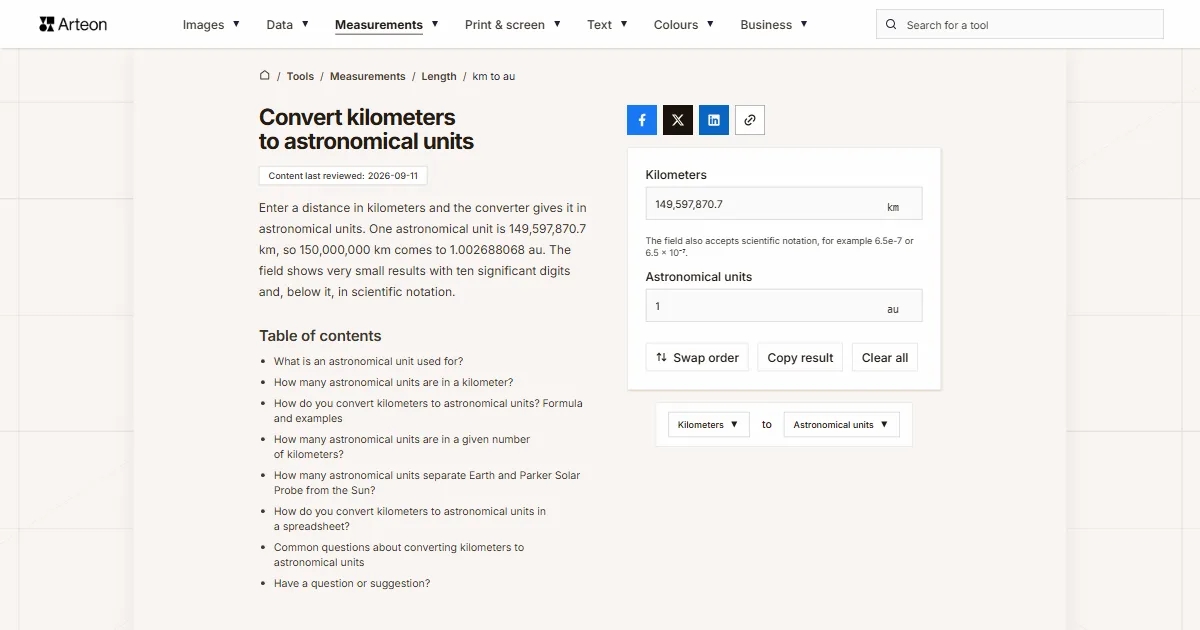
Enter a distance in kilometers and the converter gives it in astronomical units. One astronomical unit is 149,597,870.7 km, so 150,000,000 km comes to 1.002688068 au. The field shows very small results with ten significant digits and, below it, in scientific notation.
The field also accepts scientific notation, for example 6.5e-7 or 6.5 × 10⁻⁷.
What is an astronomical unit used for?
Distances in the Solar System are measured in hundreds of millions and billions of kilometers. In astronomical units the same distances become short numbers that are easy to compare. Between stars, distances are given in parsecs and light-years, because the astronomical unit is too small for them[1].
In 2012 the International Astronomical Union defined the astronomical unit as a conventional length of exactly 149,597,870,700 meters. The resolution also gives the reason: astronomy needs a unit of length that approximates the Sun–Earth distance[2].
The unit is useful in computing as well. In a numerical model of the Solar System it provides a scale that keeps floating-point errors small, including errors from numbers that are too large or too small for the format, or cut short[1].
How many astronomical units are in a kilometer?
One kilometer is 0.000000006684587122 astronomical units. The result is so small because one astronomical unit is 149,597,870.7 kilometers.
With larger distances the results are easier to read. One million kilometers is 0.006684587122 au. One billion kilometers is 6.684587122 au. The rounded figure of 150 million kilometers[3] comes to 1.002688068 au.
Two thresholds follow from these numbers. A distance below one million kilometers gives a result with at least two zeros after the decimal point. A distance above 150 billion kilometers gives more than one thousand astronomical units.
In scientific notation one kilometer is 6.684587122 × 10⁻⁹ au. The negative exponent means the decimal point moves nine places to the left.
The converter above calculates as you type and also accepts scientific notation such as 1.5e8. For results below 0.01 au, the same result also appears in scientific notation under the result field, which saves counting zeros for small distances.
How do you convert kilometers to astronomical units? Formula and examples
To convert kilometers to astronomical units, divide by 149,597,870.7. That is the number of kilometers in one astronomical unit under the 2012 definition.
The formula: astronomical units = kilometers ÷ 149,597,870.7. The other way, multiply: kilometers = astronomical units × 149,597,870.7.
Two examples show different orders of magnitude. The average distance between Earth and the Moon is approximately 385,000 km[4]. Divided by the constant, that gives 0.002573566042 au. A distance of 4.5 billion kilometers comes to 30.08064205 au.
You can convert a result in astronomical units back into kilometers with the au to km converter, and kilometers into miles with the km to miles converter.
How many astronomical units are in a given number of kilometers?
| Kilometers | Astronomical units | Scientific notation |
|---|---|---|
| 1 km | 0.000000006684587122 au | 6.684587122 × 10⁻⁹ au |
| 10 km | 0.00000006684587122 au | 6.684587122 × 10⁻⁸ au |
| 100 km | 0.0000006684587122 au | 6.684587122 × 10⁻⁷ au |
| 1,000 km | 0.000006684587122 au | 6.684587122 × 10⁻⁶ au |
| 10,000 km | 0.00006684587122 au | 6.684587122 × 10⁻⁵ au |
| 100,000 km | 0.0006684587122 au | 6.684587122 × 10⁻⁴ au |
| 384,399 km | 0.002569548605 au | 2.569548605 × 10⁻³ au |
| 1,000,000 km | 0.006684587122 au | 6.684587122 × 10⁻³ au |
| 10,000,000 km | 0.06684587122 au | 6.684587122 × 10⁻² au |
| 50,000,000 km | 0.3342293561 au | 3.342293561 × 10⁻¹ au |
| 57,910,000 km | 0.3871044403 au | 3.871044403 × 10⁻¹ au |
| 70,000,000 km | 0.4679210986 au | 4.679210986 × 10⁻¹ au |
| 100,000,000 km | 0.6684587122 au | 6.684587122 × 10⁻¹ au |
| 122,000,000 km | 0.8155196289 au | 8.155196289 × 10⁻¹ au |
| 149,597,870.7 km | 1 au | 1 × 10⁰ au |
| 150,000,000 km | 1.002688068 au | 1.002688068 × 10⁰ au |
| 200,000,000 km | 1.336917424 au | 1.336917424 × 10⁰ au |
| 300,000,000 km | 2.005376137 au | 2.005376137 × 10⁰ au |
| 421,000,000 km | 2.814211178 au | 2.814211178 × 10⁰ au |
| 500,000,000 km | 3.342293561 au | 3.342293561 × 10⁰ au |
| 778,000,000 km | 5.200608781 au | 5.200608781 × 10⁰ au |
| 1,000,000,000 km | 6.684587122 au | 6.684587122 × 10⁰ au |
| 1,400,000,000 km | 9.358421971 au | 9.358421971 × 10⁰ au |
| 1,500,000,000 km | 10.02688068 au | 1.002688068 × 10¹ au |
| 3,000,000,000 km | 20.05376137 au | 2.005376137 × 10¹ au |
| 4,500,000,000 km | 30.08064205 au | 3.008064205 × 10¹ au |
| 5,000,000,000 km | 33.42293561 au | 3.342293561 × 10¹ au |
| 5,900,000,000 km | 39.43906402 au | 3.943906402 × 10¹ au |
| 6,000,000,000 km | 40.10752273 au | 4.010752273 × 10¹ au |
| 10,000,000,000 km | 66.84587122 au | 6.684587122 × 10¹ au |
| 100,000,000,000 km | 668.4587122 au | 6.684587122 × 10² au |
| 1,000,000,000,000 km | 6,684.587122 au | 6.684587122 × 10³ au |
How many astronomical units separate Earth and Parker Solar Probe from the Sun?
| Distance | Kilometers | Astronomical units |
|---|---|---|
| Earth at perihelion | 147,098,074 km | 0.9832898912 au |
| Earth at aphelion | 152,097,701 km | 1.0167103335 au |
| Parker Solar Probe on December 24, 2024, from the Sun's surface | about 6,100,000 km | about 0.041 au |
How do you convert kilometers to astronomical units in a spreadsheet?
A spreadsheet helps when you have a whole column of distances, for example from an orbit table or mission data.
Excel: divide by the constant
The CONVERT function lists light-years and parsecs among its distance units[6]. To get astronomical units, divide: with a distance in cell A1, type =A1/149597870.7.Distances in millions of kilometers
If your data is in millions of kilometers, divide by 149.5978707. For the value 778 in cell A1, the formula =A1/149.5978707 returns about 5.2006 au.Small results in scientific format
The result for a single kilometer has eight zeros after the decimal point before the first non-zero digit. Select the cells, go to Home, in the Number group click the small More button next to Number, and in the Category list click Scientific. Excel then shows 6.68E-09[7].
Convert Kilometers to other units
Sources
- Astronomical unit — Wikipedia
- Resolution B2 on the re-definition of the astronomical unit of length — International Astronomical Union
- Light-year — Wikipedia
- Lunar distance — Wikipedia
- Parker Solar Probe Makes History With Closest Pass to the Sun — Johns Hopkins University Applied Physics Laboratory
- CONVERT function — Microsoft
- Display numbers in scientific (exponential) notation — Microsoft
- Parsec — Wikipedia
Every figure in the tables was computed from the unit definitions and checked arithmetically before publication. Historical values and the names of local units come from the sources listed above.
Content last reviewed: · written and checked by the Arteon team
Common questions about converting kilometers to astronomical units
How many astronomical units are in a light-year?
A light-year is about 63,241.077 au. That result comes from dividing 9,460,730,472,580.8 km, the distance light travels in a Julian year[3], by 149,597,870.7 km.
How many astronomical units are in a parsec?
A parsec is 648,000/π astronomical units, about 206,264.806 au. A 2015 resolution of the International Astronomical Union refers to this definition of the parsec[8].
How do I enter a distance given in millions of kilometers?
Type the full number of kilometers, for example 778000000, or the scientific notation 7.78e8. Both give the same result: 5.200608781 au.
How does the converter show very small results?
It gives them with at least ten significant digits. One hundred kilometers appear in the result field as 0.0000006684587122 au and in the Scientific notation line below as 6.68459 × 10⁻⁷ au.
Are au, AU and ua the same unit?
Yes. The International Astronomical Union recommends au, AU is common in astronomical literature, and ua comes from the French unité astronomique, the symbol the International Bureau of Weights and Measures recommended in 2006[1]. Each of them means 149,597,870.7 km.
Have a question or suggestion?
If you spotted an error in the tables or have an idea to improve the converter, write to us — we reply within 24 hours.