Convert kilometers to light-years
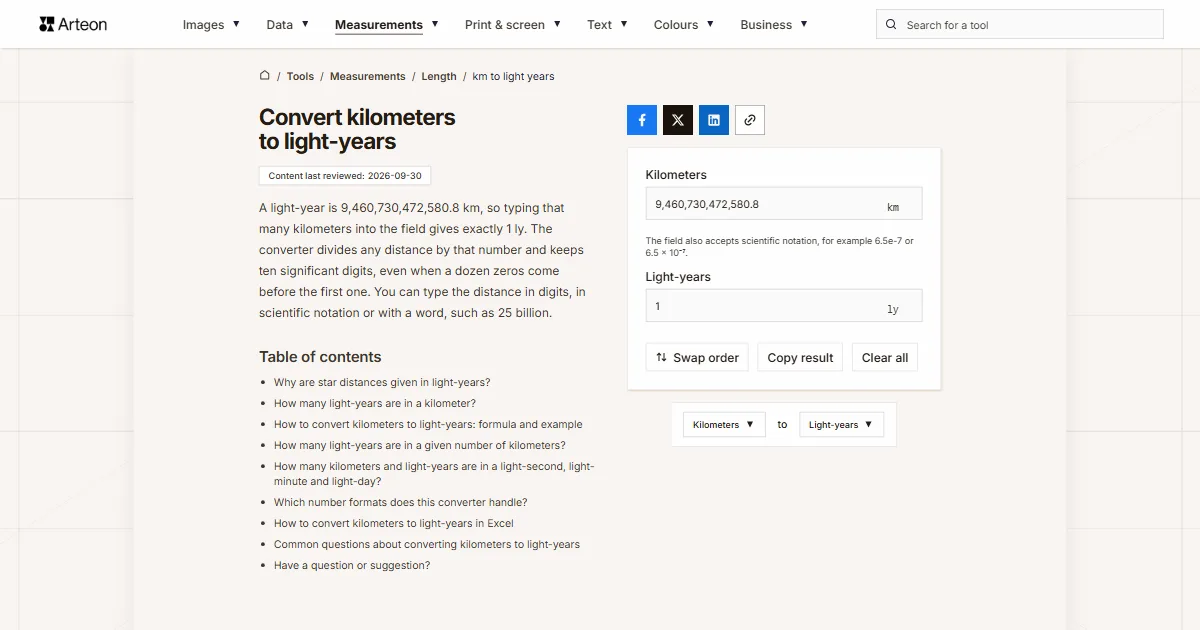
A light-year is 9,460,730,472,580.8 km, so typing that many kilometers into the field gives exactly 1 ly. The converter divides any distance by that number and keeps ten significant digits, even when a dozen zeros come before the first one. You can type the distance in digits, in scientific notation or with a word, such as 25 billion.
The field also accepts scientific notation, for example 6.5e-7 or 6.5 × 10⁻⁷.
Why are star distances given in light-years?
Kilometers work well on Earth, but star distances in kilometers run into trillions and quadrillions, and strings of digits that long are hard to read. The light-year turns them into numbers you can remember.
A light-year is the distance light travels in a vacuum in one Julian year of 365.25 days[1]. The name also tells you how long a star's light has been on its way. A star 100 light-years away looks the way it looked 100 years ago.
Smaller units are built the same way: the light-second, light-minute, light-hour and light-day. They tell you straight away how long a signal from Earth takes: a command sent to a spacecraft one light-day away arrives 24 hours later[2]. To go from light-years back to kilometers, use the light years to km converter.
How many light-years are in a kilometer?
One kilometer is 0.0000000000001057000834 of a light-year, or 1.057000834 × 10⁻¹³ ly. The minus sign in the exponent tells you to move the decimal point to the left: twelve zeros stand after the point before the digit 1.
The converter shows results like this with ten significant digits, counted from the first digit that is not zero. That way a million kilometers does not collapse to zero but gives 0.0000001057000834 ly. Under the result field the same value appears in the Scientific notation line, rounded to six digits.
How to convert kilometers to light-years: formula and example
Divide the distance in kilometers by the length of a light-year: light-years = kilometers ÷ 9,460,730,472,580.8. To go the other way, multiply: kilometers = light-years × 9,460,730,472,580.8. The constant comes from the speed of light, exactly 299,792,458 m/s[3], multiplied by the seconds in a Julian year.
On November 18, 2026, NASA's Voyager 1 is due to be 25,902,068,356 km, or 16,094,799,096 miles, from Earth, the distance light covers in 24 hours[2]. Dividing gives 0.002737850786 ly. The most distant object people have built has not covered even three thousandths of a light-year.
You can paste a figure from a news story the way it was written. The field reads 25.9 billion as 25,900,000,000 km and 9.46 trillion as 9,460,000,000,000 km.
How many light-years are in a given number of kilometers?
| Kilometers | Light-years | Scientific notation |
|---|---|---|
| 1 km | 0.0000000000001057000834 ly | 1.057000834 × 10⁻¹³ ly |
| 100 km | 0.00000000001057000834 ly | 1.057000834 × 10⁻¹¹ ly |
| 1,000 km | 0.0000000001057000834 ly | 1.057000834 × 10⁻¹⁰ ly |
| 10,000 km | 0.000000001057000834 ly | 1.057000834 × 10⁻⁹ ly |
| 100,000 km | 0.00000001057000834 ly | 1.057000834 × 10⁻⁸ ly |
| 1,000,000 km | 0.0000001057000834 ly | 1.057000834 × 10⁻⁷ ly |
| 10,000,000 km | 0.000001057000834 ly | 1.057000834 × 10⁻⁶ ly |
| 150,000,000 km | 0.00001585501251 ly | 1.585501251 × 10⁻⁵ ly |
| 1,000,000,000 km | 0.0001057000834 ly | 1.057000834 × 10⁻⁴ ly |
| 10,000,000,000 km | 0.001057000834 ly | 1.057000834 × 10⁻³ ly |
| 25,000,000,000 km | 0.002642502085 ly | 2.642502085 × 10⁻³ ly |
| 100,000,000,000 km | 0.01057000834 ly | 1.057000834 × 10⁻² ly |
| 1,000,000,000,000 km | 0.1057000834 ly | 1.057000834 × 10⁻¹ ly |
| 9,460,730,472,580.8 km | 1 ly | 1 × 10⁰ ly |
| 10,000,000,000,000 km | 1.057000834 ly | 1.057000834 × 10⁰ ly |
| 40,000,000,000,000 km | 4.228003336 ly | 4.228003336 × 10⁰ ly |
| 100,000,000,000,000 km | 10.57000834 ly | 1.057000834 × 10¹ ly |
| 1,000,000,000,000,000 km | 105.7000834 ly | 1.057000834 × 10² ly |
| 1,000,000,000,000,000,000 km | 105,700.0834 ly | 1.057000834 × 10⁵ ly |
| 100,000,000,000,000,000,000 km | 10,570,008.34 ly | 1.057000834 × 10⁷ ly |
How many kilometers and light-years are in a light-second, light-minute and light-day?
| Unit | Kilometers | Light-years | Scientific notation |
|---|---|---|---|
| Light-second | 299,792.458 km | 0.00000003168808781 ly | 3.168808781 × 10⁻⁸ ly |
| Light-minute | 17,987,547.48 km | 0.000001901285269 ly | 1.901285269 × 10⁻⁶ ly |
| Light-hour | 1,079,252,848.8 km | 0.0001140771161 ly | 1.140771161 × 10⁻⁴ ly |
| Light-day | 25,902,068,371.2 km | 0.002737850787 ly | 2.737850787 × 10⁻³ ly |
| Light-year | 9,460,730,472,580.8 km | 1 ly | 1 × 10⁰ ly |
Which number formats does this converter handle?
| What you type | What the converter shows | How we read it |
|---|---|---|
| 384,400 | 0.00000004063111206 ly | A comma followed by three digits is a thousands separator, so the field converts three hundred eighty-four thousand four hundred kilometers. A note under the field shows the other possible reading, 384.4. |
| 384 400 | 0.00000004063111206 ly | A space between the thousands, as printed in many European documents, is skipped over as well. |
| 0.5 | 0.0000000000000528500417 ly | The decimal point is read exactly as English writes it, so this is half a kilometer. |
| 150 million | 0.00001585501251 ly | The word million multiplies the number by a million, so the field converts one hundred fifty million kilometers. |
| 25 billion | 0.002642502085 ly | The word billion multiplies the number by a thousand million, the way news reports give the distance of space probes. |
| 9.46 trillion | 0.999922789 ly | A trillion is a million million, so the result comes out very close to one light-year. |
| 4e13 | 4.228003336 ly | Scientific notation from a calculator or spreadsheet is read as it stands: 4e13 is 40 trillion kilometers. |
| 4 × 10¹³ | 4.228003336 ly | Standard form from a textbook, with a multiplication sign and a superscript exponent, works the same as 4e13. |
| 1/2 | 0.0000000000000528500417 ly | We work out a slash fraction ourselves, so half a kilometer needs no conversion to 0.5 first. |
| 2½ | 0.0000000000002642502085 ly | The ½ character copied from a document is added to the number in front of it. |
| 150,000,000 km | 0.00001585501251 ly | A unit symbol pasted along with the number is left out and only the number is converted. |
How to convert kilometers to light-years in Excel
A column of distances in kilometers takes one formula, and the Scientific format shortens results with long runs of zeros.
The CONVERT function in reverse
Excel knows the light-year as "ly" and kilometers as "km"[5]. For a distance in cell A1, type =CONVERT(A1,"km","ly") or divide by the constant with =A1/9460730472580.8.Scientific format for small results
To give every result in the column the same exponent form, select the cells and apply the Scientific format from the Number group on the Home tab[6]. One kilometer then shows as 1.06E-13, where E-13 means divided by 10¹³.
Convert Kilometers to other units
Sources
- Measuring the Universe: The IAU and astronomical units — International Astronomical Union
- Voyager 1: What Is a Light-Day? — NASA
- The International System of Units (SI Brochure) — BIPM
- Light-year — Wikipedia
- CONVERT function — Microsoft
- Display numbers in scientific (exponential) notation — Microsoft
- Resolution B2 on the re-definition of the astronomical unit of length — International Astronomical Union
Every figure in the tables was computed from the unit definitions and checked arithmetically before publication. Historical values and the names of local units come from the sources listed above.
Content last reviewed: · written and checked by the Arteon team
Common questions about converting kilometers to light-years
How many light-years away is the Sun?
About 0.0000158 of a light-year. The astronomical unit, roughly the average distance between the Earth and the Sun, is exactly 149,597,870.7 km[7], which divides out to 0.00001581250741 ly. Light takes about 499 seconds, or 8.32 minutes, to cover it[4]. The km to au converter handles distances inside the Solar System.
How many kilometers away is the nearest star?
Proxima Centauri, the nearest known star after the Sun, is about 4.24 light-years away[4]. That is roughly 40.1 trillion kilometers, and the converter going the other way gives the exact figure for any number of light-years.
Is a light-year longer in a leap year?
No. The light-year is worked out from the Julian year, which always has 365.25 days[1]. That extra quarter of a day stands for one leap day every four years, so the length of a light-year does not depend on the calendar.
Have a question or suggestion?
If a distance you need is missing from the tables or you spot a mistake in a result, write to us.