Convert deciliters to liters
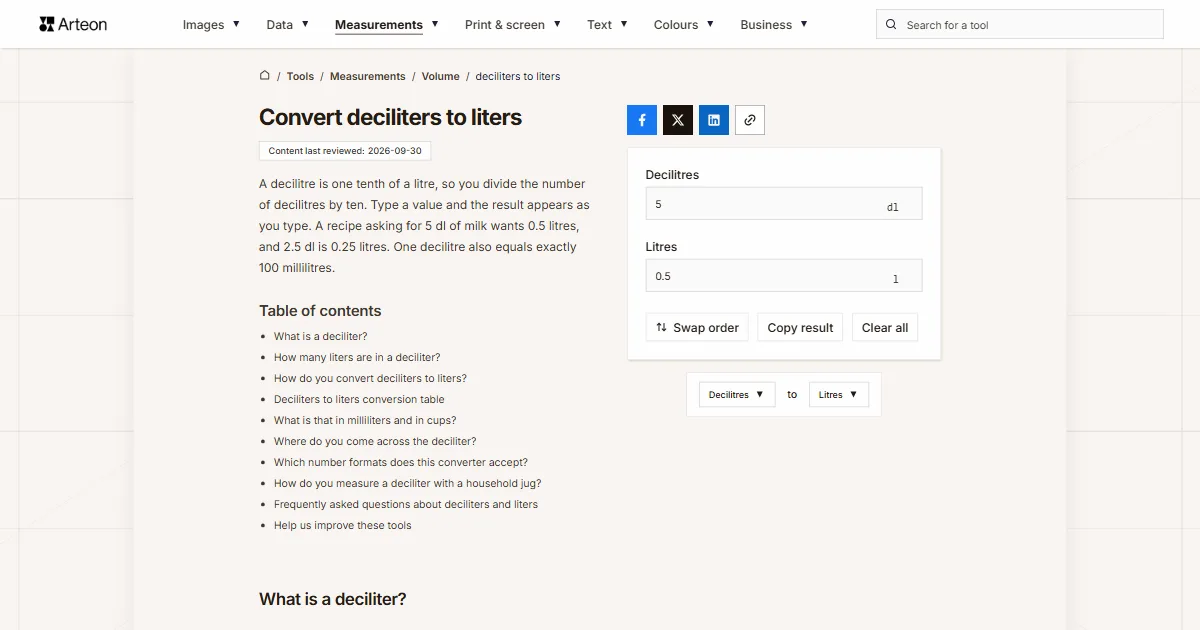
A decilitre is one tenth of a litre, so you divide the number of decilitres by ten. Type a value and the result appears as you type. A recipe asking for 5 dl of milk wants 0.5 litres, and 2.5 dl is 0.25 litres. One decilitre also equals exactly 100 millilitres.
What is a deciliter?
A decilitre is a unit of volume equal to 100 millilitres. Deci stands for one tenth, and its symbol is the letter d.[1] Placed in front of the litre symbol it gives the unit written dl.
The litre itself is one cubic decimetre, the volume of a cube ten centimetres on each side.[2] Split into ten equal parts, it gives decilitres.
In Croatia, Switzerland and Scandinavia the decilitre is a common unit, often found in cookbooks and on restaurant and café menus.[3]
How many liters are in a deciliter?
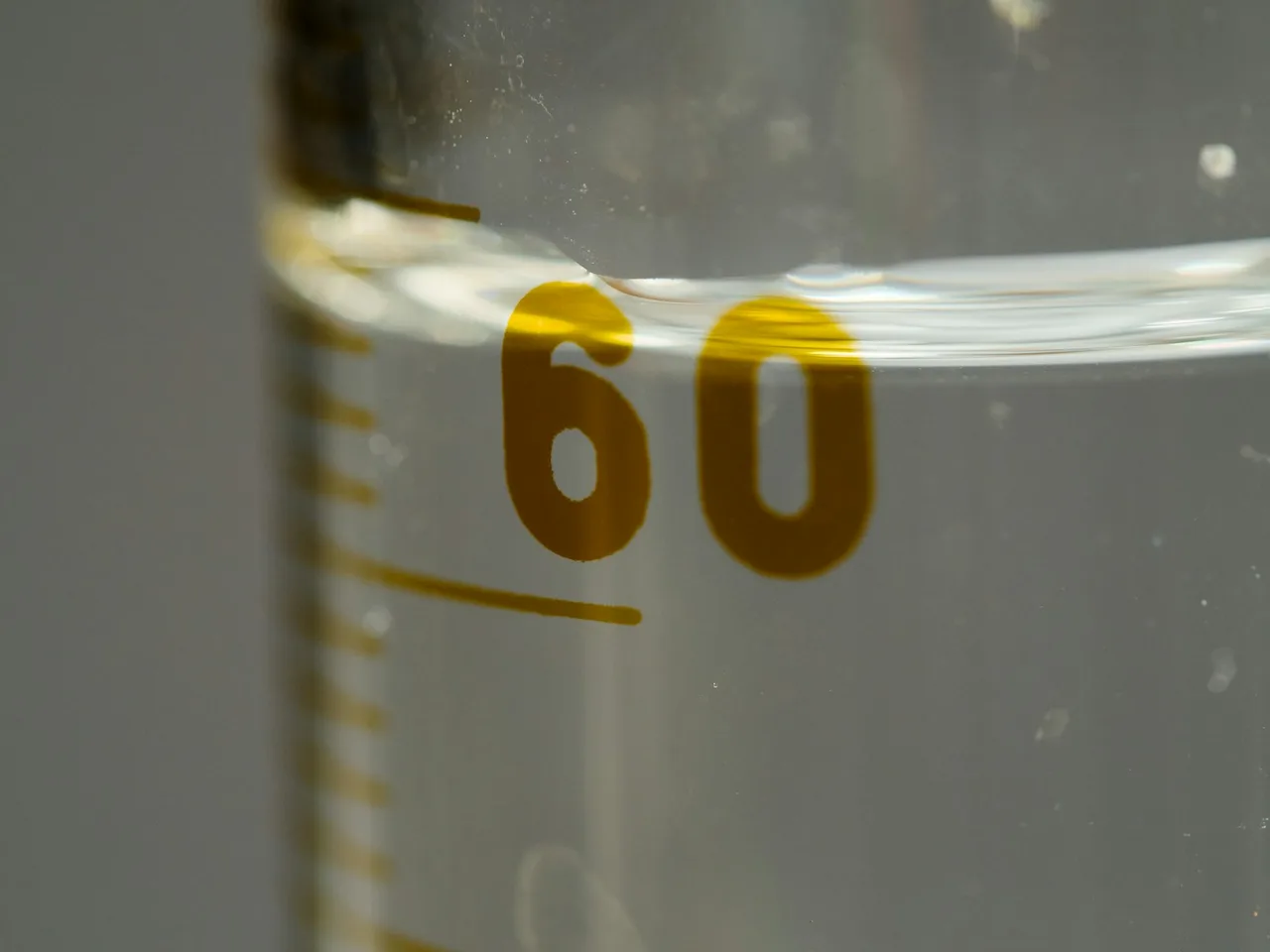
One decilitre is 0.1 litres. Ten decilitres make a full litre, so the conversion comes down to dividing by ten.
A recipe asking for 5 decilitres of milk wants 0.5 litres, the contents of a small bottle. An amount of 2.5 decilitres is 0.25 litres, which is one small glass. And 10 decilitres gives exactly 1 litre, the size of a milk carton.
Millilitres are the other natural conversion. A decilitre is 100 millilitres, so 3 decilitres is 300 millilitres and 7.5 decilitres is 750 millilitres, the capacity of a wine bottle.
The ratio is fixed and does not depend on the country, because both units belong to the same system of measurement. A decilitre in a Swiss recipe and a decilitre in a Swedish one describe the same volume, so you convert a foreign recipe exactly as you would a local one.
How do you convert deciliters to liters?
The formula has one step: liters = deciliters ÷ 10. Dividing by ten moves the decimal point one place to the left, so 15 decilitres is 1.5 litres and 3 decilitres is 0.3 litres.
For a single figure, moving the decimal point in your head is enough. For a recipe where decilitres show up in several ingredients at once, the field above is faster, because it answers as soon as you type.
The other direction is handled by the liters to deciliters converter, and millilitres by the deciliters to ml converter.
Deciliters to liters conversion table
| Deciliters | Liters | Milliliters |
|---|---|---|
| 0.5 dl | 0.05 l | 50 ml |
| 1 dl | 0.1 l | 100 ml |
| 1.5 dl | 0.15 l | 150 ml |
| 2 dl | 0.2 l | 200 ml |
| 2.5 dl | 0.25 l | 250 ml |
| 3 dl | 0.3 l | 300 ml |
| 3.5 dl | 0.35 l | 350 ml |
| 4 dl | 0.4 l | 400 ml |
| 5 dl | 0.5 l | 500 ml |
| 6 dl | 0.6 l | 600 ml |
| 7 dl | 0.7 l | 700 ml |
| 7.5 dl | 0.75 l | 750 ml |
| 8 dl | 0.8 l | 800 ml |
| 9 dl | 0.9 l | 900 ml |
| 10 dl | 1 l | 1,000 ml |
| 12 dl | 1.2 l | 1,200 ml |
| 15 dl | 1.5 l | 1,500 ml |
| 20 dl | 2 l | 2,000 ml |
| 25 dl | 2.5 l | 2,500 ml |
| 30 dl | 3 l | 3,000 ml |
| 50 dl | 5 l | 5,000 ml |
| 75 dl | 7.5 l | 7,500 ml |
| 100 dl | 10 l | 10,000 ml |
| 250 dl | 25 l | 25,000 ml |
What is that in milliliters and in cups?
| Recipe amount | Milliliters | US cups of 236.6 ml |
|---|---|---|
| 0.5 dl | 50 ml | 0.21 cup |
| 1 dl | 100 ml | 0.42 cup |
| 1.5 dl | 150 ml | 0.63 cup |
| 2 dl | 200 ml | 0.85 cup |
| 2.5 dl | 250 ml | 1.06 cups |
| 3 dl | 300 ml | 1.27 cups |
| 4 dl | 400 ml | 1.69 cups |
| 5 dl | 500 ml | 2.11 cups |
Where do you come across the deciliter?
| Unit | In liters | Where you meet it |
|---|---|---|
| Milliliter (ml) | 0.001 l | Medicine doses, cosmetics capacities, syringe graduations |
| Centiliter (cl) | 0.01 l | Drink labels that state capacity in centilitres |
| Deciliter (dl) | 0.1 l | Cookbooks and café menus in Croatia, Switzerland and Scandinavia |
| Liter (l) | 1 l | Bottles, cartons, fuel tanks, water usage |
| Hectoliter (hl) | 100 l | Beer and wine production, farm statistics, industrial tanks |
Which number formats does this converter accept?
| What you type | What the converter shows | How we read it |
|---|---|---|
| 5 | 0.5 l | A number on its own is read as decilitres, because that is the unit on the field. |
| 5dl | 0.5 l | The dl symbol pasted with the number, with or without a space, is skipped, and so is the word decilitres. |
| 2.5 | 0.25 l | The decimal point separates the fraction, exactly as you would expect. |
| 2,5 | 0.25 l | A comma followed by one or two digits can only be a decimal comma, so the result is the same. |
| 1,500 | 150 l | A comma before three digits groups thousands in English, so this is fifteen hundred decilitres. A note under the field shows the other possible reading, 1.5. |
| 1.500 | 0.15 l | A single point is always read as a decimal point, so the field counts one and a half decilitres. A note under the field shows the other possible reading, 1500. |
| 1 500 | 150 l | A space between the thousands, as written in much of Europe and in SI style, gives the same result as 1,500. |
| 3/4 | 0.075 l | We work out a fraction with a slash for you, so three quarters of a decilitre needs no conversion to 0.75 first. |
| 1 1/2 | 0.15 l | A mixed number is read as one and a half decilitres. |
| 2½ | 0.25 l | A ½ sign copied from a label or a recipe is added to the number in front of it. |
| 250 ml | 0.25 l | Millilitres from a jug are converted to decilitres: the field enters 2.5 and says so in a line under it. |
How do you measure a deciliter with a household jug?
A jug graduated in millilitres measures decilitres just as accurately. These four methods show how.
Count the marks every 100 millilitres
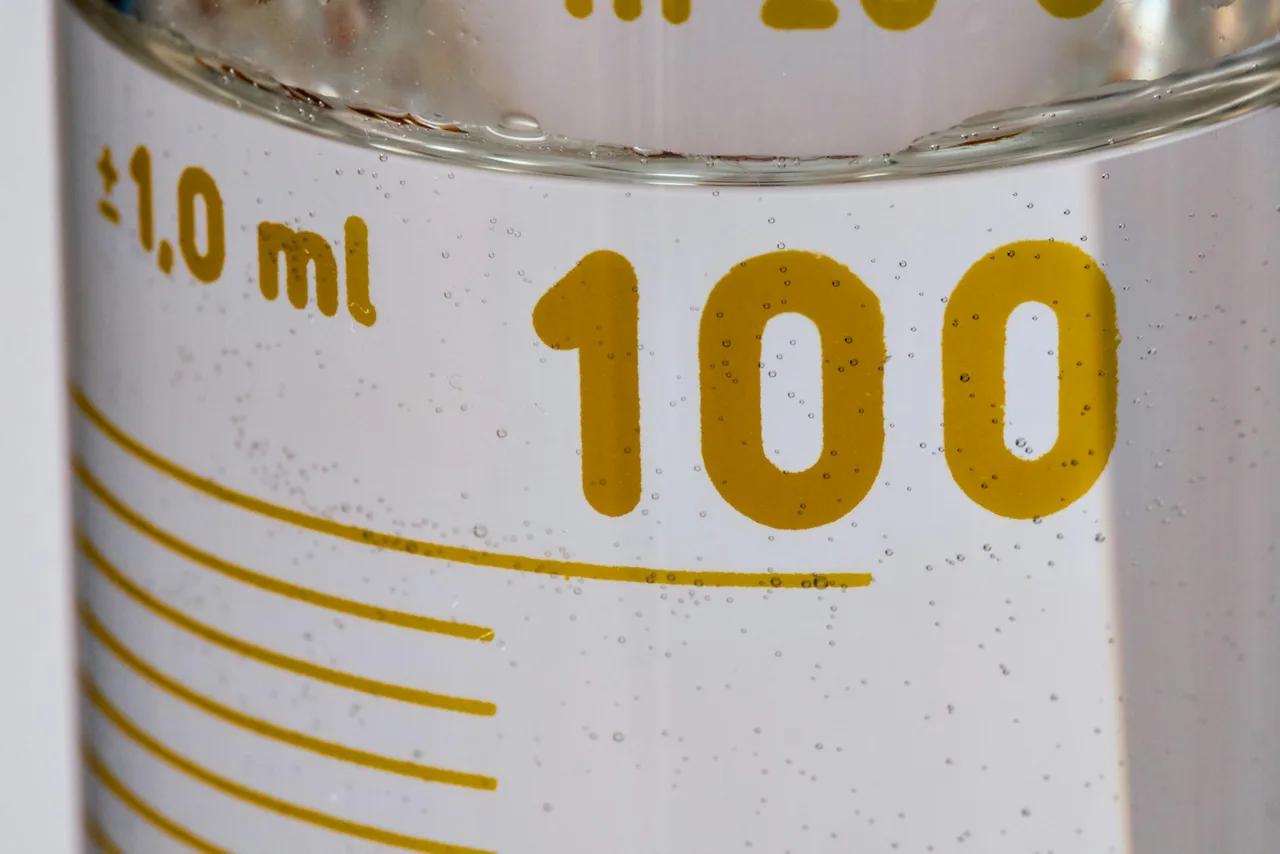
Each 100 millilitres on the scale is one full decilitre. The 300 ml mark measures 3 decilitres and the 500 ml mark measures five. On jugs graduated every 50 millilitres, a full decilitre falls on every second line.Read from the bottom of the meniscus
Liquid in a narrow vessel curves at the surface, and the level is read from the bottom of that curve. Keep your eye level with the mark, because looking down or up at it shifts the reading.Measure with a US customary cup
A US customary cup holds 236.6 millilitres, which is about 2.37 decilitres, so two cups come to about 4.73 decilitres. Half a cup is about 1.18 decilitres. This works for liquids in a batter, where a few millilitres make no difference.Convert the whole list in a spreadsheet
For a recipe with several ingredients it is easier to convert everything at once. Type =A1/10 into the sheet, or use =CONVERT(A1,"dl","l") in Excel, since the documentation allows the prefix d in front of the litre symbol[5].
Convert other units to Litres
Convert Decilitres to other units
Sources
- Metric (SI) prefixes — National Institute of Standards and Technology
- NIST Special Publication 330, section 4 — non-SI units accepted for use with the SI — National Institute of Standards and Technology
- Litre — Wikipedia
- Pannkakor, grundsmet — a Swedish recipe measuring flour and milk in decilitres — ICA
- CONVERT function — Microsoft
Every figure in the tables was computed from the unit definitions and checked arithmetically before publication. Historical values and the names of local units come from the sources listed above.
Content last reviewed: · written and checked by the Arteon team
Frequently asked questions about deciliters and liters
Is dl the same as dL?
Yes. The litre carries two accepted symbols, the lower-case l and the capital L, so the decilitre appears as dl and as dL.[3] Both mean one tenth of a litre.
Is the deciliter part of the SI?
The litre is not an SI unit, but it is accepted for use with the SI and appears in the tables as one cubic decimetre.[2] The decilitre is built from it with the prefix deci, so it carries the same status.
Help us improve these tools
Have an idea for a feature, spotted a mistake or want to suggest another tool? Write to us.