See how long your text takes to read
An adult reads English silently at about 236 words per minute and aloud at about 190. Paste a text or enter just the word count, choose a pace, and you get the time in minutes, or in hours and minutes for a long text. Both speeds come from reading research.
Time
The reading time appears here once you paste text or enter a word count.
What is reading speed?
Reading speed is the number of words a person takes in per minute. It is written as wpm, short for words per minute.
The same person has several speeds, depending on what they do with the text. Silent reading is the fastest, because it skips the work of speaking. Reading aloud is slower, because every word has to be pronounced. Speed also depends on age, on whether the text is in the reader's first language, and on how difficult the text is.
One more thing matters for this calculator. A speed in words per minute differs between languages, because languages differ in word length and in how many words they need for the same content. Each language version of the calculator therefore uses speeds set for its own language.

How long does it take to read a text?
Reading time is the word count divided by the reading speed. A 1,000-word text read silently at 236 words per minute takes 5 minutes. Read aloud at 190 words per minute, the same text takes 6 minutes.
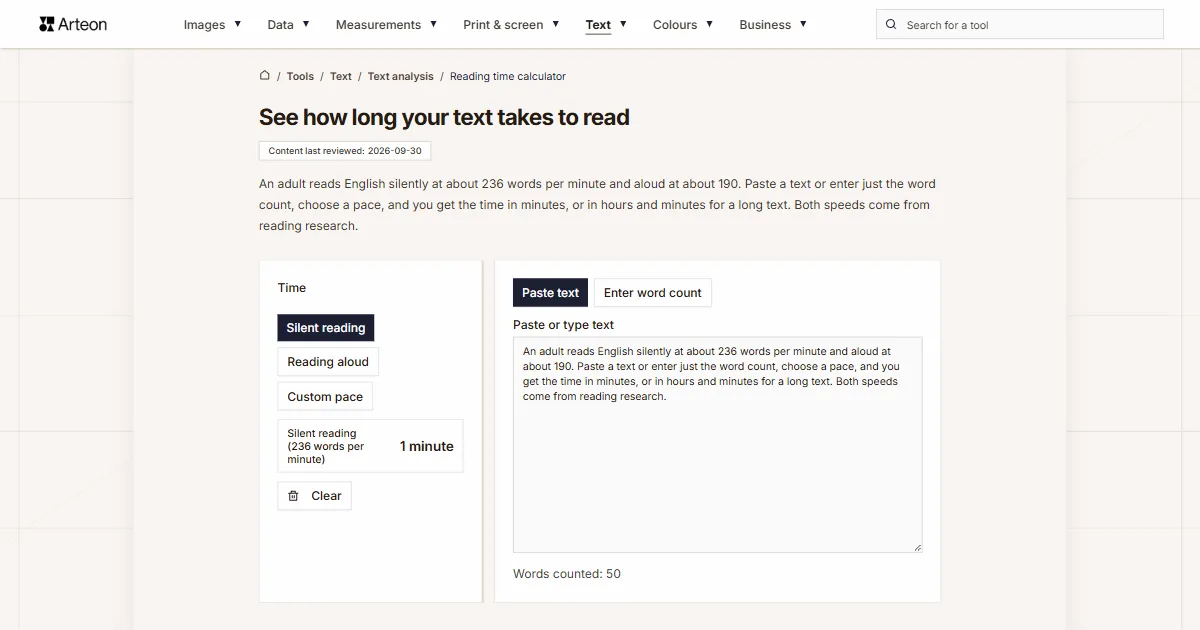
The calculator above does this for you. Paste your text into the Paste or type text field, and the tool counts the words and shows the number under the field. When you already know the length, switch with the Enter word count button and type just the number.
You choose the pace with one of three buttons: Silent reading, Reading aloud or Custom pace. Next to the first two, the panel shows the words per minute it is using, so you can see where the result comes from. The result is rounded up to whole minutes, and from one hour upwards it appears in hours and minutes.
Where do the English reading speeds come from?
Both speeds come from Marc Brysbaert's meta-analysis of reading rate, which brought together 190 studies with 18,573 participants[1]. For English it lists 236 words per minute for silent reading, based on 144 studies. Reading aloud comes to 190 words per minute, based on 27 studies. These are the two values in the calculator.
The abstract of the same paper gives two other figures: 238 words per minute for non-fiction and 260 for fiction. Fiction reads faster because its words are shorter on average. The value of 236 comes from the table the paper uses to compare languages, and the German, French, Spanish and Italian versions of this calculator take their speeds from the same table.
Reading aloud also has a measured norm from the IReST study. It tested 25 English readers aged 18 to 35, each reading ten short texts written at sixth-grade level, and recorded 228 words per minute[2]. The calculator keeps 190, the average across 27 English studies with 3,482 participants.
How long does a text of a given length take to read?
| Text length | Silent (236 wpm) | Aloud (190 wpm) |
|---|---|---|
| 100 words | 1 minute | 1 minute |
| 250 words | 2 minutes | 2 minutes |
| 500 words | 3 minutes | 3 minutes |
| 800 words | 4 minutes | 5 minutes |
| 1,000 words | 5 minutes | 6 minutes |
| 1,500 words | 7 minutes | 8 minutes |
| 2,000 words | 9 minutes | 11 minutes |
| 3,000 words | 13 minutes | 16 minutes |
| 5,000 words | 22 minutes | 27 minutes |
| 10,000 words | 43 minutes | 53 minutes |
| 50,000 words | 3 hours 32 minutes | 4 hours 24 minutes |
| 90,000 words | 6 hours 22 minutes | 7 hours 54 minutes |
How fast do people read in other languages?
| Language | Silent (wpm) | Aloud (wpm) | Words for 1,000 English words |
|---|---|---|---|
| Dutch | 228 | 171 | 1,005 |
| English | 236 | 190 | 1,000 |
| Finnish | 195 | 162 | 764 |
| French | 214 | 180 | 1,062 |
| German | 260 | 169 | 975 |
| Italian | 285 | 182 | 1,006 |
| Spanish | 278 | 191 | 1,025 |
| Swedish | 218 | 163 | 897 |
What text does this calculator accept, and how does it count it?
| What you type | What the calculator uses | How we count it |
|---|---|---|
| “1,000” or “1000” in Number of words | 1,000 words, 5 minutes silent | We drop the thousands separator, because a word count is always a whole number: “1,000” and “1000” mean the same to us |
| “2,500 words” in Number of words | 2,500 words, 11 minutes silent | We drop the word written after the number and keep the digits, so there is nothing to delete yourself |
| “250 wpm” in Custom pace | a pace of 250 words per minute | We drop the unit in the pace field in the same way as in the word count field |
| “Tom—who was late—arrived.” in the text field | 5 words | An em dash between two words separates them, so this counts as five |
| “Great job 🙂” in the text field | 2 words | We do not count an emoji as a word |
| “<img src="cover.jpg" alt="Cover"> <p>Hello world</p>” in the text field | 5 words | Tag names and attributes count as ordinary words, so paste the text as it appears on the page rather than its HTML |
How do you calculate reading time in three steps?
The calculation runs in your browser, so the text stays on your device.
1. Add the text or the word count
With pasted text, the tool counts the words and shows the number under the field. The Enter word count button switches to typing just the number.2. Choose a pace
Silent reading and Reading aloud use the speeds measured for English. Custom pace opens a field where you type your own words per minute.3. Read the time
The result appears in the Time panel in whole minutes, and from one hour upwards in hours and minutes. The Clear button empties all fields at once.
What pace should you type into the custom field?
The Custom pace field is useful when you know your own speed or when you prepare a recording or a talk. For speech, a common reference is the scale published by Tauroza and Allison in their study of speech rates in British English[3].
On that scale, speech below 100 words per minute sounds slower than normal, and 100 to 125 is moderately slow. The range from 125 to 160 is average, and 160 to 185 is moderately fast. Above 185 words per minute, listeners hear speech as faster than normal.
The reading-aloud speed of 190 words per minute sits just above that last threshold. It describes continuous reading of a text, so for a talk with pauses a custom pace from the average range fits better. Brysbaert also cites a study that considered 120 words per minute an acceptable pace for reading aloud over an eight-hour day[1], which is a useful figure for long narration. Count the words of your script in the word and character counter and read the time from the field above.
Why does Medium show a different reading time?
Medium calculates the read time of every story at roughly 265 words per minute, with an adjustment for images[4]. Only Chinese, Japanese and Korean are handled differently, at 500 characters per minute.
That pace is about 12 percent faster than the 236 words per minute in this calculator. A 2,000-word article takes 9 minutes here, and at Medium's pace it comes to about seven and a half. When you want to show readers a time based on the research average, calculate it here.
How fast can you read with full comprehension?
For silent reading of English non-fiction, most adults fall between 175 and 300 words per minute. For fiction the range is 200 to 320[1]. Brysbaert also cites a 2016 review by Rayner and colleagues, which explains why reading faster than 1,000 words per minute is impossible without a severe loss of understanding.
The meta-analysis also tested Carver's theory of five reading “gears”, from memorising a text at 138 words per minute to scanning at 650. It found no separate gears for learning for a multiple-choice test and for ordinary reading, which Carver set at 200 and 300. Once word length is taken into account, both kinds of reading came out at a similar pace between those two numbers. Only scanning clearly differs from reading, because the reader no longer tries to understand the text and only looks for a word in it[1].
Memorising a text does take longer. Brysbaert puts it at about 100 words per minute, and several studies found even less, but he attributes the slowdown to the reader organising the information and going back over the text, not to a different way of reading[1]. You can enter that pace, or any other, in the Custom pace field, and the calculator works out the time for it.
What else affects reading time?
The research figures describe adults reading easy prose in their first language. Brysbaert names three groups who read more slowly: children, older adults and people reading in a second language[1]. When your audience reads English as a second language, a lower custom pace gives a more realistic time.
The text itself matters too. A manual full of technical terms reads more slowly than a novel, because longer words and longer sentences take more work. To check the length and the average sentence length of a text before you publish it, use the word and character counter. The Flesch Reading Ease score rates the same text from 0 to 100, from very difficult to very easy, and the Gunning fog index answers the same question in years of schooling.
When you design a page before the final copy exists, create placeholder text with the number of words you plan in the Lorem Ipsum generator and check here what reading time such an article gets.
Sources
- How many words do we read per minute? A review and meta-analysis of reading rate — Journal of Memory and Language 109, 2019
- Standardized Assessment of Reading Performance: The New International Reading Speed Texts IReST — Investigative Ophthalmology & Visual Science 53(9), 2012
- Speech Rates in British English — Applied Linguistics 11(1), 1990
- Read time — Medium Help Center
The results in the tables were computed by this tool's own function and checked by an automated test before publication. The rules, standards and figures the text relies on come from the sources listed above.
Content last reviewed: · written and checked by the Arteon team
Frequently asked questions about reading time
How many words per minute does the average adult read?
In English, about 236 words per minute silently and 190 aloud, according to Brysbaert's meta-analysis of 190 studies. For non-fiction alone the paper gives 238 words per minute, and for fiction 260.
How long does it take to read 1,000 words?
5 minutes silently and 6 minutes aloud, at the English averages.
How long does it take to read a 90,000-word book?
Silently, 6 hours 22 minutes of uninterrupted reading. Read aloud, the same book takes 7 hours 54 minutes.
Why is reading aloud slower than silent reading?
Every word has to be pronounced, and speech has its own pace. In English, the research averages are 236 words per minute for silent reading and 190 for reading aloud.
Can I enter my own reading speed?
Yes. The Custom pace button opens a field where you type your own words per minute, and the calculator uses that speed.
Do I have to paste the whole text?
No. The Enter word count button switches the tool to typing just the number of words.
Is my text sent to a server?
The calculation runs in your browser, and the text stays on your device.
Help us improve our tools
Have an idea for a new feature, found a bug, or want to suggest another tool that would make your work easier? Write to us.
Explore other useful tools

Meta title & description checker
Check title and description length in pixels. Live Google preview and optimization tips.
PNG to JPG
Convert PNG files to JPG in your browser. No file limits, no signup, no server uploads.

Favicon generator
Create a complete favicon.ico set for your website from one image. All required sizes, no login.
Color palette generator
Generate 17 palettes from one color: monochromatic, complementary, triadic and more. HEX codes.
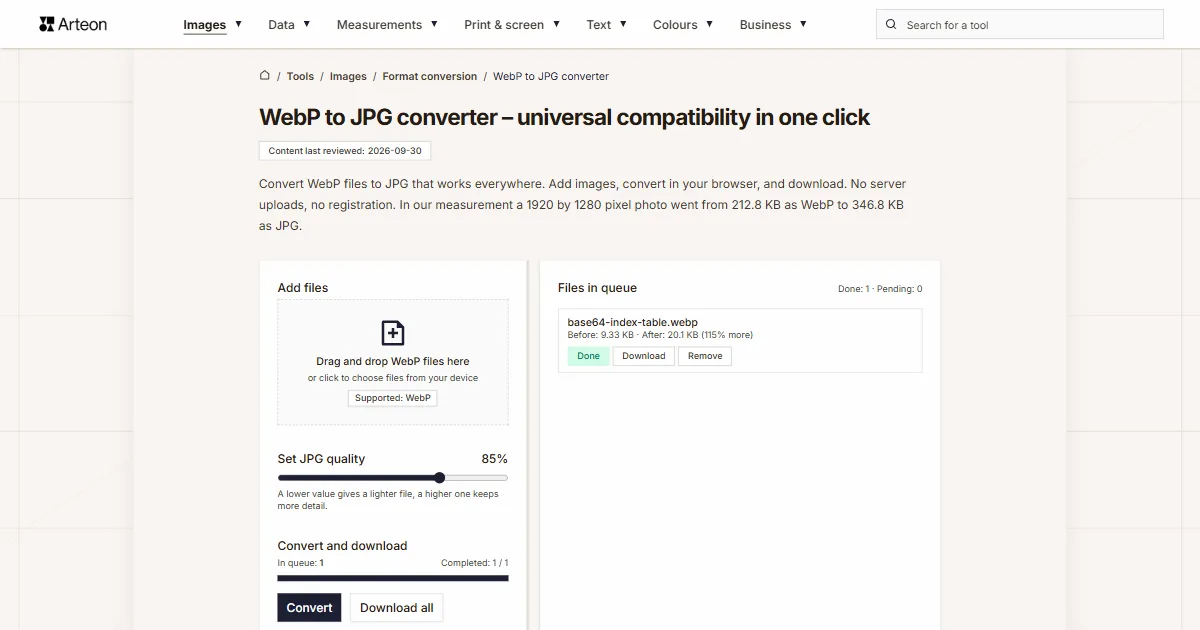
WebP to JPG
Convert WebP files to universally compatible JPG. Works in every app and platform.
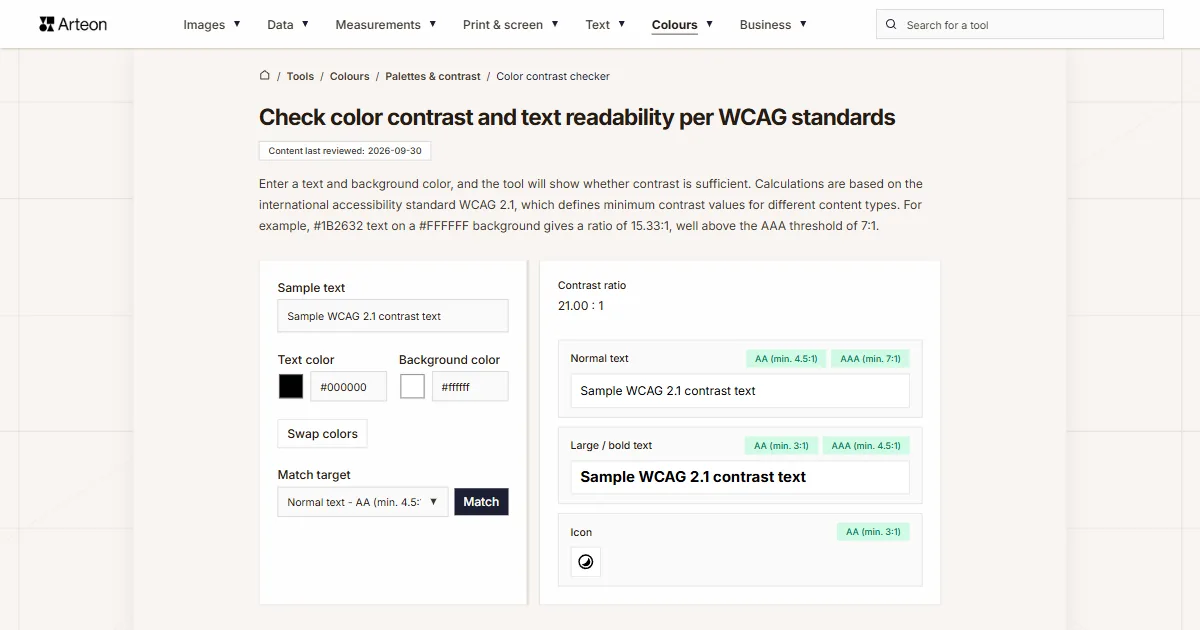
Color contrast checker
Check text and background contrast per WCAG 2.1 AA and AAA. Automatic color correction.
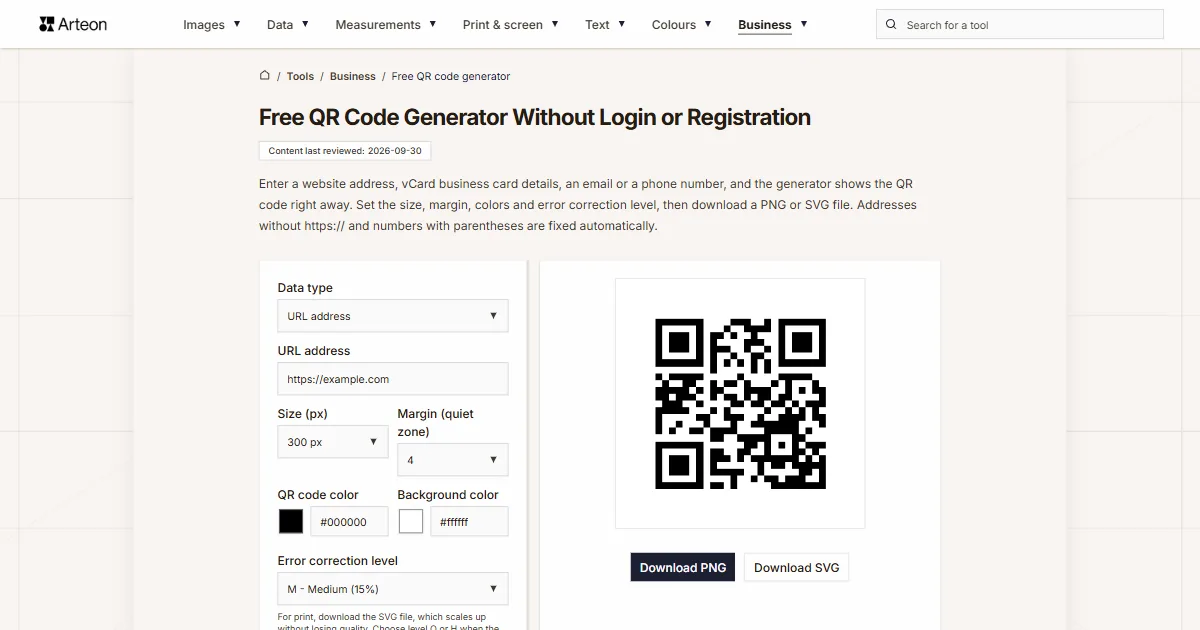
Free QR code generator
Create a QR code for a website, vCard business card or print. Export PNG and SVG, no registration.
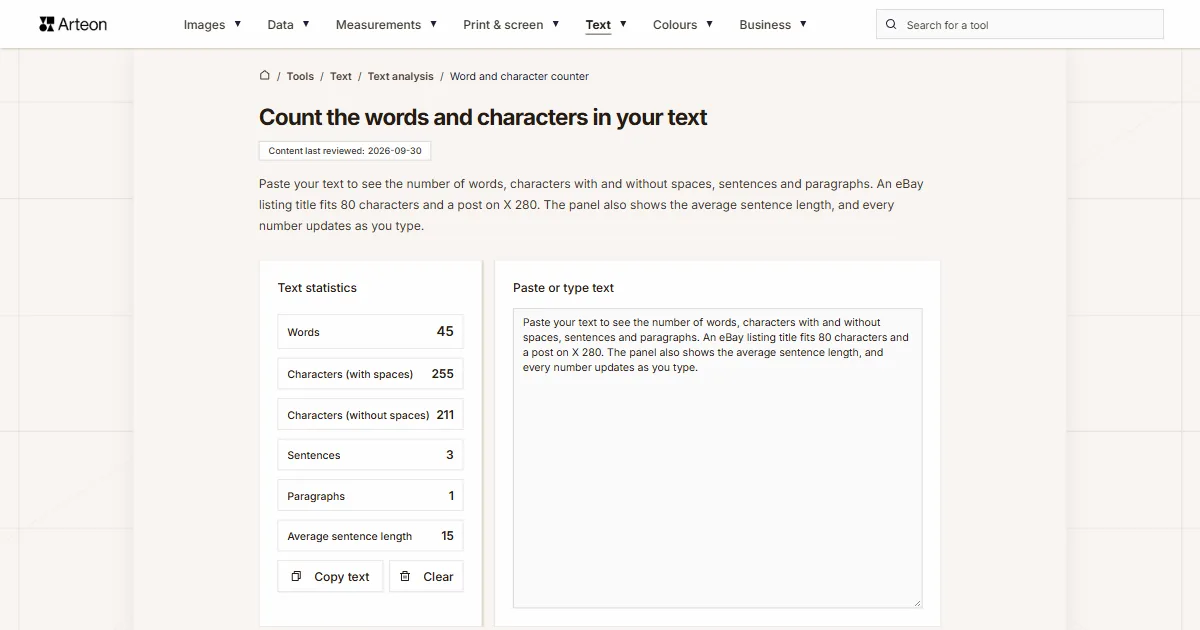
Word & character counter
Count words, characters with and without spaces, sentences, paragraphs and the average sentence length.
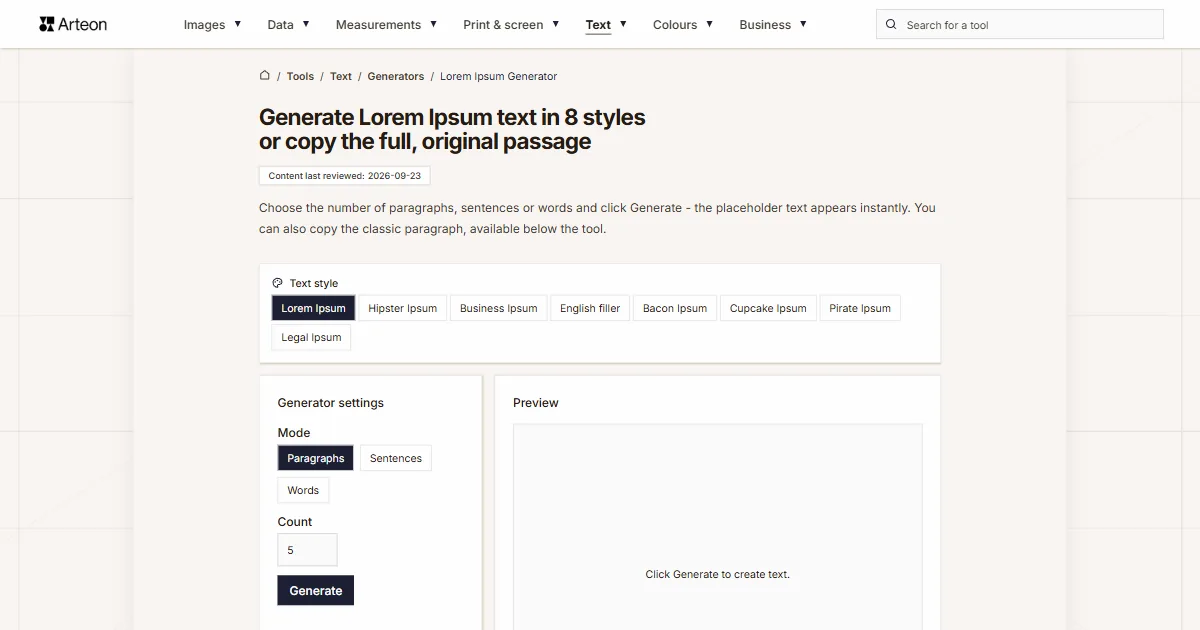
Lorem Ipsum Generator
Free Lorem Ipsum generator — 8 text styles, paragraphs, sentences or words. Copy in one click.