Convert miles to yards
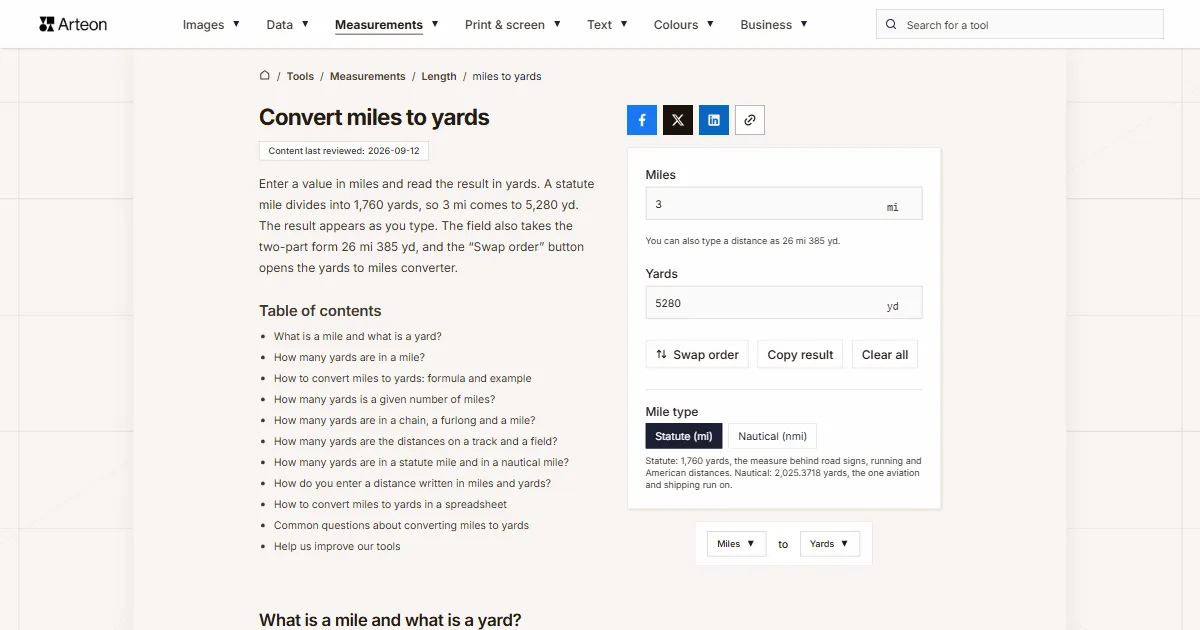
Enter a value in miles and read the result in yards. A statute mile divides into 1,760 yards, so 3 mi comes to 5,280 yd. The result appears as you type. The field also takes the two-part form 26 mi 385 yd, and the “Swap order” button opens the yards to miles converter.
You can also type a distance as 26 mi 385 yd.
What is a mile and what is a yard?
The mile and the yard belong to the same system of measures, the one the United States and the United Kingdom use every day. The mile describes a distance you travel: a road, a running route, a stretch of trail. The yard describes shorter lengths: a piece of a field, a length of fabric, the distance to the pin on a golf course.
A mile, written mi, is exactly 1,609.344 metres[1]. It is the same mile an American highway sign shows and the same one a running app reports once you set it to imperial units.
A yard, written yd, is exactly 0.9144 metres[2]. That makes it a little under nine centimetres shorter than a metre. Both values come from one agreement: on 1 July 1959 the English-speaking countries adopted a common yard of 0.9144 metres[3], and the mile took its present length as a multiple of it.
Every conversion on this page uses one number: 1,760. One mile is 1,760 yards[1].
The two countries use the yard in different places. In the United Kingdom road signs give shorter distances in yards and longer ones in miles[2]. In the United States the yard is the unit of the football field, of the swimming pool and of fabric sold by the bolt.
How many yards are in a mile?
One mile is 1,760 yards. Five miles come to 8,800 yards, and ten miles to 17,600 yards.
The sum is the same every time: you multiply the number of miles by 1,760. Two miles therefore give 3,520 yards, three miles give 5,280 yards, and four miles give 7,040 yards. That third value turns up on the feet side as well, because a mile holds 5,280 feet and three miles hold exactly that many yards.
The same number gives the fractions of a mile. A quarter of a mile is 440 yards, and that was once the length of a single lap of an American track. Half a mile is 880 yards. Three quarters of a mile is 1,320 yards.
A marathon measures 46,145 yards, and in two-part form that is 26 miles and 385 yards. The same figure put through the yards to kilometres converter comes to 42.194988 kilometres.
How to convert miles to yards: formula and example
Multiply the number of miles by 1,760 and you have the result in yards. Two miles come to 3,520 yards.
Formula: yards = miles × 1,760
Going the other way, the same multiplier becomes a divisor. Eight thousand eight hundred yards correspond to five miles, and the yards to miles converter does that sum for you.
The number 1,760 is fixed in law. Schedule 1 of the Weights and Measures Act 1985 gives the mile as 1,760 yards[4]. The same schedule sets the yard at 0.9144 metres, so both figures on this page come from a single document.
If you need the answer in metric units, go to the miles to meters converter. Lengths below a yard are handled by the yards to feet converter, and a driving distance by the miles to km converter.

How many yards is a given number of miles?
| Miles | Yards (yd) | Metres (m) |
|---|---|---|
| 0.05 miles | 88 yd | 80.47 m |
| 0.1 miles | 176 yd | 160.93 m |
| 0.125 miles | 220 yd | 201.17 m |
| 0.15 miles | 264 yd | 241.4 m |
| 0.2 miles | 352 yd | 321.87 m |
| 0.25 miles | 440 yd | 402.34 m |
| 0.3 miles | 528 yd | 482.8 m |
| 0.4 miles | 704 yd | 643.74 m |
| 0.5 miles | 880 yd | 804.67 m |
| 0.6 miles | 1,056 yd | 965.61 m |
| 0.7 miles | 1,232 yd | 1,126.54 m |
| 0.75 miles | 1,320 yd | 1,207.01 m |
| 0.8 miles | 1,408 yd | 1,287.48 m |
| 0.9 miles | 1,584 yd | 1,448.41 m |
| 1 mile | 1,760 yd | 1,609.34 m |
| 1.2 miles | 2,112 yd | 1,931.21 m |
| 1.5 miles | 2,640 yd | 2,414.02 m |
| 2 miles | 3,520 yd | 3,218.69 m |
| 2.4 miles | 4,224 yd | 3,862.43 m |
| 3 miles | 5,280 yd | 4,828.03 m |
| 3.5 miles | 6,160 yd | 5,632.7 m |
| 4 miles | 7,040 yd | 6,437.38 m |
| 5 miles | 8,800 yd | 8,046.72 m |
| 6 miles | 10,560 yd | 9,656.06 m |
| 7 miles | 12,320 yd | 11,265.41 m |
| 8 miles | 14,080 yd | 12,874.75 m |
| 9 miles | 15,840 yd | 14,484.1 m |
| 10 miles | 17,600 yd | 16,093.44 m |
| 11 miles | 19,360 yd | 17,702.78 m |
| 12 miles | 21,120 yd | 19,312.13 m |
| 13 miles | 22,880 yd | 20,921.47 m |
| 13.1 miles | 23,056 yd | 21,082.41 m |
| 14 miles | 24,640 yd | 22,530.82 m |
| 15 miles | 26,400 yd | 24,140.16 m |
| 16 miles | 28,160 yd | 25,749.5 m |
| 18 miles | 31,680 yd | 28,968.19 m |
| 20 miles | 35,200 yd | 32,186.88 m |
| 21 miles | 36,960 yd | 33,796.22 m |
| 25 miles | 44,000 yd | 40,233.6 m |
| 26 miles | 45,760 yd | 41,842.94 m |
| 35 miles | 61,600 yd | 56,327.04 m |
| 50 miles | 88,000 yd | 80,467.2 m |
| 62 miles | 109,120 yd | 99,779.33 m |
| 75 miles | 132,000 yd | 120,700.8 m |
| 100 miles | 176,000 yd | 160,934.4 m |
| 111 miles | 195,360 yd | 178,637.18 m |
How many yards are in a chain, a furlong and a mile?
| Unit | Yards (yd) | Feet (ft) | Metres (m) | Miles (mi) |
|---|---|---|---|---|
| Yard | 1 yd | 3 ft | 0.9144 m | 0.000568 mi |
| Chain | 22 yd | 66 ft | 20.1168 m | 0.0125 mi |
| Furlong | 220 yd | 660 ft | 201.168 m | 0.125 mi |
| Statute mile | 1,760 yd | 5,280 ft | 1,609.344 m | 1 mi |
How many yards are the distances on a track and a field?
| Distance | Yards (yd) | Miles (mi) | Metres (m) |
|---|---|---|---|
| American football field, between the goal lines | 100 yd | 0.056818 mi | 91.44 m |
| American football field including the end zones | 120 yd | 0.068182 mi | 109.728 m |
| 220 yard race | 220 yd | 0.125 mi | 201.168 m |
| 440 yard race | 440 yd | 0.25 mi | 402.336 m |
| 880 yard race | 880 yd | 0.5 mi | 804.672 m |
| One mile race | 1,760 yd | 1 mi | 1,609.344 m |
| Marathon | 46,145 yd | 26.21875 mi | 42,194.988 m |
How many yards are in a statute mile and in a nautical mile?
| Value | Yards at the statute mile (yd) | Yards at the nautical mile (yd) |
|---|---|---|
| 0.5 miles | 880 yd | 1,012.69 yd |
| 1 mile | 1,760 yd | 2,025.3718 yd |
| 2 miles | 3,520 yd | 4,050.74 yd |
| 5 miles | 8,800 yd | 10,126.86 yd |
| 10 miles | 17,600 yd | 20,253.72 yd |
| 100 miles | 176,000 yd | 202,537.18 yd |
How do you enter a distance written in miles and yards?
Race results, route descriptions and railway plates give a distance as two numbers at once. The converter takes that form directly and adds the two numbers itself. The example is the marathon distance.
Type the whole miles and the mi abbreviation
Start with the whole number and the unit, which gives 26 mi. That form on its own is already valid and comes to 45,760 yards.Add the remainder in yards
After a space, give the second number and the yd abbreviation, so the whole entry reads 26 mi 385 yd. The closing yd is optional, because the field reads the remainder from the mi abbreviation alone.Read the result in the field beside it
For the marathon distance the result field shows 46,145 yards. That is 45,760 yards from the whole miles plus 385 yards of remainder.Swap the direction when you start from yards
The “Swap order” button opens the yards to miles converter. There the result appears in both forms: as a decimal number and as whole miles with the remainder.
How to convert miles to yards in a spreadsheet
Put the number of miles in cell A1 and give the formula =A1*1760 in the cell beside it. Excel, Google Sheets and LibreOffice Calc all compute it the same way, and copying that cell downwards converts the whole column.
The built-in unit function gives the same answer: =CONVERT(A1,"mi","yd"). The function is called CONVERT and its three arguments are number, from_unit and to_unit[7].
Unit codes go in quotation marks and stay the same in every language version. The statute mile is "mi", the yard is "yd" and the nautical mile is "Nmi"[7]. So =CONVERT(A1,"Nmi","yd") converts nautical miles to yards.
Convert other units to Yards
Convert Miles to other units
Sources
- Mile — Wikipedia
- Yard — Wikipedia
- SI Units – Length — NIST
- Weights and Measures Act 1985, Schedule 1 — legislation.gov.uk
- 440 yards — Wikipedia
- Marathon — Wikipedia
- CONVERT function — Microsoft
Every figure in the tables was computed from the unit definitions and checked arithmetically before publication. Historical values and the names of local units come from the sources listed above.
Content last reviewed: · written and checked by the Arteon team
Common questions about converting miles to yards
How many yards, feet and metres are in a mile?
One statute mile holds 1,760 yards. That is the same as 5,280 feet and 1,609.344 metres. A nautical mile holds 2,025.3718 yards, fifteen per cent more than the statute mile.
Why does a mile have 1,760 yards?
The number comes from dividing a field into furlongs. One furlong is 220 yards and a mile runs to eight furlongs, so eight times 220 gives 1,760. The same division shows on the feet side, where a mile holds 5,280 feet — the miles to feet converter covers the history of that figure.
Can I type 26 mi 385 yd into the field?
Yes. The field reads whole miles with the mi abbreviation and the remainder in yards with the yd abbreviation, so 26 mi 385 yd comes to 46,145 yards. The closing yd is optional and capitalisation makes no difference.
How many yards are in half a mile and in a quarter of a mile?
Half a mile is 880 yards and a quarter of a mile is 440 yards. Three quarters of a mile gives 1,320 yards. All three come out whole, because 1,760 divides by four without a remainder.
What do the abbreviations mi, yd and nmi mean?
The abbreviation mi stands for the statute mile and yd for the yard. The abbreviation nmi stands for the nautical mile of 1,852 metres, the one aviation and shipping work in.
How many yards are in 5 miles?
Five miles come to 8,800 yards. The same stretch measures 8,046.72 metres, which is about eight kilometres. In two-part form it is exactly five miles, because 8,800 divides by 1,760 without a remainder.
Does the yard hold the same length in Britain and in the United States?
Yes. The 1959 agreement gave the English-speaking countries a single yard, and since then it measures 0.9144 metres in both countries. The number of yards in a mile matches too, and the Weights and Measures Act 1985 gives it as 1,760.
How many yards are in a nautical mile?
A nautical mile holds 2,025.3718 yards. The figure follows from its definition of 1,852 metres divided by the yard of 0.9144 metres. Choose Nautical (nmi) in the Mile type switch and the converter uses that multiplier.
Help us improve our tools
Have an idea for a new feature, spotted a bug or want to suggest another tool? Write to us — we reply within 24 hours.