Convert yards to miles
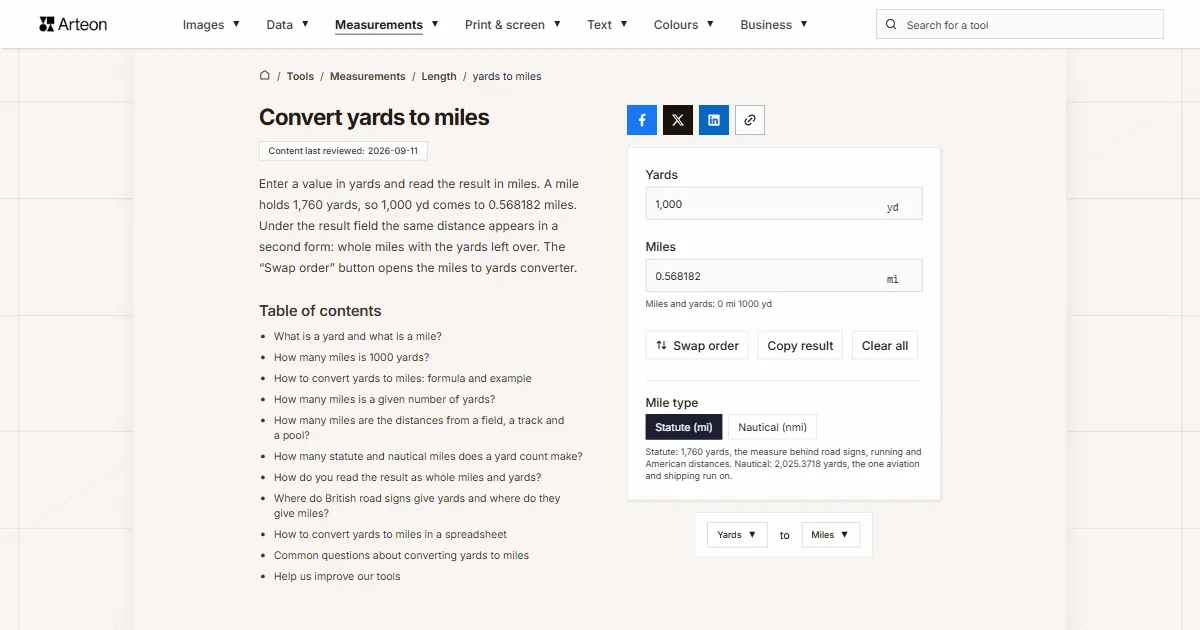
Enter a value in yards and read the result in miles. A mile holds 1,760 yards, so 1,000 yd comes to 0.568182 miles. Under the result field the same distance appears in a second form: whole miles with the yards left over. The “Swap order” button opens the miles to yards converter.
What is a yard and what is a mile?
The yard is the unit the United States and the United Kingdom use for shorter lengths. Markings on a field, a length of fabric off the bolt, the distance to the pin on a golf course — all of these are given in yards. The mile covers the longer distances, the ones counted in thousands of yards.
A yard, written yd, is exactly 0.9144 metres[1]. It divides into three feet or thirty-six inches.
A mile, written mi, is exactly 1,609.344 metres and holds 1,760 yards[2]. Every sum on this page uses that second figure.
Both values were settled on one day. On 1 July 1959 the common yard of the English-speaking countries took effect at 0.9144 metres[3], and the mile took its present length as a multiple of it.

How many miles is 1000 yards?
A thousand yards is 0.568182 miles. Five hundred yards gives 0.284091 miles, and two thousand yards gives 1.136364 miles.
Each of those answers comes from one operation: you divide the number of yards by 1,760. A hundred yards gives 0.056818 miles, and six hundred yards gives 0.340909 miles.
The answers are long here, because dividing by 1,760 gives a short result only for a whole number of miles or a simple fraction of one, such as 440 or 880 yards. That is why the converter gives a second form of the same value under the result field: whole miles and the remainder in yards. Two thousand yards is written there as 1 mi 240 yd.
A few values come out round. Eight hundred and eighty yards is exactly half a mile, and four hundred and forty yards is a quarter of a mile. The number 1,760 closes that series, because one thousand seven hundred and sixty yards is exactly one mile.
How to convert yards to miles: formula and example
Divide the number of yards by 1,760 and you have the result in miles. Three thousand five hundred and twenty yards comes to exactly two miles.
Formula: miles = yards ÷ 1,760
Going the other way, the same divisor becomes a multiplier. Two miles are 3,520 yards, and the miles to yards converter does that sum for you.
The divisor 1,760 is fixed in law. Schedule 1 of the Weights and Measures Act 1985 gives the mile as 1,760 yards and the yard as 0.9144 metres[4], so both figures used on this page come from the same document.
If your yard count comes from a fabric description or a land measurement, the yards to meters converter is the more useful one. Shorter lengths are handled by the yards to feet converter, and a driving distance by the miles to km converter.
How many miles is a given number of yards?
| Yards | Miles (mi) | Whole miles and yards | Metres (m) |
|---|---|---|---|
| 25 yards | 0.014205 mi | 0 mi 25 yd | 22.86 m |
| 40 yards | 0.022727 mi | 0 mi 40 yd | 36.58 m |
| 50 yards | 0.028409 mi | 0 mi 50 yd | 45.72 m |
| 60 yards | 0.034091 mi | 0 mi 60 yd | 54.86 m |
| 75 yards | 0.042614 mi | 0 mi 75 yd | 68.58 m |
| 100 yards | 0.056818 mi | 0 mi 100 yd | 91.44 m |
| 110 yards | 0.0625 mi | 0 mi 110 yd | 100.58 m |
| 120 yards | 0.068182 mi | 0 mi 120 yd | 109.73 m |
| 150 yards | 0.085227 mi | 0 mi 150 yd | 137.16 m |
| 200 yards | 0.113636 mi | 0 mi 200 yd | 182.88 m |
| 220 yards | 0.125 mi | 0 mi 220 yd | 201.17 m |
| 250 yards | 0.142045 mi | 0 mi 250 yd | 228.6 m |
| 300 yards | 0.170455 mi | 0 mi 300 yd | 274.32 m |
| 330 yards | 0.1875 mi | 0 mi 330 yd | 301.75 m |
| 350 yards | 0.198864 mi | 0 mi 350 yd | 320.04 m |
| 400 yards | 0.227273 mi | 0 mi 400 yd | 365.76 m |
| 440 yards | 0.25 mi | 0 mi 440 yd | 402.34 m |
| 450 yards | 0.255682 mi | 0 mi 450 yd | 411.48 m |
| 500 yards | 0.284091 mi | 0 mi 500 yd | 457.2 m |
| 550 yards | 0.3125 mi | 0 mi 550 yd | 502.92 m |
| 600 yards | 0.340909 mi | 0 mi 600 yd | 548.64 m |
| 650 yards | 0.369318 mi | 0 mi 650 yd | 594.36 m |
| 660 yards | 0.375 mi | 0 mi 660 yd | 603.5 m |
| 700 yards | 0.397727 mi | 0 mi 700 yd | 640.08 m |
| 750 yards | 0.426136 mi | 0 mi 750 yd | 685.8 m |
| 800 yards | 0.454545 mi | 0 mi 800 yd | 731.52 m |
| 850 yards | 0.482955 mi | 0 mi 850 yd | 777.24 m |
| 880 yards | 0.5 mi | 0 mi 880 yd | 804.67 m |
| 900 yards | 0.511364 mi | 0 mi 900 yd | 822.96 m |
| 950 yards | 0.539773 mi | 0 mi 950 yd | 868.68 m |
| 1,000 yards | 0.568182 mi | 0 mi 1000 yd | 914.4 m |
| 1,100 yards | 0.625 mi | 0 mi 1100 yd | 1,005.84 m |
| 1,200 yards | 0.681818 mi | 0 mi 1200 yd | 1,097.28 m |
| 1,300 yards | 0.738636 mi | 0 mi 1300 yd | 1,188.72 m |
| 1,320 yards | 0.75 mi | 0 mi 1320 yd | 1,207.01 m |
| 1,500 yards | 0.852273 mi | 0 mi 1500 yd | 1,371.6 m |
| 1,650 yards | 0.9375 mi | 0 mi 1650 yd | 1,508.76 m |
| 1,760 yards | 1 mi | 1 mi 0 yd | 1,609.34 m |
| 2,000 yards | 1.136364 mi | 1 mi 240 yd | 1,828.8 m |
| 2,200 yards | 1.25 mi | 1 mi 440 yd | 2,011.68 m |
| 2,500 yards | 1.420455 mi | 1 mi 740 yd | 2,286 m |
| 2,640 yards | 1.5 mi | 1 mi 880 yd | 2,414.02 m |
| 3,200 yards | 1.818182 mi | 1 mi 1440 yd | 2,926.08 m |
| 3,520 yards | 2 mi | 2 mi 0 yd | 3,218.69 m |
| 5,000 yards | 2.840909 mi | 2 mi 1480 yd | 4,572 m |
| 8,800 yards | 5 mi | 5 mi 0 yd | 8,046.72 m |
| 10,000 yards | 5.681818 mi | 5 mi 1200 yd | 9,144 m |
| 46,145 yards | 26.21875 mi | 26 mi 385 yd | 42,194.99 m |
How many miles are the distances from a field, a track and a pool?
| Distance | Yards (yd) | Miles (mi) | Metres (m) |
|---|---|---|---|
| American football field, between the goal lines | 100 yd | 0.056818 mi | 91.44 m |
| American football field including the end zones | 120 yd | 0.068182 mi | 109.728 m |
| 440 yard race | 440 yd | 0.25 mi | 402.336 m |
| 880 yard race | 880 yd | 0.5 mi | 804.672 m |
| Longest freestyle race in a 25 yard pool | 1,650 yd | 0.9375 mi | 1,508.76 m |
| One mile race | 1,760 yd | 1 mi | 1,609.344 m |
How many statute and nautical miles does a yard count make?
| Yards | Statute miles (mi) | Nautical miles (nmi) |
|---|---|---|
| 1,000 yards | 0.568182 mi | 0.493737 nmi |
| 2,000 yards | 1.136364 mi | 0.987473 nmi |
| 2,025.3718 yards | 1.150779 mi | 1 nmi |
| 5,000 yards | 2.840909 mi | 2.468683 nmi |
| 10,000 yards | 5.681818 mi | 4.937365 nmi |
How do you read the result as whole miles and yards?
The decimal answer is what you need for further sums, and a distance can also be written as two numbers at once. The converter shows both forms together, and the four steps below trace where the second one comes from. The example is 2,000 yards.
Type the number of yards
Typing 2000 puts 1.136364 miles in the result field. That is the decimal form, the one to use when the figure feeds another calculation.Look under the result field
Below the result sits a line labelled “Miles and yards”. For 2,000 yards it reads 1 mi 240 yd.Check where the remainder comes from
Subtract 1,760 yards, the length of one whole mile, from that number. That leaves 240 yards, the remainder shown beside the whole mile.Recognise the notation on railway plates
British railways number their positions in miles and chains, where one chain is 22 yards[7]. A plate reading 112 miles 63 chains therefore marks a point 112 miles and 1,386 yards from the start of the line.
Where do British road signs give yards and where do they give miles?
British road signs describe distances in miles and yards only[8]. Shorter distances are given in yards and longer ones in miles[1].
A sign reading 200 yards describes 0.113636 miles, and a sign reading 800 yards describes 0.454545 miles. In yards these distances are whole numbers, and in miles they become decimals.
One part of the system works differently from the wording on the plate. The traffic signs manual generally places temporary roadworks signs by measuring the distance in metres, within an allowed 10% tolerance[8]. A sign reading 200 yards describes 182.88 metres, yet it usually stands 200 metres before the obstruction, which is 218.72 yards.
How to convert yards to miles in a spreadsheet
Put the number of yards in cell A1 and give the formula =A1/1760 in the cell beside it. Excel, Google Sheets and LibreOffice Calc all compute it the same way, and copying that cell downwards converts the whole column.
The built-in unit function gives the same answer: =CONVERT(A1,"yd","mi"). The function is called CONVERT and its three arguments are number, from_unit and to_unit[9].
The two-part form takes two separate formulas. Whole miles come from rounding down: =FLOOR(A1/1760,1). The remainder in yards comes from the modulus: =MOD(A1,1760). For 2,000 yards the first returns 1 and the second returns 240, which is exactly one mile and 240 yards.
Convert other units to Miles
Convert Yards to other units
Sources
- Yard — Wikipedia
- Mile — Wikipedia
- SI Units – Length — NIST
- Weights and Measures Act 1985, Schedule 1 — legislation.gov.uk
- American football field — Wikipedia
- List of United States records in swimming — Wikipedia
- Chain (unit) — Wikipedia
- Road signs in the United Kingdom — Wikipedia
- CONVERT function — Microsoft
Every figure in the tables was computed from the unit definitions and checked arithmetically before publication. Historical values and the names of local units come from the sources listed above.
Content last reviewed: · written and checked by the Arteon team
Common questions about converting yards to miles
How far is 1000 yards in miles and in metres?
A thousand yards is 0.568182 miles. The same stretch measures 914.4 metres. In the form with a remainder it is 0 mi 1000 yd, because a full mile is still 760 yards away.
How do I turn miles back into yards?
Multiply the number of miles by 1,760. The miles to yards converter does that sum for you, and the “Swap order” button above this section opens it.
How many miles is 500 yards?
Five hundred yards is 0.284091 miles, a little over a quarter of a mile. That comes to 457.2 metres. An exact quarter of a mile is 440 yards.
Why does the result have so many decimal places?
Dividing by 1,760 gives a recurring decimal for most yard counts. A hundred yards is 0.056818 miles and 300 yards is 0.170455 miles. That is why the converter also gives whole miles with the remainder, where both numbers are integers.
How many miles is 100 yards?
A hundred yards is 0.056818 miles. The same stretch measures 91.44 metres. That is the length of the playing field on an American football field, counted between the goal lines.
How many miles is 1650 yards in the pool?
One thousand six hundred and fifty yards is 0.9375 miles, or 1,508.76 metres. A full mile is another 110 yards away. In a 25 yard pool that is 4.4 lengths.
What do the abbreviations yd, mi and nmi mean?
The abbreviation yd stands for the yard and mi for the statute mile. The abbreviation nmi stands for the nautical mile of 1,852 metres, the one aviation and shipping use.
How many square yards are in a square mile?
A square mile holds 3,097,600 square yards. The figure follows straight from the value on this page: the side of the square is 1,760 yards, so the area comes from multiplying 1,760 by 1,760. For an area, multiply the number of square miles by 3,097,600.
Help us improve our tools
Have an idea for a new feature, spotted a bug or want to suggest another tool? Write to us — we reply within 24 hours.