Convert yards to kilometres
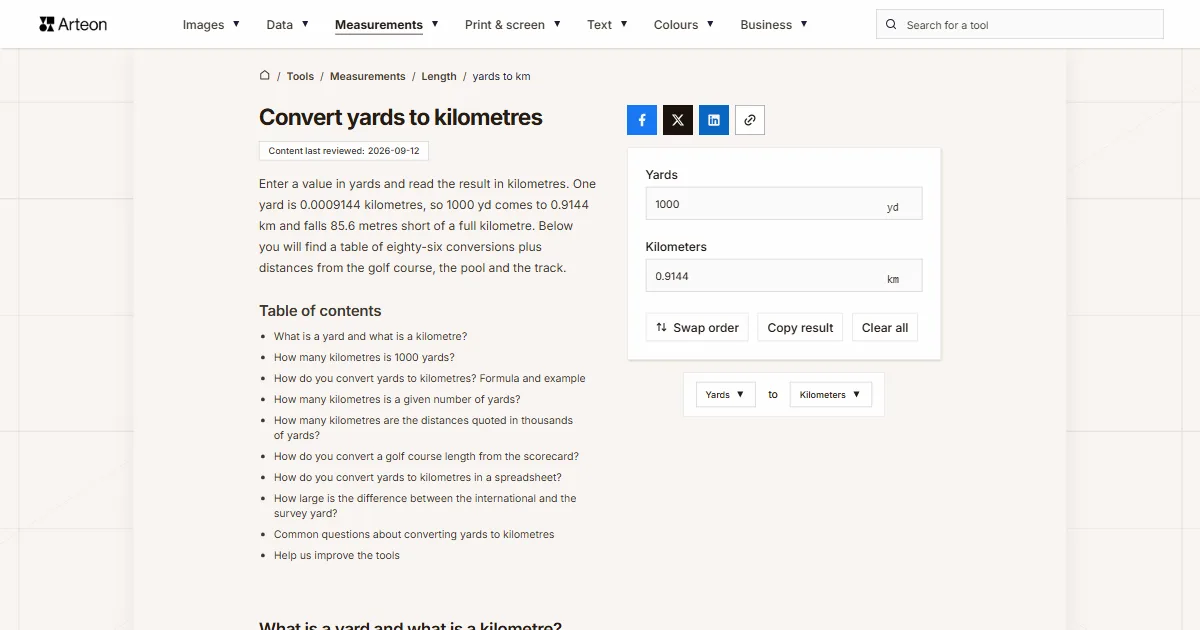
Enter a value in yards and read the result in kilometres. One yard is 0.0009144 kilometres, so 1000 yd comes to 0.9144 km and falls 85.6 metres short of a full kilometre. Below you will find a table of eighty-six conversions plus distances from the golf course, the pool and the track.
What is a yard and what is a kilometre?
The yard belongs to the imperial and US customary systems, and it starts from the way the mile is divided: a statute mile holds 1,760 yards, and each yard holds three feet, or 36 inches. That second division is handled by the yards to feet converter.
The yard takes its present length from the metre. The international yard and pound agreement fixed it at exactly 0.9144 metres, effective 1 July 1959[1]. Every calculation on this page starts from that single number.
The kilometre comes from the other system and means one thousand metres. The metre is the SI base unit of length, and its value follows from the speed of light in vacuum[2]. Both multipliers are therefore exact, and the conversion between them lands on a non-whole number because the units come from separate systems of measurement.
How many kilometres is 1000 yards?
One thousand yards is 0.9144 kilometres. That leaves 85.6 metres to a full kilometre, so a round thousand yards and a round kilometre describe two different distances. One yard is 0.0009144 kilometres, and that is the number you multiply every value by.
The same multiplier works on any other value. One hundred yards is 0.09144 kilometres, or 91.44 metres. Five hundred yards gives 0.4572 kilometres. One thousand seven hundred and sixty yards, a full statute mile, comes to 1.609344 kilometres, while the kilometre mark is already passed at 1,094 yards.
Above a thousand yards it is easier to think in kilometres, because the numbers in yards grow quickly. Three thousand yards is 2.7432 kilometres. Seven thousand yards gives 6.4008 kilometres. Ten thousand yards comes to 9.144 kilometres, which is 856 metres short of ten kilometres, since the gap grows in direct proportion to the distance.
The conversion the other way divides by the same multiplier and is handled by the kilometres to yards converter.
How do you convert yards to kilometres? Formula and example
The calculation has one step: multiply the number of yards by 0.0009144. You can also divide it by 1,093.6133, because that is how many yards fit into a kilometre. The result comes out the same.
Take a golf scorecard that reads 6500 yards. Six and a half thousand times 0.0009144 gives 5.9436 kilometres. That figure covers the sum of all the holes, so the walk a player actually takes comes out longer by the stretches between each green and the next tee.
When it suits you better to go through metres, multiply the yards by 0.9144 and divide the metres you get by a thousand. The first step is handled by the yards to metres converter.
Distances written as miles with yards are read as one value by the yards to miles converter, whose field takes the form 12 mi 752 yd directly. That particular distance is 19.9998 kilometres, which is 24 centimetres under twenty kilometres.
How many kilometres is a given number of yards?
| Yards | Kilometres | Metres |
|---|---|---|
| 1 yd | 0.0009144 km | 0.91 m |
| 5 yd | 0.004572 km | 4.57 m |
| 9 yd | 0.0082296 km | 8.23 m |
| 10 yd | 0.009144 km | 9.14 m |
| 20 yd | 0.018288 km | 18.29 m |
| 25 yd | 0.02286 km | 22.86 m |
| 30 yd | 0.027432 km | 27.43 m |
| 36 yd | 0.0329184 km | 32.92 m |
| 40 yd | 0.036576 km | 36.58 m |
| 45 yd | 0.041148 km | 41.15 m |
| 50 yd | 0.04572 km | 45.72 m |
| 52 yd | 0.0475488 km | 47.55 m |
| 60 yd | 0.054864 km | 54.86 m |
| 70 yd | 0.064008 km | 64.01 m |
| 75 yd | 0.06858 km | 68.58 m |
| 80 yd | 0.073152 km | 73.15 m |
| 90 yd | 0.082296 km | 82.3 m |
| 100 yd | 0.09144 km | 91.44 m |
| 110 yd | 0.100584 km | 100.58 m |
| 120 yd | 0.109728 km | 109.73 m |
| 125 yd | 0.1143 km | 114.3 m |
| 150 yd | 0.13716 km | 137.16 m |
| 200 yd | 0.18288 km | 182.88 m |
| 220 yd | 0.201168 km | 201.17 m |
| 231 yd | 0.2112264 km | 211.23 m |
| 250 yd | 0.2286 km | 228.6 m |
| 300 yd | 0.27432 km | 274.32 m |
| 350 yd | 0.32004 km | 320.04 m |
| 385 yd | 0.352044 km | 352.04 m |
| 400 yd | 0.36576 km | 365.76 m |
| 440 yd | 0.402336 km | 402.34 m |
| 450 yd | 0.41148 km | 411.48 m |
| 500 yd | 0.4572 km | 457.2 m |
| 550 yd | 0.50292 km | 502.92 m |
| 600 yd | 0.54864 km | 548.64 m |
| 650 yd | 0.59436 km | 594.36 m |
| 700 yd | 0.64008 km | 640.08 m |
| 750 yd | 0.6858 km | 685.8 m |
| 800 yd | 0.73152 km | 731.52 m |
| 825 yd | 0.75438 km | 754.38 m |
| 880 yd | 0.804672 km | 804.67 m |
| 900 yd | 0.82296 km | 822.96 m |
| 925 yd | 0.84582 km | 845.82 m |
| 1,000 yd | 0.9144 km | 914.4 m |
| 1,050 yd | 0.96012 km | 960.12 m |
| 1,100 yd | 1.00584 km | 1,005.84 m |
| 1,200 yd | 1.09728 km | 1,097.28 m |
| 1,300 yd | 1.18872 km | 1,188.72 m |
| 1,320 yd | 1.207008 km | 1,207.01 m |
| 1,400 yd | 1.28016 km | 1,280.16 m |
| 1,500 yd | 1.3716 km | 1,371.6 m |
| 1,650 yd | 1.50876 km | 1,508.76 m |
| 1,760 yd | 1.609344 km | 1,609.34 m |
| 1,900 yd | 1.73736 km | 1,737.36 m |
| 2,000 yd | 1.8288 km | 1,828.8 m |
| 2,100 yd | 1.92024 km | 1,920.24 m |
| 2,400 yd | 2.19456 km | 2,194.56 m |
| 2,500 yd | 2.286 km | 2,286 m |
| 2,700 yd | 2.46888 km | 2,468.88 m |
| 2,800 yd | 2.56032 km | 2,560.32 m |
| 3,000 yd | 2.7432 km | 2,743.2 m |
| 3,200 yd | 2.92608 km | 2,926.08 m |
| 3,500 yd | 3.2004 km | 3,200.4 m |
| 3,600 yd | 3.29184 km | 3,291.84 m |
| 3,800 yd | 3.47472 km | 3,474.72 m |
| 4,000 yd | 3.6576 km | 3,657.6 m |
| 4,200 yd | 3.84048 km | 3,840.48 m |
| 4,400 yd | 4.02336 km | 4,023.36 m |
| 4,700 yd | 4.29768 km | 4,297.68 m |
| 5,000 yd | 4.572 km | 4,572 m |
| 5,500 yd | 5.0292 km | 5,029.2 m |
| 6,000 yd | 5.4864 km | 5,486.4 m |
| 6,300 yd | 5.76072 km | 5,760.72 m |
| 6,500 yd | 5.9436 km | 5,943.6 m |
| 6,600 yd | 6.03504 km | 6,035.04 m |
| 6,800 yd | 6.21792 km | 6,217.92 m |
| 7,000 yd | 6.4008 km | 6,400.8 m |
| 7,200 yd | 6.58368 km | 6,583.68 m |
| 7,223 yd | 6.6047112 km | 6,604.71 m |
| 7,500 yd | 6.858 km | 6,858 m |
| 7,700 yd | 7.04088 km | 7,040.88 m |
| 8,000 yd | 7.3152 km | 7,315.2 m |
| 9,000 yd | 8.2296 km | 8,229.6 m |
| 10,000 yd | 9.144 km | 9,144 m |
| 20,000 yd | 18.288 km | 18,288 m |
| 25,000 yd | 22.86 km | 22,860 m |
How many kilometres are the distances quoted in thousands of yards?
| Distance | Yards | Kilometres | Metres |
|---|---|---|---|
| Minimum length of an 18-hole course that can be rated | 1,500 yd | 1.3716 km | 1,371.6 m |
| Length tolerance allowed over a full round | 100 yd | 0.09144 km | 91.44 m |
| Royal Birkdale as set up for the 154th Open | 7,223 yd | 6.6047 km | 6,604.71 m |
| The 14th hole there, the longest on the card | 602 yd | 0.5505 km | 550.47 m |
| Longest freestyle event in a 25-yard pool | 1,650 yd | 1.5088 km | 1,508.76 m |
| Yard event paired with the 800 metres | 1,000 yd | 0.9144 km | 914.4 m |
| Yard event paired with the 400 metres | 500 yd | 0.4572 km | 457.2 m |
| Length of a short course yards pool | 25 yd | 0.02286 km | 22.86 m |
| Upper limit on a track for records at 200 m and above | 440 yd | 0.402336 km | 402.34 m |
| Upper limit on an oval track in those same races | 220 yd | 0.201168 km | 201.17 m |
| Canadian football field between the goal lines | 110 yd | 0.100584 km | 100.58 m |
| Canadian football field including both goal areas | 150 yd | 0.13716 km | 137.16 m |
| Statute mile | 1,760 yd | 1.609344 km | 1,609.34 m |
| Ten mile road race | 17,600 yd | 16.09344 km | 16,093.44 m |
How do you convert a golf course length from the scorecard?
A scorecard gives the length of every hole and the total for the round. These four steps turn that total into kilometres.
Take the total from the row for your tees
The card has a separate row for each set of tees, and every one of them carries its own yardage total. Copy the one from the row you intend to play.Type it into the yards field
Enter the total 6500 exactly as it appears on the card: the field reads 6500 and 6,500 with the thousands separator alike. The result in kilometres appears as you type.Read metres from the table when the number is short
A single 150-yard hole gives 0.13716 kilometres, and the same value in metres, 137.16, reads faster. The table carries both columns side by side.Save the figure with Copy result
The Copy result button puts the number on the clipboard, and the Swap order button exchanges the fields when you want to go from kilometres to yards.
How do you convert yards to kilometres in a spreadsheet?
For a single value the field above is quicker. For a whole column of lengths it is easier to write the formula once and drag it down.
In English Excel the function is called CONVERT, and its syntax is CONVERT(number,from_unit,to_unit)[8]. The yard is written as "yd", and the kilometre is written as the metre with the kilo prefix, that is "km". For a value in cell A1 the formula reads =CONVERT(A1,"yd","km").
Without the function, plain multiplication is enough: the formula =A1*0.0009144 gives the same result and works in Google Sheets and LibreOffice Calc as well. Before you drag the formula down the whole column, put 1000 into cell A1 and check that the result reads 0.9144.
How large is the difference between the international and the survey yard?
The survey yard came from the US survey foot, which measured 0.304800609601 metres[9]. Three of those feet give a yard of 0.914401828803 metres, longer than the international one by just under two millionths of a metre.
Over a thousand yards that difference reaches 1.8 millimetres. Over ten thousand yards, a distance of more than nine kilometres, it grows to 18 millimetres. NIST, the US national measurement institute, advises that definitions based on the survey foot be used after 31 December 2022 for historic and legacy applications only[9].
The converter works with the international yard of 0.9144 metres, so the result matches every scorecard and every rulebook written since that date.
Convert other units to Kilometers
Convert Yards to other units
Sources
- SI Units – Length — National Institute of Standards and Technology
- SI base unit: metre (m) — Bureau International des Poids et Mesures
- Rules of Handicapping, Appendix G — The R&A
- Royal Birkdale course guide, the 154th Open — The R&A
- 2026 Rules & Regulations — USA Swimming
- Competition and Technical Rules 2026 — World Athletics
- 2026 Official Playing Rules — Canadian Football League
- CONVERT function — Microsoft
- U.S. Survey Foot: Revised Unit Conversion Factors — National Institute of Standards and Technology
Every figure in the tables was computed from the unit definitions and checked arithmetically before publication. Historical values and the names of local units come from the sources listed above.
Content last reviewed: · written and checked by the Arteon team
Common questions about converting yards to kilometres
What is the formula for converting yards to kilometres?
Multiply the number of yards by 0.0009144. For 2500 yards the sum reads: 2500 × 0.0009144 = 2.286 km.
Is a thousand yards a kilometre?
A thousand yards is 0.9144 kilometres, or 914.4 metres. That leaves 85.6 metres to a full kilometre.
How many yards make up a full kilometre?
A kilometre holds 1,093.6133 yards. The figure is not a whole number, because the yard and the kilometre come from two separate systems of measurement.
How much shorter is a yard than a metre?
By 8.56 centimetres. A metre holds 100 centimetres and a yard holds 91.44.
How do I convert a distance written as miles and yards?
A form such as 12 mi 752 yd is taken directly by the field of the yards to miles converter. That distance is 19.9998 kilometres.
Does the field take decimal values?
Yes. Type them with a full stop, for example 1650.5, because the English version of the page reads the separator used in the language you are viewing it in.
Why does the result show seven decimal places?
One yard is 0.0009144 kilometres, so short stretches only begin at the fourth decimal place. Seven places keep both a single yard and a full mile readable at once.
How do I reverse the direction of the conversion?
The Swap order button exchanges the fields, so the same page also goes from kilometres to yards. The dedicated page for that direction is the kilometres to yards converter.
How many kilometres is a hundred yards?
One hundred yards is 0.09144 kilometres, or 91.44 metres. One hundred metres is 0.1 kilometres, so the difference is 8.56 metres.
Can I convert a pool length into kilometres?
Yes. A 25-yard pool is 0.02286 kilometres, so forty-four lengths come to 1.00584 kilometres.
How do I work out the distance of a whole swim session?
Add up the sets in yards and type the total into the field. A 3000-yard session is 2.7432 kilometres.
Help us improve the tools
Write to us if you would like other values in the table or have a question about converting a golf course length. We read every message and keep the pages up to date.