Convert yards to millimeters
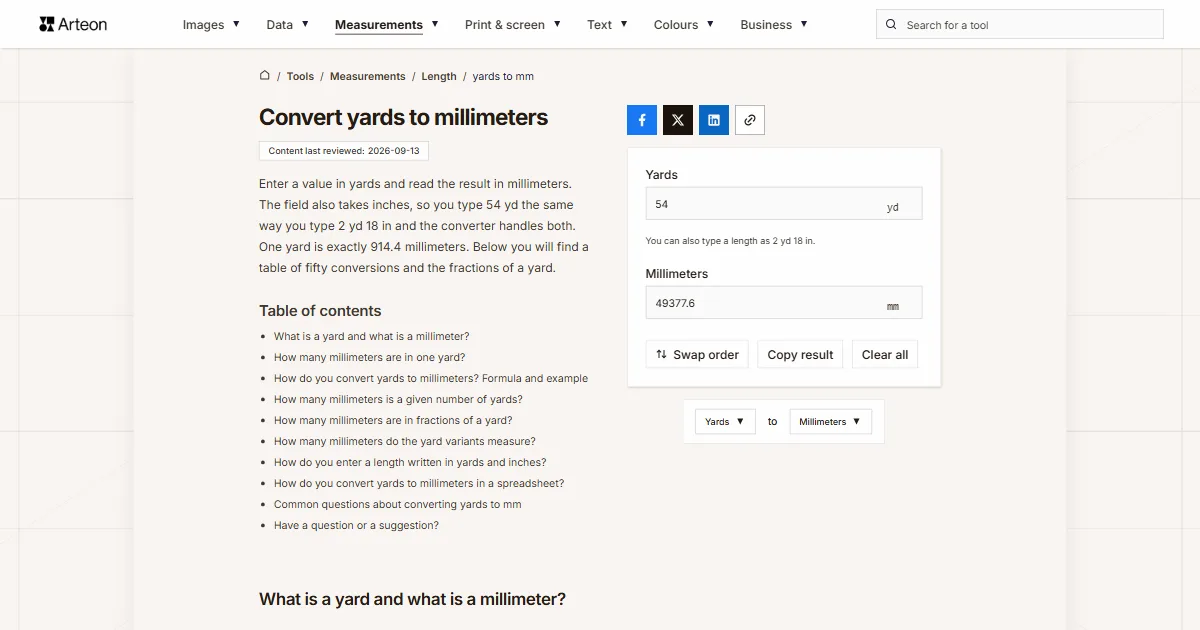
Enter a value in yards and read the result in millimeters. The field also takes inches, so you type 54 yd the same way you type 2 yd 18 in and the converter handles both. One yard is exactly 914.4 millimeters. Below you will find a table of fifty conversions and the fractions of a yard.
You can also type a length as 2 yd 18 in.
What is a yard and what is a millimeter?
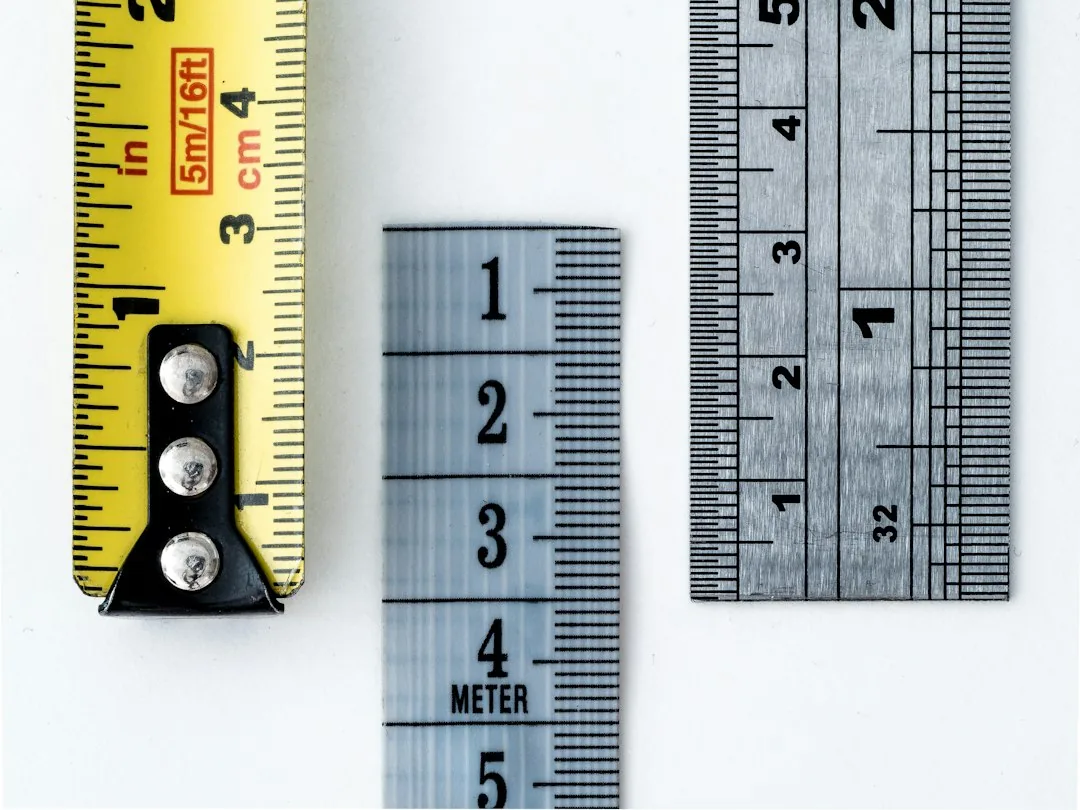
A millimeter is one thousandth of a meter. The meter is the SI base unit of length and takes its value from the speed of light in vacuum[1]. The milli prefix divides the meter into a thousand equal parts, and the millimeter is the graduation you can see on a ruler and on a tape measure.
The yard comes from a different system of measures and takes its present length from the meter. The international agreement of 1959 set the yard at exactly 0.9144 meter, and the value has applied since July 1 of that year[2]. In millimeters that gives exactly 914.4, and this is the only number you need to remember.
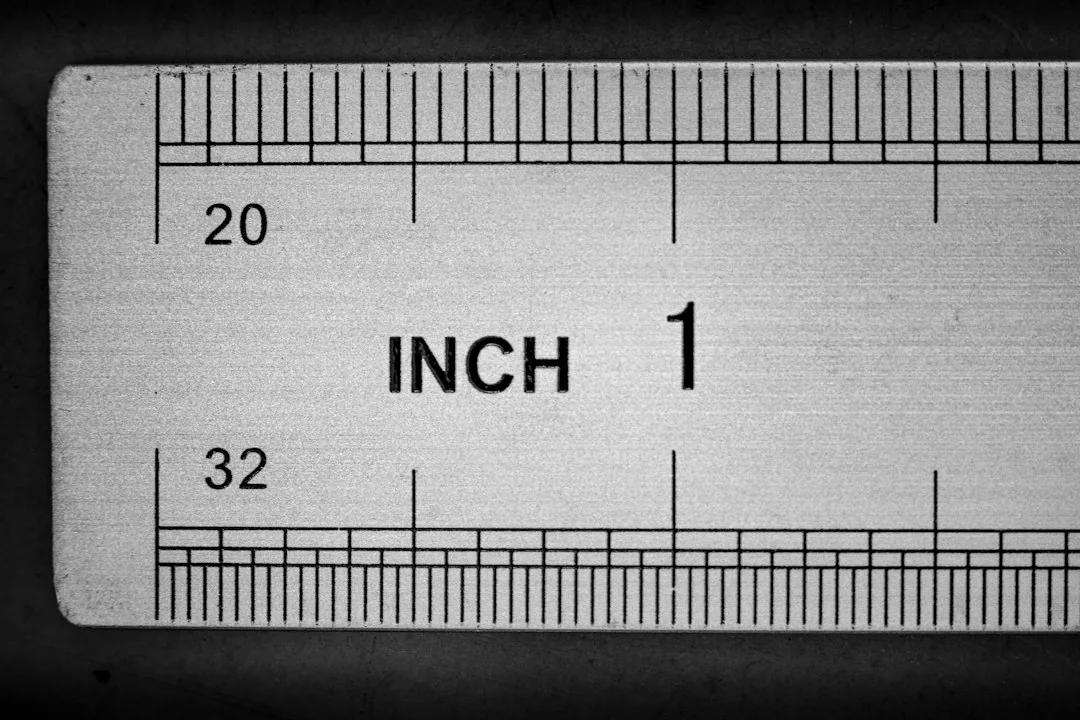
A yard holds three feet, and each foot holds twelve inches, so the whole yard holds 36 inches. That division is handled by the yards to feet converter. An inch measures exactly 25.4 millimeters[2], so both multipliers on this page are exact values. That ratio on its own is handled by the inches to millimeters converter.
How many millimeters are in one yard?
One yard is exactly 914.4 millimeters. To turn yards into millimeters you multiply the value by 914.4. The multiplier follows straight from the definition of the yard, so the result keeps its full accuracy.
Three values come out of that calculation and return in the tables below. Half a yard is 457.2 millimeters. Two yards give 1,828.8 millimeters. Ten yards come to 9,144 millimeters, which is 9.144 meters.
The same multiplier works for fractional values: one hundredth of a yard is 9.144 millimeters and one thousandth is 0.9144 millimeter.
You can write the remainder of a yard in inches, because a yard holds 36 of them. The input field takes that notation directly: 2 yd 18 in gives 2,286 millimeters, and so does 2.5 yd.
Fractions of a yard use the same multiplier. A quarter of a yard is 228.6 millimeters, and one eighth gives 114.3 millimeters. Every eighth of a yard ends one place after the decimal point, because the multiplier carries a single decimal.
How do you convert yards to millimeters? Formula and example
The calculation takes one step: you multiply the number of yards by 914.4. The multiplier is an exact value, so the number of digits in the result depends on the value you enter.
Take 54 yards as the example. Fifty-four times 914.4 gives 49,377.6 millimeters. The same length measures 49.3776 meters.
The same conversion can be written out as a chain, where each step turns one unit into the next. This is the form known as dimensional analysis. You multiply fifty-four yards by three, because a yard holds three feet, and you get 162 feet. You multiply that by twelve, because a foot holds twelve inches, and you have 1,944 inches. Finally you multiply by 25.4, because an inch measures that many millimeters[2], and you arrive at 49,377.6 millimeters.
Both routes end on the same number, because the product 3 × 12 × 25.4 is exactly 914.4. The chain helps when the calculation has to be shown step by step, and the single multiplier helps when only the result matters.
The conversion in the other direction is a division by 914.4 and it is handled by the millimeters to yards converter. For longer distances the yards to meters converter reads more easily, and for fabric there is the yards to centimeters converter.
How many millimeters is a given number of yards?
| Yards | Millimeters | Inches |
|---|---|---|
| 0.125 yd | 114.3 mm | 4.5 in |
| 0.25 yd | 228.6 mm | 9 in |
| 0.5 yd | 457.2 mm | 18 in |
| 0.75 yd | 685.8 mm | 27 in |
| 1 yd | 914.4 mm | 36 in |
| 1.5 yd | 1,371.6 mm | 54 in |
| 2 yd | 1,828.8 mm | 72 in |
| 2.5 yd | 2,286 mm | 90 in |
| 3 yd | 2,743.2 mm | 108 in |
| 4 yd | 3,657.6 mm | 144 in |
| 5 yd | 4,572 mm | 180 in |
| 6 yd | 5,486.4 mm | 216 in |
| 7 yd | 6,400.8 mm | 252 in |
| 8 yd | 7,315.2 mm | 288 in |
| 9 yd | 8,229.6 mm | 324 in |
| 10 yd | 9,144 mm | 360 in |
| 12 yd | 10,972.8 mm | 432 in |
| 15 yd | 13,716 mm | 540 in |
| 18 yd | 16,459.2 mm | 648 in |
| 20 yd | 18,288 mm | 720 in |
| 22 yd | 20,116.8 mm | 792 in |
| 25 yd | 22,860 mm | 900 in |
| 27 yd | 24,688.8 mm | 972 in |
| 30 yd | 27,432 mm | 1,080 in |
| 33 yd | 30,175.2 mm | 1,188 in |
| 35 yd | 32,004 mm | 1,260 in |
| 36 yd | 32,918.4 mm | 1,296 in |
| 40 yd | 36,576 mm | 1,440 in |
| 45 yd | 41,148 mm | 1,620 in |
| 50 yd | 45,720 mm | 1,800 in |
| 54 yd | 49,377.6 mm | 1,944 in |
| 60 yd | 54,864 mm | 2,160 in |
| 67 yd | 61,264.8 mm | 2,412 in |
| 70 yd | 64,008 mm | 2,520 in |
| 75 yd | 68,580 mm | 2,700 in |
| 80 yd | 73,152 mm | 2,880 in |
| 90 yd | 82,296 mm | 3,240 in |
| 100 yd | 91,440 mm | 3,600 in |
| 110 yd | 100,584 mm | 3,960 in |
| 120 yd | 109,728 mm | 4,320 in |
| 150 yd | 137,160 mm | 5,400 in |
| 180 yd | 164,592 mm | 6,480 in |
| 200 yd | 182,880 mm | 7,200 in |
| 250 yd | 228,600 mm | 9,000 in |
| 300 yd | 274,320 mm | 10,800 in |
| 350 yd | 320,040 mm | 12,600 in |
| 400 yd | 365,760 mm | 14,400 in |
| 500 yd | 457,200 mm | 18,000 in |
| 885 yd | 809,244 mm | 31,860 in |
| 1,000 yd | 914,400 mm | 36,000 in |
How many millimeters are in fractions of a yard?
| Fraction of a yard | In yards | In inches | In millimeters |
|---|---|---|---|
| One thirty-second | 1/32 yd | 1.125 in | 28.575 mm |
| One sixteenth | 1/16 yd | 2.25 in | 57.15 mm |
| One eighth | 1/8 yd | 4.5 in | 114.3 mm |
| One sixth | 1/6 yd | 6 in | 152.4 mm |
| One quarter | 1/4 yd | 9 in | 228.6 mm |
| One third | 1/3 yd | 12 in | 304.8 mm |
| Three eighths | 3/8 yd | 13.5 in | 342.9 mm |
| One half | 1/2 yd | 18 in | 457.2 mm |
| Five eighths | 5/8 yd | 22.5 in | 571.5 mm |
| Two thirds | 2/3 yd | 24 in | 609.6 mm |
| Three quarters | 3/4 yd | 27 in | 685.8 mm |
| Seven eighths | 7/8 yd | 31.5 in | 800.1 mm |
| A full yard | 1 yd | 36 in | 914.4 mm |
How many millimeters do the yard variants measure?
| Yard variant | Value in millimeters | Difference from the international yard | Where you meet it |
|---|---|---|---|
| International yard | 914.4 mm | reference value | The 1959 agreement; the value has applied since July 1 of that year[2] |
| United States survey yard | 914.4018 mm | 0.0018 mm longer | American survey data; after December 31, 2022 the standards institute recommends it for legacy records only[4] |
| English yard measured in 1895 | 914.3992 mm | 0.0008 mm shorter | A comparison of the meter with the British yard standard, made before the 1959 agreement[3] |
How do you enter a length written in yards and inches?
A length given as yards with inches goes into the field directly, and the converter joins both parts into a single value.
Type both parts with their symbols
You type 2 yd 18 in exactly in that form, spaces included. The converter reads the symbol yd as yards and the symbol in as inches, and joins them into one value: 2,286 mm.The inch symbol is optional
Typing 2 yd 18 works the same as 2 yd 18 in, because the second part is always a number of inches. Letter case is free, so 2 YD 18 IN gives the same result.Write a fraction of an inch with your own separator
In the English version of the page you type 2 yd 18.5 in with a dot. The field reads the separator according to the language you are viewing the page in, so the Polish version of the same tool takes a comma.A plain number is enough on its own
Typing 2.5 with no symbol tells the converter to read the value as yards and it returns 2,286 mm. The two-part notation helps when the length already comes written in yards and inches.
How do you convert yards to millimeters in a spreadsheet?
For a single value the field above is quicker. For a whole column of lengths it pays to write the formula once and drag it down.
In Excel the formula takes the form CONVERT(number, from_unit, to_unit). The yard carries the code "yd", so for a value in cell A1 you type =CONVERT(A1,"yd","mm")[5].
Excel builds the code "mm" from two parts: the first m is the milli prefix and the second m is the meter[5]. The unit list in the documentation therefore carries the meter alone, and you add the prefix from a separate table. The codes "cm" and "km" are formed the same way.
Without the function a plain multiplication does the job: the formula =A1*914.4 gives the same result and works in Google Sheets and LibreOffice Calc as well. Before you drag the formula down the column, put the value 1 in cell A1 and check that the result reads 914.4.
Convert other units to Millimeters
Convert Yards to other units
Sources
- SI base unit: metre (m) — Bureau International des Poids et Mesures
- SI Units – Length — National Institute of Standards and Technology
- Yard — Wikipedia
- U.S. Survey Foot: Revised Unit Conversion Factors — National Institute of Standards and Technology
- CONVERT function — Microsoft
Every figure in the tables was computed from the unit definitions and checked arithmetically before publication. Historical values and the names of local units come from the sources listed above.
Content last reviewed: · written and checked by the Arteon team
Common questions about converting yards to mm
How many millimeters are in 54 yards?
Fifty-four yards is 49,377.6 millimeters, which is 49.3776 meters. The calculation reads 54 × 914.4 = 49,377.6 mm.
How many millimeters are in 3 yards?
Three yards is 2,743.2 millimeters, which is 2.7432 meters. In inches that comes to exactly 108.
What is the formula for converting yards to millimeters?
You multiply the number of yards by 914.4. For 7 yards the calculation reads 7 × 914.4 = 6,400.8 mm.
How do you write out a yards to millimeters conversion step by step?
You multiply yards by 3 to get feet, feet by 12 to get inches, and inches by 25.4 to get millimeters. For 54 yards the successive numbers are 162 feet, 1,944 inches and 49,377.6 mm.
How many millimeters are in 100 yards?
One hundred yards is 91,440 millimeters, which is 91.44 meters.
How many millimeters are in half a yard?
Half a yard is 457.2 millimeters, which is eighteen inches.
How many millimeters are in one third of a yard?
One third of a yard is 304.8 millimeters, which is exactly one foot. A yard divides into three feet, so both numbers describe the same length.
How many millimeters are in 25 yards?
Twenty-five yards is 22,860 millimeters, which is 22.86 meters.
Can I type 2 yd 18 in?
Yes. The input field recognises both parts and joins them into one value, in this case 2,286 mm.
Does the yard have a single value today?
The yard measures 0.9144 meter[2] in every country of the 1959 agreement: Australia, Canada, New Zealand, South Africa, the United Kingdom and the United States[3]. The former survey value followed from the United States survey foot, and the American standards institute recommends reaching for it after December 31, 2022 only for legacy records[4].
Have a question or a suggestion?
Write to us if the table could use a value that is missing, or if one of the numbers looks out of date.