Convert millimeters to yards
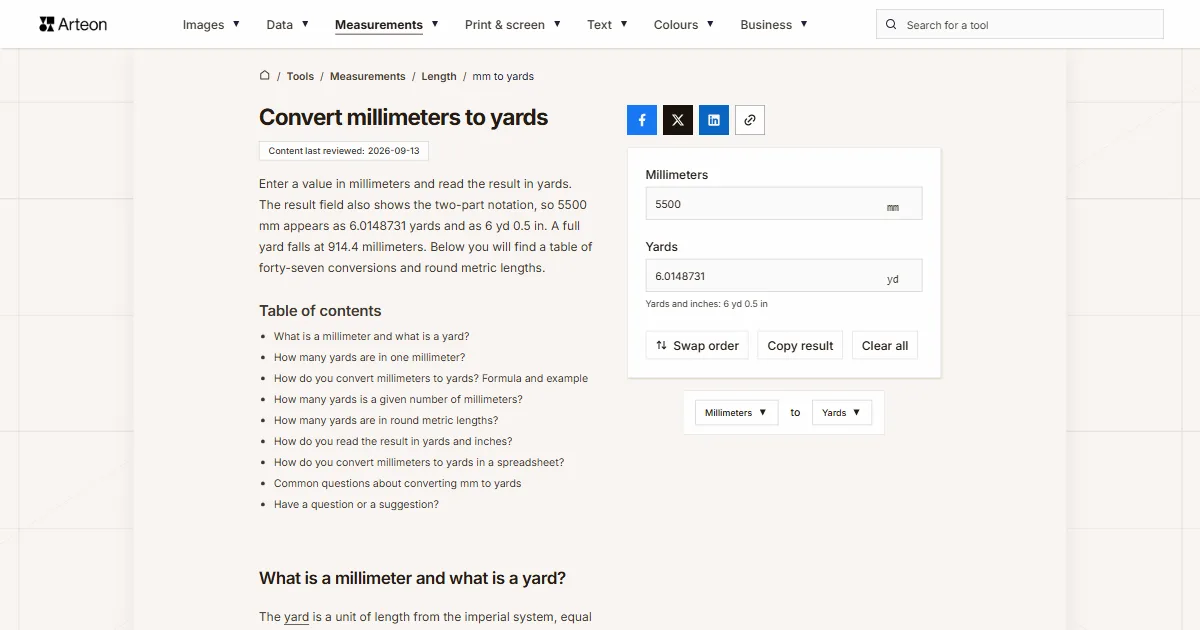
Enter a value in millimeters and read the result in yards. The result field also shows the two-part notation, so 5500 mm appears as 6.0148731 yards and as 6 yd 0.5 in. A full yard falls at 914.4 millimeters. Below you will find a table of forty-seven conversions and round metric lengths.
What is a millimeter and what is a yard?
The yard is a unit of length from the imperial system, equal to three feet or 36 inches. Its present value is written in meters: the international agreement of 1959 set the yard at exactly 0.9144 meter, and that number has applied since July 1 of that year[1]. In millimeters it comes to 914.4.
The millimeter stands on the metric side of this calculation and is one thousandth of a meter. The meter is the SI base unit, and its length follows from the speed of light in vacuum[2]. Because the yard was tied to the meter, the move between these two units is exact in both directions.
One unit fits into the other a fractional number of times, because each of them came from a different system of measures. That is why one millimeter is 0.0010936 yard and a round meter gives 1.0936 yards. The three feet a yard divides into are handled by the millimeters to feet converter.
How many yards are in one millimeter?
One millimeter is 0.0010936 yard. To turn millimeters into yards you divide the value by 914.4. The divisor follows straight from the definition of the yard, so the result is exact.
Three numbers come out of that division and they return in the tables below. One hundred millimeters is 0.1093613 yard. One thousand millimeters, a round meter, gives 1.0936133 yards. One full yard is 914.4 millimeters.
Those three values are enough for a rough estimate in your head. A hundred millimeters is roughly a tenth of a yard, and a round meter is a yard with a little to spare.
You can also read the result in yards and inches, because the result field shows both parts. For 5,500 millimeters that gives 6.0148731 yards, and in the two-part notation 6 yd 0.5 in.
At small values the result carries several zeros before the first significant digit. Twenty-one millimeters is 0.0229659 yard. Lengths like this read more easily in inches, and the millimeters to inches converter gives them.
How do you convert millimeters to yards? Formula and example
The calculation takes one step: you divide the number of millimeters by 914.4. The divisor is an exact value, so the accuracy of the result depends only on the number of places the field shows.
Take 5,500 millimeters as the example. Five thousand five hundred divided by 914.4 gives 6.0148731 yards. The same length measures 5.5 meters.
The same conversion can be written out as a chain that passes through the intermediate units. You divide five thousand five hundred millimeters by 25.4, because an inch measures that many millimeters[1], and you get 216.5354 inches. You divide that by twelve and you have 18.0446 feet. Finally you divide by three, because a yard holds three feet, and you arrive at 6.0148731 yards.
Both routes end on the same number, because the product 25.4 × 12 × 3 is exactly 914.4. The chain shows the calculation step by step, and the single divisor shortens it to one operation.
The conversion in the other direction is a multiplication by 914.4 and it is handled by the yards to millimeters converter. For longer distances the millimeters to meters converter is more convenient.
How many yards is a given number of millimeters?
| Millimeters | Yards | Inches |
|---|---|---|
| 1 mm | 0.0010936 yd | 0.0394 in |
| 5 mm | 0.0054681 yd | 0.1969 in |
| 10 mm | 0.0109361 yd | 0.3937 in |
| 20 mm | 0.0218723 yd | 0.7874 in |
| 21 mm | 0.0229659 yd | 0.8268 in |
| 25 mm | 0.0273403 yd | 0.9843 in |
| 50 mm | 0.0546807 yd | 1.9685 in |
| 85 mm | 0.0929571 yd | 3.3465 in |
| 100 mm | 0.1093613 yd | 3.937 in |
| 150 mm | 0.164042 yd | 5.9055 in |
| 200 mm | 0.2187227 yd | 7.874 in |
| 225 mm | 0.246063 yd | 8.8583 in |
| 250 mm | 0.2734033 yd | 9.8425 in |
| 300 mm | 0.328084 yd | 11.811 in |
| 400 mm | 0.4374453 yd | 15.748 in |
| 425 mm | 0.4647857 yd | 16.7323 in |
| 460 mm | 0.5030621 yd | 18.1102 in |
| 500 mm | 0.5468066 yd | 19.685 in |
| 530 mm | 0.579615 yd | 20.8661 in |
| 580 mm | 0.6342957 yd | 22.8346 in |
| 600 mm | 0.656168 yd | 23.622 in |
| 635 mm | 0.6944444 yd | 25 in |
| 660 mm | 0.7217848 yd | 25.9843 in |
| 680 mm | 0.743657 yd | 26.7717 in |
| 700 mm | 0.7655293 yd | 27.5591 in |
| 720 mm | 0.7874016 yd | 28.3465 in |
| 740 mm | 0.8092738 yd | 29.1339 in |
| 760 mm | 0.8311461 yd | 29.9213 in |
| 790 mm | 0.8639545 yd | 31.1024 in |
| 800 mm | 0.8748906 yd | 31.4961 in |
| 850 mm | 0.9295713 yd | 33.4646 in |
| 880 mm | 0.9623797 yd | 34.6457 in |
| 900 mm | 0.984252 yd | 35.4331 in |
| 914 mm | 0.9995626 yd | 35.9843 in |
| 914.4 mm | 1 yd | 36 in |
| 940 mm | 1.0279965 yd | 37.0079 in |
| 960 mm | 1.0498688 yd | 37.7953 in |
| 980 mm | 1.071741 yd | 38.5827 in |
| 1,000 mm | 1.0936133 yd | 39.3701 in |
| 1,280 mm | 1.399825 yd | 50.3937 in |
| 2,000 mm | 2.1872266 yd | 78.7402 in |
| 2,200 mm | 2.4059493 yd | 86.6142 in |
| 4,500 mm | 4.9212598 yd | 177.1654 in |
| 5,000 mm | 5.4680665 yd | 196.8504 in |
| 5,500 mm | 6.0148731 yd | 216.5354 in |
| 8,000 mm | 8.7489064 yd | 314.9606 in |
| 10,000 mm | 10.936133 yd | 393.7008 in |
How many yards are in round metric lengths?
| Length | Yards | Yards and inches |
|---|---|---|
| 1 m | 1.0936 yd | 1 yd 3.4 in |
| 2 m | 2.1872 yd | 2 yd 6.7 in |
| 3 m | 3.2808 yd | 3 yd 10.1 in |
| 5 m | 5.4681 yd | 5 yd 16.9 in |
| 10 m | 10.9361 yd | 10 yd 33.7 in |
| 20 m | 21.8723 yd | 21 yd 31.4 in |
| 25 m | 27.3403 yd | 27 yd 12.3 in |
| 50 m | 54.6807 yd | 54 yd 24.5 in |
| 100 m | 109.3613 yd | 109 yd 13 in |
| 250 m | 273.4033 yd | 273 yd 14.5 in |
| 500 m | 546.8066 yd | 546 yd 29 in |
| 1 km | 1,093.6133 yd | 1093 yd 22.1 in |
How do you read the result in yards and inches?
Below the result in yards stands the same length written out as whole yards and inches, so you have both forms side by side.
Read the whole yards first
The first part of the notation gives the number of whole yards. For 5,500 mm that is 6 yd, because six full yards take up 5,486.4 mm.Read the remainder in inches
The second part is the remainder turned into inches, rounded to one decimal place. For 5,500 mm the remainder is 13.6 mm, which is 0.5 in.Check the decimal result beside it
The result field gives the decimal value in parallel, in this case 6.0148731 yd. The decimal form goes into a spreadsheet, and the form with inches is what you read off a tape measure.Copy the result with one click
The Copy result button puts the value on the clipboard, ready to paste into a spreadsheet. The Swap order button reverses the direction of the conversion.
How do you convert millimeters to yards in a spreadsheet?
For a single value the field above is quicker. For a whole column of dimensions it pays to write the formula once and drag it down.
In Excel the formula takes the form CONVERT(number, from_unit, to_unit). For a value in cell A1 you type =CONVERT(A1,"mm","yd")[4].
Excel builds the code "mm" from two parts: the first m is the milli prefix and the second m is the meter[4]. The yard stands on the unit list directly, under the code "yd".
Without the function a plain division does the job: the formula =A1/914.4 gives the same result and works in Google Sheets and LibreOffice Calc as well. Before you drag the formula down the column, put the value 914.4 in cell A1 and check that the result reads 1.
Convert other units to Yards
Convert Millimeters to other units
Sources
- SI Units – Length — National Institute of Standards and Technology
- SI base unit: metre (m) — Bureau International des Poids et Mesures
- Yard — Wikipedia
- CONVERT function — Microsoft
Every figure in the tables was computed from the unit definitions and checked arithmetically before publication. Historical values and the names of local units come from the sources listed above.
Content last reviewed: · written and checked by the Arteon team
Common questions about converting mm to yards
How many yards are in 5500 millimeters?
Five thousand five hundred millimeters is 6.0148731 yards, which is 6 yd 0.5 in. The same length measures 5.5 meters.
How many yards are in 200 millimeters?
Two hundred millimeters is 0.2187227 yard, which is 7.874 inches. In the two-part notation that reads 0 yd 7.9 in.
What is the formula for converting millimeters to yards?
You divide the number of millimeters by 914.4. For 2,000 mm the calculation reads 2,000 ÷ 914.4 = 2.1872266 yd.
How many yards are in 21 millimeters?
Twenty-one millimeters is 0.0229659 yard, which is 0.8268 inch. At dimensions this small inches read more easily than yards.
How many yards are in a meter?
One meter is 1,000 millimeters, which is 1.0936133 yards. In the two-part notation that reads 1 yd 3.4 in.
How many yards are in 100 millimeters?
One hundred millimeters is 0.1093613 yard, which is 3.937 inches.
At how many millimeters does exactly one yard fall?
Exactly one yard falls at 914.4 millimeters. That number follows from the 1959 agreement, which set the yard at 0.9144 meter[1].
Why does the result in yards carry so many decimal places?
A millimeter is more than nine hundred times shorter than a yard, so the first significant digit stands at the third decimal place. The field gives seven places so that a single millimeter still shows a visible value.
How do I turn the result into yards and inches?
The result field gives both forms in parallel. You read the whole part as yards, and the remainder multiplied by 36 as inches.
How many yards are in 8000 millimeters?
Eight thousand millimeters is 8.7489064 yards, which is 8 yd 27 in. The same length measures eight meters.
Have a question or a suggestion?
Write to us if the table could use a value that is missing, or if the notation in yards and inches looks different from what you expect.