Convert millimeters to microns
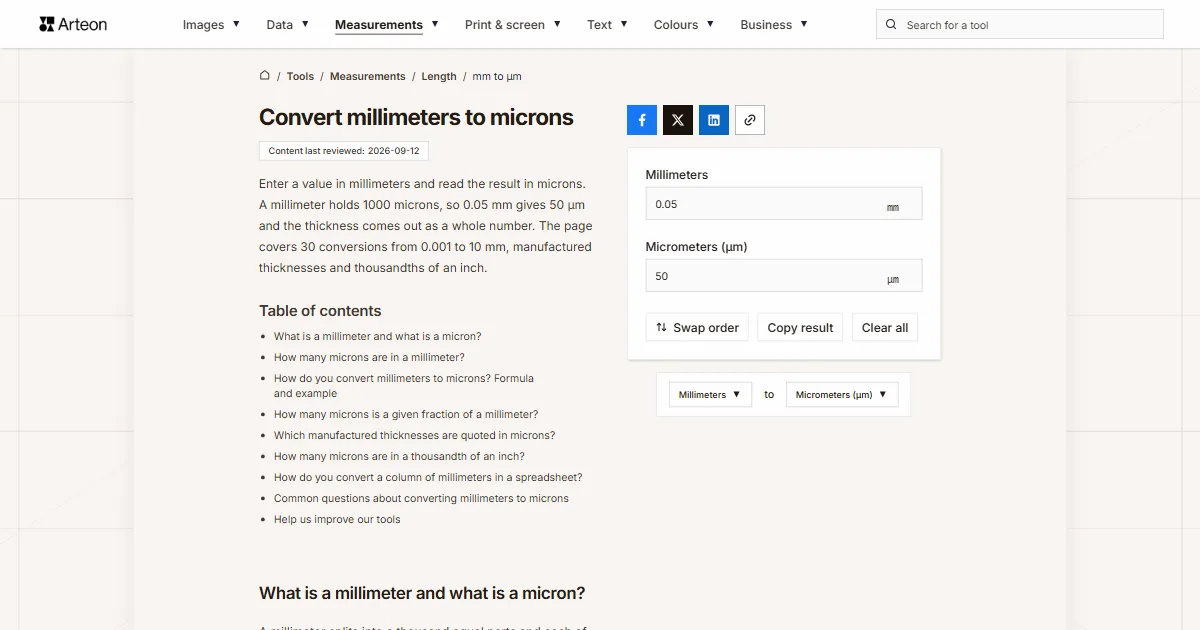
Enter a value in millimeters and read the result in microns. A millimeter holds 1000 microns, so 0.05 mm gives 50 µm and the thickness comes out as a whole number. The page covers 30 conversions from 0.001 to 10 mm, manufactured thicknesses and thousandths of an inch.
What is a millimeter and what is a micron?
A millimeter splits into a thousand equal parts and each of them is one micron. That split is what the prefix micro- describes: a millionth of a meter, adopted by the General Conference on Weights and Measures in 1960 together with the name of the SI system[1]. The symbol of the unit is µm.
Below a millimeter the same thickness has two forms: 0.025 mm and 25 µm. The second one is a whole number, so under a millimeter the micron writes the value without leading zeros after the point.
The unit has an older name as well. Micron was accepted in 1879 and revoked by the SI in 1967, and it stays in use partly because micrometer is also the name of a measuring device[2].
How many microns are in a millimeter?
A millimeter holds 1000 microns. To turn millimeters into microns you multiply the number of millimeters by a thousand, so 0.05 mm gives 50 µm. The same multiplier holds at every value, from a thousandth of a millimeter up to a dozen millimeters.
The multiplier comes from the prefixes. A millimeter is 10⁻³ of a meter and a micrometer is 10⁻⁶ of a meter[1]. The exponents are three apart, so one millimeter holds a thousand microns and the multiplier is exact.
Written as a decimal, the whole calculation is a shift of the point three places to the right. A value of 0.25 mm becomes 250 µm that way. A fraction with three decimal places lands on a whole number of microns, so 0.025 mm is exactly 25 µm. The millimeter itself is 1000 µm, a one followed by three zeros.
The converter at the top of the page does this as you type, and the table of ready conversions covers thirty values.
How do you convert millimeters to microns? Formula and example
The formula has one shape: microns = millimeters × 1000. Dividing by 0.001 gives the same answer, because one thousandth is the reciprocal of a thousand.
Take the aluminium foil in a kitchen drawer. The Wikipedia entry puts standard household foil at 0.016 mm[3]. Multiplied by a thousand, that is 16 µm, the same thickness written as a whole number.
There is one more prefix below the micron. A nanometer is a thousand times smaller than a micron, and the millimeters to nanometers converter takes millimeters straight there. For the opposite direction, use the microns to millimeters converter. Going up the scale, there are the millimeters to meters converter and the centimeters to millimeters converter.
How many microns is a given fraction of a millimeter?
| Millimeters | Microns |
|---|---|
| 0.001 mm | 1 µm |
| 0.002 mm | 2 µm |
| 0.005 mm | 5 µm |
| 0.01 mm | 10 µm |
| 0.015 mm | 15 µm |
| 0.02 mm | 20 µm |
| 0.025 mm | 25 µm |
| 0.03 mm | 30 µm |
| 0.04 mm | 40 µm |
| 0.05 mm | 50 µm |
| 0.06 mm | 60 µm |
| 0.07 mm | 70 µm |
| 0.08 mm | 80 µm |
| 0.1 mm | 100 µm |
| 0.12 mm | 120 µm |
| 0.15 mm | 150 µm |
| 0.18 mm | 180 µm |
| 0.2 mm | 200 µm |
| 0.25 mm | 250 µm |
| 0.3 mm | 300 µm |
| 0.35 mm | 350 µm |
| 0.4 mm | 400 µm |
| 0.5 mm | 500 µm |
| 0.75 mm | 750 µm |
| 1 mm | 1000 µm |
| 1.5 mm | 1500 µm |
| 2 mm | 2000 µm |
| 3 mm | 3000 µm |
| 5 mm | 5000 µm |
| 10 mm | 10,000 µm |
Which manufactured thicknesses are quoted in microns?
| Material | In millimeters | In microns |
|---|---|---|
| Thinnest aluminium foil in common use | 0.006 mm | 6 µm |
| Standard household aluminium foil | 0.016 mm | 16 µm |
| Heavy-duty household aluminium foil | 0.024 mm | 24 µm |
| Sheet of paper | 0.07–0.18 mm | 70–180 µm |
| Limit below which aluminium counts as foil | 0.2 mm | 200 µm |
| Payment card in the ID-1 format | 0.76 mm | 760 µm |

How many microns are in a thousandth of an inch?
| Thousandths of an inch | In microns | In millimeters |
|---|---|---|
| 0.1 mil | 2.54 µm | 0.00254 mm |
| 0.25 mil | 6.35 µm | 0.00635 mm |
| 0.5 mil | 12.7 µm | 0.0127 mm |
| 1 mil | 25.4 µm | 0.0254 mm |
| 2 mil | 50.8 µm | 0.0508 mm |
| 3 mil | 76.2 µm | 0.0762 mm |
| 4 mil | 101.6 µm | 0.1016 mm |
| 5 mil | 127 µm | 0.127 mm |
| 10 mil | 254 µm | 0.254 mm |
| 20 mil | 508 µm | 0.508 mm |
| 30 mil | 762 µm | 0.762 mm |
| 40 mil | 1016 µm | 1.016 mm |
How do you convert a column of millimeters in a spreadsheet?
A single dimension goes into the converter at the top of the page. For a whole list of dimensions from a drawing or a measurement, one formula written once and dragged down the column is quicker.
Excel: the CONVERT function with the u prefix
The formula reads =CONVERT(A1,"mm","um"). The order of the arguments follows the direction of the conversion: first the unit of the value you entered, then the unit of the result. The prefix u stands in for the symbol µ, and the documentation warns that the case of the letters matters[6].Multiplying by a thousand without a function
The formula =A1*1000 returns the same result as CONVERT and asks for no knowledge of unit symbols. It works in every spreadsheet, because it uses nothing but multiplication. Put the multiplier in cell B1 once and =A1*$B$1 drags down the column.Zero decimal places for results in microns
Measurements in millimeters usually carry three decimal places at most, so multiplying by a thousand leaves whole numbers. Select the column of results, open the Format Cells dialog box from the Number group on the Home tab, and enter zero in the Decimal places box.
Convert Millimeters to other units
Sources
- Resolution 12 of the 11th CGPM (1960): Système International d’Unités, list of prefixes — Bureau International des Poids et Mesures
- Micrometre — Wikipedia
- Aluminium foil — Wikipedia
- Thousandth of an inch — Wikipedia
- NIST Guide to the SI, appendix B9: conversion factors — National Institute of Standards and Technology
- CONVERT function — Microsoft
Every figure in the tables was computed from the unit definitions and checked arithmetically before publication. Historical values and the names of local units come from the sources listed above.
Content last reviewed: · written and checked by the Arteon team
Common questions about converting millimeters to microns
Why is the same thickness quoted in millimeters in one place and in microns in another?
Both figures describe the same size and differ only in how long they are to write. A thickness of 0.025 mm written in microns is 25 µm, a whole number. Below a millimeter the whole number belongs to the micron, while at a few millimeters the result in microns already runs to four digits, and that is what decides the unit a given document uses.
Does the micron mean the same thing in every country?
Will the field take a value written with a comma, such as 0,025?
Yes. The field reads a fraction written with a dot or with a comma, so 0.025 and 0,025 both give 25 µm. A figure copied from a spreadsheet or from a European datasheet goes in without being retyped.
How many nanometers are in one micron?
A thousand. A micron splits into a thousand nanometers in the same way a millimeter splits into a thousand microns, which makes one millimeter a million nanometers. Nanometers are the unit for wavelengths of light and for distances at molecular scale.
Help us improve our tools
Have an idea for a new feature, found a bug, or want to suggest another tool? Write to us — we reply within 24 hours.