Convert microns to millimeters
Enter a value in microns and read the result in millimeters. A micron, formally a micrometer, is one thousandth of a millimeter, so 50 µm gives 0.05 mm. The page lists 35 ready conversions and the thicknesses that get quoted in microns, from bacteria to a sheet of paper.
What is a micrometer, and where does the name micron come from?
A micrometer is one millionth of a meter and one thousandth of a millimeter. Its symbol is µm, because the prefix micro- stands for a millionth. The General Conference on Weights and Measures adopted that prefix in 1960, alongside the name of the SI system itself[1].
The same unit carried the name micron for close to ninety years, with its own symbol µ. It was accepted in 1879 and revoked by the SI in 1967[2]. Resolution 7 of the 13th General Conference on Weights and Measures removed it, because the symbol µ had become the prefix micro-[3]. NIST now lists micron among the names that the SI unit name replaces when results are written down, next to mho in place of the siemens[4].
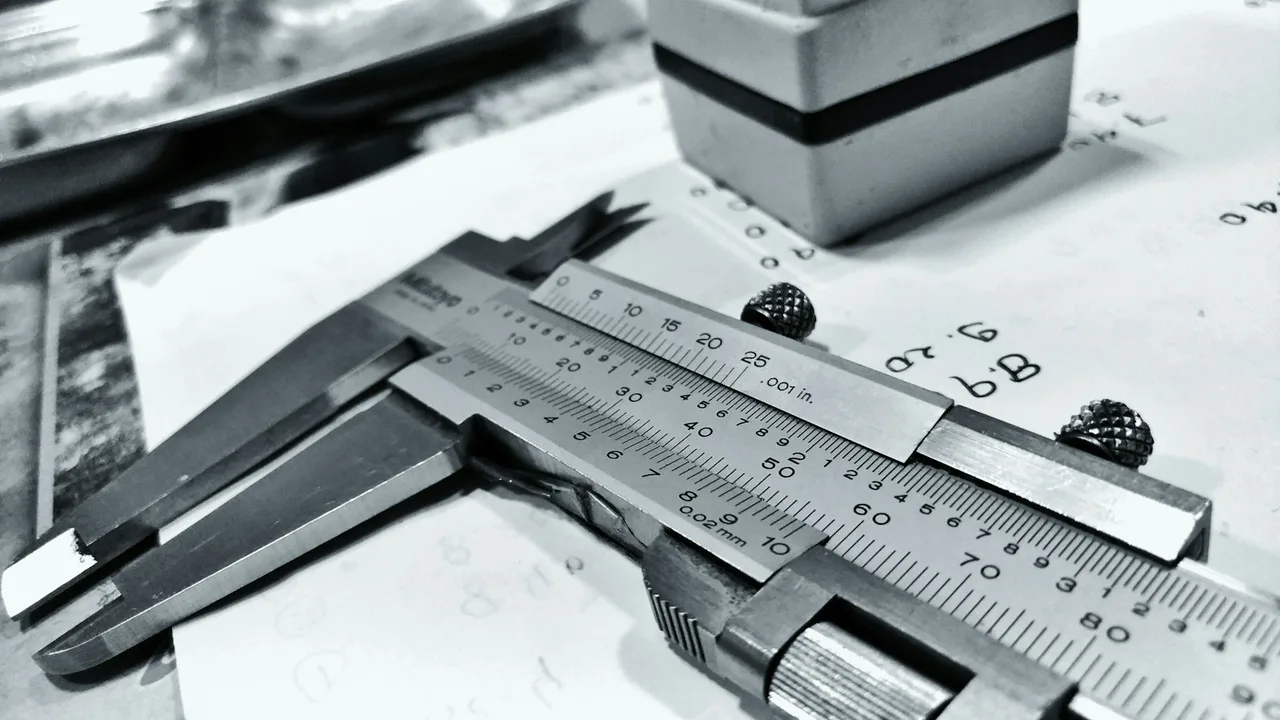
Outside scientific writing the older word is still everywhere, and there is a practical reason for it. In American English, micron keeps the unit apart from the micrometer, which is also the name of a workshop instrument for measuring thickness[2]. A filter rated at five microns and a micrometer screw gauge sitting in a drawer are two different things, and the two words keep them separate.
How many millimeters are in a micron?
A micron is 0.001 millimeters, one thousandth of a millimeter. To turn microns into millimeters you divide the number of microns by a thousand, so 50 µm gives 0.05 mm. The same divisor holds at every value, from a tenth of a micron up to several thousand microns.
The thousand comes straight from the prefixes. A millimeter is 10⁻³ of a meter and a micrometer is 10⁻⁶ of a meter[1]. The exponents are three apart, so a millimeter is a thousand times longer than a micron and the divisor is exact.
Written as a decimal, the whole calculation is a shift of the point three places to the left. A value of 250 µm becomes 0.25 mm that way. One- and two-digit numbers get zeros in the empty places, so 25 µm gives 0.025 mm. One micron is 0.001 mm, a single digit in the third decimal place.
The converter at the top of the page does this as you type.
How do you convert microns to millimeters? Formula and example
The formula has one shape: millimeters = microns ÷ 1000. Multiplying by 0.001 gives the same answer, because one thousandth is the reciprocal of a thousand.
Take the PM10 threshold used for air quality. The EPA describes PM10 as inhalable particles with diameters that are generally 10 micrometers and smaller[5]. Divided by a thousand, that is 0.01 mm, one hundredth of a millimeter.
The same relationship links the neighbouring units of the scale. A nanometer is a thousand times smaller than a micron, and the nanometers to millimeters converter handles it. For the opposite direction, use the millimeters to microns converter. Finished millimeters go to centimeters in the millimeters to centimeters converter, and to inches in the millimeters to inches converter.
How many millimeters is a given number of microns?
| Microns | Millimeters |
|---|---|
| 0.1 µm | 0.0001 mm |
| 0.5 µm | 0.0005 mm |
| 1 µm | 0.001 mm |
| 2 µm | 0.002 mm |
| 3 µm | 0.003 mm |
| 4 µm | 0.004 mm |
| 5 µm | 0.005 mm |
| 6 µm | 0.006 mm |
| 8 µm | 0.008 mm |
| 10 µm | 0.01 mm |
| 12 µm | 0.012 mm |
| 15 µm | 0.015 mm |
| 20 µm | 0.02 mm |
| 25 µm | 0.025 mm |
| 30 µm | 0.03 mm |
| 40 µm | 0.04 mm |
| 50 µm | 0.05 mm |
| 60 µm | 0.06 mm |
| 70 µm | 0.07 mm |
| 75 µm | 0.075 mm |
| 80 µm | 0.08 mm |
| 90 µm | 0.09 mm |
| 100 µm | 0.1 mm |
| 125 µm | 0.125 mm |
| 150 µm | 0.15 mm |
| 200 µm | 0.2 mm |
| 250 µm | 0.25 mm |
| 300 µm | 0.3 mm |
| 400 µm | 0.4 mm |
| 500 µm | 0.5 mm |
| 600 µm | 0.6 mm |
| 800 µm | 0.8 mm |
| 1000 µm | 1 mm |
| 2000 µm | 2 mm |
| 5000 µm | 5 mm |
What has a thickness or a diameter measured in microns?
| What is measured | In microns | In millimeters |
|---|---|---|
| Typical bacterium, length | 1–10 µm | 0.001–0.01 mm |
| PM2.5 threshold | 2.5 µm | 0.0025 mm |
| Red blood cell, diameter | 6–8 µm | 0.006–0.008 mm |
| Fog, mist or cloud droplet | about 10 µm | about 0.01 mm |
| PM10 threshold | 10 µm | 0.01 mm |
| Wool fibre, width | 10–55 µm | 0.01–0.055 mm |
| Human hair, diameter | 17–181 µm | 0.017–0.181 mm |
| Sheet of paper, thickness | 70–180 µm | 0.07–0.18 mm |
How do you convert a column of microns in a spreadsheet?
A single value goes into the converter at the top of the page, while a whole column of measurements takes one formula dragged down.
Excel: the CONVERT function with the u prefix
The formula reads =CONVERT(A1,"um","mm"). The prefix u stands for micro, a multiplier of 1E-06, and the prefix m in front of the metre symbol stands for milli. The documentation states that unit names and prefixes are case-sensitive, so both letters stay lowercase[6].Dividing by a thousand without a function
The formula =A1/1000 returns the same result as CONVERT and works in any spreadsheet, Google Sheets included. Put the divisor in cell B1 once and =A1/$B$1 drags down the column without the number being retyped.Set as many decimal places as the smallest value needs
A result of 0.025 mm needs three decimal places and 0.0125 mm needs four. Select the column of results, open the Format Cells dialog box from the Number group on the Home tab, and enter the figure you need in the Decimal places box[7].
Convert other units to Millimeters
Sources
- Resolution 12 of the 11th CGPM (1960): Système International d’Unités, list of prefixes — Bureau International des Poids et Mesures
- Micrometre — Wikipedia
- Resolution 7 of the 13th CGPM (1967): Abrogation of earlier decisions (micron, new candle) — Bureau International des Poids et Mesures
- NIST Guide to the SI, chapter 5.3.2: units outside the SI — National Institute of Standards and Technology
- Particulate Matter (PM) Basics — United States Environmental Protection Agency
- CONVERT function — Microsoft
- Format numbers as percentages in Excel (Format Cells dialog box) — Microsoft
Every figure in the tables was computed from the unit definitions and checked arithmetically before publication. Historical values and the names of local units come from the sources listed above.
Content last reviewed: · written and checked by the Arteon team
Common questions about converting microns to millimeters
Is a micron the same as a micrometer?
Yes, they are two names for the same length of 0.001 mm. Micron was accepted in 1879 and revoked by the SI in 1967[2], and the unit is now called a micrometer with the symbol µm. Filtration and textiles kept the older word.
Why do people still say micron rather than micrometer?
Because the word micrometer already names something else. In American English, micron keeps the unit of length apart from the micrometer, a measuring device[2]. A sentence such as “measure it with a micrometer to the nearest micron” reads clearly only when both words are in it.
How do I write the µ symbol in a spreadsheet formula?
You write the letter u instead. Excel takes u as the prefix for micro, so the unit goes into the CONVERT function as "um" and the documentation notes that the case of the letters matters[6].
Does the converter accept fractions of a micron?
Yes. Enter 0.1 µm and the result field shows 0.0001 mm. The field reads values written with a dot or a comma, so a figure copied from a spreadsheet or from a European datasheet goes straight in.
Help us improve our tools
Have an idea for a new feature, found a bug, or want to suggest another tool? Write to us — we reply within 24 hours.