Convert decimeters to millimeters
3.5 dm is 350 mm, because one decimeter, the metric unit a tenth of a meter long, holds exactly 100 millimeters. Type the number of decimeters and the millimeters appear as you type. The converter also works the other way when you type into the millimeter field.
What is a decimeter, and what is a millimeter?
Both are metric units of length taken from the meter. A decimeter is one tenth of a meter, ten centimeters or 3.937 inches[1]. A millimeter is one thousandth of a meter, the smallest division you see on a metric ruler. The prefixes explain the whole relationship: deci means a tenth and milli means a thousandth[2], so a thousand millimeters divided into ten parts gives 100 millimeters in every decimeter.
In English the letters dm can be confusing, because on social media DM means a direct message. Here dm is always the decimeter, and mm is the unit you see on drill bits, screws, product dimensions and metric drawings. American spelling writes decimeter and millimeter, British spelling writes decimetre and millimetre[1], and both mean the same units.
The decimeter is also used in building design. Modular coordination sizes buildings and components in steps of a basic module called M, and ISO 1006 set it at 1 M = 100 mm[3]. The current standard, ISO 21723 from 2019, keeps that value and allows 4 inches, or 101.6 mm, in countries that build in imperial units[4]. One module is therefore one decimeter, and a dimension marked 6 M on a drawing means 600 mm.
How many millimeters are in a decimeter?
There are 100 millimeters in a decimeter. Multiply the number of decimeters by 100: millimeters = decimeters × 100.
In your head, move the decimal point two places to the right. 3.5 dm becomes 350 mm and 1.2 dm becomes 120 mm. When there are fewer than two digits after the point, fill the gap with zeros: 12 dm is 1,200 mm and 0.05 dm is 5 mm.
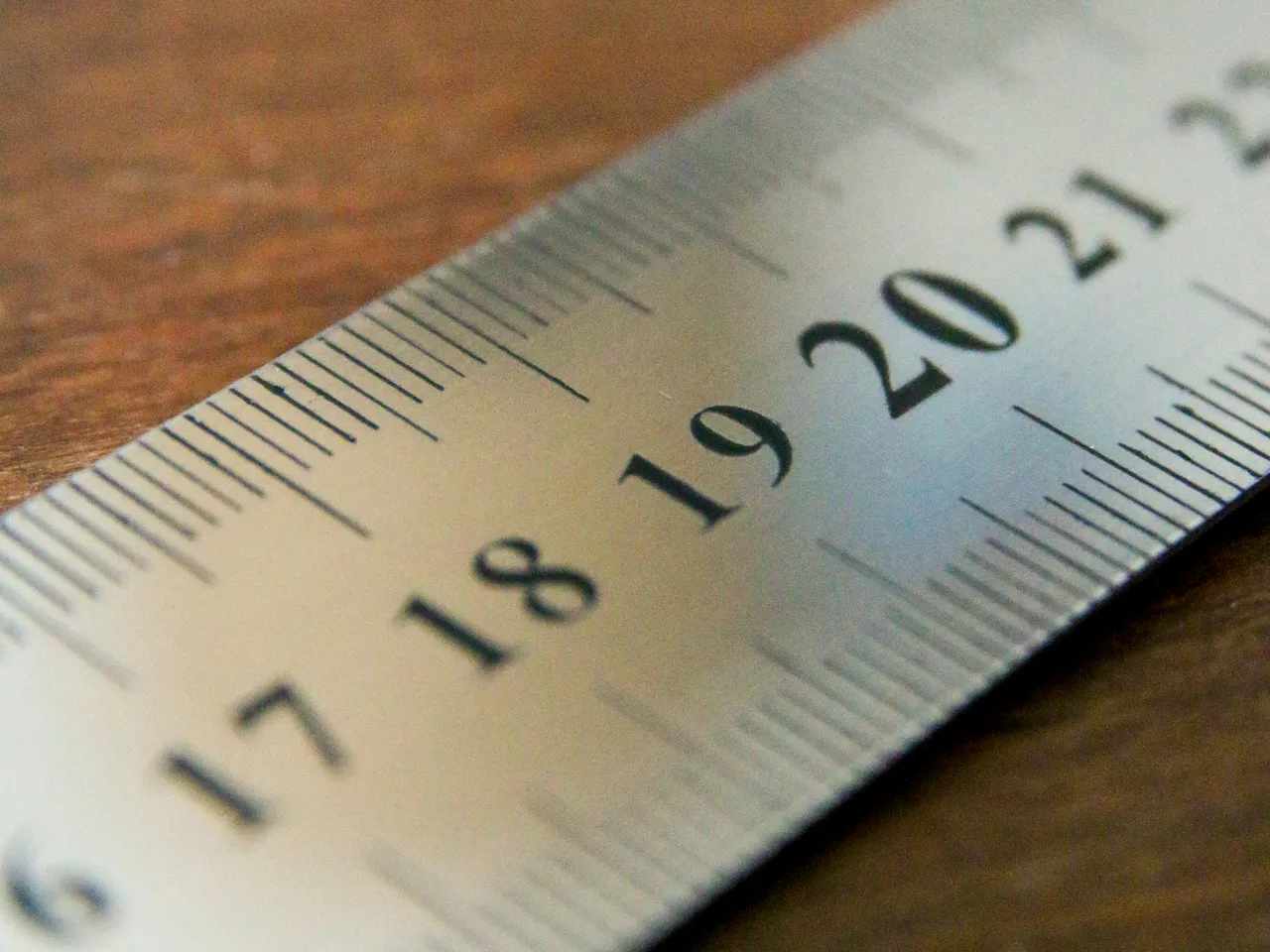
The usual mistake is to multiply by 10, the way you do for centimeters, which makes the answer ten times too small. A quick check on a ruler settles it: one decimeter runs from 0 to 10 cm, and the marks split it into 100 millimeter steps. For the opposite direction, use the mm to dm converter.
How many millimeters is a given number of decimeters?
| Decimeters | Millimeters | Centimeters |
|---|---|---|
| 0.01 dm | 1 mm | 0.1 cm |
| 0.05 dm | 5 mm | 0.5 cm |
| 0.1 dm | 10 mm | 1 cm |
| 0.25 dm | 25 mm | 2.5 cm |
| 0.5 dm | 50 mm | 5 cm |
| 1 dm | 100 mm | 10 cm |
| 1.2 dm | 120 mm | 12 cm |
| 1.5 dm | 150 mm | 15 cm |
| 2 dm | 200 mm | 20 cm |
| 2.5 dm | 250 mm | 25 cm |
| 3 dm | 300 mm | 30 cm |
| 4 dm | 400 mm | 40 cm |
| 5 dm | 500 mm | 50 cm |
| 6 dm | 600 mm | 60 cm |
| 7 dm | 700 mm | 70 cm |
| 8 dm | 800 mm | 80 cm |
| 9 dm | 900 mm | 90 cm |
| 10 dm | 1,000 mm | 100 cm |
| 12 dm | 1,200 mm | 120 cm |
| 15 dm | 1,500 mm | 150 cm |
| 20 dm | 2,000 mm | 200 cm |
| 25 dm | 2,500 mm | 250 cm |
| 50 dm | 5,000 mm | 500 cm |
| 87 dm | 8,700 mm | 870 cm |
| 100 dm | 10,000 mm | 1,000 cm |
Which number formats does this converter handle?
| What you type | What the converter shows | Note |
|---|---|---|
| 2.5 | 250 mm | The decimal point is how English writes decimals, and that is how we read it. |
| 2,5 | 250 mm | A comma pasted from a European document is read as a decimal point, so the result stays the same. |
| 1,500 | 150000 mm | Three digits follow the comma, so we read it as a thousands separator and convert one thousand five hundred decimeters. A note under the field shows the other possible reading, 1.5. |
| 1 500 | 150000 mm | A space between the thousands, common in scientific writing, is ignored, so this is also one thousand five hundred. |
| 3/4 | 75 mm | We work out a fraction written with a slash ourselves, so you do not need to turn it into a decimal first. |
| 1½ | 150 mm | The ½ character copied from a worksheet or a document is added to the number in front of it. |
| 2.5 dm | 250 mm | A unit symbol pasted along with the number does no harm, because we take the number and leave the symbol out. |
Convert other units to Millimeters
Convert Decimeters to other units
Sources
- Decimetre — Wikipedia
- SI prefixes — Bureau International des Poids et Mesures
- ISO 1006:1983 Building construction – Modular coordination – Basic module — International Organization for Standardization
- ISO 2848 — Wikipedia
- CONVERT function — Microsoft
Every figure in the tables was computed from the unit definitions and checked arithmetically before publication. Historical values and the names of local units come from the sources listed above.
Content last reviewed: · written and checked by the Arteon team
Frequently asked questions about decimeters and millimeters
Is a decimeter smaller than a millimeter?
No. A decimeter is 100 times longer than a millimeter. That is why the number grows when you convert dm to mm and shrinks when you convert mm to dm.
How many millimeters are in 87 decimeters?
87 decimeters are 8,700 millimeters, a little under 9 meters. Move the decimal point two places to the right, or type 87 in the field above.
How many square millimeters are in a square decimeter?
A square decimeter holds 10,000 square millimeters, because for area the factor of 100 applies twice. For volume it applies three times, so a cubic decimeter, the size of one liter, holds a million cubic millimeters. This converter handles length only.
How do I convert dm to mm in Excel?
Use the CONVERT function and put the prefix in front of the meter code: "d" stands for deci and "m" for milli. The formula =CONVERT(A1,"dm","mm") turns the value in cell A1 into millimeters[5]. A plain =A1*100 gives the same result.
Have a question or a suggestion?
Write to us if the converter is missing a unit you need, or if something on this page needs fixing.