Convert centimeters to kilometers
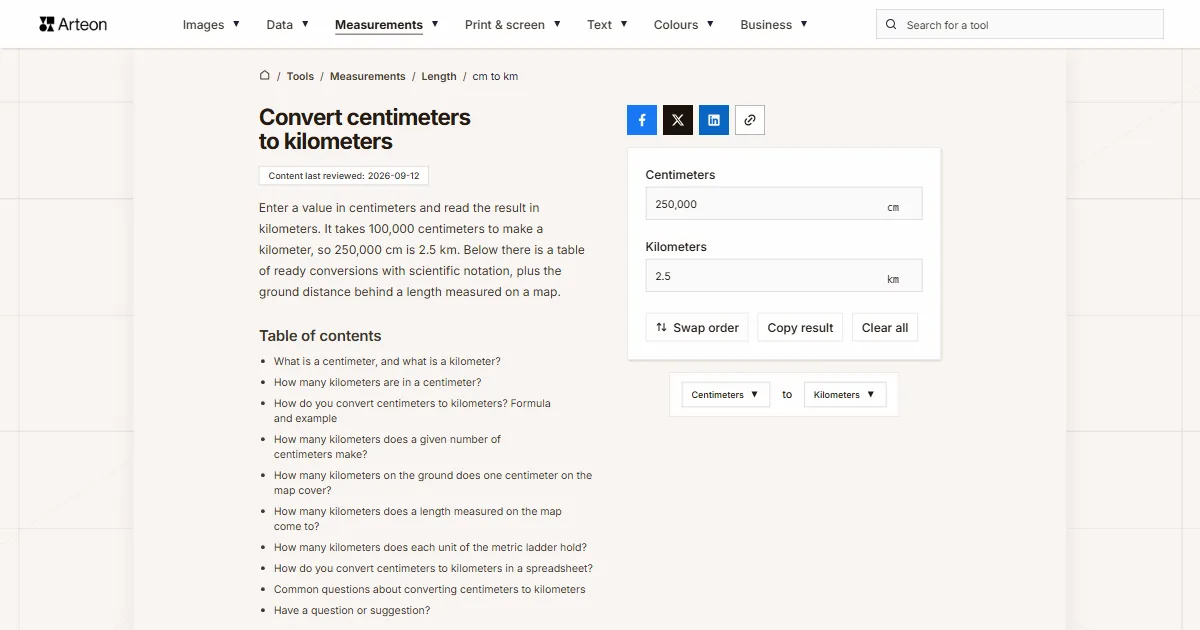
Enter a value in centimeters and read the result in kilometers. It takes 100,000 centimeters to make a kilometer, so 250,000 cm is 2.5 km. Below there is a table of ready conversions with scientific notation, plus the ground distance behind a length measured on a map.
What is a centimeter, and what is a kilometer?
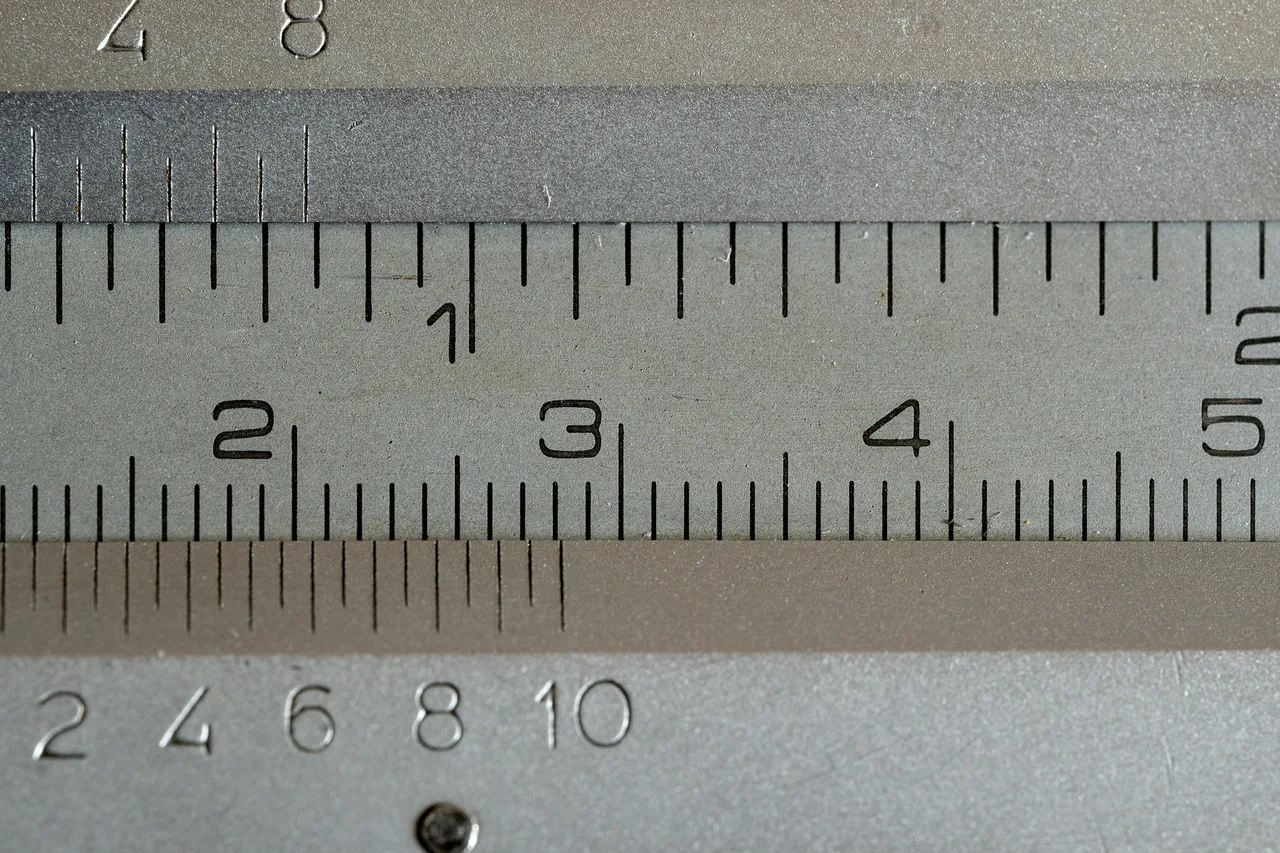
A centimeter is the unit you can see on a ruler: one hundredth of a meter, divided further into ten millimeters. It is the scale for height, furniture and paper sizes, because the answer stays within two or three digits.
The kilometer describes the far end of the same scale. It holds 1,000 meters and it is the preferred unit for distances between places on land in most of the world; the United States, the United Kingdom and Liberia are the exceptions, where the statute mile is used[1]. Both units take their value from the meter and from an SI prefix: centi- is one hundredth and kilo- is one thousand[2].
That is where the distance between them comes from. Turning a centimeter into a kilometer means growing it one hundred thousand times, because five rungs of the metric ladder separate them. One centimeter written in kilometers therefore carries four zeros after the point before the first digit arrives, and the field above and the table below both hand you that number straight away.
How many kilometers are in a centimeter?
One centimeter is 0.00001 kilometers. Read the other way the arithmetic gives a round figure: 100,000 centimeters make exactly one kilometer.
Every conversion in this direction comes down to dividing the number of centimeters by one hundred thousand. One thousand centimeters is 0.01 kilometers. Ten thousand centimeters gives 0.1 kilometers. Five hundred thousand centimeters is 5 kilometers.
Short lengths start with a run of zeros, and that is when reading the answer off a ready table is quickest. One hundred centimeters, a meter, is 0.001 kilometers. Twenty-five thousand centimeters gives 0.25 kilometers, a quarter of a kilometer.
Scientific notation states the same values more briefly. A centimeter is 1 × 10⁻⁵ km, and a thousand centimeters is 1 × 10⁻² km. A negative exponent counts the places the decimal point moves to the left.
The converter above works in both directions and shows the result while you are still typing, so you can check any number of centimeters without counting zeros.
How do you convert centimeters to kilometers? Formula and example
The conversion rests on a fixed relationship: 100,000 centimeters make one kilometer. To turn centimeters into kilometers you divide their number by one hundred thousand.
The full formula: kilometers = centimeters ÷ 100,000. The other way round: centimeters = kilometers × 100,000.
Three examples of different sizes come out of that formula. Two hundred and fifty thousand centimeters divided by one hundred thousand gives 2.5 kilometers. Five thousand centimeters is 0.05 kilometers, that is fifty meters. One hundred centimeters, a meter, works out at 0.001 kilometers.
On paper the division is a single move of the decimal point, five places to the left. From 150,000 centimeters you get 1.5 kilometers, and from 4.5 centimeters you get 0.000045 kilometers. Fill the places in front of the digits with zeros.
In the other direction the operation is reversed: you multiply by one hundred thousand and the point travels five places to the right. That is what the kilometers to centimeters converter does. If going through meters suits you better, the centimeters to meters converter handles that step.
How many kilometers does a given number of centimeters make?
| Centimeters | Kilometers | Scientific notation |
|---|---|---|
| 1 cm | 0.00001 km | 1 × 10⁻⁵ km |
| 2 cm | 0.00002 km | 2 × 10⁻⁵ km |
| 2.5 cm | 0.000025 km | 2.5 × 10⁻⁵ km |
| 4.5 cm | 0.000045 km | 4.5 × 10⁻⁵ km |
| 5 cm | 0.00005 km | 5 × 10⁻⁵ km |
| 6 cm | 0.00006 km | 6 × 10⁻⁵ km |
| 7 cm | 0.00007 km | 7 × 10⁻⁵ km |
| 7.5 cm | 0.000075 km | 7.5 × 10⁻⁵ km |
| 10 cm | 0.0001 km | 1 × 10⁻⁴ km |
| 12 cm | 0.00012 km | 1.2 × 10⁻⁴ km |
| 15 cm | 0.00015 km | 1.5 × 10⁻⁴ km |
| 20 cm | 0.0002 km | 2 × 10⁻⁴ km |
| 24 cm | 0.00024 km | 2.4 × 10⁻⁴ km |
| 25 cm | 0.00025 km | 2.5 × 10⁻⁴ km |
| 30 cm | 0.0003 km | 3 × 10⁻⁴ km |
| 50 cm | 0.0005 km | 5 × 10⁻⁴ km |
| 85 cm | 0.00085 km | 8.5 × 10⁻⁴ km |
| 100 cm | 0.001 km | 1 × 10⁻³ km |
| 500 cm | 0.005 km | 5 × 10⁻³ km |
| 825 cm | 0.00825 km | 8.25 × 10⁻³ km |
| 1,000 cm | 0.01 km | 1 × 10⁻² km |
| 2,050 cm | 0.0205 km | 2.05 × 10⁻² km |
| 2,500 cm | 0.025 km | 2.5 × 10⁻² km |
| 3,200 cm | 0.032 km | 3.2 × 10⁻² km |
| 4,900 cm | 0.049 km | 4.9 × 10⁻² km |
| 5,000 cm | 0.05 km | 5 × 10⁻² km |
| 7,500 cm | 0.075 km | 7.5 × 10⁻² km |
| 10,000 cm | 0.1 km | 1 × 10⁻¹ km |
| 50,000 cm | 0.5 km | 5 × 10⁻¹ km |
| 91,000 cm | 0.91 km | 9.1 × 10⁻¹ km |
| 100,000 cm | 1 km | 1 × 10⁰ km |
| 500,000 cm | 5 km | 5 × 10⁰ km |
| 1,000,000 cm | 10 km | 1 × 10¹ km |
| 10,000,000 cm | 100 km | 1 × 10² km |
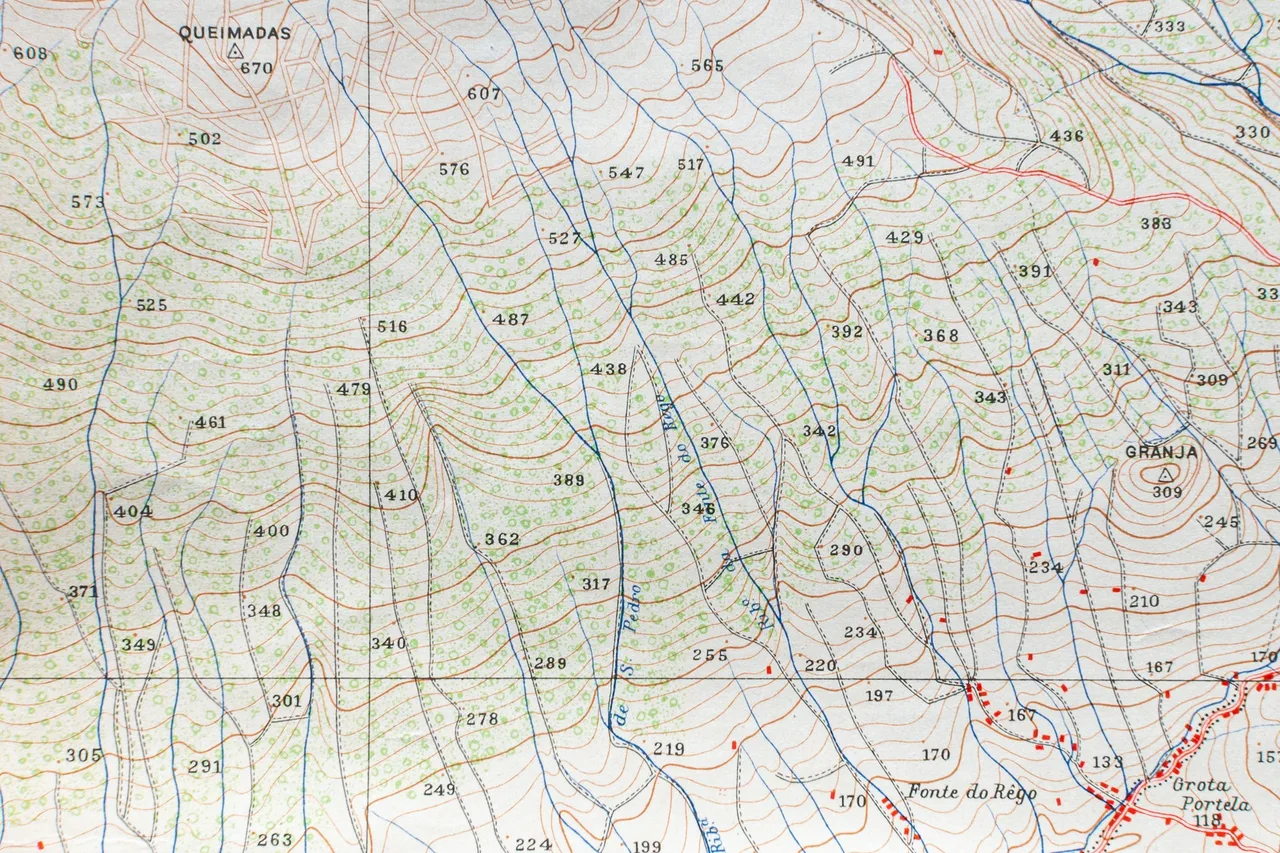
How many kilometers on the ground does one centimeter on the map cover?
| Map scale | Distance on the ground | Where you meet this scale |
|---|---|---|
| 1:5,000 | 0.05 km | Cadastral and planning maps |
| 1:10,000 | 0.1 km | Large-scale urban mapping |
| 1:24,000 | 0.24 km | USGS US Topo quadrangles across the United States |
| 1:25,000 | 0.25 km | OS Explorer walking maps in Great Britain |
| 1:50,000 | 0.5 km | OS Landranger maps covering a whole region |
| 1:100,000 | 1 km | County and cycling maps |
| 1:200,000 | 2 km | State and county overview maps |
| 1:500,000 | 5 km | Country-wide driving maps |
| 1:1,000,000 | 10 km | Overview maps and atlases |
How many kilometers does a length measured on the map come to?
| Length on the map | Scale 1:25,000 | Scale 1:50,000 | Scale 1:100,000 |
|---|---|---|---|
| 2 cm on the map | 0.5 km | 1 km | 2 km |
| 2.5 cm on the map | 0.625 km | 1.25 km | 2.5 km |
| 3 cm on the map | 0.75 km | 1.5 km | 3 km |
| 4 cm on the map | 1 km | 2 km | 4 km |
| 5 cm on the map | 1.25 km | 2.5 km | 5 km |
| 7.5 cm on the map | 1.875 km | 3.75 km | 7.5 km |
| 10 cm on the map | 2.5 km | 5 km | 10 km |
| 12 cm on the map | 3 km | 6 km | 12 km |
| 15 cm on the map | 3.75 km | 7.5 km | 15 km |
| 20 cm on the map | 5 km | 10 km | 20 km |
How many kilometers does each unit of the metric ladder hold?
| Unit | Symbol | Kilometers | Scientific notation |
|---|---|---|---|
| Millimeter | mm | 0.000001 km | 1 × 10⁻⁶ km |
| Centimeter | cm | 0.00001 km | 1 × 10⁻⁵ km |
| Decimeter | dm | 0.0001 km | 1 × 10⁻⁴ km |
| Meter | m | 0.001 km | 1 × 10⁻³ km |
| Dekameter | dam | 0.01 km | 1 × 10⁻² km |
| Hectometer | hm | 0.1 km | 1 × 10⁻¹ km |
| Kilometer | km | 1 km | 1 × 10⁰ km |
How do you convert centimeters to kilometers in a spreadsheet?
For a single value the field above is quicker, but for a whole column of measurements the spreadsheet does it with one formula dragged downwards.
Excel: the CONVERT function
The syntax is CONVERT(number, from_unit, to_unit). The centimeter is written "cm" and the kilometer "km", so for a value in cell A1 the formula reads =CONVERT(A1,"cm","km"). The prefixes c and k may be put in front of any metric unit argument[5].Plain division, if you would rather skip the function
The formula =A1/100000 gives the same result and works in every spreadsheet, including Google Sheets and LibreOffice Calc. In the default General format Excel shows fewer decimal places so that the number fits the width of the cell, which can make the result for a few centimeters look rounded[6].More decimal places, or a power of ten
To see the full result for a few centimeters, select the column and in Excel go to the Home tab, in the Number group, and click Increase Decimal until six places show. Picking Scientific from the number format list instead gives 4.50E-05, the same value written as a power of ten[7].Check the result on a single cell
Before you drag the formula down the whole column, type 250000 into cell A1 and check that the result reads 2.5. A #VALUE! message where the result should be means Excel does not read the content of cell A1 as a number, for example when a unit has been typed next to the value. Leave just the number in the cell[5].
Convert other units to Kilometers
Convert Centimeters to other units
Sources
- Kilometre — Wikipedia
- SI prefixes — Bureau International des Poids et Mesures
- A Beginner’s Guide to Map Scales — Ordnance Survey
- US Topo: Maps for America — U.S. Geological Survey
- CONVERT function — Microsoft
- Stop showing rounded numbers — Microsoft
- Display numbers in scientific (exponential) notation — Microsoft
Every figure in the tables was computed from the unit definitions and checked arithmetically before publication. Historical values and the names of local units come from the sources listed above.
Content last reviewed: · written and checked by the Arteon team
Common questions about converting centimeters to kilometers
How many kilometers are in 1 centimeter?
A centimeter is 0.00001 kilometers. Written as a common fraction it is one hundred-thousandth of a kilometer, and in scientific notation 1 × 10⁻⁵ km.
How many kilometers are in 100,000 cm?
One hundred thousand centimeters make exactly one kilometer. Ten thousand centimeters gives 0.1 kilometers, and one thousand centimeters 0.01 kilometers.
How many kilometers are in 4.5 cm?
Four and a half centimeters is 0.000045 kilometers, that is 4.5 × 10⁻⁵ km. The same length written in meters comes to 0.045 m.
How do you read a ground distance off a length measured on a map?
You multiply the length you measured by the number after the colon and divide by one hundred thousand. Five centimeters on a 1:50,000 map gives 250,000 centimeters, and dividing brings that to 2.5 kilometers. Ready answers for three scales are in the table of measured lengths on this page.
How many kilometers are in 1 meter?
A meter is 0.001 kilometers, because a kilometer holds 1,000 meters. One hundred meters gives 0.1 kilometers, and five hundred meters 0.5 kilometers. A whole table of those values sits on the meters to kilometers converter.
Why does the divisor carry five zeros?
Because it takes five steps up the metric ladder to get from the centimeter to the kilometer, and each step multiplies the value by ten. On the way you pass four units, the decimeter, the meter, the dekameter and the hectometer, so 10 × 10 × 10 × 10 × 10 makes 100,000.
Will the tool show a result for just a few centimeters?
Yes. The result field carries up to seven decimal places, so 4.5 cm shows up as 0.000045 km and one millimeter, that is 0.1 cm, as 0.000001 km. You can type the value with a point or a comma, and as a simple fraction such as 1/2 as well.
Have a question or suggestion?
If you spotted an error in the tables or have an idea to improve the converter, write to us — we reply within 24 hours.