Convert centimeters to yards
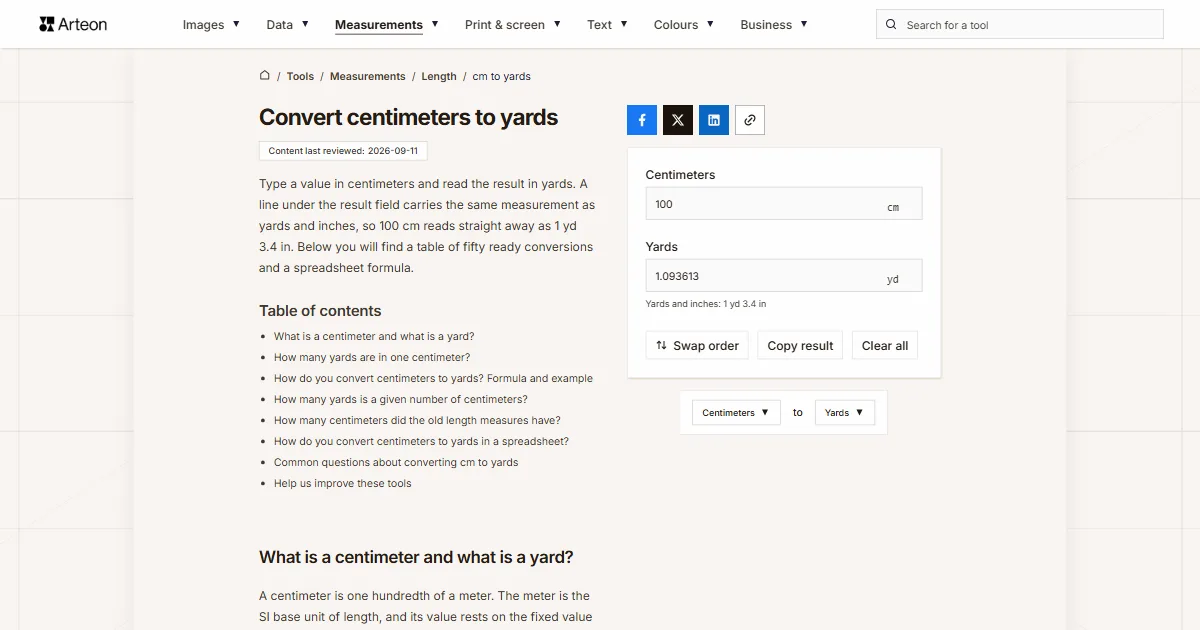
Type a value in centimeters and read the result in yards. A line under the result field carries the same measurement as yards and inches, so 100 cm reads straight away as 1 yd 3.4 in. Below you will find a table of fifty ready conversions and a spreadsheet formula.
What is a centimeter and what is a yard?
A centimeter is one hundredth of a meter. The meter is the SI base unit of length, and its value rests on the fixed value of the speed of light: it is the distance light travels in a vacuum in 1/299 792 458 of a second[1]. The centimeter carries the same exactness, so the number you type into the centimeters field has an unambiguous reference.
The yard belongs to the imperial system and splits into three feet, which makes 36 inches; the yards to feet converter handles that split. Its length now comes straight from the meter. The international yard and pound agreement fixed the yard at exactly 0.9144 meter, and that value has applied since 1 July 1959[2]. In centimeters the yard measures exactly 91.44.
In football (soccer) the Laws of the Game give each dimension in meters with yards in brackets, and the penalty area reaches 16.5 meters, or 18 yards, into the field of play[3]. On road signs in the United Kingdom, shorter distances are given in yards, as the law requires[4].
How many yards are in one centimeter?
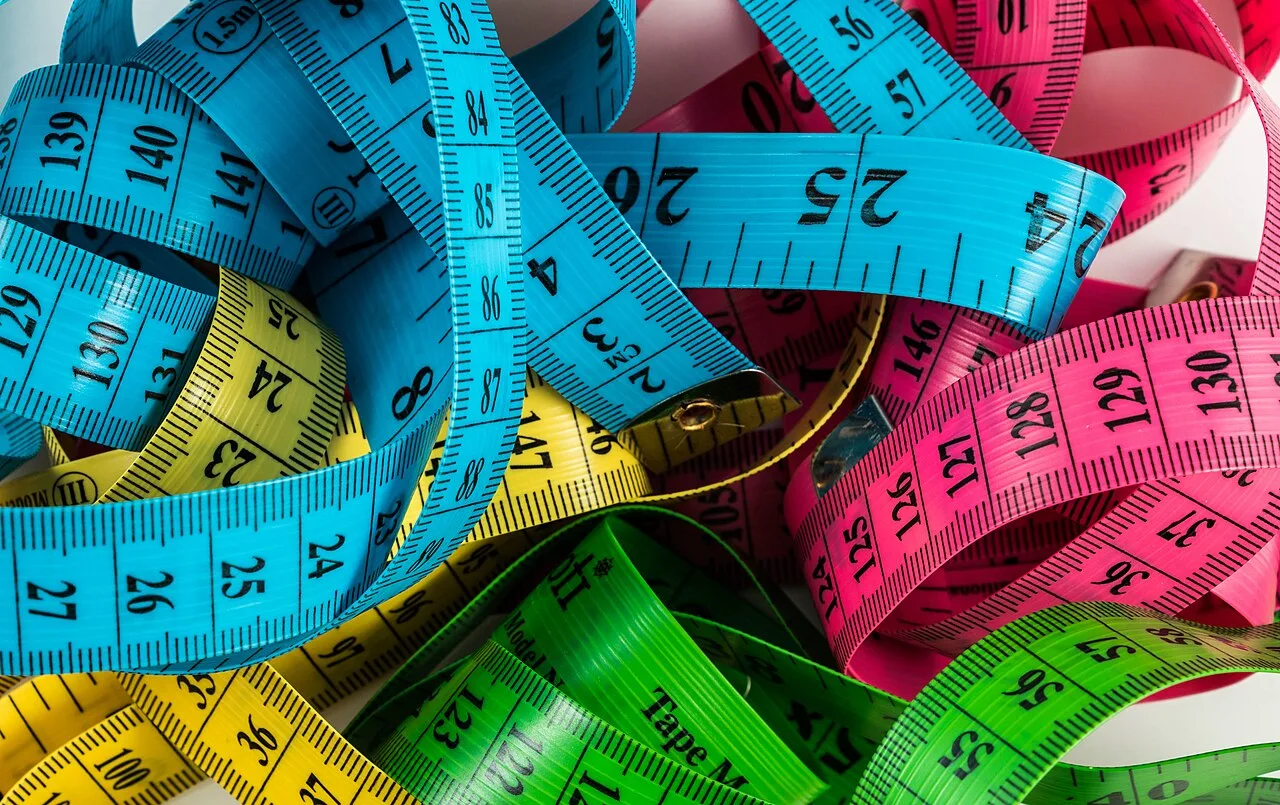
One centimeter is 0.010936 yard. The other direction is exact: a yard measures 91.44 centimeters. To turn centimeters into yards, divide the value by 91.44.
Only multiples of 91.44 give a whole number of yards. A value of 91.44 cm gives exactly one yard. A value of 182.88 cm gives exactly two yards. A value of 457.2 cm gives exactly five yards. Any other value leaves a remainder, and that remainder can be written in two ways.
In the United States and the United Kingdom, fabric is bought by the yard, divided into eighths[4]. A yard holds 36 inches, so the converter also gives the remainder in inches. The result field holds the decimal value, and the line under it holds the same length written as yards and inches. A meter, 100 cm, comes to 1.093613 yard or 1 yd 3.4 in. Short pieces carry both notations as well: 30 cm is 0.328084 yard, and in the inch notation 0 yd 11.8 in.
How do you convert centimeters to yards? Formula and example
The calculation takes one step: divide the number of centimeters by 91.44. That divisor is exact, because a yard measures precisely that many centimeters, so the result is as accurate as your measurement was.
Take three meters of fabric. Three hundred centimeters divided by 91.44 gives 3.28084 yards. The whole part is three full yards. The remainder is 0.28084 yard, and multiplied by 36 it gives 10.1 inches. Written as yards and inches, that makes 3 yd 10.1 in.
You can also work through inches. Divide the centimeters by 2.54, then divide the resulting inches by 36. The answer comes out the same, and the centimeters to inches converter takes care of the first step.
Going the other way means multiplying by 91.44. The yards to centimeters converter does that, and its input field accepts a length typed straight in as yards with inches. For longer distances quoted in meters, reach for the meters to yards converter.
How many yards is a given number of centimeters?
| Centimeters | Yards | Yards and inches |
|---|---|---|
| 1 cm | 0.010936 yd | 0 yd 0.4 in |
| 5 cm | 0.054681 yd | 0 yd 2 in |
| 10 cm | 0.109361 yd | 0 yd 3.9 in |
| 16 cm | 0.174978 yd | 0 yd 6.3 in |
| 20 cm | 0.218723 yd | 0 yd 7.9 in |
| 22 cm | 0.240595 yd | 0 yd 8.7 in |
| 25 cm | 0.273403 yd | 0 yd 9.8 in |
| 30 cm | 0.328084 yd | 0 yd 11.8 in |
| 40 cm | 0.437445 yd | 0 yd 15.7 in |
| 50 cm | 0.546807 yd | 0 yd 19.7 in |
| 60 cm | 0.656168 yd | 0 yd 23.6 in |
| 70 cm | 0.765529 yd | 0 yd 27.6 in |
| 80 cm | 0.874891 yd | 0 yd 31.5 in |
| 90 cm | 0.984252 yd | 0 yd 35.4 in |
| 91.44 cm | 1 yd | 1 yd 0 in |
| 100 cm | 1.093613 yd | 1 yd 3.4 in |
| 110 cm | 1.202975 yd | 1 yd 7.3 in |
| 120 cm | 1.312336 yd | 1 yd 11.2 in |
| 130 cm | 1.421697 yd | 1 yd 15.2 in |
| 140 cm | 1.531059 yd | 1 yd 19.1 in |
| 145 cm | 1.585739 yd | 1 yd 21.1 in |
| 150 cm | 1.64042 yd | 1 yd 23.1 in |
| 160 cm | 1.749781 yd | 1 yd 27 in |
| 170 cm | 1.859143 yd | 1 yd 30.9 in |
| 180 cm | 1.968504 yd | 1 yd 34.9 in |
| 190 cm | 2.077865 yd | 2 yd 2.8 in |
| 200 cm | 2.187227 yd | 2 yd 6.7 in |
| 210 cm | 2.296588 yd | 2 yd 10.7 in |
| 220 cm | 2.405949 yd | 2 yd 14.6 in |
| 230 cm | 2.515311 yd | 2 yd 18.6 in |
| 250 cm | 2.734033 yd | 2 yd 26.4 in |
| 260 cm | 2.843395 yd | 2 yd 30.4 in |
| 280 cm | 3.062117 yd | 3 yd 2.2 in |
| 288 cm | 3.149606 yd | 3 yd 5.4 in |
| 300 cm | 3.28084 yd | 3 yd 10.1 in |
| 320 cm | 3.499563 yd | 3 yd 18 in |
| 340 cm | 3.718285 yd | 3 yd 25.9 in |
| 350 cm | 3.827647 yd | 3 yd 29.8 in |
| 360 cm | 3.937008 yd | 3 yd 33.7 in |
| 380 cm | 4.155731 yd | 4 yd 5.6 in |
| 400 cm | 4.374453 yd | 4 yd 13.5 in |
| 450 cm | 4.92126 yd | 4 yd 33.2 in |
| 500 cm | 5.468066 yd | 5 yd 16.9 in |
| 600 cm | 6.56168 yd | 6 yd 20.2 in |
| 900 cm | 9.84252 yd | 9 yd 30.3 in |
| 914 cm | 9.995626 yd | 9 yd 35.8 in |
| 1,000 cm | 10.936133 yd | 10 yd 33.7 in |
| 2,100 cm | 22.965879 yd | 22 yd 34.8 in |
| 11,900 cm | 130.139983 yd | 130 yd 5 in |
| 48,100 cm | 526.027997 yd | 526 yd 1 in |
How many centimeters did the old length measures have?
| Measure | In centimeters | In yards | Where it applied |
|---|---|---|---|
| International yard | 91.44 cm | 1 yd | countries of the yard and pound agreement |
| Łokieć nowopolski | 57.6 cm | 0.63 yd | Kingdom of Poland from 1819 |
| Braccio fiorentino | 58.32 cm | 0.64 yd | Florence |
| Loket český | 59.3 cm | 0.65 yd | Kingdom of Bohemia from 1268 |
| Łokieć warszawski | 59.6 cm | 0.65 yd | Poland until 1819 |
| Preußische Elle | 66.68 cm | 0.73 yd | Prussia |
| Côvado | 68 cm | 0.74 yd | Portugal until 1852 |
| Wiener Tuchelle | 77.6 cm | 0.85 yd | Vienna |
| Vara castellana | 83.59 cm | 0.91 yd | Castile |
| Vara portuguesa | 110 cm | 1.2 yd | Portugal until 1852 |
| English ell | 114.3 cm | 1.25 yd | England, in the cloth trade |
| Aune de Paris | 118.84 cm | 1.3 yd | France from 1540 |
How do you convert centimeters to yards in a spreadsheet?
For a single value the field above is quicker. For a whole column of measurements a spreadsheet does the job with one formula dragged down.
Excel: the CONVERT function
The syntax is CONVERT(number, from_unit, to_unit). The centimeter carries the code "cm" and the yard the code "yd", so for a value in cell A1 the formula reads =CONVERT(A1,"cm","yd")[7].Plain division, if you would rather skip the function
The formula =A1/91.44 gives the same result and works in every spreadsheet, Google Sheets and LibreOffice Calc included. If you prefer multiplying, use =A1*0.010936 and keep in mind that this multiplier is rounded to six places.Yards and inches in two columns
The formula =INT(A1/91.44) gives whole yards and =MOD(A1/2.54,36) gives the inches left over. Side by side the two columns read the same way as the yards and inches line under the converter’s result field.Check the formula on one cell first
Before you drag the formula down the whole column, type 91.44 into cell A1 and check that the result is exactly 1. A #VALUE! message in place of the result means Excel does not read the content of cell A1 as a number, for example when a unit has been typed next to the value. Leave just the number in the cell[8].
Convert other units to Yards
Convert Centimeters to other units
Sources
- SI base unit: metre (m) — Bureau International des Poids et Mesures
- SI Units – Length — National Institute of Standards and Technology
- Laws of the Game – The Field of Play — The International Football Association Board
- Yard — Wikipedia
- Ell — Wikipedia
- Aune — Wikipedia
- CONVERT function — Microsoft
- How to correct a #VALUE! error — Microsoft
- U.S. Survey Foot: Revised Unit Conversion Factors — National Institute of Standards and Technology
Every figure in the tables was computed from the unit definitions and checked arithmetically before publication. Historical values and the names of local units come from the sources listed above.
Content last reviewed: · written and checked by the Arteon team
Common questions about converting cm to yards
Is a yard 100 centimeters?
A yard is 91.44 centimeters, which is 8.56 centimeters short of a meter. One hundred centimeters comes to 1.093613 yard.
Where does the divisor 91.44 come from?
A yard measures exactly 0.9144 meter, and a meter has 100 centimeters. Multiplying the two gives 91.44 centimeters, and that is the value the converter divides by.
What is the formula for cm to yards?
Divide the number of centimeters by 91.44. For 250 cm the arithmetic runs 250 ÷ 91.44 = 2.734033 yards.
How many yards is 100 cm?
One hundred centimeters is 1.093613 yard, or 1 yd 3.4 in. A running meter of fabric is therefore just under three and a half inches longer than a yard.
How many yards is 150 cm?
One hundred and fifty centimeters is 1.64042 yard, or 1 yd 23.1 in.
How many yards is 200 cm?
Two hundred centimeters is 2.187227 yards, or 2 yd 6.7 in.
How much is one yard of fabric?
A yard of fabric is a piece 91.44 centimeters long, measured along the bolt. The width of the material is a separate dimension, and the centimeters to inches converter turns the figure on the label into inches.
Is a yard the same as a meter?
A yard is 8.56 centimeters shorter than a meter. A meter is 1.093613 yard, so over ten meters the gap grows to 85.6 centimeters.
Can I read the result in inches as well?
Yes. A line under the result field carries the same length written as yards and inches, for example 3 yd 10.1 in for 300 cm.
How accurate is a cm to yard conversion?
The arithmetic is exact, because a yard is 91.44 centimeters by definition. Only the number of decimal places in the result is rounded.
Is there more than one yard?
One international yard of 0.9144 meter is in use. The survey yard followed from the U.S. survey foot, and NIST advises that definitions based on that foot be avoided after 31 December 2022 except for historic and legacy applications[9].
Why do yard calculators disagree?
The differences come from the number of decimal places a given page stops at. A calculator that rounds the yard to 0.91 meter shifts the result by 4.4 millimeters on every yard.
Help us improve these tools
Write to us if you would like other values in the table or have a question about how the converter works. We read every message and improve the pages.