Convert centimeters to decimeters
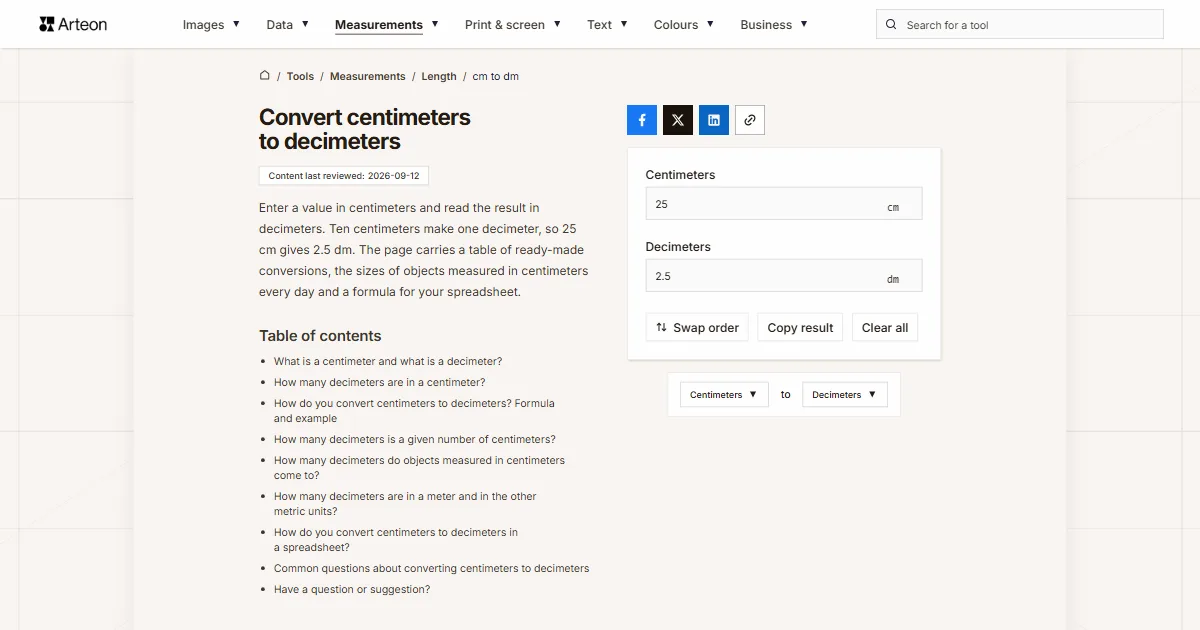
Enter a value in centimeters and read the result in decimeters. Ten centimeters make one decimeter, so 25 cm gives 2.5 dm. The page carries a table of ready-made conversions, the sizes of objects measured in centimeters every day and a formula for your spreadsheet.
What is a centimeter and what is a decimeter?
The starting point for both units is the meter cut into equal parts. Cutting it into a hundred gives the centimeter, cutting it into ten gives the decimeter[1]. That is why one decimeter holds ten centimeters.
The centimeter is the base unit of length in the centimetre–gram–second system, now deprecated, and it remains a practical unit for everyday measurement: human height is commonly given in centimeters[2]. One inch equals exactly 2.54 centimeters, so a centimeter comes to 0.3937 inches[2]. One cubic centimeter is one milliliter, so the same volume carries two names. The milliliters to liters converter handles that side of the family.
The decimeter covers lengths an order of magnitude larger. It earns its place where the count of centimeters climbs into the tens and working in tens is easier: on the scale of a measuring instrument, or on an area written in square decimeters.
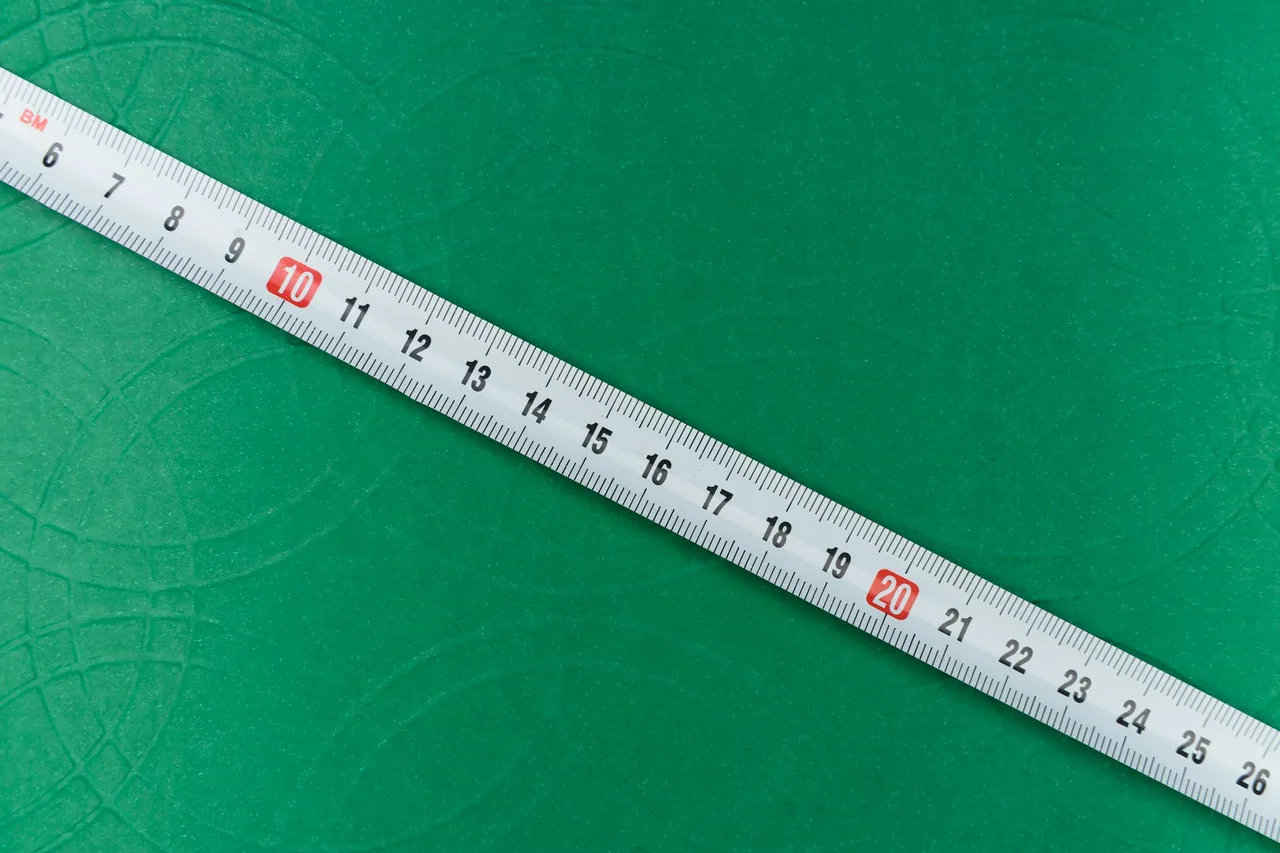
For a reader raised on inches there is one figure worth keeping: a decimeter is 3.937 inches, a shade under four. Ten centimeters and just under four inches describe the same length, and that single pairing makes every row of the conversion table easy to picture.
How many decimeters are in a centimeter?
A centimeter is 0.1 decimeters. Ten centimeters make exactly one decimeter. One hundred centimeters give ten decimeters, which is one meter.
Every conversion in this direction comes down to dividing the number of centimeters by ten. Twenty-five centimeters is 2.5 decimeters. Fifty centimeters gives 5 decimeters. Eighty centimeters is 8 decimeters.
For figures ending in zero you get the answer by striking that zero out, so those values you can quote from memory. Sixty centimeters gives 6 decimeters. Ninety centimeters is 9 decimeters. For every other figure the decimal point moves one place to the left, so 23.6 cm becomes 2.36 dm and 5.21 cm becomes 0.521 dm.
Values below one centimeter drop past the hundredths of a decimeter. Seven hundredths of a centimeter, written 0.07 cm, is 0.007 dm. The result field shows three decimal places for exactly that reason.
The result appears in the field alongside as you type, and the Swap order button turns the conversion round to decimeters and centimeters.
How do you convert centimeters to decimeters? Formula and example
The conversion rests on one fixed relationship: ten centimeters make one decimeter. To turn centimeters into decimeters you divide their number by ten.
The full formula: decimeters = centimeters ÷ 10. The other way round: centimeters = decimeters × 10.
Three examples of different size follow from that formula. Twelve and a half centimeters divided by ten give 1.25 decimeters. One hundred centimeters is 10 decimeters. Five hundred and thirty-six centimeters gives 53.6 decimeters.
On paper the division is a single move. The digits stay as they are and the decimal point shifts one place to the left. From 47 centimeters you get 4.7 decimeters, and from 6.5 centimeters you get 0.65 decimeters. With a single digit in front, a zero takes its place before the point.
Going the other way the operation is reversed: you multiply by ten and the point travels one place to the right. That is exactly what the decimeters to centimeters converter does. If you want the answer in meters, the centimeters to meters converter gives it, and for the step down to millimeters there is the centimeters to millimeters converter.
How many decimeters is a given number of centimeters?
| Centimeters | Decimeters | Meters |
|---|---|---|
| 0.07 cm | 0.007 dm | 0.0007 m |
| 0.1 cm | 0.01 dm | 0.001 m |
| 0.277 cm | 0.0277 dm | 0.00277 m |
| 0.5 cm | 0.05 dm | 0.005 m |
| 1 cm | 0.1 dm | 0.01 m |
| 2 cm | 0.2 dm | 0.02 m |
| 3 cm | 0.3 dm | 0.03 m |
| 4.2 cm | 0.42 dm | 0.042 m |
| 5 cm | 0.5 dm | 0.05 m |
| 5.21 cm | 0.521 dm | 0.0521 m |
| 6 cm | 0.6 dm | 0.06 m |
| 6.5 cm | 0.65 dm | 0.065 m |
| 8 cm | 0.8 dm | 0.08 m |
| 9 cm | 0.9 dm | 0.09 m |
| 10 cm | 1 dm | 0.1 m |
| 12 cm | 1.2 dm | 0.12 m |
| 12.5 cm | 1.25 dm | 0.125 m |
| 14 cm | 1.4 dm | 0.14 m |
| 15 cm | 1.5 dm | 0.15 m |
| 20 cm | 2 dm | 0.2 m |
| 23.6 cm | 2.36 dm | 0.236 m |
| 25 cm | 2.5 dm | 0.25 m |
| 26.5 cm | 2.65 dm | 0.265 m |
| 30 cm | 3 dm | 0.3 m |
| 40 cm | 4 dm | 0.4 m |
| 45 cm | 4.5 dm | 0.45 m |
| 47 cm | 4.7 dm | 0.47 m |
| 50 cm | 5 dm | 0.5 m |
| 58 cm | 5.8 dm | 0.58 m |
| 60 cm | 6 dm | 0.6 m |
| 64 cm | 6.4 dm | 0.64 m |
| 80 cm | 8 dm | 0.8 m |
| 85 cm | 8.5 dm | 0.85 m |
| 86.2 cm | 8.62 dm | 0.862 m |
| 90 cm | 9 dm | 0.9 m |
| 93.6 cm | 9.36 dm | 0.936 m |
| 100 cm | 10 dm | 1 m |
| 200 cm | 20 dm | 2 m |
| 250 cm | 25 dm | 2.5 m |
| 536 cm | 53.6 dm | 5.36 m |
| 600 cm | 60 dm | 6 m |
| 678 cm | 67.8 dm | 6.78 m |
| 6,500 cm | 650 dm | 65 m |
How many decimeters do objects measured in centimeters come to?
| Object | Size in centimeters | Size in decimeters |
|---|---|---|
| Payment card, longer side (ID-1 format) | 8.56 cm | 0.856 dm |
| CD, diameter | 12 cm | 1.2 dm |
| A5 sheet, shorter side | 14.8 cm | 1.48 dm |
| A4 sheet, shorter side | 21 cm | 2.1 dm |
| A4 sheet, longer side | 29.7 cm | 2.97 dm |
| A3 sheet, longer side | 42 cm | 4.2 dm |
| A2 sheet, longer side | 59.4 cm | 5.94 dm |
| Side of a square with an area of 1 dm² | 10 cm | 1 dm |
How many decimeters are in a meter and in the other metric units?
| Unit | Symbol | Decimeters | Meters |
|---|---|---|---|
| Millimeter | mm | 0.01 dm | 0.001 m |
| Centimeter | cm | 0.1 dm | 0.01 m |
| Decimeter | dm | 1 dm | 0.1 m |
| Meter | m | 10 dm | 1 m |
| Decameter | dam | 100 dm | 10 m |
| Hectometer | hm | 1,000 dm | 100 m |
| Kilometer | km | 10,000 dm | 1,000 m |
How do you convert centimeters to decimeters in a spreadsheet?
For a single value the field above is quicker, but for a column of dimensions copied off a drawing a spreadsheet does the job with one formula dragged down.
Excel: the CONVERT function
The syntax is CONVERT(number, from_unit, to_unit). The unit code for the meter is "m" and prefixes go in front of it: "c" for centi and "d" for deci. For a value in cell A1 the formula is therefore =CONVERT(A1,"cm","dm")[6].Plain division if you would rather skip the function
The formula =A1/10 returns the same result and works in every spreadsheet, Google Sheets and LibreOffice Calc included. Set three decimal places on the column, because values below one centimeter drop into thousandths of a decimeter.Rounding the result with the ROUND function
When the result goes onto a drawing or into a summary, round it with =ROUND(A1/10,2). The second argument is called num_digits and says how many decimal places stay, so a two leaves hundredths of a decimeter[7].Checking the result on a single cell
Before you drag the formula down the column, put 25 into cell A1 and check that the answer reads 2.5. A #VALUE! message in place of the result means Excel is not reading cell A1 as a number, which happens when a unit has been typed next to the figure. Leave the cell holding just the number[6].
Convert other units to Decimeters
Convert Centimeters to other units
Sources
- SI prefixes — Bureau International des Poids et Mesures
- Centimetre — Wikipedia
- ISO/IEC 7810 — Wikipedia
- Compact Disc — Wikipedia
- ISO 216 — Wikipedia
- CONVERT function — Microsoft
- ROUND function — Microsoft
Every figure in the tables was computed from the unit definitions and checked arithmetically before publication. Historical values and the names of local units come from the sources listed above.
Content last reviewed: · written and checked by the Arteon team
Common questions about converting centimeters to decimeters
How many decimeters are in 1 centimeter?
A centimeter is 0.1 decimeters. Ten centimeters make one decimeter, so a single centimeter is a tenth of it.
How many decimeters is 100 cm?
One hundred centimeters is 10 decimeters, which is exactly one meter. Fifty centimeters gives 5 decimeters. Two hundred centimeters gives 20 decimeters.
How many decimeters is 536 cm?
That comes to 53.6 decimeters. The decimal point moves one place to the left, so the digits stay as they are and the answer is ten times smaller than the figure in centimeters.
What do you divide centimeters by to get decimeters?
By ten. One step in this ladder means a multiplier of ten, and there is exactly one such step between the centimeter and the decimeter.
How many cubic centimeters are in a cubic decimeter?
One thousand. A cube one decimeter along each edge holds a thousand cubes one centimeter along each edge, and its volume is one liter. A cubic centimeter is then one milliliter.
Is it dm or dam?
Both, but they name different units. The symbol dm is the decimeter, a tenth of a meter, while dam is the decameter, ten meters. The decameter is therefore one hundred times larger than the decimeter.
How do you enter a value with a decimal point?
Type it with a point or a comma: the field takes 23.6 and 23,6, and also a simple fraction such as 1/2. The result appears as you type, with no separate button to press.
Have a question or suggestion?
If you spotted an error in the tables or have an idea to improve the converter, write to us — we reply within 24 hours.