Convert kilometers to decimeters
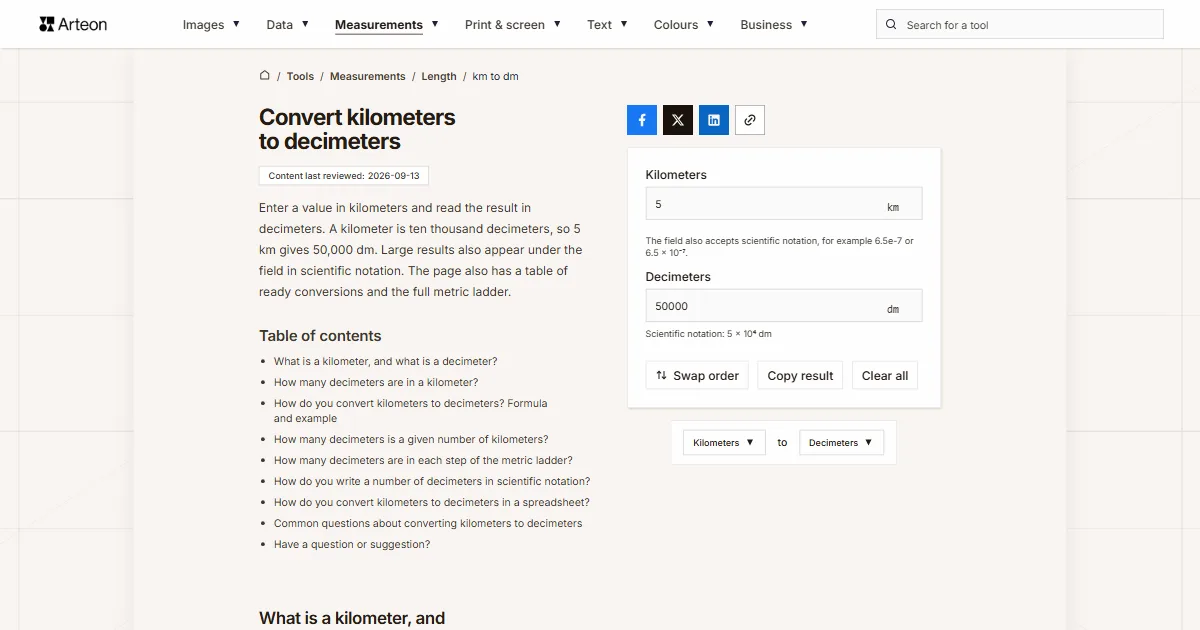
Enter a value in kilometers and read the result in decimeters. A kilometer is ten thousand decimeters, so 5 km gives 50,000 dm. Large results also appear under the field in scientific notation. The page also has a table of ready conversions and the full metric ladder.
The field also accepts scientific notation, for example 6.5e-7 or 6.5 × 10⁻⁷.
What is a kilometer, and what is a decimeter?
Both units take their value from the meter, the base unit of length in the SI, and both get it from a prefix written in front. The prefix kilo- stands for a thousand and the prefix deci- for one tenth[1]. A kilometer is therefore a thousand meters, and a decimeter is one tenth of a meter.
Four steps of ten separate the two units, and that is where the multiplier of ten thousand comes from. Going down from the kilometer, the next steps are the hectometer at a hundred meters, the decameter at ten meters and the meter itself. The decimeter is one step below the meter. Both middle steps have their own symbols in the table of SI prefixes: hm for the hectometer and dam for the decameter[1].
The kilometer measures distances on land. The English article calls it "the preferred measurement unit to express distances between geographical places on land in most of the world" and names the United States, the United Kingdom and Liberia as the places where the statute mile serves that purpose[2].
The decimeter describes lengths measured at close range, and the English article lists three settings where it is the working unit: the liter is defined as one cubic decimeter, the path length in a polarimeter is given in decimeters, and ship's draft markings are shown in decimeters in most of the world[3].
Which unit you use depends on the size of the thing you are measuring. Kilometers describe routes and distances between places, decimeters describe object sizes and lengths read off a rule. The conversion helps when one value has to be used in a calculation done in the other unit: a homework question, a spreadsheet column of dimensions, or an instrument reading labeled differently from the rest of a document.
How many decimeters are in a kilometer?
A kilometer is 10,000 decimeters. Two kilometers give 20,000 decimeters, and five kilometers give 50,000 decimeters.
Every conversion in this direction comes down to multiplying the number of kilometers by ten thousand. Half a kilometer is 5,000 decimeters. A quarter of a kilometer gives 2,500 decimeters. One hundred meters, which is one tenth of a kilometer, is 1,000 decimeters.
For whole kilometers the result ends in four zeros added to their number, so those values come straight from memory. Eight kilometers is 80,000 decimeters. Thirteen kilometers gives 130,000 decimeters.
For values with a decimal point, the point itself moves four places to the right. 8.24 km becomes 82,400 dm. 0.005 km becomes 50 dm.
The converter above works in both directions and shows the result while you type. For numbers from a thousand up it repeats the result under the field on a line labeled Scientific notation, so you do not have to work out the power of ten yourself.
How do you convert kilometers to decimeters? Formula and example
The conversion rests on a fixed relation: one kilometer is 10,000 decimeters. To turn kilometers into decimeters you multiply their number by ten thousand.
The full formula: decimeters = kilometers × 10,000. The other way round: kilometers = decimeters ÷ 10,000.
Three examples of different size come out of that formula. A value of 0.54 km multiplied by ten thousand gives 5,400 decimeters. A stretch of 22.5 km gives 225,000 decimeters. A route of 515 km gives 5,150,000 decimeters, and the same number in scientific notation reads 5.15 × 10⁶ dm.
In writing, the multiplication changes only the position of the decimal point. The digits stay as they are and the point moves four places to the right. 1.5 kilometers becomes 15,000 decimeters, and 0.2 kilometers becomes 2,000 decimeters. You fill the empty places with zeros.
The other way round the operation is reversed: you divide by ten thousand and the point moves four places to the left. That is what the decimeters to kilometers converter does. If your value is written in meters, use the meters to kilometers converter, and for the step below the decimeter use the decimeters to centimeters converter.
How many decimeters is a given number of kilometers?
| Kilometers | Decimeters | Meters |
|---|---|---|
| 0.00097 km | 9.7 dm | 0.97 m |
| 0.005 km | 50 dm | 5 m |
| 0.01 km | 100 dm | 10 m |
| 0.097 km | 970 dm | 97 m |
| 0.2 km | 2,000 dm | 200 m |
| 0.301 km | 3,010 dm | 301 m |
| 0.4 km | 4,000 dm | 400 m |
| 0.5 km | 5,000 dm | 500 m |
| 0.54 km | 5,400 dm | 540 m |
| 1 km | 10,000 dm | 1,000 m |
| 1.007 km | 10,070 dm | 1,007 m |
| 1.5 km | 15,000 dm | 1,500 m |
| 1.8 km | 18,000 dm | 1,800 m |
| 2 km | 20,000 dm | 2,000 m |
| 2.5 km | 25,000 dm | 2,500 m |
| 3.5 km | 35,000 dm | 3,500 m |
| 4 km | 40,000 dm | 4,000 m |
| 5 km | 50,000 dm | 5,000 m |
| 5.33 km | 53,300 dm | 5,330 m |
| 6 km | 60,000 dm | 6,000 m |
| 8 km | 80,000 dm | 8,000 m |
| 8.24 km | 82,400 dm | 8,240 m |
| 9.5 km | 95,000 dm | 9,500 m |
| 10 km | 100,000 dm | 10,000 m |
| 12 km | 120,000 dm | 12,000 m |
| 13 km | 130,000 dm | 13,000 m |
| 20 km | 200,000 dm | 20,000 m |
| 22.5 km | 225,000 dm | 22,500 m |
| 24.1 km | 241,000 dm | 24,100 m |
| 32.9 km | 329,000 dm | 32,900 m |
| 35.7 km | 357,000 dm | 35,700 m |
| 40 km | 400,000 dm | 40,000 m |
| 41.1 km | 411,000 dm | 41,100 m |
| 45.5 km | 455,000 dm | 45,500 m |
| 50 km | 500,000 dm | 50,000 m |
| 52.5 km | 525,000 dm | 52,500 m |
| 55.3 km | 553,000 dm | 55,300 m |
| 60.9 km | 609,000 dm | 60,900 m |
| 63.3 km | 633,000 dm | 63,300 m |
| 64.3 km | 643,000 dm | 64,300 m |
| 86 km | 860,000 dm | 86,000 m |
| 274 km | 2,740,000 dm | 274,000 m |
| 300 km | 3,000,000 dm | 300,000 m |
| 515 km | 5,150,000 dm | 515,000 m |
How many decimeters are in each step of the metric ladder?
| Unit | Symbol | Decimeters | Kilometers |
|---|---|---|---|
| Millimeter | mm | 0.01 dm | 0.000001 km |
| Centimeter | cm | 0.1 dm | 0.00001 km |
| Decimeter | dm | 1 dm | 0.0001 km |
| Meter | m | 10 dm | 0.001 km |
| Decameter | dam | 100 dm | 0.01 km |
| Hectometer | hm | 1,000 dm | 0.1 km |
| Kilometer | km | 10,000 dm | 1 km |
How do you write a number of decimeters in scientific notation?
| Kilometers | Decimeters | Decimeters in scientific notation |
|---|---|---|
| 1 km | 10,000 dm | 1 × 10⁴ |
| 2 km | 20,000 dm | 2 × 10⁴ |
| 5 km | 50,000 dm | 5 × 10⁴ |
| 8.24 km | 82,400 dm | 8.24 × 10⁴ |
| 10 km | 100,000 dm | 1 × 10⁵ |
| 13 km | 130,000 dm | 1.3 × 10⁵ |
| 50 km | 500,000 dm | 5 × 10⁵ |
| 274 km | 2,740,000 dm | 2.74 × 10⁶ |
| 300 km | 3,000,000 dm | 3 × 10⁶ |
| 515 km | 5,150,000 dm | 5.15 × 10⁶ |
How do you convert kilometers to decimeters in a spreadsheet?
For a single value the field above is quicker, and for a whole column of distances one formula dragged down in a spreadsheet is enough.
Excel: the CONVERT function
In English Excel you write CONVERT(number,from_unit,to_unit). The unit code for the meter is "m", and the prefix goes in front of it: "k" for kilo, "d" for deci. For a value in cell A1 the formula reads =CONVERT(A1,"km","dm")[4]. The same page states that these prefixes can be prepended to any metric unit[4].Plain multiplication, if you would rather skip the function
The formula =A1*10000 gives the same result and works in every spreadsheet, Google Sheets and LibreOffice Calc included. For a column of distances set zero decimal places, so that results in the hundreds of thousands read at a glance.A meters column next to it
Meters are the middle step between the kilometer and the decimeter, so it pays to have the sheet give both values at once. The formula =A1*1000 in the next column gives meters. For a value of 8.24 in cell A1 the decimeters column shows 82400 and the meters column 8240.Check the result on a single cell
Before you drag the formula down the whole column, type 1.5 into cell A1 and check that the result comes to 15000. A #VALUE! message where the result should be means Excel reads the content of cell A1 as text, for example when a unit has been typed next to the value. Leave just the number in the cell[4].
Convert other units to Decimeters
Convert Kilometers to other units
Sources
- SI prefixes — Bureau International des Poids et Mesures
- Kilometre — Wikipedia
- Decimetre — Wikipedia
- CONVERT function — Microsoft
Every figure in the tables was computed from the unit definitions and checked arithmetically before publication. Historical values and the names of local units come from the sources listed above.
Content last reviewed: · written and checked by the Arteon team
Common questions about converting kilometers to decimeters
How many decimeters are in 1 kilometer?
A kilometer is 10,000 decimeters. The number follows from two prefixes: kilo- stands for a thousand and deci- for one tenth, so a thousand meters make ten thousand tenths of a meter.
How many decimeters are in 515 km?
Five hundred and fifteen kilometers come to 5,150,000 decimeters. In scientific notation the same number reads 5.15 × 10⁶ dm. The converter gives both forms at once.
How many decimeters are in half a kilometer?
Half a kilometer is 5,000 decimeters. A quarter of a kilometer gives 2,500 decimeters, and one tenth of a kilometer, which is a hundred meters, gives 1,000 decimeters.
What is 8.24 km in decimeters?
It is 82,400 decimeters. The decimal point moves four places to the right, so the digits stay as they are and the result is ten thousand times the number of kilometers.
How do you convert kilometers to decimeters without a calculator?
Move the decimal point four places to the right. For a whole number this amounts to adding four zeros: 6 km becomes 60,000 dm, and 0.3 km becomes 3,000 dm.
How many meters are in a kilometer, and how many decimeters in a meter?
A kilometer is 1,000 meters and a meter is 10 decimeters. The product of those two numbers gives the multiplier of 10,000 that links the kilometer to the decimeter.
Does the field take decimals and scientific notation?
Yes. You can type 1.5 or 1,5, a fraction such as 1/2, and a number in scientific notation such as 5.15e6. The result appears as you type, with no separate button to press.
Have a question or suggestion?
If you spotted an error in the tables or have an idea to improve the converter, write to us — we reply within 24 hours.