Convert kPa to psi
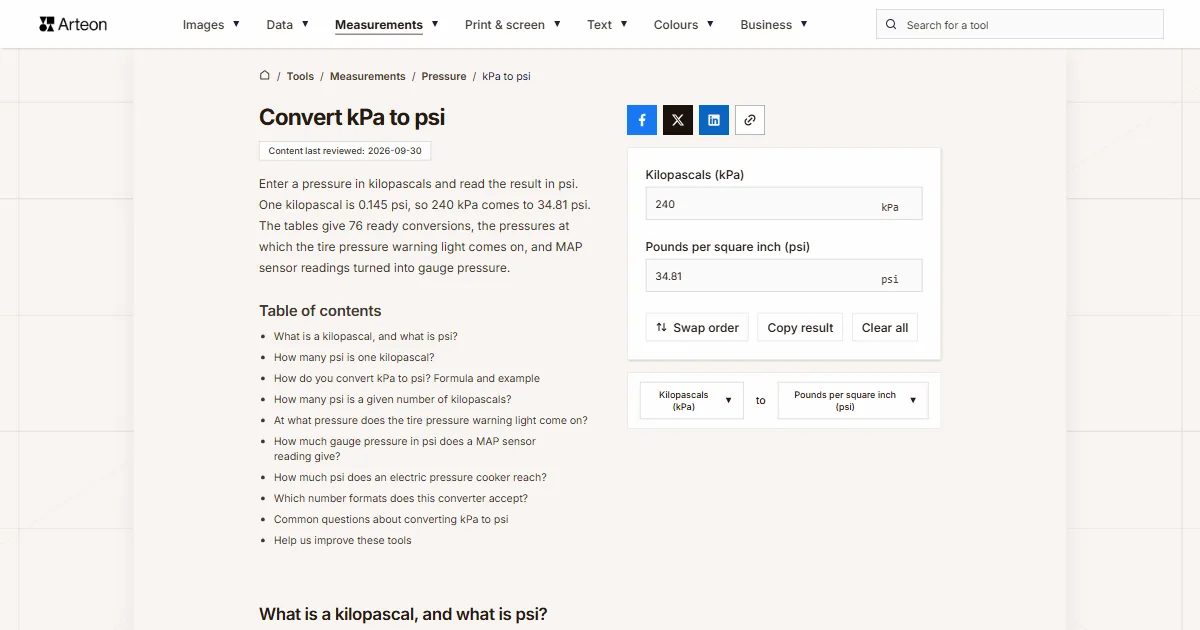
Enter a pressure in kilopascals and read the result in psi. One kilopascal is 0.145 psi, so 240 kPa comes to 34.81 psi. The tables give 76 ready conversions, the pressures at which the tire pressure warning light comes on, and MAP sensor readings turned into gauge pressure.
What is a kilopascal, and what is psi?
A kilopascal is a thousand pascals. The pascal is the SI unit of pressure and equals a force of one newton acting on one square meter[1]. The General Conference on Weights and Measures adopted the name pascal for this unit in 1971[2].
The standard atmosphere, which the same conference defined in a 1954 resolution, is exactly 101.325 kPa[3].
Psi stands for pound-force per square inch, the pressure produced when a force of one pound-force acts on an area of one square inch[4]. One inch is exactly 2.54 cm[5], and other lengths in inches convert in the inches to cm converter. The conversion table of NIST, the US national metrology institute, gives one psi as 6.894757 kPa[5].
One hundred kilopascals is exactly one bar[5]. A value written in bar converts to psi in the bar to psi converter.
How many psi is one kilopascal?
One kilopascal is 0.145038 psi. To convert kilopascals to psi, divide the number of kilopascals by 6.894757, the value of one psi in the NIST conversion table[5].
A pressure of 220 kPa gives 31.91 psi. A pressure of 240 kPa is 34.81 psi. A pressure of 250 kPa equals 36.26 psi. Multiplying 34.81 psi back by the same number gives 240.01 kPa, the starting value to within rounding.
The converter does this division as you type and shows the result to hundredths of a psi. The field also accepts decimals, so 232.5 kPa becomes 33.72 psi. With smaller values the result has more decimal places, so half a kilopascal shows as 0.07252 psi.
The conversion keeps the type of pressure. Gauge pressure read from a gauge stays gauge pressure in psi. A reading from a sensor that measures from vacuum stays absolute pressure, and the MAP sensor table gives the matching gauge pressure.
How do you convert kPa to psi? Formula and example
Formula: psi = kPa ÷ 6.894757
Take 230 kPa. Dividing by 6.894757 gives 33.36 psi. Multiplying by 0.145038 gives the same result, because that number is the reciprocal of the divisor.
The converter also accepts negative values. A vacuum gauge shows pressure below atmospheric with a minus sign, because it takes the ambient pressure as its zero[6]. Enter -30 kPa and the result field shows -4.351 psi.
For the other direction, from psi to kilopascals, use the psi to kPa converter.
How many psi is a given number of kilopascals?
| Kilopascals | Psi |
|---|---|
| 1 kPa | 0.145 psi |
| 2 kPa | 0.2901 psi |
| 3 kPa | 0.4351 psi |
| 5 kPa | 0.7252 psi |
| 7 kPa | 1.015 psi |
| 10 kPa | 1.45 psi |
| 15 kPa | 2.176 psi |
| 20 kPa | 2.901 psi |
| 25 kPa | 3.626 psi |
| 30 kPa | 4.351 psi |
| 35 kPa | 5.076 psi |
| 40 kPa | 5.802 psi |
| 50 kPa | 7.252 psi |
| 60 kPa | 8.702 psi |
| 69 kPa | 10.01 psi |
| 70 kPa | 10.15 psi |
| 75 kPa | 10.88 psi |
| 80 kPa | 11.6 psi |
| 88 kPa | 12.76 psi |
| 90 kPa | 13.05 psi |
| 95 kPa | 13.78 psi |
| 100 kPa | 14.5 psi |
| 101.325 kPa | 14.7 psi |
| 105 kPa | 15.23 psi |
| 108 kPa | 15.66 psi |
| 110 kPa | 15.95 psi |
| 120 kPa | 17.4 psi |
| 125 kPa | 18.13 psi |
| 130 kPa | 18.85 psi |
| 137 kPa | 19.87 psi |
| 140 kPa | 20.31 psi |
| 150 kPa | 21.76 psi |
| 160 kPa | 23.21 psi |
| 170 kPa | 24.66 psi |
| 175 kPa | 25.38 psi |
| 180 kPa | 26.11 psi |
| 190 kPa | 27.56 psi |
| 200 kPa | 29.01 psi |
| 205 kPa | 29.73 psi |
| 210 kPa | 30.46 psi |
| 215 kPa | 31.18 psi |
| 220 kPa | 31.91 psi |
| 225 kPa | 32.63 psi |
| 230 kPa | 33.36 psi |
| 235 kPa | 34.08 psi |
| 240 kPa | 34.81 psi |
| 245 kPa | 35.53 psi |
| 250 kPa | 36.26 psi |
| 255 kPa | 36.98 psi |
| 260 kPa | 37.71 psi |
| 270 kPa | 39.16 psi |
| 275 kPa | 39.89 psi |
| 280 kPa | 40.61 psi |
| 290 kPa | 42.06 psi |
| 300 kPa | 43.51 psi |
| 310 kPa | 44.96 psi |
| 320 kPa | 46.41 psi |
| 340 kPa | 49.31 psi |
| 350 kPa | 50.76 psi |
| 360 kPa | 52.21 psi |
| 380 kPa | 55.11 psi |
| 400 kPa | 58.02 psi |
| 420 kPa | 60.92 psi |
| 450 kPa | 65.27 psi |
| 500 kPa | 72.52 psi |
| 550 kPa | 79.77 psi |
| 600 kPa | 87.02 psi |
| 650 kPa | 94.27 psi |
| 700 kPa | 101.53 psi |
| 800 kPa | 116.03 psi |
| 900 kPa | 130.53 psi |
| 1,000 kPa | 145.04 psi |
| 1,500 kPa | 217.56 psi |
| 2,000 kPa | 290.08 psi |
| 4,000 kPa | 580.15 psi |
| 10,000 kPa | 1,450.38 psi |
At what pressure does the tire pressure warning light come on?
| Operating pressure | Psi | Warning at (kPa) | Warning at (psi) |
|---|---|---|---|
| 180 kPa | 26.11 psi | 150 kPa | 21.76 psi |
| 190 kPa | 27.56 psi | 152 kPa | 22.05 psi |
| 200 kPa | 29.01 psi | 160 kPa | 23.21 psi |
| 210 kPa | 30.46 psi | 168 kPa | 24.37 psi |
| 220 kPa | 31.91 psi | 176 kPa | 25.53 psi |
| 230 kPa | 33.36 psi | 184 kPa | 26.69 psi |
| 240 kPa | 34.81 psi | 192 kPa | 27.85 psi |
| 250 kPa | 36.26 psi | 200 kPa | 29.01 psi |
| 260 kPa | 37.71 psi | 208 kPa | 30.17 psi |
| 270 kPa | 39.16 psi | 216 kPa | 31.33 psi |
| 280 kPa | 40.61 psi | 224 kPa | 32.49 psi |
| 290 kPa | 42.06 psi | 232 kPa | 33.65 psi |
| 300 kPa | 43.51 psi | 240 kPa | 34.81 psi |
| 320 kPa | 46.41 psi | 256 kPa | 37.13 psi |
| 350 kPa | 50.76 psi | 280 kPa | 40.61 psi |
How much gauge pressure in psi does a MAP sensor reading give?
| MAP sensor reading | Gauge pressure |
|---|---|
| 20 kPa | -11.8 psi |
| 30 kPa | -10.34 psi |
| 40 kPa | -8.894 psi |
| 50 kPa | -7.444 psi |
| 60 kPa | -5.994 psi |
| 70 kPa | -4.543 psi |
| 80 kPa | -3.093 psi |
| 90 kPa | -1.643 psi |
| 100 kPa | -0.1922 psi |
| 101.325 kPa | 0 psi |
| 108 kPa | 0.9681 psi |
| 110 kPa | 1.258 psi |
| 120 kPa | 2.709 psi |
| 130 kPa | 4.159 psi |
| 140 kPa | 5.609 psi |
| 150 kPa | 7.06 psi |
| 160 kPa | 8.51 psi |
| 170 kPa | 9.96 psi |
| 180 kPa | 11.41 psi |
| 200 kPa | 14.31 psi |
| 220 kPa | 17.21 psi |
| 250 kPa | 21.56 psi |
| 300 kPa | 28.82 psi |
How much psi does an electric pressure cooker reach?
The UK user manual of the Instant Pot Duo gives the cooking pressure in both units. Low pressure is 35–55 kPa and high pressure is 65–85 kPa, which the same page puts at 5–8 psi and 9.4–12.3 psi[10].
The converter agrees with that page: 35 kPa is 5.076 psi, 55 kPa is 7.977 psi, 65 kPa is 9.427 psi and 85 kPa is 12.33 psi. The cooking table in the same manual prints 10.2–11.6 psi next to 65–85 kPa. Those psi figures match only 70.33–79.98 kPa, the middle part of the kilopascal range.
Which number formats does this converter accept?
| What you type | What the converter shows | Note |
|---|---|---|
| 240 | 34.81 psi | A plain number is read as kilopascals, because that’s what the field is labeled. |
| 240 kPa | 34.81 psi | The kPa symbol pasted along with the number is skipped, so only the number counts. |
| 2.4 bar | 34.81 psi | A pressure in bar is turned into kilopascals by the field itself, so the result matches 240 kPa. |
| 35 psi | 35 psi | A value typed straight in psi is recognized by its symbol and left as it is. |
| 101.325 | 14.7 psi | That’s the standard atmosphere in kilopascals, and that’s how we read it. A note under the field says: Read as 101.325. If you meant 101325, type 101325. |
| 2.5 | 0.3626 psi | The period is your decimal point, and that’s exactly how we read it. |
| 2,5 | 0.3626 psi | A comma with fewer than three digits after it is a decimal comma from a European document, so we read two and a half kilopascals. |
| 1.500 | 0.2176 psi | A single period is always read as a decimal point, so the field takes one and a half kilopascals. A note under the field says: Read as 1.5. If you meant 1500, type 1500. |
| 1,500 | 217.56 psi | A comma followed by three digits groups thousands, so the field reads fifteen hundred kilopascals. A note under the field says: Read as 1500. If you meant 1.5, type 1.5. |
| 1/2 | 0.07252 psi | A fraction with a slash is worked out for you, so half a kilopascal doesn’t need to become 0.5 first. |
| -80 | -11.6 psi | A minus sign is accepted, so a vacuum gauge reading converts too. |
| - 80 kPa | The result field stays empty. | A minus separated by a space isn’t joined to the number, so nothing is calculated. Type the minus right before the digit. |
Convert other units to Pounds per square inch (psi)
Convert Kilopascals (kPa) to other units
Sources
- SI: A concise summary of the International System of Units — Bureau International des Poids et Mesures
- Decision of the 14th CGPM (1971): pascal and siemens — Bureau International des Poids et Mesures
- Resolution 4 of the 10th CGPM (1954): Definition of the standard atmosphere — Bureau International des Poids et Mesures
- Pound per square inch — Wikipedia
- NIST Guide to the SI, Appendix B.9: Factors for units listed by kind of quantity or field of science — National Institute of Standards and Technology
- Pressure measurement — Wikipedia
- Regulation (EC) No 661/2009 of the European Parliament and of the Council of 13 July 2009 — EUR-Lex
- UN Regulation No 141 — Uniform provisions concerning the approval of vehicles with regard to their Tyre Pressure Monitoring Systems (TPMS) — EUR-Lex
- MAP sensor — Wikipedia
- Duo Multi-Use Pressure Cooker: User manual — Instant Pot
- CONVERT function — Microsoft
- Pascal (unit) — Wikipedia
Every figure in the tables was computed from the unit definitions and checked arithmetically before publication. Historical values and the names of local units come from the sources listed above.
Content last reviewed: · written and checked by the Arteon team
Common questions about converting kPa to psi
How many bar is 240 kPa?
240 kPa is 2.4 bar, because one bar is exactly 100 kPa[5]. In psi the same value is 34.81. When a gauge shows psi and you need bar, the psi to bar converter gives the result.
Is tire pressure in kPa given as gauge pressure?
Yes. Tire pressure is given as gauge pressure by convention, meaning the pressure above ambient[6]. You convert a value in kilopascals directly, and the result in psi is gauge pressure as well.
How do you read vacuum from a MAP sensor in psi?
Subtract 101.325 kPa, the standard atmosphere, from the reading and divide the result by 6.894757. A MAP sensor measures absolute pressure and never displays a negative reading[9], so the minus sign only appears after this subtraction. A reading of 65 kPa gives -5.268 psi this way.
How do you convert kPa to psi in your head?
Multiply the number of kilopascals by 0.145. The result comes out less than three hundredths of a percent below the exact value. For 1,000 kPa the mental calculation gives 145 psi, and the converter shows 145.04 psi.
How do you convert kPa to psi in Excel?
Use the CONVERT function: =CONVERT(A1,"kPa","psi"). Unit codes are case-sensitive, and the prefix k can be added to any metric unit, including the pascal code Pa[11].
Help us improve these tools
Have an idea for a feature, found a bug or want to suggest another tool? Write to us.