Convert bar to kilopascals
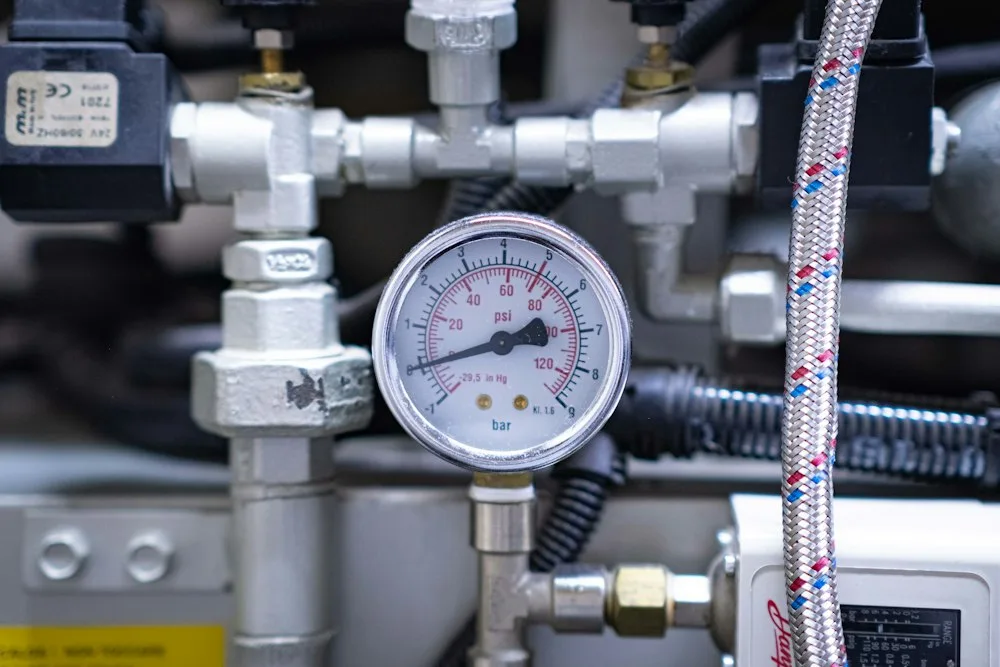
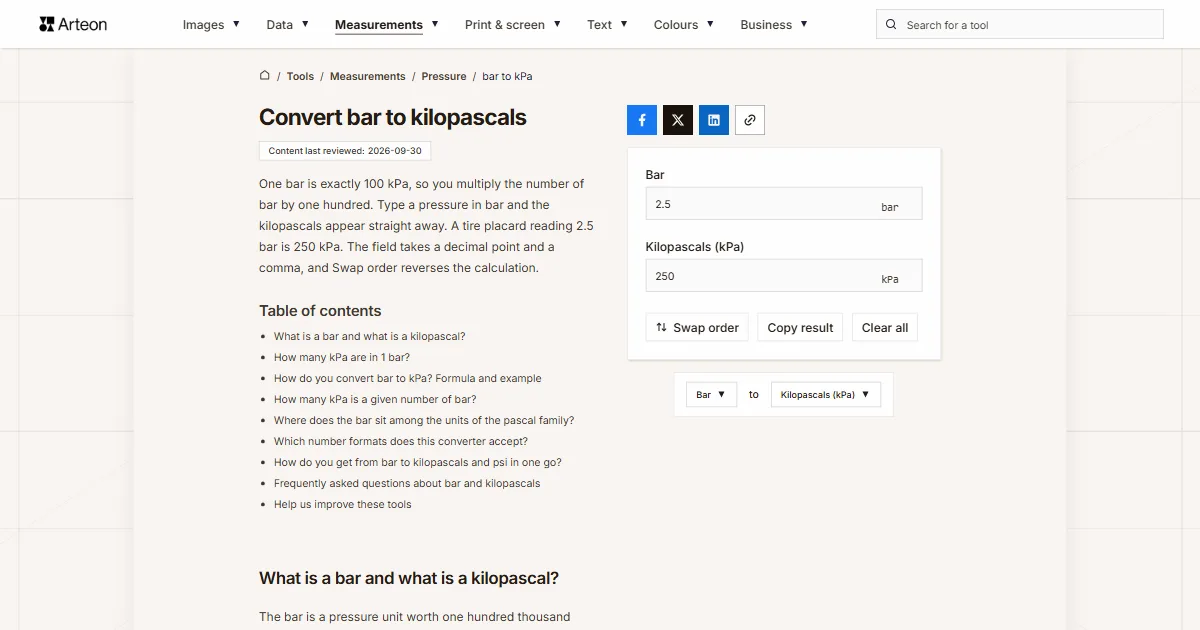
One bar is exactly 100 kPa, so you multiply the number of bar by one hundred. Type a pressure in bar and the kilopascals appear straight away. A tire placard reading 2.5 bar is 250 kPa. The field takes a decimal point and a comma, and Swap order reverses the calculation.
What is a bar and what is a kilopascal?
The bar is a pressure unit worth one hundred thousand pascals. The International Bureau of Weights and Measures (BIPM), the body that looks after the SI, lists it in its table of units outside the SI and writes it out in full: 1 bar = 0.1 MPa = 10⁵ Pa[1]. The symbol came into use through Resolution 7 of the 9th General Conference on Weights and Measures in 1948[1].
The category BIPM puts the bar in is called “historical names for decimal multiples and submultiples of SI units”, and the are, the hectare, the litre, the tonne and the angstrom sit in it beside the bar[1]. The bar is therefore treated as a separate name for a multiple of the pascal, much as the tonne is a separate name for a thousand kilograms.
A kilopascal is a thousand pascals. The pascal is the SI unit of pressure and the SI Brochure expresses it as a newton per square metre[1], meaning one newton of force spread evenly over one square metre. The prefix kilo stands for a thousand in this system[1].
The ratio of those two values is one hundred, and that is the whole relationship between the units. There is more about the units themselves in the articles on the bar and the pascal.
How many kPa are in 1 bar?
One bar is 100 kPa. Multiply the number of bar by one hundred: kPa = bar × 100[2]. The factor is exact by definition, so the calculation comes down to moving the decimal point two places to the right.
Three examples from this formula show the whole calculation. Two bar is 200 kPa. A value of 2.5 bar gives 250 kPa. Ten bar is 1,000 kPa.
The bar and the kilopascal belong to the same decimal family, and that is where the precision comes from. NIST, the American metrology institute, prints the factor for the bar in bold in its conversion table, and in that table bold marks an exact value[2]. For the pound-force per square inch the same table gives a rounded factor, because psi is built on the pound-force and the inch, units from outside the metric system[2]. You can see that on the bar to psi converter.
To turn a pressure written in kilopascals back into bar, use the kPa to bar converter.
How do you convert bar to kPa? Formula and example
The formula has a single term: kPa = bar × 100. Take a tire placard reading 2.4 bar. Multiply it by one hundred and you get 240 kPa.
The same rule covers fractions and long figures alike. A value of 0.8 bar becomes 80 kPa. A value of 12 bar becomes 1,200 kPa. Every digit of the input figure survives into the result.
One more unit from the same family belongs here. A millibar is a thousandth of a bar, which is 0.1 kPa. The World Meteorological Organization records in its guide that one millibar is by definition one hectopascal[3]. That is where the number in a weather forecast comes from. A pressure of 1,013.25 hPa is the same as 1.01325 bar. In kilopascals the same value is 101.325 kPa.
The pound-force per square inch, the third unit of this subcategory, is handled by the kPa to psi converter.
How many kPa is a given number of bar?
| Pressure in bar | Pressure in kilopascals |
|---|---|
| 0.1 bar | 10 kPa |
| 0.2 bar | 20 kPa |
| 0.3 bar | 30 kPa |
| 0.4 bar | 40 kPa |
| 0.5 bar | 50 kPa |
| 0.6 bar | 60 kPa |
| 0.7 bar | 70 kPa |
| 0.8 bar | 80 kPa |
| 0.9 bar | 90 kPa |
| 1 bar | 100 kPa |
| 1.1 bar | 110 kPa |
| 1.2 bar | 120 kPa |
| 1.3 bar | 130 kPa |
| 1.4 bar | 140 kPa |
| 1.5 bar | 150 kPa |
| 1.6 bar | 160 kPa |
| 1.7 bar | 170 kPa |
| 1.8 bar | 180 kPa |
| 1.9 bar | 190 kPa |
| 2 bar | 200 kPa |
| 2.1 bar | 210 kPa |
| 2.2 bar | 220 kPa |
| 2.3 bar | 230 kPa |
| 2.4 bar | 240 kPa |
| 2.5 bar | 250 kPa |
| 2.6 bar | 260 kPa |
| 2.7 bar | 270 kPa |
| 2.8 bar | 280 kPa |
| 2.9 bar | 290 kPa |
| 3 bar | 300 kPa |
| 3.5 bar | 350 kPa |
| 4 bar | 400 kPa |
| 4.5 bar | 450 kPa |
| 5 bar | 500 kPa |
| 6 bar | 600 kPa |
| 7 bar | 700 kPa |
| 8 bar | 800 kPa |
| 9 bar | 900 kPa |
| 10 bar | 1,000 kPa |
| 12 bar | 1,200 kPa |
| 15 bar | 1,500 kPa |
| 16 bar | 1,600 kPa |
| 20 bar | 2,000 kPa |
| 25 bar | 2,500 kPa |
| 30 bar | 3,000 kPa |
| 40 bar | 4,000 kPa |
| 50 bar | 5,000 kPa |
| 60 bar | 6,000 kPa |
| 80 bar | 8,000 kPa |
| 100 bar | 10,000 kPa |
| 150 bar | 15,000 kPa |
| 200 bar | 20,000 kPa |
| 250 bar | 25,000 kPa |
| 300 bar | 30,000 kPa |
| 350 bar | 35,000 kPa |
| 400 bar | 40,000 kPa |
| 700 bar | 70,000 kPa |
| 1,000 bar | 100,000 kPa |
Where does the bar sit among the units of the pascal family?
| Unit | Value in pascals | Value in bar |
|---|---|---|
| pascal (Pa) | 1 Pa | 0.00001 bar |
| hectopascal (hPa) | 100 Pa | 0.001 bar |
| millibar (mbar) | 100 Pa | 0.001 bar |
| kilopascal (kPa) | 1,000 Pa | 0.01 bar |
| bar | 100,000 Pa | 1 bar |
| megapascal (MPa) | 1,000,000 Pa | 10 bar |
| standard atmosphere (atm) | 101,325 Pa | 1.01325 bar |
Which number formats does this converter accept?
| What you type | What the converter shows | Note |
|---|---|---|
| 2.5 | 250 kPa | A plain number is read as bar, because that's how the field is labeled. |
| 2,5 | 250 kPa | A comma with fewer than three digits after it is a decimal comma from a European document, so the result is the same. |
| 2.5 bar | 250 kPa | The unit symbol pasted along with the number is skipped. |
| 36 psi | 248.21 kPa | A value in another pressure unit is converted to bar first, so 36 psi from a US tire placard gives kilopascals straight away. |
| 1013 hPa | 101.3 kPa | Hectopascals from a weather report are converted too, and 1013 hPa is 1.013 bar. |
| 1.500 | 150 kPa | A single period is a decimal point, so we read one and a half bar. A note under the field says “Read as 1.5. If you meant 1500, type 1500.” |
| 1,500 | 150000 kPa | A comma followed by three digits groups thousands, so the field reads fifteen hundred bar. A note under the field says “Read as 1500. If you meant 1.5, type 1.5.” |
| 1 500 | 150000 kPa | A space between the thousands is skipped, so this is fifteen hundred bar as well. |
| 2 1/2 | 250 kPa | We work out a slash fraction ourselves, so the mixed number reads as two and a half bar. |
| -0.8 | -80 kPa | A minus sign marks vacuum, a gauge reading below the pressure of the surroundings, and the factor stays the same. |
| -80 kPa | -80 kPa | The minus sign stays when the entry uses a different unit from the field. |
How do you get from bar to kilopascals and psi in one go?
These three pressure units meet on tires and on equipment bought abroad. The steps use a value of 2.5 bar.
Write down the value in bar
Start from the number on the placard or on the gauge. In this example it is 2.5 bar.Move the decimal point two places to the right
That gives you kilopascals. From 2.5 bar you get 250 kPa.Multiply the bar by 14.5038 to get psi
From 2.5 bar you get 36.26 psi. That factor follows from the definitions of the pound-force and the inch, and the full conversion with its table is on the bar to psi converter.Set the unit your car displays
A trip computer can show tire pressure in three units. The Kia Seltos owner’s manual lists psi, kPa and bar as the options in the cluster user settings[4]. With all three figures side by side you can read the scale you meet.
Convert other units to Kilopascals (kPa)
Convert Bar to other units
Sources
- SI Brochure, 9th edition (2019), Table 4, Table 7 and Table 8 — Bureau International des Poids et Mesures
- NIST Guide to the SI, Appendix B.8: Factors for Units Listed Alphabetically — National Institute of Standards and Technology
- Guide to Instruments and Methods of Observation (WMO-No. 8), 2023 edition, Volume I, section 1.5.1 — World Meteorological Organization
- Kia Seltos owner’s manual, chapter “Tyre Pressure Indicator” — Kia Corporation
Every figure in the tables was computed from the unit definitions and checked arithmetically before publication. Historical values and the names of local units come from the sources listed above.
Content last reviewed: · written and checked by the Arteon team
Frequently asked questions about bar and kilopascals
How many kPa is 2.5 bar?
A value of 2.5 bar is 250 kPa. The same pressure is 0.25 MPa, because a megapascal is ten bar[1]. In pounds-force per square inch it comes to 36.26 psi, which the bar to psi converter will work out for you.
Is the bar an SI unit?
The SI has one unit for pressure and it is the pascal[1]. The bar works alongside it as a separate name for a hundred thousand pascals, and BIPM lists it among the historical names for decimal multiples of SI units[1]. The World Meteorological Organization adds in its guide that any document using the bar should define it in relation to the SI, and states plainly that its continued use is not encouraged[3].
Does a g or an a after the unit change the conversion?
The factor stays the same. The form barg means gauge pressure measured against the surroundings, and bara means absolute pressure counted from vacuum. Both scales convert to kilopascals by one hundred, because the letter describes the reference point of the measurement while the size of the unit stays put. What separates one scale from the other is atmospheric pressure, roughly 101.3 kPa.
How many kPa is a millibar?
One millibar is 0.1 kPa. Meteorology calls the same value a hectopascal, because the World Meteorological Organization records the identity 1 mbar = 1 hPa as a definition[3]. That is why a barometer with an old millibar scale shows exactly the figures a modern forecast gives in hectopascals.
Help us improve these tools
Have an idea for a feature, found a bug or want to suggest another tool? Write to us.