Convert drops to ml
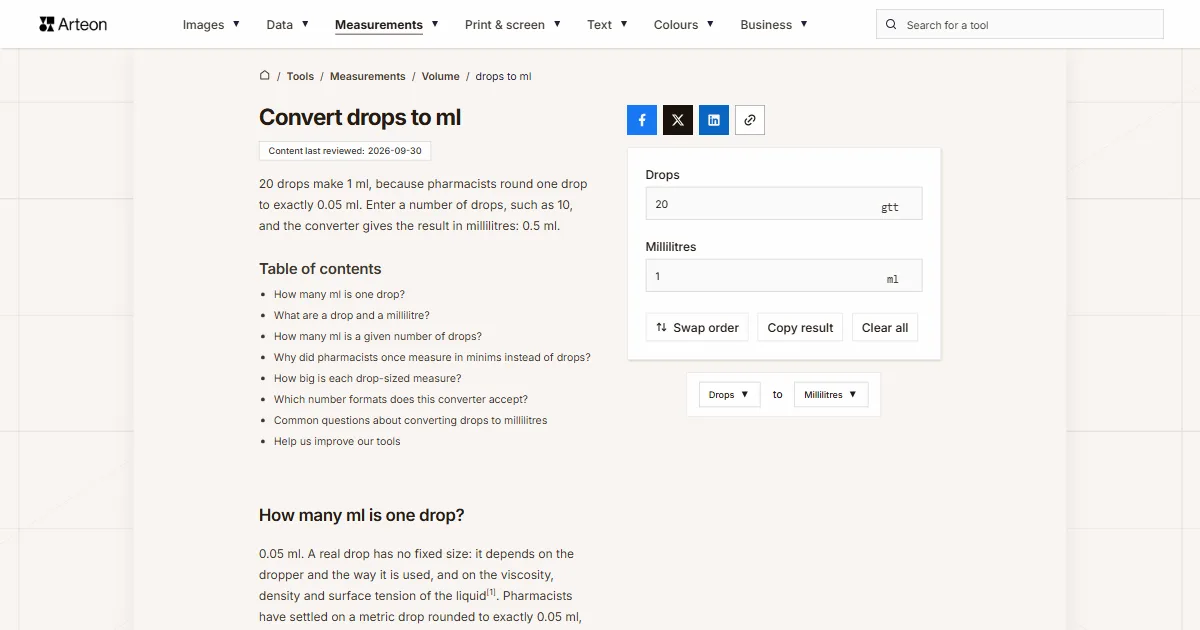
20 drops make 1 ml, because pharmacists round one drop to exactly 0.05 ml. Enter a number of drops, such as 10, and the converter gives the result in millilitres: 0.5 ml.
How many ml is one drop?
0.05 ml. A real drop has no fixed size: it depends on the dropper and the way it is used, and on the viscosity, density and surface tension of the liquid[1]. Pharmacists have settled on a metric drop rounded to exactly 0.05 ml, which makes 20 drops per millilitre[1], and that is the drop this converter counts.
The formula is millilitres = drops × 0.05, or drops ÷ 20. 5 drops are 0.25 ml, 30 drops are 1.5 ml, and 100 drops are 5 ml, the capacity of a metric teaspoon, as the ml to tsp converter shows.
To go back from millilitres to drops, use the ml to drops converter.
What are a drop and a millilitre?
A millilitre is one thousandth of a litre, the same volume as a cubic centimetre, and it never changes size. The liters to ml converter handles the larger unit.
A drop is the amount of liquid that falls from a dropper or a drip chamber on its own. On prescriptions it is written gtt, with gtts for the plural, from the Latin gutta[1]. Because the size of a drop changes with the liquid and the dropper, the number of drops only means a volume once you agree which drop you count.
How many ml is a given number of drops?
| Drops | Millilitres |
|---|---|
| 1 | 0.05 ml |
| 2 | 0.1 ml |
| 3 | 0.15 ml |
| 4 | 0.2 ml |
| 5 | 0.25 ml |
| 6 | 0.3 ml |
| 8 | 0.4 ml |
| 10 | 0.5 ml |
| 12 | 0.6 ml |
| 15 | 0.75 ml |
| 16 | 0.8 ml |
| 20 | 1 ml |
| 24 | 1.2 ml |
| 25 | 1.25 ml |
| 30 | 1.5 ml |
| 40 | 2 ml |
| 50 | 2.5 ml |
| 60 | 3 ml |
| 80 | 4 ml |
| 100 | 5 ml |
| 200 | 10 ml |
| 500 | 25 ml |
| 1,000 | 50 ml |
Why did pharmacists once measure in minims instead of drops?
Because drops came out in different sizes. In the first decade of the 19th century the medical establishment promoted the minim as an alternative to the drop, since the size of a drop varied with the liquid and with the vessel it was poured from[1]. The 1809 pharmacopoeia of the Royal College of Physicians of London defined the minim as one sixtieth of a fluid dram[1].
A minim is about 61.6 µl in the US system and 59.2 µl in the British one[1], a little larger than the 0.05 ml drop that pharmacists use now. A microlitre (µl) is one thousandth of a millilitre.
How big is each drop-sized measure?
| Measure | Volume of one | Per millilitre |
|---|---|---|
| Metric drop | 0.05 ml | 20 |
| US minim | about 0.0616 ml | about 16.2 |
| British imperial minim | about 0.0592 ml | about 16.9 |
| Macro-drip IV set | 0.05 to 0.1 ml | 10, 15 or 20 |
| Micro-drip IV set | about 0.0167 ml | 60 |
Which number formats does this converter accept?
| What you type | What the converter shows | How we read it |
|---|---|---|
| 20 | 1 ml | A number on its own is read in drops, because that is the unit of the field. |
| 20 drops | 1 ml | The word drops after the number is the unit of the field, so the number goes in unchanged. |
| 20 gtt | 1 ml | The prescription abbreviation gtt also means drops, so the number goes in unchanged. |
| 1.5 | 0.075 ml | The point is the decimal separator, so this is one and a half drops. |
| 1,500 | 75 ml | Three digits after the comma mark a thousands separator, so we count one thousand five hundred drops. A note under the field says “Read as 1500. If you meant 1.5, type 1.5.” |
| ½ | 0.025 ml | The half sign is read as 0.5, so this is half a drop. |
| 3/4 | 0.038 ml | A fraction is divided out: three quarters of a drop is 0.0375 ml, which rounds to 0.038 ml at three decimal places. |
| 1 ml | 1 ml | Millilitres are converted to 20 drops with a note under the field, so the result comes back to 1 ml. |
| 2 tsp | 10 ml | Teaspoons are converted to 200 drops, because the field counts a metric teaspoon of 5 ml, and a note under the field says so. |
| 1e3 | 50 ml | Scientific notation from a spreadsheet is read as it stands: 1e3 is one thousand drops. |
Convert other units to Millilitres
Sources
- Drop (unit) — Wikipedia
- Gravity flow rate drip chart — B. Braun Medical Inc., via ISMP
- Drop size of commercial glaucoma medications — American Journal of Ophthalmology, PubMed
Every figure in the tables was computed from the unit definitions and checked arithmetically before publication. Historical values and the names of local units come from the sources listed above.
Content last reviewed: · written and checked by the Arteon team
Common questions about converting drops to millilitres
How many ml is one eye drop?
On average less than 0.05 ml. A 1986 study of 20 glaucoma medications found an average drop of 39.0 µl, or 0.039 ml, with preparations ranging from 25.1 to 56.4 µl[3].
Does every dropper give 20 drops per ml?
No. The volume of a drop depends on the device that makes it and on the liquid[1], so a dropper built into a bottle can give more or fewer drops per millilitre than the metric drop assumes.
Help us improve our tools
Have an idea for a new feature, found a bug or want to suggest another tool? Write to us.