AVIF to PNG converter
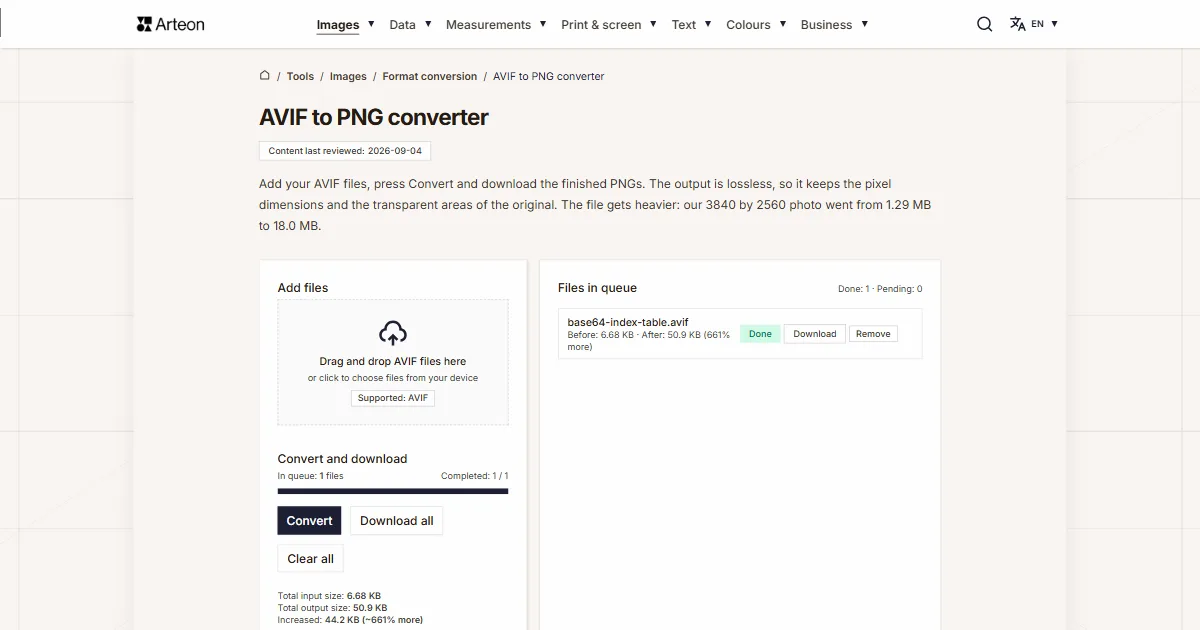
Add your AVIF files, press Convert and download the finished PNGs. The output is lossless, so it keeps the pixel dimensions and the transparent areas of the original. The file gets heavier: our 3840 by 2560 photo went from 1.29 MB to 18.0 MB.
Files in queue
What is AVIF and what is PNG?
AVIF grew out of the AV1 video codec. The Alliance for Open Media wrote a specification, AV1 Image File Format, that describes how a single AV1 frame is stored in a HEIF container — the same container an iPhone uses for HEIC photos. Version 1.2.0 of that document is dated 16 October 2025 and it sets out what the format can hold: 8, 10 or 12 bits per colour channel, a wide colour gamut, an alpha channel and image sequences, which is how AVIF animates.[1]
PNG is a quarter of a century older. It appeared in 1995 as a replacement for GIF, after Unisys and CompuServe asserted patent claims over the LZW compression both GIF and TIFF used.[2] It was lossless by design: the data is packed so that every pixel can be reconstructed to the exact value it had. The W3C specification allows sample depths from 1 to 16 bits, an optional alpha channel and indexed, greyscale and truecolour images.[3]
The third edition of that specification, published by W3C on 24 June 2025, folded into the standard several things that had been working outside it. The APNG animation chunks, in wide use for years, became official. The cICP chunk arrived, which lets a PNG describe a high dynamic range and wide colour gamut image. The eXIf chunk, the place where camera data lives, moved into the main body of the document. The previous edition was dated 10 November 2003, so this update took PNG more than twenty years.[3]
How do you convert AVIF to PNG?
Drag your AVIF files onto the Add files box, or click it and pick the images from your device. Then press Convert. You can save the results one at a time with the Download button on each queue row, or take the whole batch with Download all.
Quality here is fixed at the maximum. PNG stores the image losslessly, so the output file receives exactly what the browser read out of the AVIF: the same pixel count, the same colours and the same transparent areas.
All of the work happens on your own machine. The page code reads the AVIF file, draws it onto a browser canvas and writes the PNG from there. The image stays on the device from the first click to the last, and it leaves the browser memory when you close the tab.
In the queue on the right, each file shows its size before and after conversion along with the difference in percent. The same summary for the whole batch sits under the buttons. Clear all empties the queue, and the Remove label on a row takes a single file out of it.
Under the converter there is a format switcher reading AVIF to PNG. Clicking either format opens a list, and picking an entry takes you to the converter page that handles that pair.
Why is the PNG file heavier than the AVIF?
AVIF saves space the way video does. The encoder predicts what the next patch of the image looks like from the patches around it and stores only the difference, and in lossy mode it drops detail that the eye will not pick up at normal viewing size.
PNG works on a different principle. Its compression has to allow every pixel to be reconstructed exactly, so it packs the data without discarding anything. The more fine detail a photograph carries, the fewer repeating patterns are left to pack, and the closer the file lands to the raw size of the image.
That raw size is easy to work out. A photo measuring 3840 by 2560 pixels holds 9,830,400 points. Each point needs four bytes: one each for red, green and blue, plus one for opacity. Together that is 37.5 MB of data before anything is compressed at all. Lossless PNG brings the same photo down to 18 MB, and that is where it stops.
That is where the number in the tool comes from. In our measurement the same photo weighed 1.29 MB as AVIF and 18.0 MB once written as PNG. An Increased line then appears under the buttons, with the number of megabytes and the percentage the file grew by.
How heavy is the same image as AVIF and as PNG?
| Image | Pixel dimensions | AVIF | PNG | Times larger |
|---|---|---|---|---|
| Landscape photograph | 3840 × 2560 | 1.29 MB | 18.0 MB | 14.0 |
| Banner graphic for a website | 1920 × 1280 | 422.2 KB | 5.19 MB | 12.6 |
| Square product photo | 1200 × 1200 | 199.3 KB | 2.79 MB | 14.3 |
| Drawing on a transparent background | 800 × 600 | 36.2 KB | 346.0 KB | 9.6 |
| Screenshot of an interface | 1200 × 630 | 20.5 KB | 160.6 KB | 7.8 |
AVIF and PNG side by side
| Format capability | AVIF | PNG |
|---|---|---|
| Lossless compression | Yes | Yes |
| Lossy compression | Yes | No |
| Alpha channel, that is transparency | Yes | Yes |
| Animation | Yes, as an image sequence | Yes, as APNG, in the standard since 2025 |
| Sample depth per channel | 8, 10 or 12 bits | 1 to 16 bits |
| High dynamic range (HDR) | Yes | Yes, through the cICP chunk since the third edition |
| EXIF metadata | Yes | Yes, through the eXIf chunk |
| The browser version that first read the format | Chrome 85, Firefox 93, Safari 16.1, Edge 121 | every version of Chrome, Firefox, Safari and Edge ever shipped |
What does the converter do with your AVIF file?
Seven things worth knowing before you drop a larger batch of photos into the queue.
The pixel count stays the same
An image of 3840 by 2560 pixels comes out as a PNG of 3840 by 2560 pixels. Only the way it is stored changes; the framing and the resolution are left alone.Transparency carries over
The alpha channel from the AVIF file reaches the PNG pixel by pixel. In our test the drawing with a cut-out background had 464,610 transparent points out of 480,000, and every one of them kept its opacity in the result.Colour is written at eight bits
A browser canvas works with eight bits per channel, so an AVIF file written at 10 or 12 bits gets an eight-bit counterpart in PNG. Photographs and screen graphics look the same afterwards, because a typical monitor shows exactly eight bits per channel.An animation gives you its first frame
An AVIF file holding an image sequence produces a still PNG of the first frame. We checked this on a four-frame animation: the finished file carried the colour of frame one.Only the image goes into the PNG
The camera model, the time of the shot and the GPS coordinates stay in the original AVIF file. The file you download carries pixels alone, so you can pass it on without auditing what else is inside it.Up to 100 MB per file
That is what the converter accepts from a single file. Anything heavier gets the message File is too large (max 100 MB). How many files the queue holds depends only on your browser memory, because the images are processed one after another.Very large images are fitted to the canvas
A browser canvas holds 16,384 pixels per side and roughly 268 million pixels in total. An image above that limit is scaled proportionally so that all of it fits into the result.
When is PNG the right target, and when is WebP or JPG?
The file is going back into an editor
PNG writes losslessly, so every further open and save hands back the same image. That makes it a sound working format for a file that still has rounds of editing or proofing ahead of it.The graphic has a transparent background
A logo, an icon and a drawing with the background cut out all need an alpha channel. PNG stores one, so you can place the result on a coloured background and it keeps its shape.The image is going onto a website
Here the weight of the file is what counts, and the gap between the formats is a factor of ten or more, so the AVIF to WebP converter serves you better. The WordPress media library has accepted AVIF since version 6.5 of April 2024, so on that platform you can upload the original file as it is.[5]A photograph with no transparency
A photograph saved as JPG weighs a fraction of the same photograph as PNG. When you have no transparency to keep, the AVIF to JPG converter gives you a file that is easier to send.Going the other way
Finished PNG files get lighter through the PNG to AVIF converter. It is the same pair of formats, turned around.
Convert other files to PNG
Convert AVIF to other formats
Sources
- AV1 Image File Format (AVIF), version 1.2.0 — Alliance for Open Media
- PNG — Wikipedia
- Portable Network Graphics (PNG) Specification (Third Edition) — W3C
- Image file type and format guide — MDN Web Docs
- WordPress 6.5 adds AVIF support — WordPress Core
The file sizes in the tables were measured by running finished images through this converter in a browser, and we report them the way the tool counts them. What the page says about either format rests on the sources listed above.
Content last reviewed: · written and checked by the Arteon team
Common questions about turning AVIF into PNG
Will converting AVIF to PNG cost me quality?
No. PNG stores the image losslessly, so the output file receives exactly what the browser read out of the AVIF. The original sets the ceiling: if that AVIF file was once written in lossy mode, the PNG reproduces it in the state it is in now.
Do my files get sent to a server?
No. The conversion is done by the page code in your own browser, using a canvas (the Canvas API). The image stays on your device for the whole session and leaves the browser memory when you close the tab.
Is the transparent background from the AVIF file kept?
Yes. The alpha channel reaches the PNG pixel by pixel, so a cut-out background stays cut out and semi-transparent shadows keep their opacity.
What happens with an animated AVIF file?
The converter writes the first frame of the animation as a still PNG image. The dimensions and colours of that frame are unchanged.
How many files can I convert at once?
You can add as many files to the queue as you like; the tool works through them one by one and shows the progress above the buttons. A single file may weigh up to 100 MB, and the total number depends on how much memory your device has.
Does the converter work on a phone?
Yes, the layout adapts to the width of the screen. What you need is a browser that reads AVIF files, which on a phone means Chrome from version 85 or Safari from version 16.1.
My program will not open a .avif file. What now?
Run the file through this converter and carry on working with the PNG. Every operating system and image editor reads that format, since it has been in everyday use since the 1990s.
Help us improve our tools
Have an idea, found a bug, or want to suggest a feature? Drop us a message - we respond within 24 hours.
Explore other useful tools
Online image editor
Resize, crop and convert your image. Ready-made formats for social media, circular avatars, export to JPG/PNG/WebP.

Meta title & description checker
Check title and description length in pixels. Live Google preview and optimization tips.
PNG to JPG
Convert PNG files to JPG in your browser. No file limits, no signup, no server uploads.

Favicon generator
Create a complete favicon.ico set for your website from one image. All required sizes, no login.
Color palette generator
Generate 9 palettes from one color: monochromatic, complementary, triadic and more. HEX codes.
WebP to JPG
Convert WebP files to universally compatible JPG. Works in every app and platform.
Color contrast checker
Check text and background contrast per WCAG 2.1 AA and AAA. Automatic color correction.
Free QR code generator
Create a QR code for a website, vCard business card or print. Export PNG and SVG, no registration.
Word & character counter
Count words, characters, sentences and reading time. Check readability with the Flesch-Kincaid score.